ORMOC CITY-A 19-year old man was arrested in a buy-bust operation for possession of dried marijuana leaves in Purok Imelda, Barangay Laboon, Maasin City last April 26.
Arrested was Christopher Francisco whose village where he lives was declared as a drug-free barangay.
Recovered from the possession of the suspect was one matchbox containing suspected dried marijuana leaves.
Charges of violation of RA 9165, the Comprehensive Law against Illegal Drugs of 2002, were filed against the suspect who is now detained at the Maasin city police station. (ROBERT DEJON)
TACLOBAN CITY– Medal winners of the Eastern Visayas Regional Athletic Association (EVRAA) Meet from Ormoc City stand to receive cash incentives.
The giving of cash incentives to the young athletes is based on Ordinance Number 64 of the city government.
Under the said ordinance, the gold medalists will receive P5,000; P3,000 for silver medalists; and P2,000 for bronze medalists.
This year’s EVRAA Meet saw again the dominance of Ormoc delegation winning 352 medals in all, of which 178 were gold medals.
The Ormoc city delegation has been ruling the regional sporting event for the past three years now.
Meantime, Ormoc Mayor Lucy Torres Gomez expressed her admiration to the award-winning performances of their student-athletes.
“I honor their grit, the sacrifice, all the hard work they have put in. And I am endlessly thankful to everyone who has contributed to each athlete’s journey towards this Grand Slam victory” she said in a statement.
“We are 3-peat champions, a feat I honor and cherish. I thank my predecessor, former Mayor Richard Gomez, for planting the seeds of pursuing excellence not just in sports but in all other endeavors one chooses to take on” Torres Gomez added.
She vowed to sustain and build up on all the gains under her watch.
The Ormoc city division will host the EVRAA next year. (LIZBETH ANN A. ABELLA)
TACLOBAN CITY– At least 8,161 job vacancies were offered by the Department of Labor and Employment (DOLE) during the Labor Day celebration Monday (May 1).
The job fair was held at the Tacloban City Convention Center or astrodome that started at 8 am and ended at 5 pm.
Norma Rae Costimiano, the DOLE regional information officer, said that the job fair was open for all, especially those who are looking for better employment opportunities.
“It’s open for all regardless if you’re an undergraduate, as it will depend on the qualifications being sought by the participating employers,” she said.
“In the labor department, we encourage equal employment opportunities,” Costimiano added.
The job fair was participated by 67 business establishments which 59 involved local companies which have a combined job opening of 1, 419 with the remaining eight involving overseas corporations offering 6,742 employment.
TACLOBAN CITY– The National Telecommunication Commission (NTC) in the region has appealed to mobile phone subscribers to avail of the extension for the SIM (subscriber identity module) registration.
To recall, President Ferdinand Marcos, Jr. approved for a 90-day extension of the SIM registration due to the request of mobile phone holders who failed to register their SIM.
The SIM registration in the country started on December 27, 2022 and was supposed to end on April 26 of this year.
With the extension, the last day of SIM registration will be on July 25 of this year.
Lawyer Marvin Indic, NTC-8 legal officer, however, said that while they are appealing for those who have yet to register their SIM cards, they should not wait again until the end of the new deadline.
He disclosed that once the SIM registration is over, there is an automatic deactivation of the SIM cards or numbers of the subscribers.
However, with this extension, the subscribers or people with SIM cards are given a chance to register their SIM.
Indic said that their office will continue to facilitate the SIM registration in the region, especially in the remote areas that don’t have access to an internet connection.
The SIM registration act, as contained under RA 11934, aims to halt the abuses of scammers and even criminals. (CARL ANGELO CORPIN, LNU Student-Intern)
As expected, the 508 strong delegation from the Ormoc city schools division ruled the five-day 2023 Eastern Visayas Regional Athletic Association (EVRAA) Meet that ended on April 28.Photo shows the delegation holding their championship trophies with Department of Education assistant regional director, Ronilo Fermo (left). (Photo Courtesy)
It’s a 3-repeat
As expected, the 508 strong delegation from the Ormoc city schools division ruled the five-day 2023 Eastern Visayas Regional Athletic Association (EVRAA) Meet that ended on April 28.Photo shows the delegation holding their championship trophies with Department of Education assistant regional director, Ronilo Fermo (left). (Photo Courtesy)
TACLOBAN CITY – Ormoc City Division remains the undefeated champion at the biggest regional sporting event sanctioned by the Department of Education (DepEd), the Eastern Visayas Regional Athletic Association (EVRAA) Meet.
With a haul of 178 gold, 104 silver, and 70 bronze, Ormoc City Division topped among 13 other schools division in the region, bagging the championship title for three years now since 2018.
There was no EVRAA Meet in 2020 to 2022 due to coronavirus disease (COVID-19) pandemic.
“I am very proud of all our athletes. I hope their grit, sacrifice, and all the hard work they have put in. And I am endlessly thankful to everyone who has contributed to each athlete’s journey towards this grand slam victory – their parents, the coaches, the teachers, and all members of the LGU. We are 3-peat champions, a feat I honor and cherish” Mayor Lucy Torres-Gomez said in a statement.
She then thanked her husband, then Ormoc City Mayor and now congressman, Richard Gomez, for laying the foundation of the sports program in the city which now reaping success not just in local sporting events but even in international competitions like the Southeast Asian Games.
Ormoc will be hosting the EVRAA 2024. Their last hosting of the sporting event was in 2019 before the pandemic.
Following Ormoc City was Leyte school division with a total medal tally of 50 gold, 74 silver, and 56 bronze while Tacloban City schools division with 19 golds, 27 silvers, and 46 bronze medals haul, landed in the 3rd place.
Both Tacloban and Leyte schools divisions were the co-host of this year’s EVRAA Meet.
More than 5, 149 elementary and secondary student-athletes from 13 school divisions participated in the five-day sporting event that return three years after it was cancelled in 2020 due to the COVID-19 pandemic.
The athletes competed in 23 fields of sports, among which is wushu, taekwondo, pencat silat, sepak takraw, futsal, football, volleyball, basketball, softball, baseball, dance sport, swimming, billiards, track and field (athletics), arnis, archery, gymnastic, badminton, boxing, chess, table tennis, tennis, and wrestling.
“I want to say that you have truly impressed us all. Your determination, perseverance, and sportsmanship, have been nothing short of inspiring. You have shown us what it means to push beyond your limit and strive for excellence and for that we are grateful,” DepEd-8 Regional Director Evelyn Fetalvero said during the closing program.
Aside from announcing the top winning delegations, DepEd also gave special awards to competing schools division which include the most discipline delegation bagged by Southern Leyte schools division (3rd); Samar schools division (2nd); and Calbayog City schools division (1st); most orderly billeting quarters was won by Southern Leyte (3rd), Ormoc City (2nd), Catbalogan City (1st); and best in uniform winners are Leyte Division (3rd), Eastern Samar (2nd), Tacloban City (1st). (ROEL T. AMAZONA)
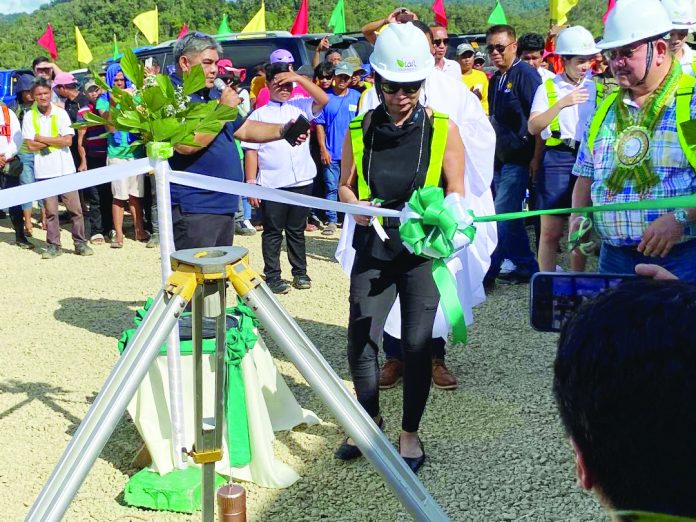
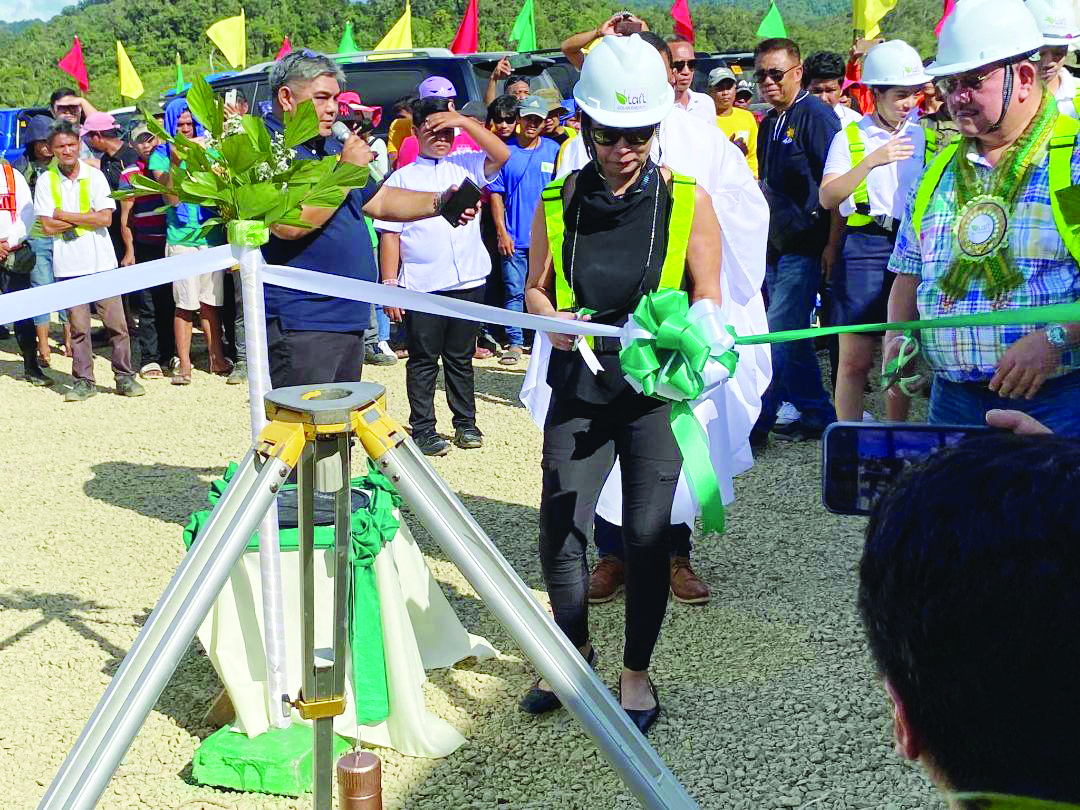
SOLAR POWER. A solar farm project in Hernani town is projected to boost the power needs of Eastern Samar as it had its groundbreaking on April 21. Leading the event were Energy Use. Sharon Garin and House Minority Floor Leader Rep. Marcelino Libanan of the 4Ps party-list. (PENELOPE POMIDA)
Harnessing renewable energy
SOLAR POWER. A solar farm project in Hernani town is projected to boost the power needs of Eastern Samar as it had its groundbreaking on April 21. Leading the event were Energy Use. Sharon Garin and House Minority Floor Leader Rep. Marcelino Libanan of the 4Ps party-list. (PENELOPE POMIDA)
TAFT, Eastern Samar-A solar farm project based in this town had its groundbreaking Friday(April 21)which is projected to help not only provide a sustainable power source in the province but also help reduce its high current power rate.
The solar farm, located in Barangay San Rafael, has a capacity of 20 megawatts, almost enough to supply the current needs of the entire province which now stand at 23 megawatts.
Benjie Picardo, the president and CEO of the Taft Solar Project, said that they are upbeat that once the proposed solar farm project will be operational, they can help the power needs of the entire province who has been experiencing not only a high cost of power rate but also unstable supply.
This is on top of complying with the mandate of the national government to harness renewable energy sources as a way to help reduce carbon emissions and mitigate climate change.
The company has earmarked P250 million for this project which is expected to be operational by September of this year.
Energy Undersecretary Sharon Garin, who graced the event, said that she is happy that the province will have now its own source of power, saying this could be a model for the same project in the country.
She vowed that their office, the Department of Energy, will commit itself to help the Taft Solar Project, accomplish its solar farm project in this town.
She also said that she is glad that the company is into harnessing renewable energy source to provide energy, adding that the solar farm project in this town will assure “energy security” in the province, in particular.
Garin also said that Taft will be the first in the country to be power sufficient based on renewable energy.
The move is in support of the department’s goal that by 2030 the country will be using at least 35% renewable energy and by 2040at least by 50%.
For his part, House minority floor leader Rep. Marcelino Libanan of the 4Ps party-list group also commended Picardo for putting up a solar farm in the province.
He said that once the solar farm project starts to operate, it could help the province to have a sustained power supply but achieve a lower rate.
At present, the power rate in the province stands at P19 per kilowatt hour.
He encouraged the Eastern Samar Electric Cooperative (Esamelco) to procure its energy supply to Taft Solar Project.
At present, the power cooperative gets its power needs from GN Corporation, which is based in Bataan, which is a coal-source.
It was learned that the Taft Solar Project pegged its rate per kilowatt hour at just P5. 07. In contrast, the Esamelco buys its power needs at about P9 per kilowatt hour.
Atty. Jose Michael Edwin Amancio, the general manager of Esamelco, said that while they welcome the solar farm project, they could not just rescind its contract with GN Corp. which is good until 2040.
He, however, said that they could still procure power supply from Taft Solar Project in case of an emergency situation, noting that it has an emergency contract with Energy Development Corp. (EDC) for 15 megawatts and another five megawatts from KEPCO.
He projects to get at least four megawatts from the Taft Solar Project.