IT’S amazing that right after Christmas Day, the second day of the Christmas Octave (December 26), we celebrate the memorial of St. Stephen who bears the title of being the protomartyr or the first Christian martyr. He was stoned to death for giving a vivid witness of the glory of the Son of Man standing at the right hand of God in heaven. (cfr. Acts 6,55) The people then could not stand what he was telling them.
Is this meant to be a wet blanket to all that joyous celebration of the birth of Christ? I don’t believe so. If at all, it is meant to give us a most realistic understanding of the spirit of Christmas, the birth of our Redeemer who being God became man to bear and conquer all our sins through his very passion, death and resurrection. To bear witness to this truth of our faith in the way St. Stephen did, actually gives full meaning to Christmas.
Thus, in the gospel of the day (cfr. Mt 10,17-22) we are told to expect all sorts of challenges and trials, even at the hands of the most unlikely persons such as our own parents and friends. But we should never worry, since God will always be with us, and as the gospel declared, “you will be hated by all for the sake of my name, but whoever will have persevered, even to the end, the same shall be saved.” (v.22)
We really have no reason to fear, nor to wallow in worries, anxieties and sadness. Let’s remember that these unfortunate states are fertile ground for the enemies of our soul, especially the devil, to take advantage of us.
About the only reason to fear, worry and be sad is when we lose our faith, when we lose touch with God. We have to pray and pray so that our doubts and fears would not undermine our faith.
What also helps is to develop a sporting attitude in life, because, to be realistic about it, we will always have frustrations, disappointments, mistakes, failures, sins and defeats in our life. But we just have to learn how to move on, just like a good sportsman.
We should always be cheerful in life, and strive to show it even externally with smiles and happy, warm and encouraging dispositions. Even in our grief and mourning, we should manage to learn how to be serene, knowing that suffering and death have already been redeemed by Christ and are now endowed with redemptive power.
Let’s not waste time and energy by falling into the grips of fears, worries and sadness. When we notice that we are having some languid moments, it can be a sign that our faith is not working, and that we are succumbing to the laws of the flesh and the world, if not, to the tricks of the devil.
We have to extricate ourselves as quickly as possible from that predicament. The ideal to have is to be always cheerful and eager to do things, no matter what the cost involved.
We should be doing a lot of good, constructive work, rather than stuck in the mode of ruing and brooding, sinking in self-pity, etc. We should never forget that God is always around.
It might be a good idea to rally the power of our faith that tells us that God takes care of everything. There is really nothing to worry even if we are made to suffer, since that suffering, if united to that of Christ, becomes something purifying and redemptive not only to oneself but also to everybody else.
Local beauty queens were named as brand ambassadors of IM Travel and Tours headed by Ma. Rochelle Alfonso (right). The beauty queens-turned brand ambassadors were MUPH Leyte 2023 1st runner-up Trisha Gabriel Moreto, Miss Universe-Leyte 2023 Angel Rose Tambal, and Miss Philippines Leyte 2023 Jamby Belegorio. (LIZBETH ANN A. ABELLA)
TACLOBAN CITY– Miss Universe Philippines Leyte 2023 Angel Rose Tambal, Miss Philippines Leyte 2023 Jamby Belegorio, and MUPH Leyte 2023 1st runner-up Trisha Gabriel Moreto are now officially the ambassadors of IM Travel and Tours, one of the accredited tour operators of the Department of Tourism in the region.
The three beauty queens signed a contract with IM Travel and Tours president Ma. Rochelle Acuba Alfonso on December 22 with the aim of promoting the tourism sites in the region.
“Our heartfelt gratitude to IM Travel for choosing us as your brand ambassadress, and a big congratulations to the corporation for the bountiful blessings that you have received,” said Tambal.
“As a brand ambassador, we promise to fulfill our commitment and bring IM travel to all over the world,” she added.
Tambal will represent Leyte in the Miss Universe Philippines pageant next year. (LIZBETH ANN A ABELLA)
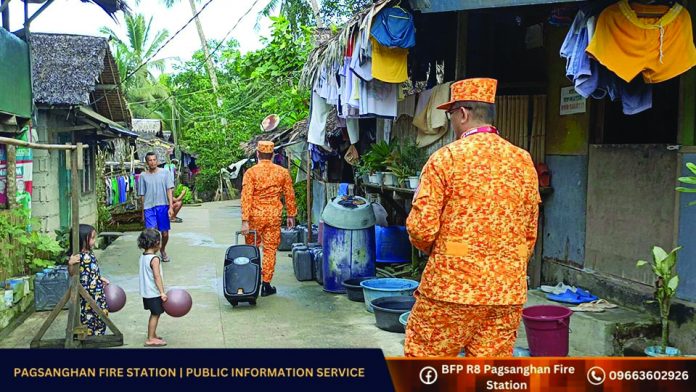
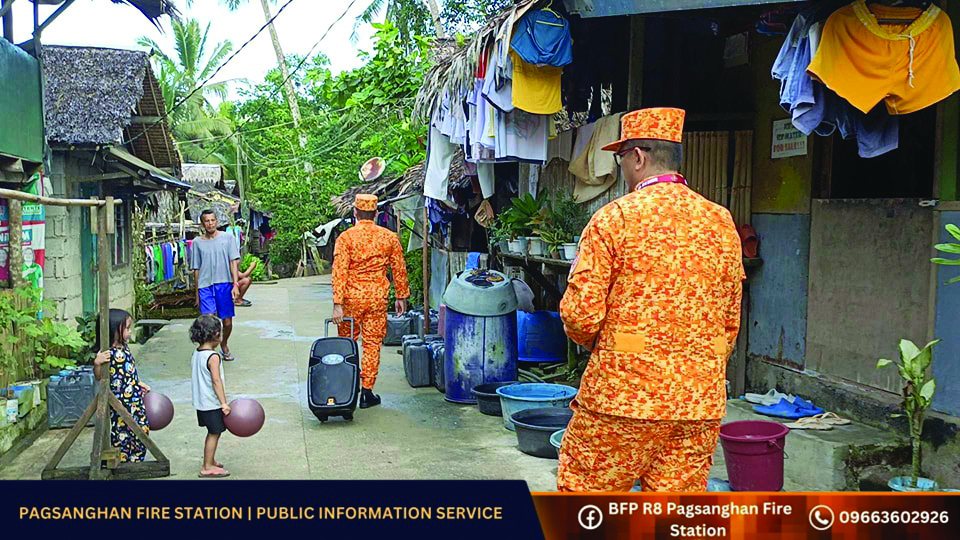
SAFE CHRISTMAS AND NEW YEAR’S CELEBRATIONS. An inter-agency task group, led by the Department of Health, is calling residents to make the forthcoming Christmas and New Year’s celebrations safe and secure. Photo shows personnel from the Bureau of Fire Protection in Pagsanghan, Samar making rounds in villages as part of its information drive to make the celebrations free from possible fire. (PAGSANGHAN FIRE STATION)
By not using banned crackers
SAFE CHRISTMAS AND NEW YEAR’S CELEBRATIONS. An inter-agency task group, led by the Department of Health, is calling residents to make the forthcoming Christmas and New Year’s celebrations safe and secure. Photo shows personnel from the Bureau of Fire Protection in Pagsanghan, Samar making rounds in villages as part of its information drive to make the celebrations free from possible fire. (PAGSANGHAN FIRE STATION)
TACLOBAN CITY – The Department of Health (DOH) in the region together with its partner agencies asked the public to celebrate Christmas and New Year’s season in a peaceful way.
And this can be achieved by not using firecrackers and pyrotechnics identified to be prohibited which could put their lives in danger, the DOH said.
“The DOH annually conducts the ‘Ligtas Christmas para sa Healthy Pilipinas’ campaign to highlight celebrations during the holiday seasons through its three sub-campaigns,” local health support division chief Dr. Ma. Teresa Caidic said in a press conference on Wednesday (Dec.20).
Included in the three sub-campaigns is the ‘Iwas Paputok.’
As an alternative to using firecrackers, the health department is promoting the use of alternative materials to produce noise when welcoming Christmas and New Year such as blowing trumpets or horns, and the use of kitchen utensils.
Last year, the region recorded six cases of firecracker-related injuries, higher than the five cases in 2022.
The injuries were mostly associated with the use of ‘lantaka’ or bamboo canon, super lolo, and kwitis.
Reporting of firecracker-related injuries will start December 21.
To avoid firecracker-related injuries, the DOH encourages local government units to enact an ordinance that prohibits its use.
Earlier, Department of Interior and Local Government Secretary Benhur Abalos called for local government units to pass an ordinance that would banned the use of firecrackers at home and recommended to identify common spaces for fireworks display, and if possible it will be supervised by licensed individuals.
Abalos cited Quezon City and Davao City which have an existing ordinance banning the use of fireworks and firecrackers.
Moreover, the Police Regional Office- 8 said that they have given permits to three firecrackers and fireworks distributors in the region while there are 120 retailers from the six provinces with permits to sell.
“These retailers are responsible to teach buyers the proper way of using firecrackers and fireworks and they should inform buyers to only use them at the designated firecracker zone,” Major Marjorie Manuta, police regional information officer, said.
The PNP prohibits the selling of firecrackers that exceed the legal limit of 0.3 grams of gunpowder including those with improper fuses.
Included in the list of prohibited firecrackers are watusi, poppop, five star, pla-pla, piccolo, giant bawang, goodbye bading, goodbye Philippines, atomic bomb, super lolo, hello Colombia, Judas’ belt, Giant whistle bomb, atomic triangle, mother rocket, goodbye Delima, goodbye Napoles, coke-in-can, Super Yolanda, pillbox star, kabasi, and Hamas.
To know that the firecrackers are within the limit set by the government, the Department of Trade and Industry instructed buyers to check for the Philippine Standard (PS) sticker.
Meanwhile, the Bureau of Fire Protection also encourages the residents across the region to be responsible in using firecrackers and fireworks to avoid cases of fire incidents.
Based on the BFP-8 record, the region has no reported cases of firecrackers-related fire incidents during last year’s celebrations.
TACLOBAN CITY– Protecting its forest covers will be among his priorities as he aims to make Borongan a green city.
Thus said Mayor Jose Ivan Dayan Agda as he stressed that he would do within his power as he disclosed that due to the significant forest cover of the city, Borongan has been spared from being directly hit by a typhoon.
The last time Borongan, the provincial capital of Eastern Samar populated with more than 71,000 people, was directly hit by a typhoon was 10 years ago when it was among the areas in the province pummeled by Super Typhoon ‘Yolanda,’ the city mayor added.
“We know that for the past several years, our environment has provided us protection from natural calamities, particularly typhoons. (And) 62 percent of our land area involves forests and we will do everything to make it remain as it is,” Agda said during the recently held first forest summit.
During the said forest summit held last December 12 at Eastern Samar State University in Borongan, Agda led in the signing of a commitment with other stakeholders to protect the city’s forest covers.
A copy of the proposed revised environment code was also submitted by Mayor Agda to the members of the city council for their review.
The summit was also attended by national government agencies, civil society organizations, the multi-sectoral forest protection committee; barangay officials and academe.
Meantime, Mayor Agda said that when he attended the COP28 in Dubai, Michael Bloomberg of the United Nations and Bloomberg Philanthropies pledged $100,000 worth of funds for Borongan’s environmental projects.
Agda said that he was asked by Bloomberg to come up with a written proposal for it chosen project or program relative to climate change reduction.
He also emphasized that his joining the international conference on climate resilience marks a crucial development in forging partnerships with agencies and organizations concerned with climate adaptation and environmental conservation. (JOEY A. GABIETA)
President Ferdinand R. Marcos Jr. described his performance for the year 2023 as “the year of structural changes,” which are significant in the country’s recovery from all economic challenges left by the COVID-19 pandemic.
In an interview with the press at the sidelines of the 50th Commemorative ASEAN-Japan Friendship and Cooperation Summit in Tokyo, President Marcos said that structural changes are the solutions to the problem left by the pandemic.
“This 2023 was really the year of structural changes,” President Marcos said during the Kapihan with the Media in Tokyo, Japan when asked to assess his performance for 2023 and what the goals of his administration are for the year to come.
“So, those structural changes were necessary because we have to remodel, or re-adjust rather, our – for example our fiscal policy, even our monetary policy, our spending policy, so that we are slowly moving – or not so slowly, so, we’re moving away from the COVID economy,” he added.
President Marcos said that the structural changes in 2023 will have a greater effect in 2024 as he emphasized that the administration has changed the structure of the different agencies by finding the best people for each of those positions.
On his outlook for 2024, the President said that the administration’s goal for the year to come does not change, which is to continue the modernization of the government.
“Medyo obsolete na ‘yung ibang structure natin sa gobyerno. That we continue to modernize, we continue to be responsive to the new economy, that we position ourselves properly,” President Marcos said.
“We’re moving in the right direction. But if you ask me, I’m always – I always say it’s too slow, it’s too slow, it’s too slow. So, we will just keep pushing and pushing and pushing para matapos lahat ito so that we can start to feel the effects of those changes that we made,” he added.
President Marcos arrived in Manila on Monday evening from his successful participation in the 50th Commemorative ASEAN-Japan Friendship and Cooperation Summit in Tokyo where he brought home *PhP14 billion* investment pledges from nine Japanese companies. (PCO)


Christmas and martyrdom
IT’S amazing that right after Christmas Day, the second day of the Christmas Octave (December 26), we celebrate the memorial of St. Stephen who bears the title of being the protomartyr or the first Christian martyr. He was stoned to death for giving a vivid witness of the glory of the Son of Man standing at the right hand of God in heaven. (cfr. Acts 6,55) The people then could not stand what he was telling them.
Is this meant to be a wet blanket to all that joyous celebration of the birth of Christ? I don’t believe so. If at all, it is meant to give us a most realistic understanding of the spirit of Christmas, the birth of our Redeemer who being God became man to bear and conquer all our sins through his very passion, death and resurrection. To bear witness to this truth of our faith in the way St. Stephen did, actually gives full meaning to Christmas.
Thus, in the gospel of the day (cfr. Mt 10,17-22) we are told to expect all sorts of challenges and trials, even at the hands of the most unlikely persons such as our own parents and friends. But we should never worry, since God will always be with us, and as the gospel declared, “you will be hated by all for the sake of my name, but whoever will have persevered, even to the end, the same shall be saved.” (v.22)
We really have no reason to fear, nor to wallow in worries, anxieties and sadness. Let’s remember that these unfortunate states are fertile ground for the enemies of our soul, especially the devil, to take advantage of us.
About the only reason to fear, worry and be sad is when we lose our faith, when we lose touch with God. We have to pray and pray so that our doubts and fears would not undermine our faith.
What also helps is to develop a sporting attitude in life, because, to be realistic about it, we will always have frustrations, disappointments, mistakes, failures, sins and defeats in our life. But we just have to learn how to move on, just like a good sportsman.
We should always be cheerful in life, and strive to show it even externally with smiles and happy, warm and encouraging dispositions. Even in our grief and mourning, we should manage to learn how to be serene, knowing that suffering and death have already been redeemed by Christ and are now endowed with redemptive power.
Let’s not waste time and energy by falling into the grips of fears, worries and sadness. When we notice that we are having some languid moments, it can be a sign that our faith is not working, and that we are succumbing to the laws of the flesh and the world, if not, to the tricks of the devil.
We have to extricate ourselves as quickly as possible from that predicament. The ideal to have is to be always cheerful and eager to do things, no matter what the cost involved.
We should be doing a lot of good, constructive work, rather than stuck in the mode of ruing and brooding, sinking in self-pity, etc. We should never forget that God is always around.
It might be a good idea to rally the power of our faith that tells us that God takes care of everything. There is really nothing to worry even if we are made to suffer, since that suffering, if united to that of Christ, becomes something purifying and redemptive not only to oneself but also to everybody else.