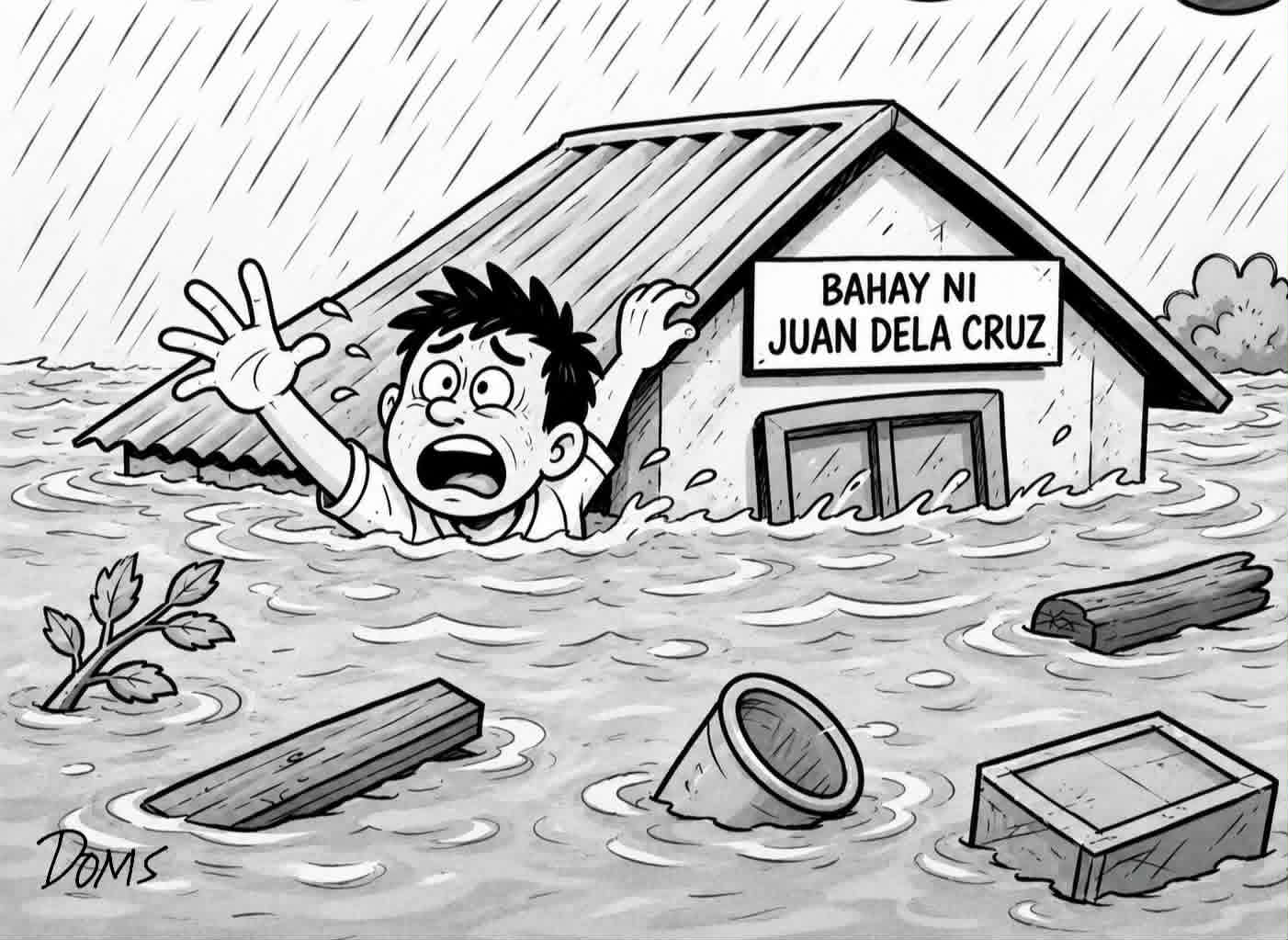
Metro Manila and many parts of Luzon are again suffering from floods brought by heavy rains, exposing the continuing weakness of the country’s defenses against a recurring disaster. Flood control projects are supposed to protect communities, not exist merely as entries in government records or as structures too weak to perform when they are needed most. When public works fail because money meant for protection is stolen or projects are built below standard, corruption becomes a direct threat to human life.
The present flooding is another harsh reminder that flood control cannot be treated as an ordinary government expenditure. Heavy rains brought by the southwest monsoon have again caused flooding and disruptions in parts of the country. The Philippines already knows the destructive power of monsoon rains and tropical cyclones; therefore, drainage systems, pumping stations, river walls, dikes, waterways, and other flood-mitigation structures must be designed and constructed to survive severe conditions. A flood control structure that looks acceptable during dry weather but fails under sustained rainfall has failed its fundamental purpose. Quality materials, sound engineering, competent artistry, proper maintenance, and strict inspection are not optional expenses. They are the very reasons taxpayers are paying for these projects.
The scandal over ghost and substandard flood control projects is no longer based merely on public suspicion. In January 2026, the Department of Justice said it had confirmed 14 flood control projects as ghost or non-existent projects. By July, the government said investigations and court proceedings involving alleged ghost and substandard projects were continuing, with some cases already before the courts. The DOJ also reported that more than P841 million had been recovered in connection with anomalous flood control projects. These facts make the issue impossible to dismiss as political noise. When a project is reported completed and paid for but does not exist, the offense is greater than falsifying documents or stealing public money. The government has also been deprived of infrastructure that could have stood between vulnerable communities and destructive floodwaters.
The economic damage goes far beyond the amount pocketed by corrupt individuals. The Department of Finance previously estimated that ghost flood control projects from 2023 to 2025 may have cost the Philippine economy between P42.3 billion and P118.5 billion, equivalent to tens of thousands of potential jobs. But statistics cannot fully describe what ordinary people lose when flood protection fails. Families lose appliances, furniture, vehicles, savings, livestock, merchandise, school materials, and sometimes their homes. Workers cannot report for duty, businesses close, classes are suspended, transportation is disrupted, and local economies slow down. Worse, floods can claim lives. Every peso stolen from a legitimate flood control project therefore carries a possible human consequence. Corruption in this sector is not simply theft from the national treasury; it can leave entire communities defenseless against disasters everyone knows will come.
The country must stop treating flood control corruption as another scandal to investigate until public anger subsides. Every questionable project must be physically inspected and matched against its contract, budget, specifications, accomplishment reports, and actual condition on the ground. Contractors, engineers, inspectors, officials, and politicians proven to have participated in ghost projects, kickbacks, falsified accomplishments, or deliberately substandard construction must face prosecution, permanent disqualification from government contracts where the law allows, and recovery of stolen public funds.
Contractors responsible for defective or unfinished works should also be compelled to correct them at their own expense, as the government has previously ordered. Flood control money must finally produce flood control—not mansions, luxury vehicles, political war chests, or private fortunes. Until public money is protected with the same seriousness with which lives are supposed to be protected, every major flood will continue to expose not only the weakness of infrastructure, but the terrible price the Filipino people pay for corruption.