When Palace Press Officer Atty. Claire Castro said that some teachers themselves teach students how to become “walang modo,” the remark immediately struck a raw nerve among educators. The statement came in the aftermath of another disturbing school shooting involving a student, when the country was searching for answers about violence among the young. I find the remark unfair, poorly aimed, and insulting to a profession already carrying more burdens than it should.
To be precise, Castro reportedly referred to some teachers, not all teachers, and that distinction should not be erased merely to make criticism easier. Certainly, no profession is populated entirely by saints. There are bad teachers just as there are bad lawyers, doctors, policemen, journalists, politicians, and government officials. But there is a considerable distance between saying that an individual teacher may behave badly and suggesting, in the context of discussing troubled children, that teachers sometimes teach students to become ill-mannered. That is where I think the remark wandered into dangerous territory. Words spoken from Malacañang do not arrive as ordinary neighborhood gossip. They carry the weight of the Palace microphone.
I have always understood teaching as almost the exact opposite of what Castro’s remark suggests. Teachers spend their working lives telling children to sit properly, listen carefully, wait for their turn, respect others, submit their work, stop fighting, stop shouting, stop bullying, and learn to accept consequences. Many teachers are, in fact, complaining about increasingly difficult classroom behavior. To imagine them entering their classrooms with the purpose of producing even more unruly children turns educational reality upside down. It would be like accusing firefighters of teaching flames how to spread. The occasional irresponsible teacher exists, of course, but the profession itself is built around instruction, discipline, guidance, and care.
And here is what particularly bothers me: teachers have gradually become society’s favorite shock absorbers. Can a child not read well? Blame the teacher. A student behaves badly? Blame the teacher. Young people spend enormous amounts of time online, absorb violent material, encounter bullying, struggle with problems at home, and live amid countless social influences—but somehow the finger still finds its way toward the classroom. Even President Marcos’s administration has previously recognized teachers as partners in educating children and has publicly spoken of reducing their administrative load so they can concentrate on teaching. It therefore sounds painfully strange when the same government machinery suddenly entertains the image of teachers as possible tutors in bad manners.
There is another reason the remark sits badly with me. The country had just been confronted with another violent incident involving the young, and such moments demand careful questions rather than convenient suspects. The Palace itself had earlier acknowledged that youth violence requires determining its roots and had raised possible influences such as violent gaming applications and imitation of violent behavior. That broader inquiry makes sense to me. A child’s behavior does not grow from a single seed. Family life, peers, social media, online content, school environment, emotional difficulties, community conditions, discipline, and access to weapons may all deserve serious examination. When the problem is that complicated, pointing casually at teachers is not analysis. It is a shortcut—and shortcuts are particularly dangerous when the destination is the truth.
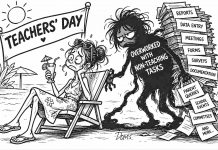
I also cannot ignore the irony. Teachers are asked to become second parents while already being teachers, advisers, record keepers, activity coordinators, counselors, disciplinarians, event organizers, and sometimes unofficial referees in quarrels that began long before the bell rang. The government has acknowledged the need to reduce teachers’ paperwork precisely so they can concentrate on their central function of teaching. Then, when children display serious behavioral problems, teachers are asked why they failed to raise somebody else’s child perfectly. At this rate, perhaps the next job description for Teacher I will require omnipresence. A teacher would need one eye on the blackboard, another on forty or fifty learners, another on social media, and perhaps two more following every child home. Even a spider would complain about the workload.
What teachers deserve from public officials is not immunity from criticism. I would never argue that. If a teacher humiliates a learner, abuses authority, encourages misconduct, or violates professional standards, investigate that teacher and impose the proper sanction when the evidence warrants it. But name the misconduct, establish the facts, and hold the responsible person accountable. Do not throw a verbal fishing net over an honorable profession because a few bad examples may exist. ACT Teachers Party-list itself publicly objected to Castro’s remarks, describing them as insulting and criticizing the Palace for pointing fingers at educators. Whether one agrees with that group politically or not, the anger behind the reaction is easy to understand: teachers who spend their days correcting bad behavior naturally resent being portrayed as people who manufacture it.
The chalkboard should not become the government’s whipping post whenever something goes terribly wrong with the young. I would rather see parents, teachers, school administrators, psychologists, law enforcers, communities, technology companies, and government agencies sitting on the same side of the table and asking the harder question: What is happening to our children, and what can each of us do about it? Teachers should certainly examine their own ranks, just as every profession must, but public officials should also choose their words with the discipline they expect teachers to instill in children. Perhaps that is where the lesson on good manners should begin—not with accusations, but with fairness, evidence, responsibility, and respect.