Education as among his top priorities
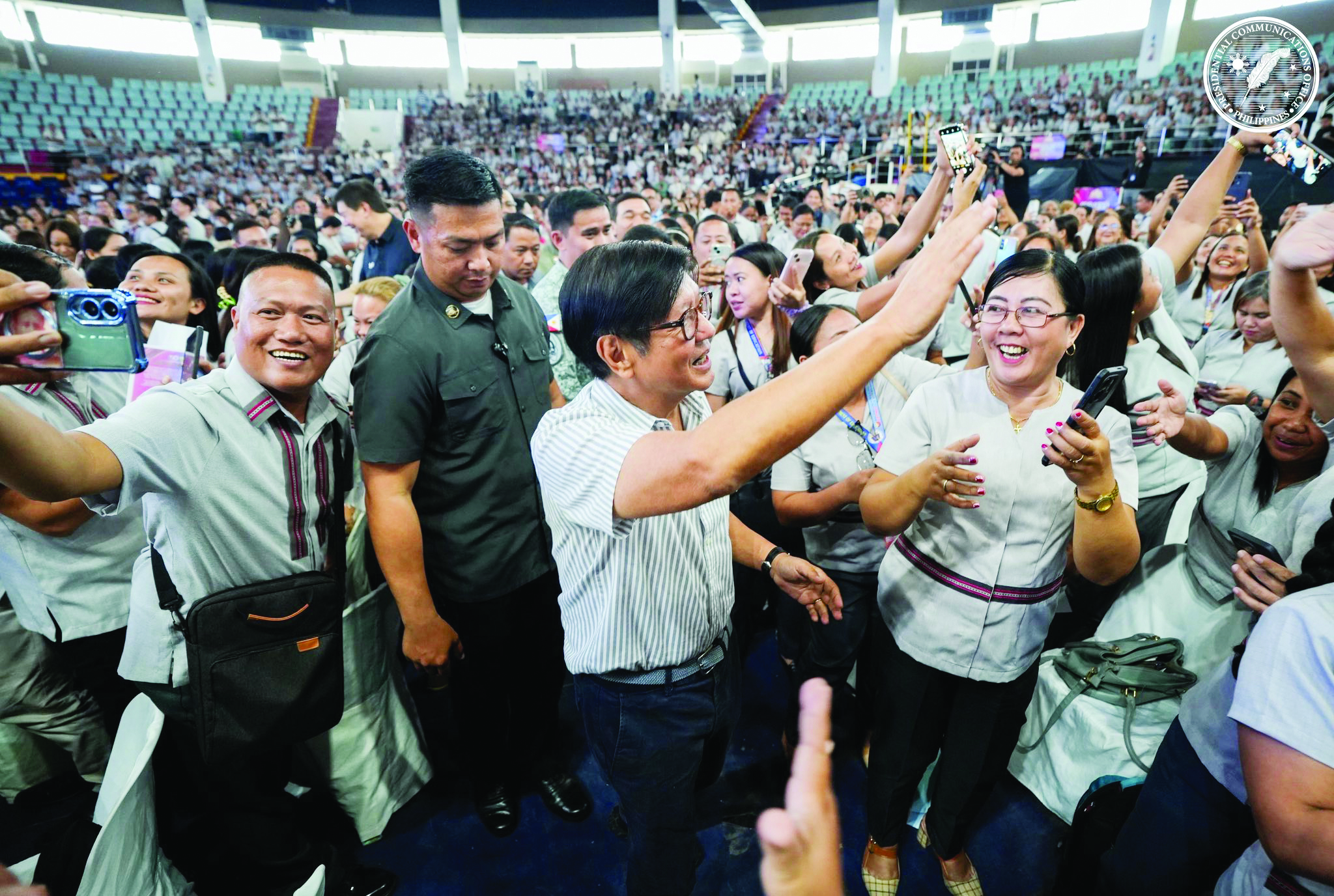
(PRESIDENTIAL COMMUNICATIONS OFFICE)
TACLOBAN CITY — The administration of Ferdinand Marcos Jr. has stepped up efforts to strengthen the country’s education sector by both reintegrating overseas Filipino worker (OFW) teachers and accelerating long-delayed promotions for public school educators.
This dual push was highlighted during the President’s two major engagements in Tacloban on Wednesday, April 15: the regional launch of the “Sa Pinas, Ikaw ang Ma’am at Sir” (SPIMS) program at Leyte National High School and a mass oath-taking of newly promoted teachers and school heads at the Tacloban Convention Center.
The SPIMS program, part of the government’s reintegration strategy for returning OFWs, aims to bring experienced Filipino teachers back into the country’s classrooms while addressing persistent shortages in public schools.
Education Secretary Sonny Angara said the initiative reflects the President’s directive to ensure that returning educators are given immediate and stable employment opportunities.
“The directive of the President is to make sure that decent jobs are ready for our returning teachers so they will no longer have to be separated from their families again,” Angara said.
The program falls under the broader Bayanihan para sa Balikbayang Manggagawa framework, a whole-of-government effort to assist displaced or returning OFWs in rebuilding their careers in the Philippines.
At the Leyte National High School gym, former migrant teachers from across Eastern Visayas gathered as among the first batch of beneficiaries. Many cited family reasons and long-term security as key factors in their decision to return.
Evan Jose Deyra, a music teacher who spent nearly two decades in Thailand, said he chose stability over higher pay abroad, noting the lack of retirement security overseas. Similarly, Gemrose Cabardo, a mother of two who taught in Bangkok, said the opportunity to be with her family ultimately drove her home.
First introduced in 2014 with only 10 beneficiaries, SPIMS has expanded significantly, serving 1,958 teachers in 2025 and allocating 2,500 slots this year—underscoring the government’s intensified reintegration efforts.
Complementing this initiative is the administration’s aggressive push to reform career progression within the education sector.
Speaking before more than 2,100 newly promoted teachers and school leaders, President Marcos assured educators that the longstanding stagnation in promotions is being dismantled.
“Wala nang teacher ang magre-retire na Teacher I,” he said, emphasizing that no teacher should remain in the entry-level position until retirement.
A total of 2,121 educators from across Eastern Visayas were inducted into higher posts, with 1,679 promoted under the Expanded Career Progression (ECP) System and 442 through the regular track.
Angara revealed that some of the promotees had waited more than 30 years for advancement under the previous system—delays that, according to the President, contributed to teacher attrition and shortages.
To address this, the administration introduced structural reforms through Executive Order No. 174 and the Career Progression System for Public School Teachers and School Leaders Act, creating clearer and faster promotion pathways.
The ECP System establishes two career tracks—classroom teaching and school administration—while opening up higher-ranking positions such as Teacher IV to VII and Master Teacher V to VI, allowing educators to advance without leaving the classroom.
From August 2025 to April 2026, more than 65,000 teachers and school heads nationwide have already been promoted, the President said, with more expected in the coming months.
Marcos also cited parallel efforts to improve teachers’ welfare, including the hiring of additional personnel, creation of non-teaching positions to ease administrative burdens, and the release of the full P10,000 teaching supply allowance for School Year 2025–2026.
He stressed that both SPIMS and the expanded promotion system form part of a broader strategy to build a stronger, more stable teaching workforce.
“You do not only teach knowledge—you also teach discipline, perseverance, and resilience,” the President told educators.
By reintegrating seasoned OFW teachers and ensuring career growth for those already in service, the administration aims to address gaps in the education system while recognizing the vital role of teachers in nation-building under its “Bagong Pilipinas” agenda.
JOEY A. GABIETA