26.6 C
Tacloban City
March 25, 2026 - Wednesday | 6:08 PM
Home Blog Page 999

“Biyahe ni Drew” features E. Samar farmers’ products

0
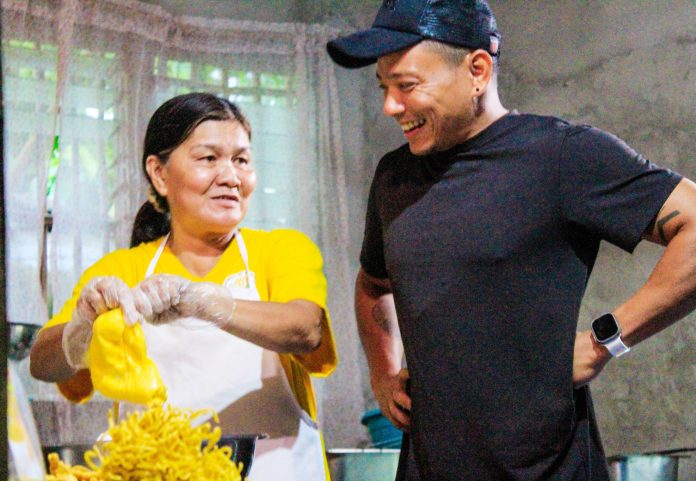
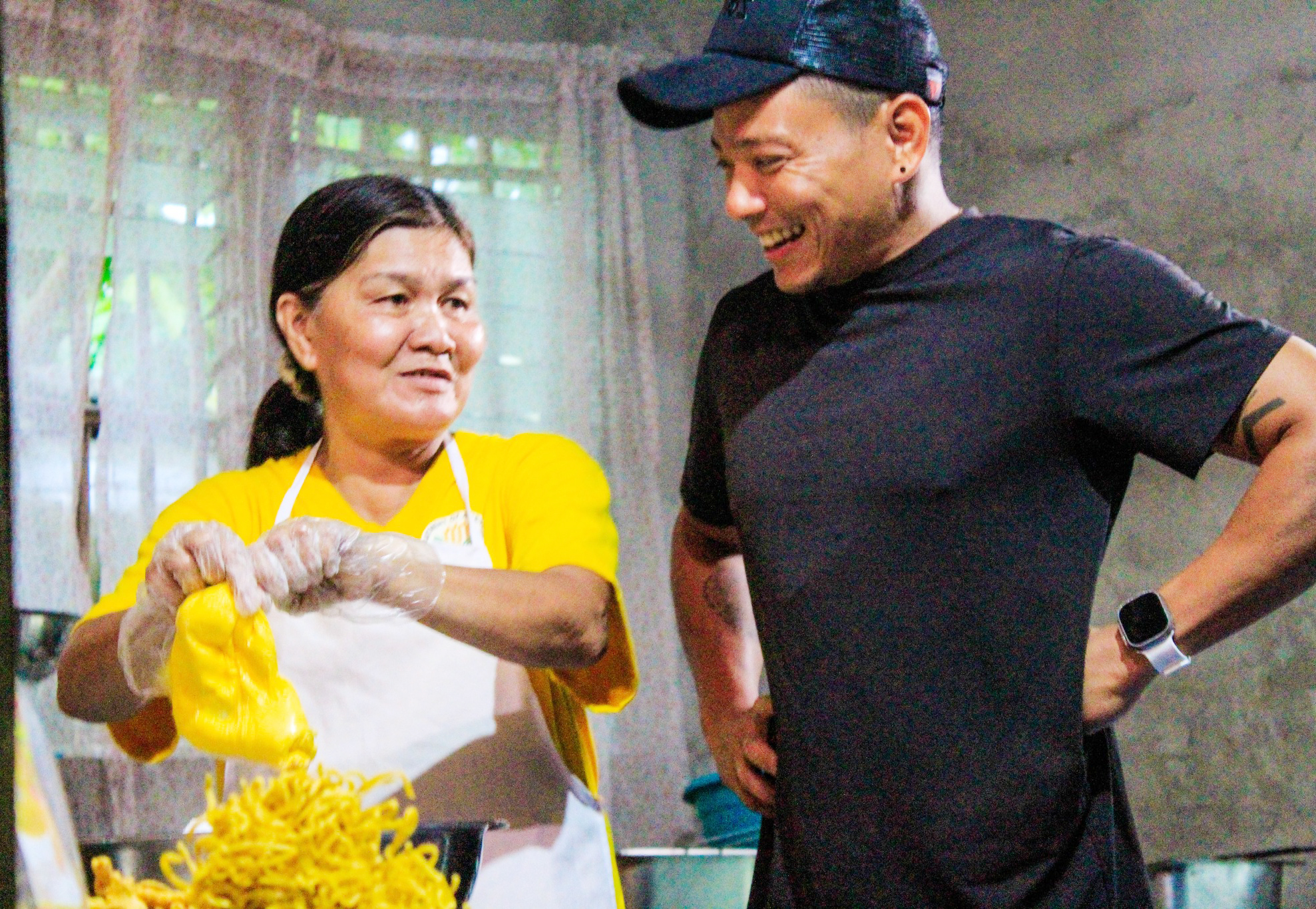
GTV’s “Biyahe ni Drew” features the squash canton noodles and crackers produced by the San Miguel Farmers Association in Hernani, Eastern Samar.

HERNANI, Eastern Samar – Watch out for the episode of “Biyahe ni Drew” featuring this picturesque town in the island of Samar.

Among those that will be featured in the said episode of the travel documentary show, hosted by Drew Arellano (Andrew James Arellano in real life) and aired every Sunday at 8:25 in the evening over GTV, are the canton noodles and crackers made from squash by an agrarian reform beneficiaries organization (ARBO).

Municipal Agrarian Reform Program Officer (MARPO) Glicerio Camenforte shared that while Arellano was going around the different beach locations and savouring local foods, he noticed the San Miguel Farmers Association’s (SMFA’s) squash noodles and crackers and got interested on them. Eventually, Arellano joined SMFA president, Bernardina Docong, in the process of making the ARBO’s products, said Camenforte.

Arellano shared, “Laking DAR (Department of Agrarian Reform) din po ako.” “Palagi po akong dinadala ng lolo ko sa kanyang opisina sa DAR noong sya ay nagtratrabaho pa,” he added.

SMFA was organized by the DAR in 2014, after super Typhoon Yolanda devastated many parts of Eastern Visayas, to be able to avail of various assistance. At the moment, according to Camenforte, SMFA has 50 members already who are all agrarian reform beneficiaries (ARBs).

Docong meanwhile disclosed: “In 2018, the Department of Science and Technology (DOST) trained us in making squash noodles and crackers.” “It also provided us with the materials and equipment needed in the production,” she added.

This episode of “Biyahe ni Drew” will be aired either on the last week of August or early part of September this year.
(LEMUELL SETH TONOG, DAR Eastern Samar)
Celebrating the ASEAN Month

0

August is widely recognized as the ASEAN Month, a time when member countries of the Association of Southeast Asian Nations come together to celebrate the rich diversity and cultural heritage of the region. This event highlights the collective efforts of ASEAN countries to foster unity, cooperation, and mutual understanding. This annual celebration serves as a platform for member states to showcase their achievements, exchange ideas, and strengthen regional integration across various sectors such as economic, political, and social.

The ASEAN Month provides an ideal opportunity for people to deepen their understanding of the regional dynamics and challenges faced by member countries. Through various conferences, workshops, and cultural events organized during this period, we can gain valuable insights into the economic potentials, political stability, and social development initiatives of ASEAN countries. Additionally, we can explore the role of ASEAN in shaping regional relations, promoting peace and stability, and addressing transnational issues like climate change, terrorism, and poverty alleviation. By participating actively in these events, we can enhance our comprehension of the complex regional dynamics as aspiring future policymakers and practitioners.

This ASEAN Month enables us to engage in meaningful discussions and collaborations with fellow students and professionals from the region. This opportunity fostered by the event enhances our intelligence and comprehension by exposing us to diverse perspectives and experiences. By exchanging knowledge, best practices, and innovative ideas, we can broaden our intellectual horizons and develop a more nuanced understanding of the challenges and opportunities facing ASEAN countries. These interactions enable us to forge lifelong connections and networks with like-minded individuals, paving the way for future collaborations and partnerships.

Again, this annual celebration serves as a platform for member countries to come together and showcase their achievements, while promoting unity, cooperation, and mutual understanding. As participants in various conferences and cultural events, we can deepen our comprehension of the regional dynamics, engage in meaningful discussions, and develop valuable networks. By actively participating in these events, we can enhance our intelligence and strengthen our commitment to contributing positively to ASEAN’s future.

Not totally resolving problems

0
DOMS PAGLIAWAN

Solving problems is the hallmark of progress, efficiency, and growth. However, in certain situations, there can be a strategic advantage in not entirely resolving problems so that funds continue to be allocated towards their resolution. We might as well delve into the intricate dynamics behind deliberately preserving unresolved issues to sustain funding, thus exploring the delicate balance between addressing problems and ensuring a perpetual stream of resources.

The importance of maintaining a steady flow of funds to sustain projects cannot be understated. By presenting problems as ongoing, organizations can secure consistent support from stakeholders and funding sources. Highlighting the lingering challenges helps justify the continuous allocation of resources, ensuring that the necessary financial backing remains available. This strategy is particularly relevant in cases where funds are more likely to be allocated to unresolved problems than to those perceived as already resolved.

Public perception plays a significant role in sustaining funding. Society often associates unresolved issues with a sense of urgency, leading to increased public interest and support. By strategically managing the narrative around unresolved problems, organizations can leverage public demand to garner increased financial backing. This approach can be particularly effective when facing multifaceted or complex issues that do not have straightforward solutions, allowing organizations to capitalize on public sympathy and continue securing funds.

Research and development (R&D) thrive on unresolved problems. The ongoing nature of these issues provides opportunities for innovation, exploration, and experimentation, all essential elements in the advancement of knowledge and problem-solving. By preserving certain unresolved problems, organizations can invest in R&D initiatives, creating avenues for continuous improvement and the generation of new ideas. This symbiotic relationship between unresolved problems and R&D helps maintain funding for these vital activities, fostering long-term progress.

While the strategic preservation of unresolved problems can sustain funding, ethical considerations must not be overlooked. It is imperative to strike a delicate balance between maintaining adequate funding and genuinely addressing problems that impact individuals and communities. Prioritizing transparency and accountability is crucial to ensure that resources are channeled effectively and responsibly, while still maintaining the necessary financial support.

Strategic management of unresolved problems, aimed at ensuring a steady flow of funding, is an approach widely employed by organizations. By strategically emphasizing the ongoing nature of certain issues, capitalizing on public perception, and leveraging the role of R&D, this strategy helps secure the necessary resources. However, it is essential to approach this practice ethically, remaining transparent and accountable to prevent the perpetuation of unresolved problems simply for financial gains. Ultimately, finding the right balance between addressing problems and maintaining funding is the key to sustainable progress in a variety of fields.

DA’s guidelines to enhance rice production

0
Dr. Paciente Cordero

Geared to increase the country’s rice production, the Department of Agriculture (DA) has issued guidelines to distribute hybrid rice seeds to offset rising costs of inputs (fertilizer) and irrigation issues. This was included in the memorandum signed by Leocadio Sebastian, undersecretary for rice industry development consonant with the provision of the National Rice Program (NRP).

The Memo emphasizes the role of the NRP distribution program to a selective location and climate suitability nationwide. Ultimately, the same Memo aims to improve the productivity and income of rice farmers through an expanded distribution and utilization of certified hybrid rice seeds.

To achieve this, it should see t the adoption of hybrid rice seeds up to 40 percent and a production yield level up to 6 tons per hectare in the wet season and up to 8 ton/hectare in the dry season in target areas by year 2028.

In April 2023, it was announced by the DA that it was targeting a 100 percent rice self sufficiency by 2027 through the Masagana Rice Program 2023-2028. This supports President Ferdinand Romualdez Marcos, Jr., wish to achieve close to self-sufficiency by 2025.

MY COMMENT:
The country’s rice production program faces multifarious hurdles, both man-made and nature-instigated. Definitely, the impending El Niño phenomenon Is an obstacle to hurdle by the rice farmers. The government will have to craft a proactive stance to confront the obstacles to increasing rice production to feed its growing population amid increasing incidence of poverty level.
ooo000ooo
NEXT TOPIC : “Moderna Plans to produce vaccine in Philippines”
SHARE S & T THOUGHTS through E-mail: drpacjr@yahoo.com

How to know ourselves properly

0
FR. ROY CIMAGALA
FR. ROY CIMAGALA

THAT question Christ asked his disciples about who did people say he, as the Son of Man, was should also be addressed to each one of us. And we should just try our best to give the right answer like what St. Peter did. (cfr. Mt 16,13-20)

And the simple reason is because knowing correctly who Christ is would lead us to know ourselves properly, since Christ is the pattern of our humanity and the savior of our humanity that is damaged by sin.

Let us always remember that Christ, being the Son of God, is the perfect image and likeness of God himself. And since we have been created in God’s image and likeness, we can truly say that we are meant to be like Christ to achieve what God wants us to be—his image and likeness, his adopted children, meant to share in his divine life and nature.
We have to be wary of our tendency to attain our self-knowledge based only on what we see and feel, on how certain worldly ideologies define us, or worse, on certain passing trends and fashions that can be prevailing at a given period of time and place.

We truly need to know Christ to know ourselves properly, and we have to do everything to attain that knowledge by every means possible—by reading and meditating on the life of Christ as recorded in the gospels, by living the clearly Christian charisms and spiritualities now available in the Church, by imitating the lives of saints who have been faithful to Christ all the way to the end, etc.

Again, Christ as the Son of God is the pattern of our humanity. If we want to know who we really are, how we ought to be, all we have to do is to look at Christ and try our best, with God’s grace, to identify ourselves with him.

More than that, because of our sin that defaced the original state in which we, in Adam and Eve, were created, Christ is the Son of God who became man to save us. The immediate conclusion we can derive from this truth of our faith is that for us to know how to handle our sinfulness, again all we have to do is to look at Christ and try our best, with God’s grace, to identify ourselves with him. He offers us the “the way, the truth and the life.”

That identification with Christ as our Redeemer cannot but involve the acceptance of the cross through which our salvation is achieved. We have to know therefore the full meaning of the cross in our life, and embrace and die on it the way Christ embraced and died on it.
This is what is meant to be ‘alter Christus,’ an ideal that can be reached because insofar as God is concerned, everything is already given for us to be able to be so. Things now just depend on us on whether we would like to be ‘alter Christus’ or not.

All the means are made available. We have the sources of divine revelation that show us the truth about ourselves. We have the word of God. We have the Church and the sacraments, especially the Holy Eucharist.

We just have to make the necessary adjustments in the way we think, in the way we identify ourselves. It would not be presumptuous, even given our limitations and woundedness, to start and keep thinking that “I am another Christ, ‘alter Christus.’” We just have to try our best, with God’s grace to think and act like Christ!

Humbug

0
AL ELLEMA
AL ELLEMA

A clear afterthought was the delayed pronouncement issued by the president by stating what his supporters and believers want to hear “I stand united with the Filipinos worldwide the Ninoy Aquino Day” which marked the 40th of that “murder of the century” that fell Ninoy on the tarmac of the Manila International Airport. Such statement was aimed at earning praises from the duped and gullible lot that he is truly for unity. It was a claptrap that caught the nod of those who believe in his oxymoronic statements that lure many people to clap at every declaration pushing for unity.

But the real score is in his actions that appear diametrically opposed to his statements. Claiming to be united with the Filipinos worldwide is nonsense humbugging as he need not look beyond the neighborhood to show proof of his statements. The momentous event that celebrated the death of Ninoy was held in Santo Domingo Parish Church along Quezon Avenue in Quezon City. It was the same hallowed place where Ninoy’s wake was held, allowing throngs of Filipinos queueing day and night to give their last respects and final glimpse of the bloodied face of their martyr and hero.

The longing of the churchgoers that swelled every minute to fill the Santo Domingo Parish Church hours before the 10:00 o’clock requiem mass officiated by His Most Reverend Archbishop Socrates B. Villegas, D.D., Bishop of Dagupan and concelebrated by over ten Archbishops and Bishops and about fifty monsignors and priests. The celebration marking the 40th death anniversary of Ninoy’s death was the apt place to show the unity being brandished by the president in his public statements. His mere presence joining the Filipinos in Santo Domingo Parish Church could have proved his sincerity, else, his true self as a mere politician of mere pretenses.

It is hard to blame the Filipinos who keep doubting every statement that appears nothing but to satiate the people of whatever they want to hear. Such statements are taken hook, line and sinker by the gullible lot who follow blindly without making any effort to verify the facts behind every statement. Worse, such unverified statements are easily and irresponsibly spread on all platforms, chiefly on social media. The spread of unverified tales creates a chain of false information worldwide.

It is high time for Filipinos to be responsible in taking tales that are intended merely to earn media mileage and confuse the public of the real story behind every politically adulterated statement. The real measure of what is factual truth is not in the speaking but in the doing with consistency of what is said. The issuance of motherhood statements that are clearly diametrically opposed to the facts and nothing by empty statements motivated by a personality and character that is merely humbugging.
comments to alellema@yahoo.com

Recent Posts

DALMACIO C. GRAFIL
PUBLISHER

ALMA GRAFIL
EDITOR-IN-CHIEF

ROMEO CEBREROS
OFFICE IN-CHARGE

OFFICE
BRGY. SONGCO, BORONGAN CITY

CONTACT NUMBERS
(055) 261 – 3319 | 0955 251 1533 | 0917 771 0320 | 0915 897 7439 | 0921 511 0010

DALMACIO C. GRAFIL
PUBLISHER

RICKY J. BAUTISTA
EDITOR

ALMA GRAFIL
BUS. MANAGER

OFFICE
RIZAL AVENUE, CATBALOGAN
(INFRONT OF FIRE DEPARTMENT, NEAR CITY HALL)

CONTACT NUMBERS
0917 771 0320 | 0915 897 7439 | 0921 511 0010

EMAIL
lsdaily2@yahoo.com

WEBSITE
www.issuu.com/samarweeklyexpress