TACLOBAN CITY – Forty-five pedicab drivers and operators in Tacloban City are set to gain ownership of their own “padyaks” under the Department of Labor and Employment’s (DOLE) Integrated Livelihood Program, giving them a more stable source of income.
Before receiving their units, the beneficiaries, validated by the Public Employment Service Office (PESO), attended an orientation at the CCDLAO Function Hall. They were briefed by the Business Permit and Licensing Division (BPLD) on securing the necessary permits for legal operation, while the Traffic Operations Management Enforcement and Control Office (TOMECO) reinforced road safety and traffic laws.
The beneficiaries include drivers from Barangays 62-A, Caibaan, Marasbaras, and Apitong, as well as former surrenderees, Balik Probinsya returnees, and solo parents.
While the official turnover date has yet to be announced, this livelihood assistance goes beyond just providing pedicabs—it offers beneficiaries a path to financial independence and a more secure future.
TACLOBAN CITY – The Tingog party-list honored its top-performing centers, managers, and volunteers for their outstanding contributions at the National Tingog Summit Awards 2025.
Among the top awardees was Tingog Center Rosales in Pangasinan, which was named Best Tingog Center in Luzon for the second consecutive year.
In the Visayas, the award went to Tingog Center Borongan City while Tingog Center Impasugong, Bukidnon was recognized as the Best Tingog Center in Mindanao.
The Tingog Center of Excellence Award was presented to Tacurong City Tingog Center for its exemplary service and impact.
The event also celebrated the Most Outstanding Tingog Center managers: Kagawad Jun Quizon – Luzon; Jackie Maceda of Maasin City – Visayas; and Arnel Anog – Mindanao.
In addition, volunteers were recognized for their unwavering dedication to providing assistance, especially to marginalized communities.
The Most Outstanding volunteers were Zigfred Ancheta – Luzon; Calbayog City Vice Mayor Rex Daguman – Visayas; and Niño Emphasis – Mindanao.
Meanwhile, the Tingog Community Center in Tacloban received the highest recognition, bagging the Tingog Institutional Award for its exemplary service and commitment to the organization’s mission.
The awarding ceremony was the highlight of the second day of the three-day National Tingog Summit in Palo, Leyte which ended on Saturday, Feb. 8.
The awards were presented by Tingog party-list Representative Jude Acidre and Director for Community Engagement Karla Estrada.
Prior to the awarding, House Speaker Martin Romualdez addressed the 500-strong crowd of Tingog members and volunteers, emphasizing the group’s transformative impact on communities across the country.
“Tingog is no longer just an idea. It is a movement that has changed lives. From Leyte to every corner of the region and across the country, we have built something that truly matters. We have reached communities that needed us most,” he said.
The House Speaker highlighted Tingog’s achievements in medical missions, scholarships, livelihood programs, and disaster relief efforts, stressing that the organization has shown Filipinos “what real, genuine public service looks like.”
Expressing his gratitude and confidence in the group’s continued success, Romualdez urged its members and volunteers to strive harder in delivering Tingog’s unique brand of service to more communities.
CATARMAN, Northern Samar – The Northern Samar province-wide health system has made significant strides in its universal health care (UHC) local health system maturity level, reaching 97% completion for its organizational level (Level 2) and showing substantial improvement in its functional level (Level 3).
Dr. Maria Aurora D. Vicencio, officer-in-charge of the Provincial Health Office (PHO), presented these advancements to Governor Edwin Ongchuan and the Provincial Health Board (PHB) during their recent meeting.
The province’s organizational level (Level 2)—which requires established network-wide guidelines, resources, and management structures—jumped from 72% in January 2024 to 97%.
Meanwhile, its functional level (Level 3), the final stage where systems are fully operational and institutionalized, saw remarkable progress from 5% in January 2024 to 75% in January 2025.
As part of the province’s ongoing healthcare reforms, Dr. Vicencio announced efforts to accredit all 24 Rural Health Units (RHUs) as primary care facilities (PCFs). She expressed optimism that this goal would be met before the end of the year, with only a few facilities awaiting accreditation.
During the same meeting, the PHO reported on the province’s leading notifiable diseases in 2024.
Dr. Ezekiel Valera, PHO Chief Technical Officer, identified rotavirus as the most prevalent category 2 notifiable disease, with 1,094 recorded cases.
The virus, known for being highly contagious, causes symptoms such as fever, stomach pain, diarrhea, and loss of appetite. Other top illnesses included dengue, influenza-like illnesses, and acute watery diarrhea.
In response, Governor Ongchuan, as chair of the Provincial Health Board(PHB), directed health officials to intensify preventive measures and urged the public to take proactive steps in combating these diseases. This includes maintaining cleanliness and eliminating mosquito breeding grounds to prevent dengue outbreaks.
The PHO surveillance report serves as a critical guide for the governor and local health officials in shaping health policies and implementing necessary interventions.
The PHB continues to meet regularly to address urgent health concerns and strengthen health initiatives, ensuring a healthier and more resilient Northern Samar.
TACLOBAN CITY – Four individuals, including a baby, miraculously survived after a landslide buried their home under boulders and sand in La Paz, Leyte, on Monday, February 10.
The incident occurred at around 10 a.m. in Barangay Bocawon, a mountainous village near Mahagnao Lake, following continuous heavy rains since Sunday, according to village chairman Jerry Pamat.
“The family managed to run outside just in time, but they were unable to save any of their belongings,” Pamat said in a media interview. The survivors sustained only minor injuries.
The house was owned by the family of Domingo Ero, Jr.
In addition to their home, the landslide also buried their family’s “koprahan” (coconut processing area) and several vehicles under debris.
The displaced family is now taking shelter with relatives in the nearby village of Mag-aso as authorities assess the situation.
Since Sunday, Eastern Visayas has been experiencing moderate to heavy rains spawned by shearline which has resulted in flooding and cancellation of classes.
Several main roads have been rendered not passable like the Catarman-Laoang Road in Northern Samar, and the Arteche-Jipapad(Eastern Samar side)- Las Navas – Rawis Road(Northern Samar).
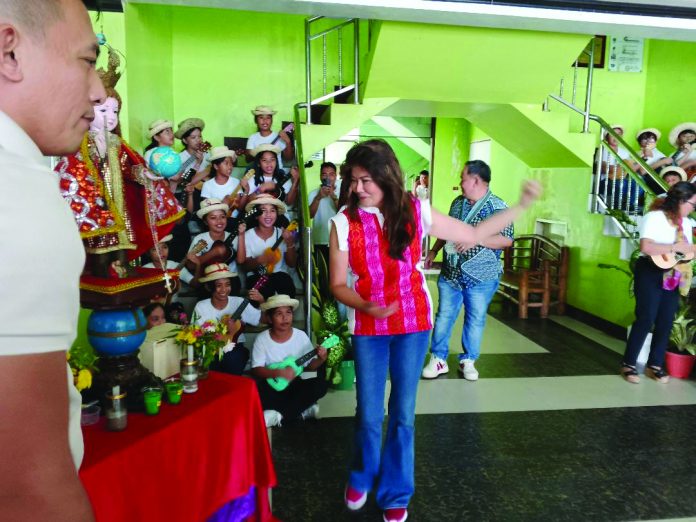
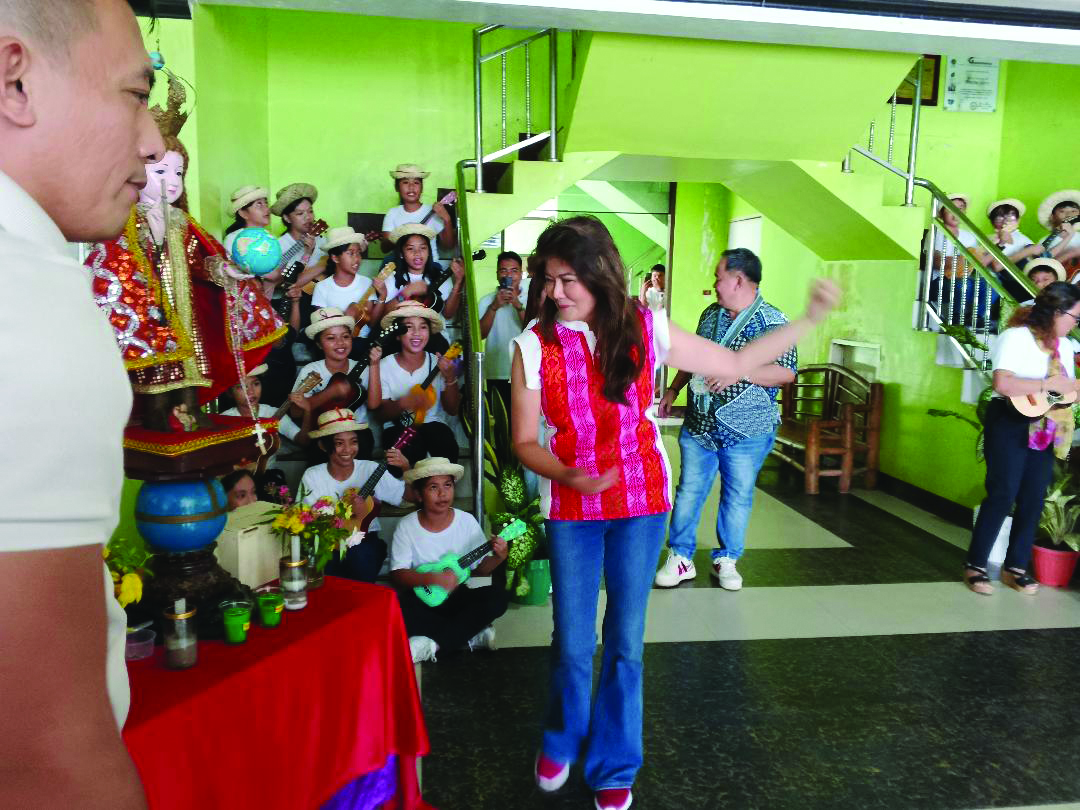
WELCOME HOME. Senator Imee Marcos is welcomed with a serenade from children during her visit to Tolosa, Leyte, on Sunday, Feb. 9, where she led the inauguration of a three-story evacuation center. (JAG)
WELCOME HOME. Senator Imee Marcos is welcomed with a serenade from children during her visit to Tolosa, Leyte, on Sunday, Feb. 9, where she led the inauguration of a three-story evacuation center. (JAG)
TACLOBAN CITY – Senator Imee Marcos has reiterated that she does not support the impeachment complaint against Vice President Sara Duterte, emphasizing her stance against political instability.
“I never said I would block the impeachment. What I said was, I don’t want chaos, I don’t want impeachment, I don’t want the ICC, I don’t want destabilization… especially against Bongbong,” Marcos said, referring to her brother, President Ferdinand “Bongbong” Marcos Jr.
The senator added that the Senate, sitting as an impeachment court, is set to deliberate on the complaint starting June 3, following an agreement among senators.
Marcos also revealed that discussions about impeaching Duterte had been circulating since 2023. “But we senators have agreed to tackle it in June when we reconvene,” she said.
Former Senate President Franklin Drilon earlier urged President Marcos Jr. to call for a special session to begin the impeachment trial. The President has said he is open to doing so if requested by a senator.
Duterte was impeached by the House of Representatives for reportedly committing culpable violation of the Constitution, for graft, and for making a threat to the lives of the President, his wife, First Lady Liza Araneta Marcos, and House Speaker Martin Romualdez.
The presidential sister was in Tolosa, the hometown of their mother, former First Lady Imelda Marcos, on Sunday, Feb.9, to lead the inauguration of a P45-million evacuation center.
She was welcomed by town officials led by Mayor Erwin Ocaña who she endorsed as her candidate for the mayor of Tolosa. (JOEY A. GABIETA)
AIMING FOR 3 SEATS. The Tingog party-list kicks off its reelection bid in a three-day summit attended by more than 500 of its organizers and staff across the country beginning Thursday, Feb. 6 as they aim for three seats in the May 12, 2025 elections. Photo shows Rep. Jude Acidre, the group’s second nominee, in a huddle with their supporters. (TINGOG CONTRIBUTED PHOTO)
Aiming for 3 congressional seats
AIMING FOR 3 SEATS. The Tingog party-list kicks off its reelection bid in a three-day summit attended by more than 500 of its organizers and staff across the country beginning Thursday, Feb. 6 as they aim for three seats in the May 12, 2025 elections. Photo shows Rep. Jude Acidre, the group’s second nominee, in a huddle with their supporters. (TINGOG CONTRIBUTED PHOTO)
PALO, Leyte – The Tingog party-list reaffirmed its commitment to public service and legislative action as it formally launched its bid for additional seats in this year’s midterm elections under the party-list system.
On Thursday, February 6, the party-list, founded by Leyte Congressman and House Speaker Martin Romualdez, began its three-day summit at the Leyte Academic Center. The event gathered more than 500 staff and local organizers from across the country.
Tingog officials expressed confidence that, given its strong performance in recent years, the party can secure at least three congressional seats in the May 12, 2025 elections.
The official campaign period for Senate and party-list candidates begins on February 11.
Rep. Jude Acidre, the party’s second nominee, highlighted Tingog’s transformation from a grassroots movement in Eastern Visayas into a national political force focused on governance and social service.
“Tingog started as a small voice from our region, but today, it has become a nationwide movement that listens, serves, and empowers the Filipino people,” Acidre said.
Since winning a seat in Congress in 2019, Tingog has expanded its reach, establishing 210 Tingog Centers across the country to deliver essential services. These centers have provided medical, educational, and financial assistance to thousands of Filipinos.
“From Ilocos Sur to Davao del Sur, Tingog Centers ensure that no Filipino is left behind. We have helped students stay in school, provided financial aid for medical emergencies, and made government services more accessible,” Acidre emphasized.
Beyond social services, the party has played a key role in shaping national policies.
In the past three years, Representatives Acidre and Yedda Romualdez, the party’s first nominee and wife of Speaker Romualdez, have authored nearly 500 bills and resolutions, 40 of which have become laws.
These include the SIM Registration Act, the Ease of Paying Taxes Act, and the Magna Carta of Filipino Seafarers Act, among others.
As Congress resumes sessions after the elections, Acidre stressed that Tingog remains focused on pushing for critical measures, including the Magna Carta of Children and other legislative initiatives aimed at uplifting marginalized communities.
“Legislation should not just be about making laws but ensuring that every Filipino has a voice in shaping policies that directly impact their lives,” Acidre stated.
Apart from legislative work, Tingog is also committed to disaster response and healthcare initiatives.
The party has spearheaded relief operations in disaster-stricken areas and launched the Kalusugan Karavan, a mobile healthcare program that has served nearly 50,000 Filipinos across 50 locations.
As the party prepares for the upcoming elections, Acidre emphasized that Tingog’s mission remains steadfast.
“Tingog is not just a political party; it is a movement of service and change. Our goal is to ensure that every Filipino, regardless of status, has access to opportunities and a government that truly listens,” he declared.
He urged supporters to continue amplifying Tingog’s advocacy to ensure the party remains a strong voice in Congress and beyond.
“We have come a long way, but there is still more work to be done. Together, we will move forward in making the Philippines a better place for all.”
With its strong track record, the party is confident it can achieve its goal of securing three congressional seats in the May 12, 2025 elections.
Aside from Romualdez and Acidre, Tingog has named six other nominees, representing various regions across the country.