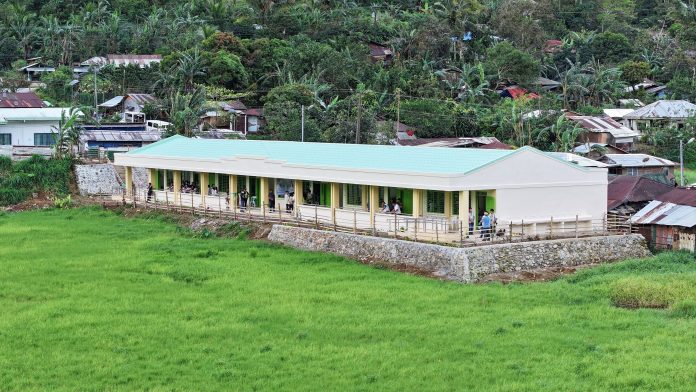
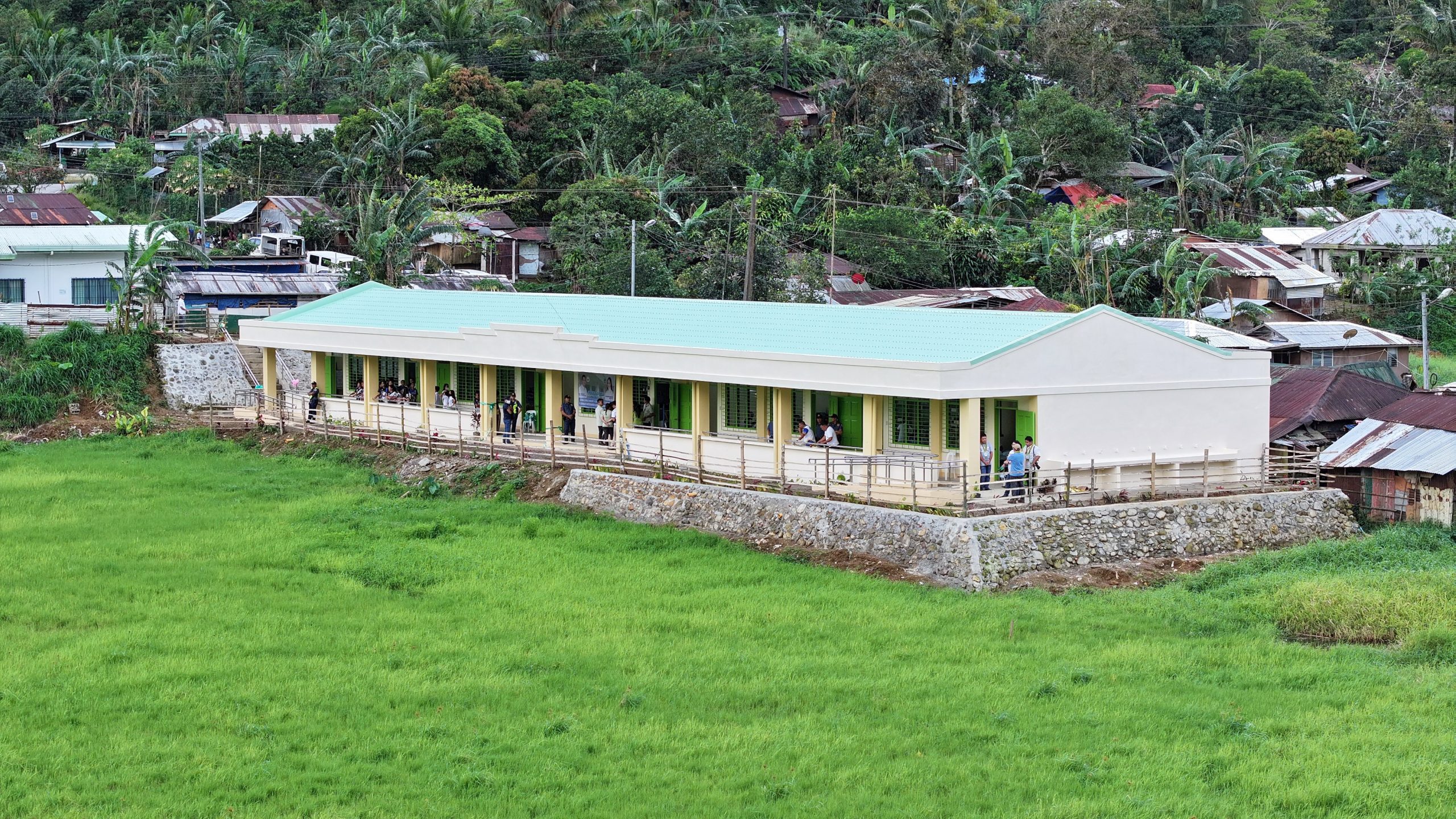
ORMOC CITY– The Department of Public Works and Highways (DPWH) Leyte 4th District Engineering Office (DEO) completes the construction of a one-story, five-classroom building at Lake Danao Integrated School, Ormoc City, with a contract amount of Php 12,313,123.20 funded under the General Appropriations Act (GAA) 2024.
Each of the five classrooms is equipped with a comfort room and four ceiling fans, ensuring a comfortable learning environment for the students. Additionally, group handwashing counter sinks with ten faucets per counter sink have been installed at the outermost sides of the building to promote proper hygiene among students.
Previously established as Lake Danao Elementary School, the institution was upgraded to Lake Danao Integrated School in 2022 to accommodate junior high students. With this expansion, the demand for additional classrooms has grown, making this newly completed project a significant contribution to the school’s development. The additional learning spaces will greatly benefit students, especially those who previously had to travel to neighboring barangays to continue their secondary education.
Furthermore, the building is expected to bring long-term positive impacts such as increased student enrollment, enhanced teaching efficiency and educational sustainability. With better infrastructure in place, students will have greater opportunities to excel academically and secure a brighter future. (PR)
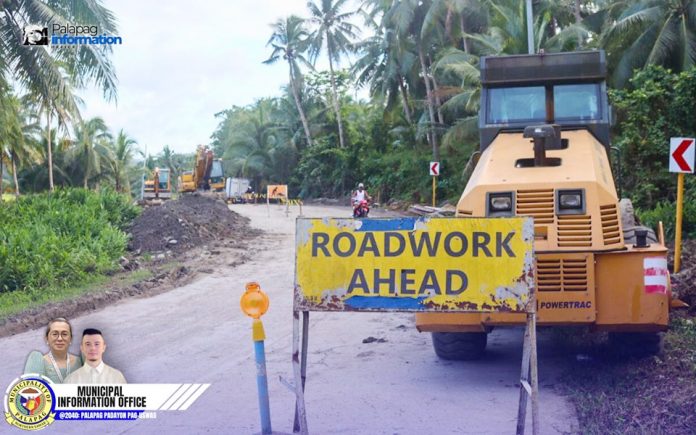
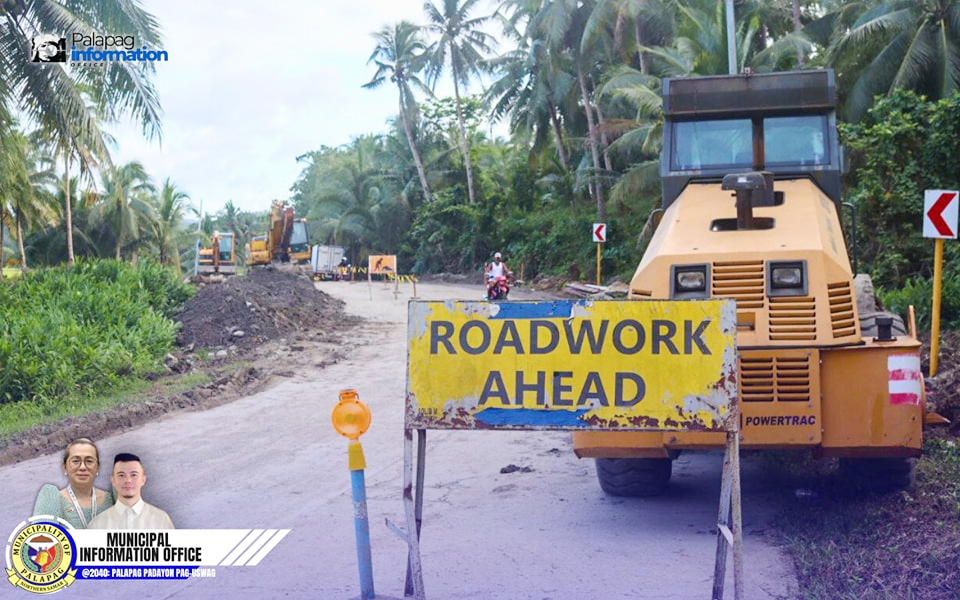
ROAD REPAIR.A portion of the Samar Pacific Coastal Road in Palapag is being repaired after it sustain damages due to the shearline-induced rains.
ROAD REPAIR.A portion of the Samar Pacific Coastal Road in Palapag is being repaired after it sustain damages due to the shearline-induced rains.
TACLOBAN CITY – Mayor Florence Batula of Palapag, Northern Samar expressed gratitude to the provincial government for funding the repair of damaged sections of the Palapag-Simora Road, a vital route for trade and transportation.
The road, part of the Samar Pacific Coastal Road (SPCR) Project, suffered heavy damage due to shearline-induced rains and overuse.
With no immediate national government assistance, Governor Edwin Ongchuan allocated provincial funds for initial rehabilitation.
The 20.6-kilometer road includes 6.58 km funded by the provincial government from Palapag town proper to Barangays Magsaysay and Mabaras, while 11.6 km was constructed under SPCR Project 1.
Although the provincial government sought national funding in August 2024, the lengthy approval process and worsening road conditions prompted Governor Ongchuan to take action.
Repairs are now underway but are limited by the election ban.
The Simora-Palapag Road has yet to be categorized as a national road.
TACLOBAN CITY – The repair of the Biliran Bridge has officially commenced, according to OIC-District Engineer Irwin Antonio of the Department of Public Works and Highways (DPWH) – Biliran District Engineering Office (BDEO).
The P28.9 million budget for the project, requested by BDEO, has been downloaded by the DPWH central office following damage assessments conducted in December 2024.
The repairs include replacing corroded bolts, steel members, steel plates, damaged expansion joints with a finger-type expansion joint, and other critical bridge components.
Experts from BDEO and the regional office identified damages beneath the deck slab, particularly on the bridge stringers, steel cross bracing, and loose nuts and bolts at spans 1 and 4.
Antonio confirmed that the contractor, engaged via negotiated procurement, began deploying manpower and materials on February 8 after receiving the notice to proceed (NTP).
The repair is expected to be completed by June 2025.
Antonio assured the public that the bridge will remain open throughout the repairs. However, only vehicles weighing five tons and below are allowed to pass, while heavier vehicles are being transported via barge.
Built in 1976, Biliran Bridge serves as the sole land access connecting Biliran province to Leyte.
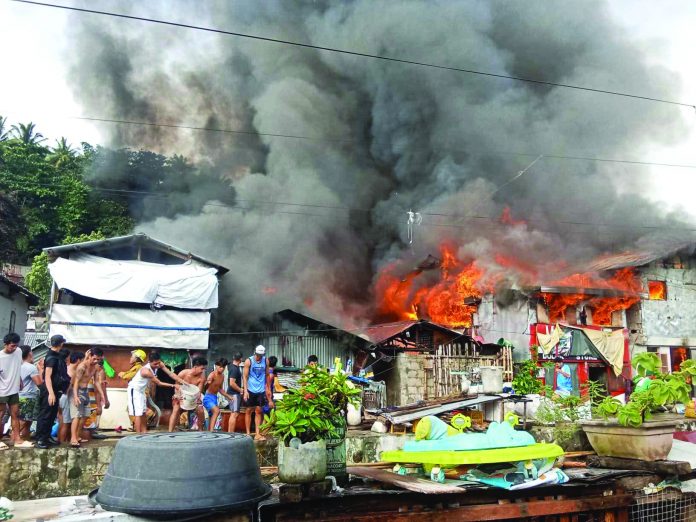
TACLOBAN CITY BLAZE. A fire that lasted for over an hour reduced 36 houses to ashes in Barangay 39, Calvary Hill, Tacloban City, on Monday, February 17. No one was injured in the incident. (RMN)
No one injured in the separate incidents
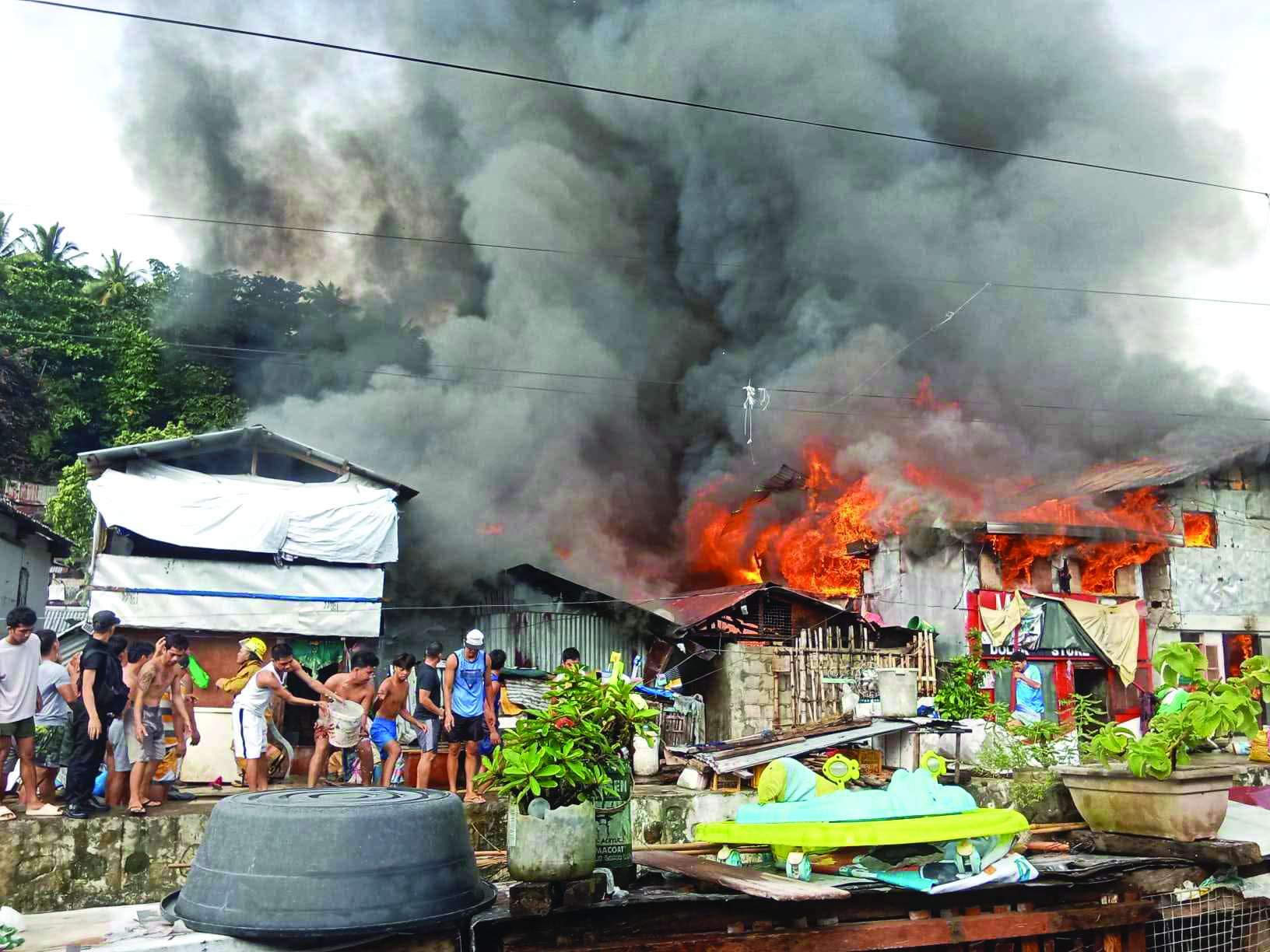
TACLOBAN CITY BLAZE. A fire that lasted for over an hour reduced 36 houses to ashes in Barangay 39, Calvary Hill, Tacloban City, on Monday, February 17. No one was injured in the incident. (RMN)
TACLOBAN CITY – A massive fire and a series of earthquakes have left residents of this city and in Hernani, Eastern Samar reeling from devastation and fear.
About 78 families, consisting of more than 390 individuals, lost their homes after a fire ravaged a depressed community in this city on Monday morning, February 17.
The blaze broke out in Barangay 39, Calvary Hill, at around 7:47 a.m. and was declared under control by 9:04 a.m., after burning 36 houses, most of which were made of light materials.
City fire director Chief Inspector Anthony de la Paz said authorities are still investigating the cause of the fire.
“We cannot yet determine the cause of the incident as the investigation is still ongoing. However, we can confirm that no one was hurt or injured,” he said in a media interview.
Initial reports suggest that the fire started in the house of Letecia Ayaso, with a plugged-in mobile phone charger that exploded as the possible cause.
Firefighters from the City Fire Office, assisted by private fire volunteers and fire stations from neighboring towns, struggled to put out the flames as the houses were closely packed, and strong winds fanned the fire.
Fire victim Rosalinda Mascarinas said she had to flee her home upon seeing thick smoke billowing from her neighbor’s house.
“We were unable to save anything except for some personal documents,” she said, adding that even their pet cat was left behind.
The displaced families are currently staying at the barangay hall or with relatives.
De la Paz estimated the damage caused by the fire at around P3 million.
The City Social Welfare and Development Office (CSWDO) has provided immediate assistance to the victims, including ready-to-eat food. The city government is also set to extend financial aid to the affected families.
Series of earthquakes in Hernani, Eastern Samar
In another disaster, residents of Hernani, Eastern Samar, have been left traumatized by a series of earthquakes that struck the town, further worsened by the spread of fake news.
This was disclosed by Lani Dingal, the municipal disaster risk reduction and management officer, as Hernani continues to experience tremors since Friday night, February 14.
The initial earthquake, recorded at magnitude 5.6, struck at around 8:50 p.m. The following morning, February 15, another tremor measuring magnitude 5.5 hit the town at approximately 9:18 a.m. On Sunday, February 16, a third quake with a magnitude of 4.7 occurred at about 7:44 p.m.
The Philippine Institute of Volcanology and Seismology (Phivolcs) has also recorded multiple aftershocks following these quakes.
Fortunately, none of these earthquakes caused damage to infrastructure, facilities, or private homes.
“But what concerns us the most now is that people are feeling traumatized due to the series of tremors,” Dingal said in a phone interview on Monday, February 17.
She also expressed frustration over individuals spreading fake news, which has heightened residents’ anxiety.
“There are people spreading false information that a tsunami will hit our town. This only adds to our people’s fear. I hope they stop spreading these baseless rumors,” Dingal added.
According to her, while earthquake drills are regularly conducted down to the barangay level, panic can override preparedness.
“We urge them not to panic,” she said.
It was learned that the Philippine Trench passes through the town of Hernani, which could be the reason for the series of quakes in the area.
TACLOBAN CITY – Approximately 1,260 Grade 1 students from various public schools in the city will participate in the government’s “Tara, Basa” program, aimed at improving reading skills among young learners.
The program, set to run from May 19 to June 23 during the summer break, will be implemented across 20 public schools in Tacloban.
Selected students, identified as slow readers or those with low comprehension, will receive two hours of tutoring each day, provided by college student tutors paid P405 daily by the Department of Social Welfare and Development (DSWD).
Lily Talagon, principal of San Jose Central School, expressed her support for the initiative, highlighting its potential to improve students’ reading abilities.
“This is a good program, and I hope all our identified students will learn to read with comprehension by the end of the program,” Talagon said in an online interview.
Her school has 160 out of 283 Grade 1 students enrolled in the program.
Imelda Gayas, principal of Tacloban City Central School, also welcomed the program, noting its timely implementation during the summer break when students can focus on enhancing their reading skills.
“Summer time has always been observed that kids tend to forget schools so with this intervention, we hope that learning will continue even its during break time,” she said.
“The goal is to improve their reading levels, especially those who are in the emergent or transition stages,” Gayas added.
Her school has identified 70 out of 89 Grade 1 students for the program.
In total, 5,040 Grade 1 students across Eastern Visayas will participate, requiring 1,510 tutors.
The “Tara, Basa” program is aligned with Executive Order 76, issued by President Ferdinand “Bongbong” Marcos Jr., to improve literacy skills, provide financial support to tutors, and increase parental involvement.
TACLOBAN CITY – Hosting major events such as the Eastern Visayas Regional Schools Press Conference (EVRSPC) and the Regional Festival of Talents is bringing significant economic and tourism benefits to Borongan City.
Mayor Jose Ivan Dayan Agda highlighted that these gatherings not only stimulate local businesses but also promote the city’s tourism potential.
He emphasized that visitors’ experiences and social media exposure serve as powerful promotional tools, reducing the need for hiring PR firms.
“The word of mouth from visitors, coupled with pictures on social media showcasing their experiences, is more effective than hiring marketing companies,” Mayor Agda stated.
From February 7 to 11, Borongan City welcomed around 3,000 student journalists, along with their coaches, teachers, and chaperones from 13 school divisions of the Department of Education, for the regional EVRSPC.
The winners of the competition will represent the region at the National Schools Press Conference in Laoag City. Three individual contestants and one group from Borongan emerged as champions.
This week, the city is set to host another batch of students for the Regional Festival of Talents at the Eastern Samar National Comprehensive High School, further boosting local tourism and economic activity.