25.5 C
Tacloban City
September 18, 2026 - Friday | 10:34 PM
Home Blog Page 631

Northern Samar LGUs tighten restrictions to prevent ASF spread

0

TACLOBAN CITY – In response to the Northern Samar provincial government’s order restricting the movement of pigs and pork meat products, several local government units (LGUs) have also issued executive orders limiting the transport of these products in their respective areas.

The move comes after reports of increased swine mortalities in the towns of Las Navas, Laoang, and Catubig following last month’s consecutive flooding.

A confirmed case of African Swine Fever (ASF) in Las Navas prompted the Provincial Veterinary Office to recommend that Governor Edwin Ongchuan issue an order to curb the movement of pigs and pork meat products.

Following Executive Order No. 25-02-01, signed on February 10, 2025, which mandates the establishment of quarantine checkpoints in affected municipalities and the activation of ‘Bantay ASF sa Barangay’, the local governments of Laoang and Palapag issued their own executive orders restricting the entry of pigs and pork meat products.

In Laoang, Mayor Hector Ong ordered the establishment of ASF checkpoints at all entry and exit points, including Barangays Oleras, Buraud, Calomotan, Aguadahan, and Doña Luisa. These checkpoints are manned by personnel from the municipal agriculture office, Laoang Municipal Police Station, and barangay officials.

Live pigs or hogs may only be transported into Laoang if accompanied by the following documents: barangay certification confirming ownership and place of origin; veterinary health certificate from an LGU-licensed veterinarian; livestock inspection certificate; local shipping permit; handler’s license; and transport carrier registration certificate.

For pork meat products, transporters must present a meat inspection certificate issued by the LGU and an official receipt from a meat stall or meat shop.

In Palapag, Mayor Florence Batula Jr. ordered all barangay officials to activate their respective Barangay ASF Task Force and Barangay Biosecurity Officers to ensure that the municipality remains ASF-free.

Palapag, which borders Laoang, has two main entry points: Pangpang-Calomotan, accessible by boat, and Simora-Palapag Road.

To further strengthen ASF prevention, the Palapag Sangguniang Bayan passed an ordinance prescribing guidelines and precautionary measures to prevent the possible spread of the disease in their municipality.

(ROEL T. AMAZONA)
House approves new state-owned medical school in Eastern Samar

0

TACLOBAN CITY – The House of Representatives has approved on third and final reading a bill establishing a state-owned college of medicine under the Eastern Samar State University (ESSU) in Borongan City.

House Bill No. 11342, authored by Minority Leader and 4Ps party-list Rep. Marcelino “Nonoy” Libanan, aims to make medical education more accessible, especially to students from low-income families.

“Once the new state-subsidized college of medicine is established, we expect it to provide opportunities for aspiring doctors, particularly those from disadvantaged backgrounds,” Libanan said in a statement.

He also emphasized that the medical school would help address the shortage of doctors, particularly in rural and underserved areas like Eastern Samar.

Although a lawyer by profession, Libanan holds a degree in medical technology.
A native of Eastern Samar, he previously represented the province’s lone congressional district for nine years before joining the 4Ps party-list.

Libanan had previously urged President Ferdinand Marcos Jr. to certify as urgent at least nine House bills seeking to establish additional medical schools in state universities.

(LIZBETH ANN A. ABELLA)

Top criminal gang member killed in shootout during search warrant operation in Calbayog City

0

ORMOC CITY– A notorious criminal gang member was killed in an alleged shootout with authorities while his live-in partner was arrested for illegal drug possession during a search warrant operation at dawn on Thursday, February 20, in Barangay Balud, Calbayog City.
The suspect, identified as Annex Sabar, alias “Nex,” 31, a construction worker and former detainee, was a known member of the Magbutay Criminal Gang and a high-value individual (HVI) in law enforcement’s drug watchlist.

His partner, identified as alias “Alyssa” or “Lalay,” 27, was also present during the raid.
At around 5 am, joint police operatives arrived at the suspect’s residence to serve a search warrant for violation of Section 11, Article II of Republic Act 9165 (Comprehensive Dangerous Drugs Act).

The warrant was issued by Judge Maricar Lucero, Executive Judge of RTC-8, Calbayog City.
Upon arrival, police knocked on the door, identified themselves, and read the warrant. However, instead of complying, Sabar allegedly grabbed his 12-gauge shotgun, loaded it, and opened fire on the officers. In response, police forced entry and engaged the suspect, fatally shooting him in the exchange of gunfire.

Sabar was immediately rushed by Calbayog City Disaster Risk Reduction and Management Office (CDRRMO) personnel to Calbayog District Hospital, but he was pronounced dead on arrival at 5:20 am by his attending physician.

During the operation, alias “Alyssa” was searched in the presence of some witnesses. Although no weapons were found in her possession, authorities seized a plastic sachet containing a white crystalline substance suspected to be shabu.

She was immediately arrested, informed of her offense, and apprised of her constitutional rights under the Miranda Doctrine in a language she understood.

The Scene of the Crime Operatives (SOCO) processed the area and recovered one 12 shotgun with three live rounds and one spent shell; .45 caliber pistol loaded with six live rounds and one spent shell; one replica short firearm pistol; two sachets of suspected shabu; one 12-gauge empty shell; three .45 caliber fired cartridge cases; and two 9mm fired cartridge cases

At the hospital, SOCO also conducted a bodily search on Sabar’s cadaver, leading to the recovery of two more sachets of suspected shabu; and P2,908 in cash in different denominations.

Charges for illegal drug possession (Section 11, RA 9165) were filed against alias “Alyssa,” who is now detained at the Calbayog City Police Station lock-up facility.

(ROBERT DEJON)

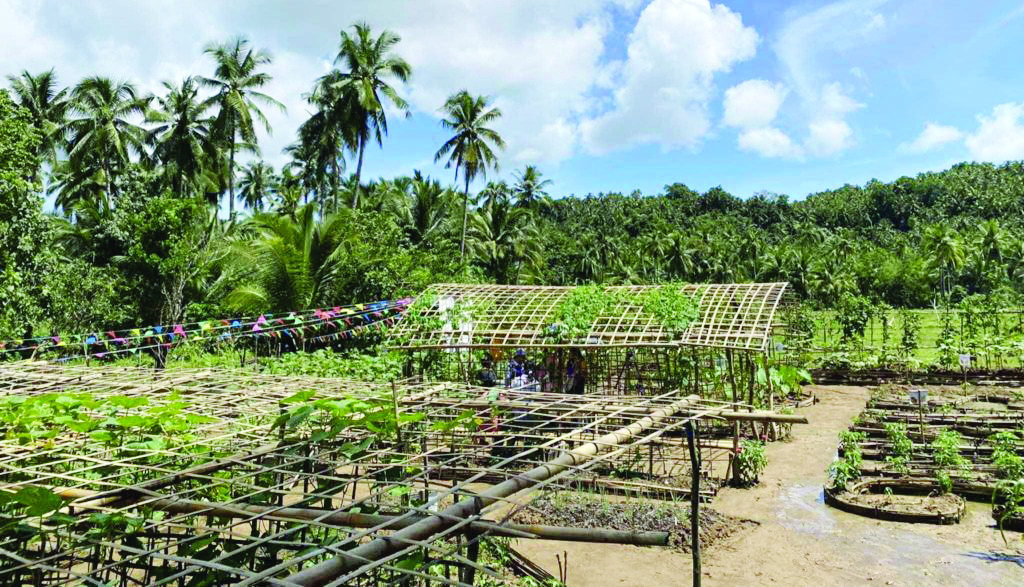
Garbage dump in Eastern Samar turns into community garden

0
One of the community gardens established under Project LAWA at BINHI in Brgy. Sabang, Oras, Eastern Samar (Photo courtesy of DSWD Field Office 8)

BORONGAN CITY-Following its successful rollout last year, the Department of Social Welfare and Development Field Office 8 will continue to implement Project LAWA (Local Adaptation to Water Access) and BINHI (Breaking Insufficiency through Nutritious Harvest for the Impoverished) in Oras, Eastern Samar.

This initiative aims to boost community resilience to climate change, particularly food security, especially in anticipation of El Niño’s effects.

One significant outcome that came out of the project implementation in Oras was Happy Land, a dumpsite turned into a community garden created by the municipality of Oras to ensure food security in their community year round.

“Prior to the implementation of this program, this place used to be a dumpsite. It didn’t attract people, there were a lot of flies, it’s dirty. But now, through and inspired by the program Lawa at Binhi, through the collaboration of the local government of Oras and the barangays, we have converted this into what we call Happy Land,” Salvador Dalosa, municipal agriculturist of Oras, said.

He also shared that 42 barangays or almost a hundred percent of barangays in Oras have community gardens through Project Lawa at Binhi.

Dalosa also thanked the DSWD for boosting the community’s engagement on agricultural endeavors through Project LAWA at BINHI.

In addition, to ensure the success of the program’s implementation, DSWD’s Risk Resiliency Program for Climate Change Adaptation and Mitigation team recently met with local agriculture and social welfare officials to plan for the project’s continued implementation and expansion.

(SEJ/PIA Eastern Samar)

Tacloban feels impact of Trump’s 90-day freeze order

0
CLASSES SUSPENDED. The shear line affecting Eastern Visayas has prompted local officials and school heads to suspend classes due to the risk of flooding and landslides. Photo shows Rizal Central School in Tacloban City empty for two days after Mayor Alfred Romualdez ordered the suspension of classes. Story on page 7... (ROEL T. AMAZONA)

City has 2 USAID-funded programs

CLASSES SUSPENDED. The shear line affecting Eastern Visayas has prompted local officials and school heads to suspend classes due to the risk of flooding and landslides. Photo shows Rizal Central School in Tacloban City empty for two days after Mayor Alfred Romualdez ordered the suspension of classes. Story on page 7… (ROEL T. AMAZONA)

TACLOBAN CITY—The 90-day freeze on all United States-funded programs imposed by President Donald Trump is now affecting projects in Tacloban City.

Tacloban is a beneficiary of two programs funded by the United States Agency for International Development (USAID), namely, Urban Connect and Cities for Enhanced Governance and Engagement (CHANGE), according to City Planning and Development Officer Janis Canta.

“In a way, we are affected by President Trump’s 90-day freeze because we have two ongoing USAID-funded programs,” Canta said in an interview on Wednesday, Feb.19.
Urban Connect focuses on urban development and management, while the CHANGE program aims to strengthen democratic governance by making local government units more responsive, transparent, and accountable with the participation of civil society groups.

Both programs, which began in 2023, are set to run for five years.
Under the Urban Connect program, USAID has assisted Tacloban in crafting its land use plan, tourism development plan, business one-stop shop digitalization, and gender and development initiatives.

Meanwhile, the CHANGE program has provided capacity-building training and helped establish a local people’s council.

Canta, who also acts as the city information officer said, the temporary suspension of these programs has significant consequences for the city’s development and governance.
“Of course, we are saddened and disappointed by this 90-day freeze order because these programs have had a significant impact on Tacloban,” she said.

She added that city officials, led by Mayor Alfred Romualdez, are now in a waiting period, as all USAID-funded programs are under review to determine which align with the new policies of the Trump administration.

“We are in a hanging mode right now,” Canta said. “We will just have to wait until the 90-day period is over and see which programs will continue under the new policy direction.”
Just hours after taking office, President Trump issued the 90-day freeze to evaluate the efficiency of US-funded programs worldwide and ensure they align with his foreign policy.
Canta also revealed that the city government has yet to receive official communication from the US Embassy regarding the status of the programs.

JOEY A. GABIETA

Samar town addresses fish losses

0

TACLOBAN CITY– The municipality of Daram, Samar, home to the largest municipal waters and longest coastline in the Samar Sea, is ramping up efforts to combat post-harvest fish losses through a comprehensive five-year development plan amounting to P249.8 million.

The initiative, backed by key stakeholders, aims to reduce fish spoilage, improve storage facilities, and enhance fisherfolk livelihoods.

During a stakeholders’ forum in the town held on February 13, Vice Mayor Lucia Astorga underscored the significance of addressing the high rate of post-harvest fish loss, which currently stands at 40.34%, according to a study conducted by the Center for Sustainable Aquaculture and Agri-based Innovations (CenSAAI) in 2024.

Post-harvest fish loss (PHFL) refers to the measurable reduction in the quantity, quality, or monetary value of fish, after the fish is caught and before it is sold to consumers.

“Our seas have long been the lifeblood of our people, yet many of our fisherfolk suffer due to inadequate preservation, lack of proper storage, and limited market access. By working together, we can reduce these losses, increase incomes, and ensure food security,” Astorga said.

“Reducing post-harvest losses is not just about economics; it’s about securing the future of our coastal communities. Through sustainable solutions, we can uplift the lives of our fisherfolk and create a more resilient fishing industry,” she concluded.

The forum gathered representatives from Oceana, the Department of Agriculture-Bureau of Fisheries and Aquatic Resources (DA-BFAR), the Department of Trade and Industry (DTI), Samar State University, and fisherfolk leaders, among others.

BFAR Region 8 Regional Director Dominador Maputol affirmed the agency’s commitment to supporting post-harvest infrastructure projects, including the construction of cold storage facilities, fish landing centers, and processing plants. “We are integrating conservation efforts with livelihood programs to ensure a sustainable fishing industry in Samar,” he said.

Gloria Estenzo Ramos, Oceana vice president, highlighted the role of sustainable fisheries governance and vessel monitoring systems in ensuring responsible fishing practices.
“Daram can serve as a model for science-based fisheries management. By enhancing fisherfolk training and strengthening policy frameworks, we can create long-term solutions,” Ramos added.

Oceana recommends the following policies to reduce post-harvest fish losses: establish robust fish catch monitoring and reporting systems; ensure accurate data on fish catch; train women and mobile peddlers in postharvest handling and processing to minimize quality loss; limit catch volumes of species with high PHFL during peak fishing seasons to reduce physical and market force loss; establish an organized marketing system to connect fishers and aquafarmers with buyers, enhancing market linkages in the fish distribution chain; and implement area- and species-specific price regulating mechanisms to control fish prices and ensure fair profits for fishers and aquafarmers, among others.
The municipality’s five-year Comprehensive PHL reduction plan proposes the establishment of cold storage units, drying facilities, fish processing centers, and skills training programs to curb losses and maximize fish value.

Stakeholders proposed solutions such as seasonal fishing quotas, expansion of market reach, and value-added fish processing to absorb the surplus supply.

The Alliance of LGUs along Samar Bays and Channels also pledged to collaborate on resolving the issue by improving market coordination and exploring inter-provincial trading partnerships.

Additionally, Daram’s Fisheries Office committed to enhancing its electronic fish catch monitoring system, ensuring transparency in daily landings.

(JOEY A. GABIETA)

Recent Posts

DALMACIO C. GRAFIL
PUBLISHER

ALMA GRAFIL
EDITOR-IN-CHIEF

ROMEO CEBREROS
OFFICE IN-CHARGE

OFFICE
BRGY. SONGCO, BORONGAN CITY

CONTACT NUMBERS
(055) 261 – 3319 | 0955 251 1533 | 0917 771 0320 | 0915 897 7439 | 0921 511 0010

DALMACIO C. GRAFIL
PUBLISHER

RICKY J. BAUTISTA
EDITOR

ALMA GRAFIL
BUS. MANAGER

OFFICE
RIZAL AVENUE, CATBALOGAN
(INFRONT OF FIRE DEPARTMENT, NEAR CITY HALL)

CONTACT NUMBERS
0917 771 0320 | 0915 897 7439 | 0921 511 0010

EMAIL
lsdaily2@yahoo.com

WEBSITE
www.issuu.com/samarweeklyexpress