ORMOC CITY-A village chief shot dead a constituent after he tried to pacify him during a confrontation in Basey, Samar on Sunday (Nov.13) evening.
Venerando Bacayo, 57, barangay chairman of San Agustin, shot to the head Rodel Lapinig,32, after the latter challenged him to shoot him.
Lapinig, who was said to be heavily intoxicated at that time and armed with a ‘sundang’, was causing havoc in the village, prompting the village chairman to pacify him.
But instead of heeding his appeal, Lapinig instead challenged the village leader to shoot him.
Apparently, the village official lost his cool and drew a gun pointing at Lapinig, hitting him on his head, the local police said.
The suspect voluntarily surrendered to Basey Municipal Police Station. (ROBERT DEJON)
THE story of Zaccheus in the gospel (cfr. Lk 19, 1-10) offers us a precious lesson on how to properly deal with the unavoidable human condition of our sinfulness. And that is, no matter how big, ugly and plenty our sins are, God’s mercy is always available. We should not waste time rutting in guilt feelings, sadness and depression because these would only make things worse.
In that gospel story, Zaccheus, regarded as a sinner at that time, promised to amend for whatever sins he committed, and Christ readily forgave him. “Today salvation has come to this house,” he said, “because this man too is a descendant of Abraham.” (v.9) These words can only show how merciful and compassionate God is with all of us.
And to think that it was Christ who invited himself to Zaccheus’ house, knowing how Zaccheus was regarded by some people, only shows that Christ always takes the initiative to look for sinners, eager to offer forgiveness. “For the Son of Man has come to seek and to save what was lost,” he said. (v.10)
We should not over-react to our sinfulness which is unavoidable in our life. What we should immediately do is to go to God, asking for forgiveness, promising some amendment and reparation for our sins, and when able, to go to confession.
We should avoid staying too long keeping some guilt-feelings and sadness in our heart. These conditions are not good for us. They are harmful, and worse, they can be like wedges that make more openings for temptations to come to us. We should get rid of these feelings as soon as possible.
The ideal condition is always for us be at peace with God and with everybody else. We have to ooze with our faith-based confidence. The moment we feel some disturbance in our heart, we should act quickly to seek relief through God’s mercy. Remember St. Paul saying, “Where sin abounded, grace did more abound.” (Rom 5,20) He is slow to anger and quick to forgive.
God is always a father to us. He will always understand us and do everything to help us. Before him, we are like little children who cannot avoid making a mess around. Let’s remember that we have to contend not only with our own weaknesses, but also with powerful evil spiritual enemies.
More, the goal that we have to reach is something supernatural. It’s just beyond our powers. We should not be too surprised if along the way, we commit all sorts of blunders. We should not be unduly entangled with them. God’s mercy and compassion is always available.
Let’s just strengthen our sense of divine filiation, that is, that we are all children of an infinitely good and merciful father who do everything to bring us back to him. His justice is never without mercy.
Whenever we feel the sting of our weaknesses and sinfulness, together with their antecedents and consequences, their causes and effects, let’s never forget to consider also God’s mercy that is always given to us, and, in fact, given to us abundantly.
What we have to avoid is to get stuck with one while ignoring the other. Our sinfulness should be viewed in the context of divine mercy. And vice-versa: God’s mercy should be regarded in the context of our unavoidable sinfulness.
On our part, of course, we should try our best to be as good a child to God as God is good to us. Obviously, we cannot perfectly achieve that ideal, but it’s in the desire to struggle to be so that truly matters.
The Christmas of the modern times is celebrating the basic instincts of humans. It is all about feeding, clothing and parties. All hedonistic , pleasure grounded things.
Depending on this Opinion seeing print, it may be that the commercial signages would remind you to skip the Christmas rush and go shopping early. Reminding you that Christmas is 40 days to go, it would mean that you can still make a financial projection side by side with the gift list. The reminder will persist on a countdown and given this mind conditioning you are thrown into the frenzy of buying, sometimes buying things we don’t need.
We are aware and certain that Christmas is now commercialized, we are certain that the marketing gurus had unleashed that spell called Christmas Sale, but we cannot and has no power resisting.
History would tell us that it was a well orchestrated marketing ploy that never fails. One soda or soft drinks has Santa endorsing its sweety taste since 1920s. Appearing in the Advertisement on the Saturday Post in the United States, we also saw Candy Canes decorative. It was said that the candy cane are white and long, given to choir boys to serve as snacks on Nativity Mass in Germany. In the Philippines, the Simbang Gabi a devotional 9 day dawn masses is an offshoot of our colonial past. The Spanish Friars had to make a schedule of the dawn mass as a compromise to farmers who had to start working early on mornings. The heat of the sun would create problem if the farmers would start late mornings. At present that would mean not only early morning masses it would also mean splurging on Pinoy delicacies like Bibingka, Puto Bumbo, Tsokolate. The opportune time of selling breakfast staple is both commercial and yet also cultural.
In the long and short of it Pasko had became commercial and not a stoic and simple observance of the birth of a Savior who opted not to be born in Rome but in a manger of simplicity in the fellowship of cow dung and sheep with shepherd without the luxe bath.
In all, the world is celebrating Christmas in the lens of luxury when the He, whose birth we celebrate was without the proper nor sanitized setting for a birthplace. It was on a crude and stinky manger. We have parties , multiple parties upon after parties, He was cold, lonely and persecuted, being chased by a Roman administrator and when found will be murdered. We are on the euphoric frenzy on the glittery side of Christmas observance when the real Nativity scene was dark , simple and has no comfortable ornaments in sight .
With the remaining 40 nights before Christmas , I would reflect and look deep into the fact that as a good friend DORELCO General Manager Allan Laniba said, Jesus did not opt to be born in Rome, He had chosen a simple manger in a place where animals of burden dwell. Where darkness and cold air pervades. All the more realizing the fact that His love sheltered us from that eventuality because his love is great.
In a much welcomed move by the Asian Development Bank (ADB), specially to us Filipino marine biologists, is its recent approval of “$3.8 million worth of support for the development of insurance for the restoration, conservation and management of coral reefs in the Philippines and three other countries in ‘Southeast Asia and the Pacific.”
ADB was quoted saying that “the project involves the development of climate risk financing and insurance solutions to protect coral reefs in the Philippines, Indonesia, Fiji and Solomon Islands.”
The ADB’s initiative is likely part of the Asia Pacific Climate Finance Fund (ACLIFF), the latter is extending $2.5 million for the project, while the Global Environment Facility through the Challenge Program for the Adaptation Innovation is financing $1.3 million.
This is a boost to finance efforts to protect the coral reefs considered as first line of defense to seawater surge, tsunami and similar natural behavior instigated by climate change, too. The destructions on coral reefs are both natural- and man-made, e.g. dynamite fishing, muro ami fishing method, use of poison/toxic substances in drawing out fish from coral habitats, boat anchors dropped in docking areas, etc.
Having been a frequent diver, I have witnessed how the coral populations in Boracay Island and Puerto Galera (Batangas and Manila Channels) have been broken, destroyed with steel anchors. Unreported is the status of the coral stands in Sogod Bay Southern Leyte. Hope that the Southern Leyte State University handful of marine biology researchers sustain the study of the undocumented coral population in Sogod Bay and its adjoining marine waters.
The Late and fellow marine biologist and a good friend Dr. Edgardo Gomez (a coral expert), left a legacy by “re-growing/ rehabilitating the coral population” in the Hundred Islands, Pangasinan – an area that I had done diving collection and ecological study of the marine macroalgae/ seaweeds. Hope that the younger generation of coral students maintained and sustained Dr. Ed’s noble project.
MY COMMENT:
There are only few practicing Filipino coral researchers who should be in involved in projects to preserve, conserve and maintain the country’s coral reefs. Also, as member of the Coral Reef Triangle, the Philippines need to play a bigger role in the protection of the corals in Southeast Asian waters.
ooo000ooo NEXT TOPIC : “DA Earmarks P84 million to Increase Coffee Output” SHARE S & T THOUGHTS through E-mail: drpacjr@yahoo.com.
One of the fringe benefits of having many elder siblings is one’s likelihood of becoming an object of teasing at home. That seems to be the case, as always—the younger ones are vulnerable to the older ones’ teasing provocations.
As the youngest in the family with ten siblings in all, I have had those innumerable moments of being jokingly annoyed by my older siblings, mostly brothers—we only have one sister. When I was yet young as a child, moreover, I could not determine the truth from a joke. I always took things seriously, then.
While soundly together sleeping with Mano Segun, (a brother next to me) one sunny afternoon, we were roused from sleep by two of our older brothers, aged roughly 8 and 12 years old. I was just around 3 years old, then, and Mano Segun was more or less 5. There were just four of us in the house that time; I noticed upon waking up.
Amid the afternoon silence and our appetite to sleep further, they tearfully broke the news to us: Mama accordingly left for Manila together with a friend and is not coming back anymore. At hearing this, I felt as though my world had collapsed. Attached extremely to our mother as a Mama’s boy, I knew I would be helpless without her, and would never survive.
My mind suddenly shifted to these two older brothers as my last hope for survival. But then they continued: “The two of us are also leaving you behind. We will also leave for Manila.”
Mano Segun and I sat next to each other in complete silence, occasionally exchanging glances, our faces painted with utter sadness. The news was too much for us to bear, beyond our childish comprehension. The thought of Mama leaving us pained me intensely. How could she do it to me, to us? Why would she abandon us, without even informing us beforehand? How unfair! Didn’t she love us anymore? Me, in particular?
“It’s time for us to leave, we might miss our trips,” our elder siblings continued. “There’s a left-over food in the kettle, you just eat it should you feel hungry.”
Having said this, the two of them got out of the house and disappeared from our sight, leaving us speechless, confused, sad, scared, shocked, pained, discouraged, furious, deprived, depressed, etc.
After exchanging glances with each other, Mano Segun and I broke into tears, crying hysterically at the same time. The emotions that we could not hold back anymore exploded into the air and broke the afternoon silence in that remote, isolated house of ours standing at the foot of a forested hill.
Later, when our crying somehow subsided, I urged my brother who, like me, was still fresh from babyhood. “Kan-na, Manoy, pangaon kita hin bahaw.” This, I said, in hopes of surviving what I thought was a rough time ahead.
But from the branches of the tree standing nearby, we heard bursts of laughter. They came from our older brothers who were supposed to leave us. They just climbed up the tree. How they enjoyed watching us, their little siblings.
That made me stop crying further. I felt so embarrassed and ashamed, pretending to be quickly at play. But when Mama came home from the farm late in the afternoon, we reported them for their foolishness, and they got scolded for real, almost to the point of being beaten. How I enjoyed listening to the sermon.
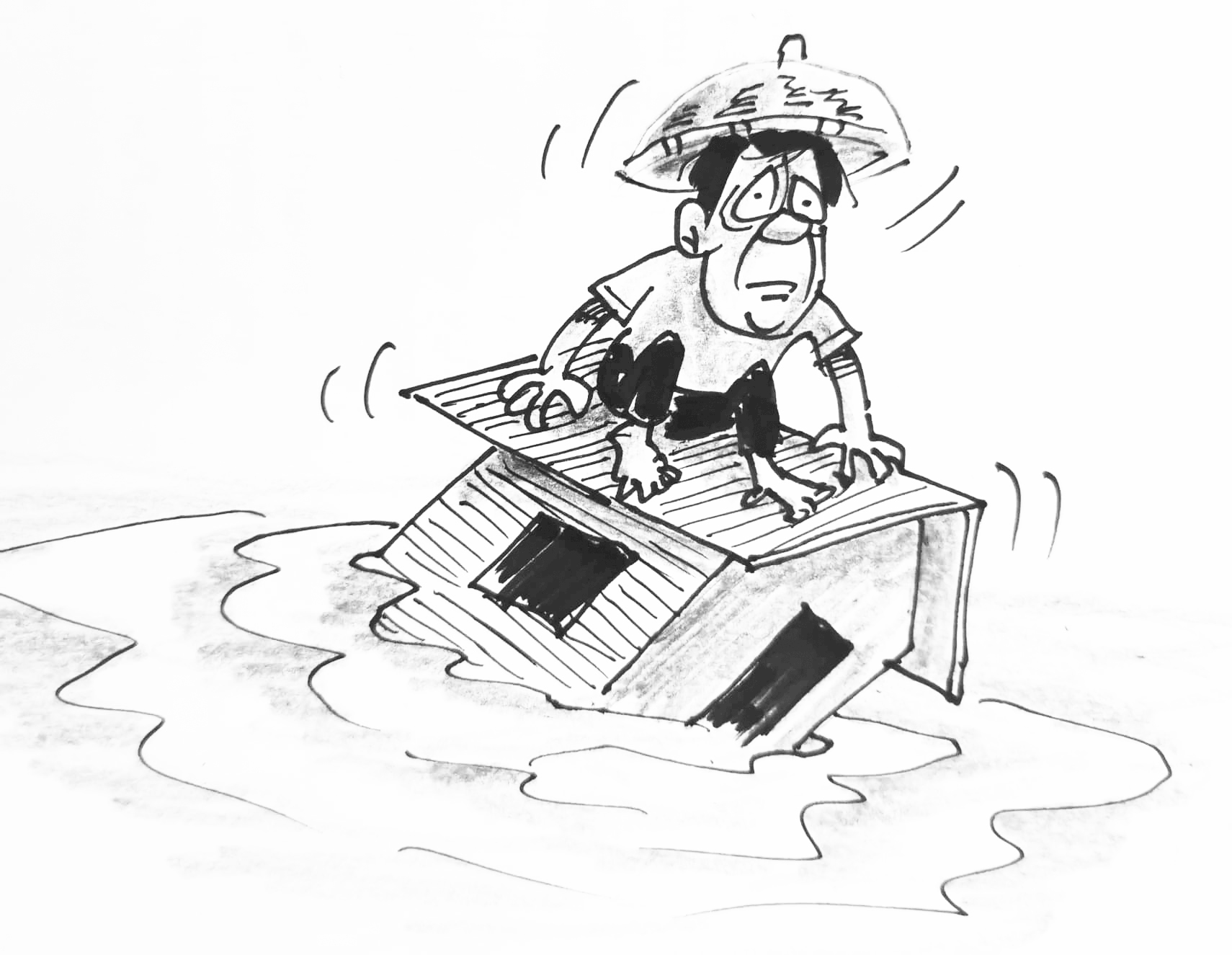
Weather experts have predicted that before the month of November ends, there will be two more typhoons that will enter the Philippine area of responsibility. We just hope and pray that these storms will not hit our islands otherwise they will again cause damage to lives and properties.
Gone are the days when our people were just affected by solid winds every time there were typhoons. What they would experience for damages were mostly plucked-off roofs and uprooted fruit trees. At least, destructions caused by winds were easier to repair.
Nowadays, however, the onslaught of typhoons could also mean severe flooding, mudslides, storm surge, and many other catastrophic effects.
If we will notice that each of these rather new consequences accompanying typhoons is caused by man’s doings. For instance, the mudslides in many areas when storms come are obviously caused by the lack or absence of huge trees that used to occupy those areas but are now gone due to the rampant cutting of those trees. Without their big roots firmly holding the soil, the latter easily move when soaked in rainwater.
Flooding also results from not having big trees in flood-prone areas. Those trees naturally siphon plenty of water into their systems. Without those trees to do that, water quickly rises in low-lying areas, causing floods when the rains come. Strom surges, moreover, run deep inland since seawater levels had already gone high due to global warming, which in turn was caused by impaired environments.
It’s no wonder why typhoons now have become rather scary, though we have been accustomed to their visits since time immemorial. They had gone from being natural calamities to unnatural phenomena that bring with them devastating effects.