
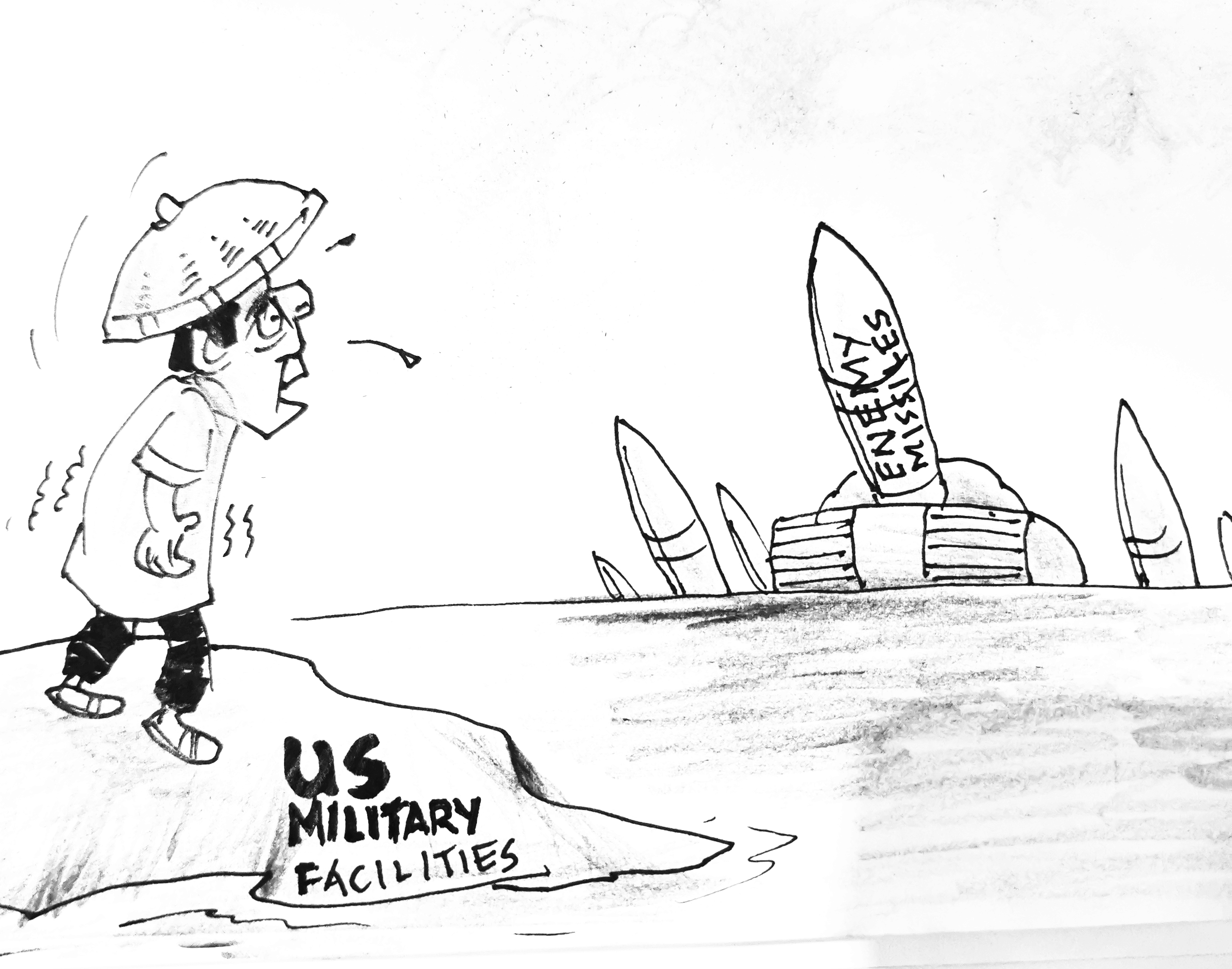
If not for the Chinese bullying and militaristic approach to resolving the West Philippine Sea maritime disputes, the presence of American military bases and troops in the Philippines is good as useless. But the government allows it primarily because of the Chinese threat; so that, should the tensions escalate into an armed confrontation over the disputed waters, the country would have a strong ally to count on.
Generally, this is how most Filipinos regard the presence of US forces in the archipelago—more of a ‘savior’ to whom we should be endlessly indebted. As such, we become overly accommodating to Uncle Sam, tolerant of their occasional ‘abuses’, and quick to meet their demands. Again, we need not behave this way had China been depriving them of a justifying reason, were it not for an impending armed conflict that we cannot handle on our own. We can therefore blame China that we are compelled to act this way.
Are the US troops really here to protect us should war erupt? Is it really the reason why they are here? Historically, and based on how the United States operates in various places, the answer is no. They are here to protect their interests, not us. They are just good at making their presence appear messianic, and at making us repay for this ‘indebtedness’; but the truth is, they don’t care for us at all and are just using us in whatever possible manner.
In countries where they maintain military bases and facilities, they pay massive amounts of money for rent, but in the Philippines, no way—they stay for free. What’s the difference? Because those countries are beholden to them as well? It’s not that. They just can’t fool those people and do away with their rental obligation. That’s why they have to pay. They are more respectful to those people than they are to us.
In the event of war, what benefits shall we get for having US troops on our soil? Our country will surely be targeted by enemy missiles and bombardment attacks, especially in the areas where US military facilities are located. We will become the venue of their war while our lives and properties are being reduced to ashes. But in terms of protection that US forces can provide, that’s a remote possibility. More likely, it’s just a pigment in our imagination.


Worst road to a subdivision
One may probably think that in subdivisions, life is satisfactorily comfortable due to the amenities enjoyed by the homeowners there, more so that the residents are expectedly well off compared to squatters living in illegal settlements.
Since subdivision blueprints require approval prior to actual construction, comfortable living is indeed ensured. Parts of this could be proper arrangements of housing units, spacious roads, excellent drainage systems, good power and water supplies, safety from both man-made and natural calamities, and many more. In fact, in the case of some subdivisions, the entrance alone is already suggestive of elegance, adorned with ornamental plants and impressive landscape, hence truly inviting to newcomers.
All these are the opposites of what can be seen in a certain subdivision here, in Tacloban City. Named St. Anthony Subdivision, this housing village has perhaps the worst road entrance/exit in the entire region or country among subdivision categories. It is located in Brgy. 87, Manlurip-San Jose, an ironically booming place for business and industry.
Two small roads branch out from the highway leading to this subdivision, separated by about 50-meter distance. One is a shortcut to the village; the other one snakes across residential units. They are too small they cannot accommodate two cars that encounter along the way. One car must have its one side out of the road and let the other one pass first so they can successfully push through in their opposite directions.
Aside from being narrow, these roads now are badly damaged. In fact, the short-cut one is not concreted; it’s just a dirt road, hence slippery during rainy days. The big rocks protruding from the surface are causing people a bumpy ride to and from the subdivision. The other one used to be a cemented road, but due to some reasons, it is now pulverized into huge and tiny cracks causing an equally rough ride.
Worse, these tiny roads are deeply submerged in flood water even after just a limited dose of rain. They are both prone to flooding, making it difficult for people to walk along them. Flooded, rough, narrow, and unpredictably risky, these roads are driving pedicab drivers away. They don’t want to get inside the subdivision anymore for fear that their tires might be deformed especially when the passenger’s luggage is heavy. If they must get inside, they charge the passengers so highly, making the transportation there very expensive.
One may wonder: why is the city government not addressing this problem there? Is it because the people there are identified with other politicians? Is it because the village is not vote-rich? Is it to punish someone there due to an old offense? Or is it due to sheer neglect and irresponsibility on the part of the city, knowing that this place is very much part and parcel of the city of Tacloban. What a shame to visitors from other places that in a highly-urbanized city, there are still Jurassic roads such as these.