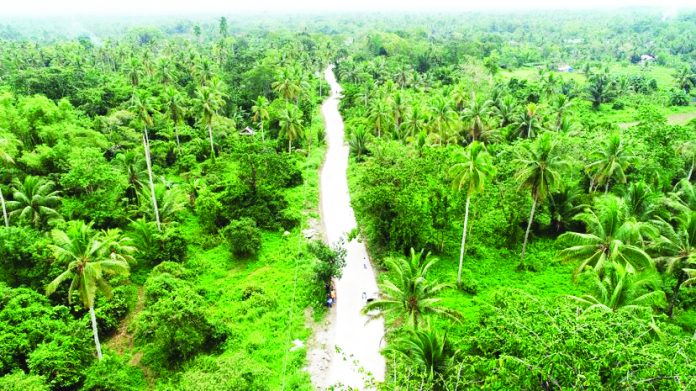
TACLOBAN CITY– Aiming to give a better service road for the residents of Barangay Anibong in Jaro town, the Department of Public Works and Highways (DPWH) constructed a road to provide them a quick access leading to Barangay Hibucawan along the Palo-Carigara-Ormoc (PCO) road.
Leo Edward Oppura, the district engineer of the Leyte Second District Engineering Office, mentioned that the project costs P9.78 million and was able to concrete 1.32 lane kilometers with provisions of application of reflectorized thermoplastic pavement markings to ensure the safety of motorists, especially at night.
Residents are now benefiting from the newly constructed road, they are now able to travel worry-free, and travel time and costs are lower, thus providing them with more opportunities.
Likewise, local traders will no longer endure the poor road network that restricts their economic activity. (LIZBETH ANN A. ABELLA)
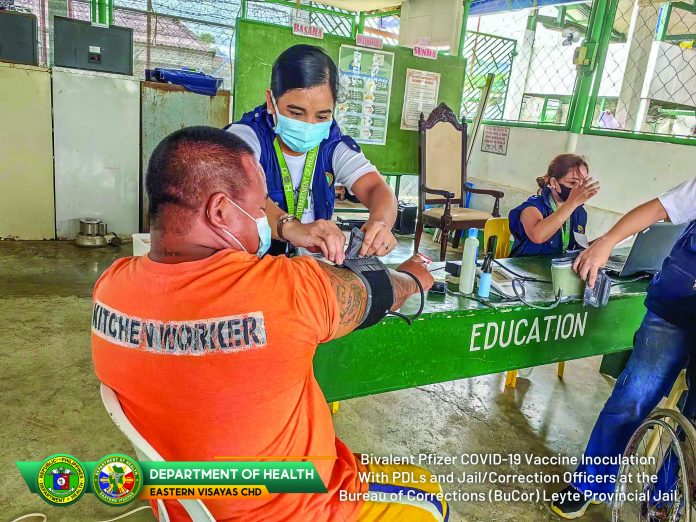
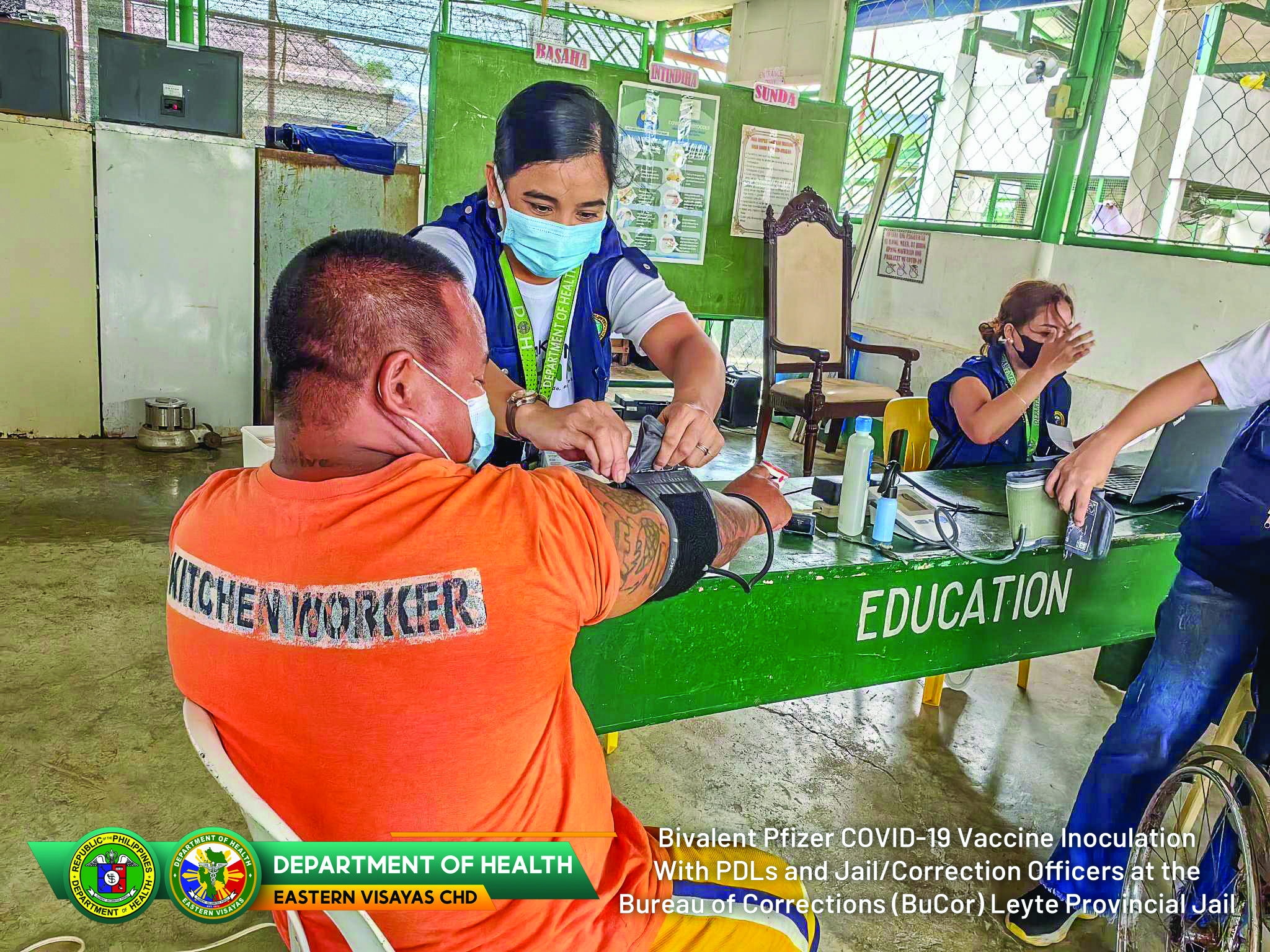
COVID-19 BOOSTER SHOT. The Department of Health(DOH) in Eastern Visayas continue its campaign against the coronavirus disease(COVID-19) as it visited the Leyte Regional Prison in Abuyog, Leyte on Tuesday(August 15) to give booster shots to 154 persons deprived of liberty. The ‘closed setting’ or facility-based inoculation is part of the ongoing bivalent Pfizer COVID-19 vaccine distribution by the national government to update the protection of various at-risk population like the PDLs. (DOH-Eastern Visayas)
COVID-19 BOOSTER SHOT. The Department of Health(DOH) in Eastern Visayas continue its campaign against the coronavirus disease(COVID-19) as it visited the Leyte Regional Prison in Abuyog, Leyte on Tuesday(August 15) to give booster shots to 154 persons deprived of liberty. The ‘closed setting’ or facility-based inoculation is part of the ongoing bivalent Pfizer COVID-19 vaccine distribution by the national government to update the protection of various at-risk population like the PDLs. (DOH-Eastern Visayas)
Seen to end region’s ‘romance’ with poverty
TACLOBAN CITY– The National Economic Development Authority (NEDA) in Eastern Visayas unveiled on Wednesday (August 16) its six-year regional development plan with big-ticket projects identified.
These multi-billion projects are expected to uplift the economic condition of the region, home to more than 4 million people with a regional poverty incidence of 28.9 percent as of 2021.
Based on the 2023-2028 Eastern Visayas Regional Development Plan, several big-ticket projects have been identified which are seen to boost the economy of the region and in the process, benefit its poor people, in particular.
“Call it ambitious but we need to be ambitious for us to strive more and achieve the goal. We should not be contented with what we have and we should end our long-time romance with poverty. Let’s stop that,” Meylene Rosales, the NEDA regional director, said in an interview after the launching held at Summit Hotel, this city.
“Of course, we have to improve our economy for us to create more jobs, decent jobs,” she added.
During the event, government officials, including representatives of governors, pledged on their commitment to support the six-year regional development plan.
Among them was Ormoc City Mayor Lucy Torres Gomez, who is also the regional chair of the Regional Development Council.
She vowed to make the development plan and the various projects contained on it, to become a reality.
“Let us all help together (to achieve the regional development plan),” she said in her video message.
In the six-year implementation of the regional development plan, it is expected that the region’s economic growth will reach up to 8.5 percent from 6.8 percent in 2021.
Also, the number of unemployed will go down to 5.2 percent by the end of the year of implementation of the program. At present, the region has a 6.6 percent unemployment rate.
Key sectors like agriculture, tourism, and infrastructure were also provided with projects to keep up with the goal.
In the agriculture sector, the regional development plan intends to construct more farm-to-market roads with a budgetary allocation of P17.2 billion; support to farmers in terms of equipment and facilities in the amount of P7.06 billion and irrigation system with an estimate allocation of P200 million, among others.
In the field of tourism, the regional development plan eyes P3.2 billion for the improvement and upgrading of various tourism sites of the Eastern Visayas.
Meantime, the area of infrastructure, which has higher allocations, among the identified projects includes P1.5 trillion intended for the upgrading and expansion of roads and bridges.
This includes the second phase of the South Samar Coastal Road Project in Northern Samar involving an amount of P7.35 billion; the construction of a new San Juanico Bridge with a tag price of P9.17 billion; the rehabilitation of the Daniel Z. Romualdez Airport, the regional airport based in Tacloban at P4 billion; and the construction of a P200 million Eastern Visayas railway system, among others.
Rey Gozon, the assistant regional director of the Office of Civil Defense, said that they are happy that several projects have been identified in the fight against climate change and natural disasters.
This includes the construction and upgrading of evacuation centers with an amount of P1.5 billion; improvement and upgrading of waste management and sewerage system and P5.9 billion urban development and public housing projects.
“These (identified projects) will help us mitigate the impacts of natural disasters and in our campaign to be resilient. Based on our Yolanda experience, all of us started from scratch,” Gozon said, referencing on the impacts the region experienced after Eastern Visayas was pummeled by Super Typhoon Yolanda in 2013.
Meantime, Rosales said that they are hoping that these projects will be given the needed budget by the national government under Pres. Ferdinand ‘Bongbong’ Marcos, Jr.
“Actually we are also looking at that as a very good opportunity for our region. We really need champions who were really push for development and who can relate to us,” she said.
“We are banking on them because they are half-Warays,” Rosales said.
The President’s mother is former first lady Imelda Marcos whose late younger brother, Benjamin, is the father of House Speaker Romualdez who represents Leyte’s first congressional district.
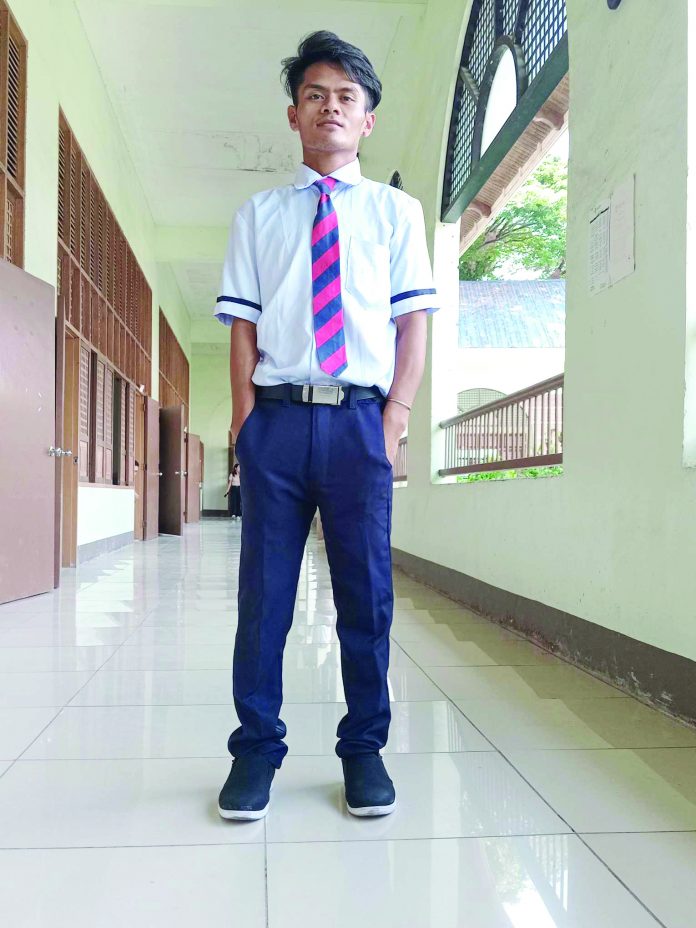
PERSEVERANCE. Aside from poverty, Jay Avila suffered a stroke due to his brain tumor. But despite this, the 22-year from Basey, Samar is determined to finish his studies and achieve his dream to become a teacher. (JAY AVILA)
Aside from health problem, Avila has to contend poverty
PERSEVERANCE. Aside from poverty, Jay Avila suffered a stroke due to his brain tumor. But despite this, the 22-year from Basey, Samar is determined to finish his studies and achieve his dream to become a teacher. (JAY AVILA)
TACLOBAN CITY- Jay Avila, at 22 years old, is now at the doorstep of his ambition to become a teacher.
But what makes it remarkable is Avila has suffered a stroke attributed to a brain tumor detected back in 2017, when he was in his Grade 8 or second-year high school.
While he stopped his studies for a year, Avila resumed his studies in 2019. And he has to walk from their village in Bulao, Basey town in Samar province, to reach his school located in the town proper, as he has no money to take a ride.
That is an hour and 30 minutes of slow, painful walk for him, he said.
“I have to start walking at 4 or 5 am in order to reach school before 7 am,” Avila said in an online interview.
He also earned some money with his classmates paying him P20 whenever he drew them for a school assignment while some of them also volunteered to pay for some of the school contributions.
“Some of my teachers took pity on pity as they also gave me some cash,” Avila said.
The little money that he gets is used by him to buy his daily needs like meals and other personal stuff.
But despite the hardships, he was able to finish his senior high at Basey National High School on July 11 this year.
And now, he is enrolled at the Leyte Normal University, this city, taking up secondary education.
Avila’s life is a stuff worthy of a ‘teleserye.’
He was just seven years old when his mother, for no apparent reason, abandoned them, leaving behind his distraught father and five other siblings.
His father died in 2013 due to a lingering illness.
Except for his younger brother, Kent, 16, his other siblings are either in Manila or in Mindanao.
Kent lives with his paternal grandmother who resides in the same village of Bulao.
Avila, meantime, has to take shelter from his friends and even at the village chapel.
“Due to some misunderstanding with my grandmother, I have to leave my younger brother behind and chose to live somewhere else. I think I have taken shelter to at least 10 houses of my friends, and even at the church,” he said.
At present, he lives with a friend, also in Basey, whose personal life is also similar with his, Avila said.
“I am grateful for all the help that was given to me by my friends, even total strangers,” he said.
In fact, his school uniforms were given to him by his friends. His tuition fee, when he enrolled at the LNU, were also shouldered by a donor who learned of his predicament.
Another friend also promised to pay for his boarding house in the city, Avila said.
“I am forever grateful to them for helping me. I could not pay them except a promise that I will make good of my studies, finish it and become a teacher,” he said.
And once he become a teacher and with enough income, he vowed to pay it forward by helping others who need assistance just like him, Avila said.
“And I won’t get tired despite of my condition. I told myself that so long I could still walk, I will continue to dream and reach my ambitions in life,” he said. (JOEY A. GABIETA)
TACLOBAN CITY– Four alleged members of the New People’s Army (NPA) surrendered to Army authorities in Northern Samar which resulted also in the recovery of several firearms.
Based on the statement issued by the 8th Infantry Division based in Catbalogan City, Samar, the four rebels decided to return to the folds of the law due to the ‘peace engagements’ made by the Army with the help of the local governments convincing them to give up their armed struggle.
The same statement disclosed that three former rebels surrendered to the 20th Infantry Battalion while the other one chose to give up to the 43rd IB on Monday (August 14).
The rebels, identified as alias Doming, 27; alias Pampam, 21; alias Gwen, 25, all belonging to the platoon 2 of front committee 15, sub-regional committee Artic of the Eastern Visayas Regional Party Committee (EVRPC) surrendered to the 20th IB which is based in Las Navas town.
The other one, alias RC and finance officer of the sub-regional unit, SRC Emporium of the EVRPC to the 43rd IB which is based in San Isidro town.
RC also led the soldiers where they buried their firearms consisting of anti-personnel mine, one M16 rifle, one improvised Caliber 22, and several magazines.
Major General Camilo Ligayo, the commanding general of the 8th Infantry Division, commended the former rebels who return to the folds of the law as he urged those still active in the underground movement to lay down their arms and join the mainstream.
“We will ensure your safety and well-being when you lay down your arms and live peacefully with your families. We assure you (that) we will work together with other stakeholders to provide the necessary assistance as you reintegrate back into the community,” he said in a statement. (ROBERT DEJON/JOEY A. GABIETA)
Globe’s cements mobile leadership, keeping revenue market share lead since Q4 2016
Globe, the undisputed leader in Mobile, has sustained its momentum, keeping revenue market share (RMS) leadership since the fourth quarter of 2016. This supremacy in the industry was delivered on the back of the strong performance of its prepaid brands, which continued to make headway against competition.
Since taking over mobile market leadership from the incumbent nearly seven years ago, Globe has never looked back and in fact, has grown the margin in the last 27 quarters.
As of Q2 2023, Globe sustained its Mobile RMS leadership, ending the quarter at 54.6%, its highest RMS level as well as the largest margin against its competitor, since the pandemic. This was driven by the recovery of mobile revenues, as the demand for mobile data returned, in step with the reopening of the economy. This figure also represents an increase from 54.3% posted in Q1 of this year.
“At Globe, the number of customers we have is just a by-product of our overall goal, which is to keep revenue market share leadership in the industry. This is the metric that most of our executives are measured by, including myself,” said Ernest Cu, Globe Group President and CEO.
“I believe we have kept this leadership position in the industry for quite some time already. We captured revenue leadership back in 2016, or seven years ago, and have never ceded that position since. We are confident we have the right strategies in place to defend this position in the coming years,” he added.
At no point since it first overtook competition has Globe ever slipped back. It has led all the way, as the erstwhile incumbent’s RMS never returned to the 50% level since the quarter it relinquished market leadership.
Globe also reigns supreme when it comes to subscriber count, having registered 53.727 million SIMs as of July 30, 2023, which is the end of the seven-month SIM registration and 5-day grace period. This is at least 1.2 million higher than its nearest competitor and accounts for 99% of its active subscriber base.
“Globe’s mobile leadership is indisputable on all fronts, from revenue market share to subscriber count. We have sustained our supremacy over the last seven years, through the pandemic and the SIM registration process, because of our inclusive and life-enabling Mobile services, first-to-market innovations, and our ecosystem of digital solutions that bring unbeatable value to our connectivity offers. This is true, holistic Mobile leadership that only Globe can deliver,” said Darius Delgado, Head of Globe’s Consumer Mobile Business.
Globe has been at the forefront of providing market-leading Mobile offers loaded with services beyond connectivity. From traditional call, text and data, Globe’s Prepaid and Postpaid plans also come with lifestyle vouchers and streaming offers.
Globe also offers a fully-digital experience for customers through the GlobeOne app, where they can access the latest promos, buy load, redeem Globe Rewards and get service support. (PR)
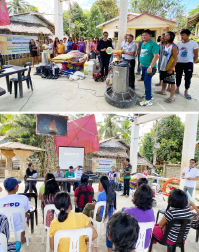
The Calanyugan Farmers Association (CFA) in Pagasanghan, Samar receives from the Department of Agrarian Reform (DAR) P465,000 worth of farm equipment, farm inputs, piglets and feeds for their livelihood activities.
(DAR Samar)
PAGSANGHAN, Samar – Some P465,000 worth of assistance were formally turned over on Monday, August 7 this year by the Department of Agrarian Reform (DAR) Samar Provincial Office to an Agrarian Reform Beneficiaries Organization (ARBO) in this town.
The Calanyugan Farmers Association (CFA) in Pagasanghan, Samar receives from the Department of Agrarian Reform (DAR) P465,000 worth of farm equipment, farm inputs, piglets and feeds for their livelihood activities. (DAR Samar)
Program Beneficiaries Development Division (PBDD) chief, Thelma Alfaro, led in the turnover of common service facilities (CSFs), farm inputs, piglets, and feeds to the Calanyugan Farmers Association (CFA).
Alfaro disclosed that the assistance provided to CFA included six piglets, starter feeds, pellet feeds, vitamins, dewormer, cylindric automatic pig feeder, seeds, vermicast, seedling tray, pruning shears, watering can, rake, shovel, wheel barrow, farming boots, net mesh, white drum, water pump, suction hose for water pump, discharge hose for water pump, nylon twine, tire wire, knapsack sprayer, and grass cutter for the ARBO’s livelihood activities.
She further disclosed that the above-mentioned CSFs, farm inputs, piglets, and feeds were funded under the Sustainable Livelihood Support to Disaster Affected Areas Project of the Climate Resilient Farm Productivity Support (CRFPS) Program.
In response, CFA Chairman Felipe Magbutay expressed gratitude, in behalf of the association, to DAR Officials for the assistance extended to them.
According to him, these will bring a positive impact to their organization.
Meanwhile, Alfaro stressed to the members of the CFA that Provincial Agrarian Reform Program Officer II (PARPO II) Alfonso Catorce and Magbutay will sign a trust agreement stipulating both parties’ responsibilities.
In the said document, according to Alfaro, the association is warned that if the farm machineries and equipment are not utilized and maintained in good condition within the next six months, DAR will pull them out and transfer to another ARBO.
But, if the farm machineries and equipment are used and well maintained, DAR will execute a Deed of Donation to CFA, Alfaro added.
On the same occasion, Alfaro, accompanied by Municipal Agrarian Reform Program Officer (MARPO) Julian Panoy, Development Facilitator (DF) Virgil Geradila and CRFPS point person Irene Lazarra conducted an ocular inspection to the CFA’s communal vegetable garden and piggery. (SARAH ALVAREZ/PR)