
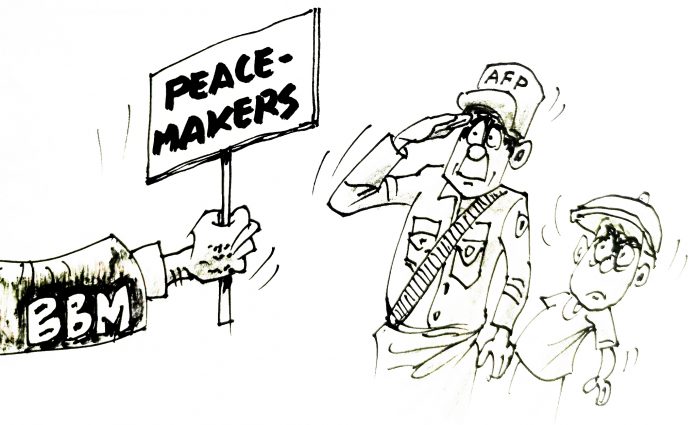
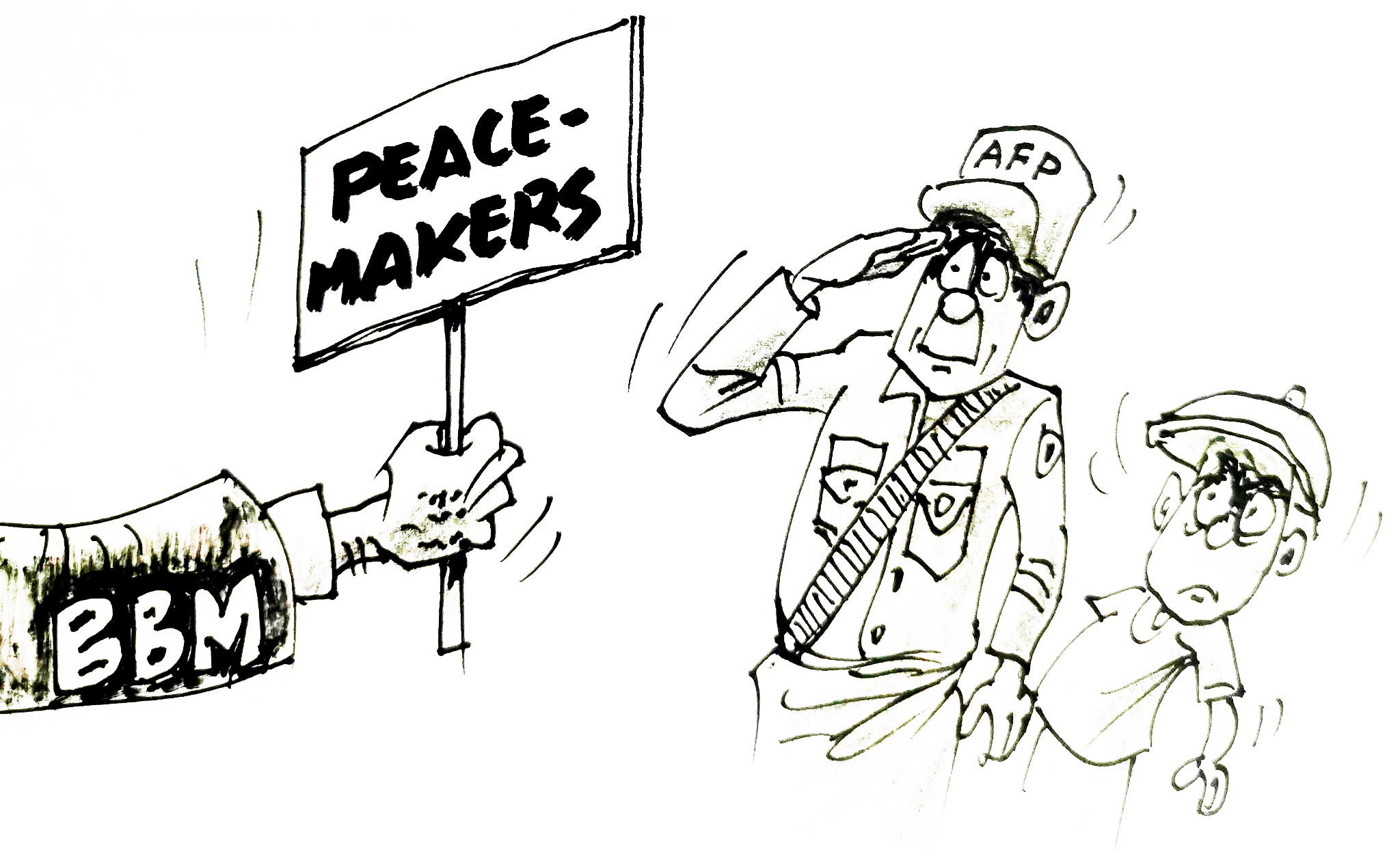
The recent order of President Ferdinand “Bongbong” Marcos Jr. for the military to be “peacemakers” in dealing with communist rebels somehow confuses some concerned citizens, hence the need for clarification on what he really means.
Surely, there is nothing wrong with offering the rebels “life after their life as rebels”. The previous administration has done that, with those hundreds and thousands of communist rebels and supporters that returned to the folds of the law and were given cash and other assistance for them to start a new life.
It’s not quite clear what the president means by the military having to act now as “peacemakers”. Is he going to allow the revival of peace talks? For sure, communist groups and organizations would welcome it. They have been demanding it since former President Rodrigo Duterte abolished it accordingly for lack of sincerity on the part of the rebels who were just exploiting the peace talks to strengthen their armed struggle.
On the part of peace and law-abiding, pro-democratic citizens, however, such a declaration is worrisome as it implies that the military would again be soft and tolerant in dealing with the rebels like they did during the reign of the liberals. In that case, the insurgency would regain everything it had lost, or even grow stronger in the future. That would also mean losses of what we have gained in these decades of armed conflict.
Understandably, the president is just being conciliatory to the enemies of the state. But the problem is, such a gesture may just work to the advantage of rebels, whose ultimate aim is to overthrow the democratic form of government. More likely, they will merely take advantage of it, to the government’s loss. Yes, we offer our arms to welcome those who return to the folds of the law, but those who don’t should be dealt with militarily, armed as they are.



Redundant tendency
Mentally and linguistically, Filipinos by nature are redundant. They keep on repeating something that they have already expressed. It seems not enough for them to say a thing once; they still repeat it. The listeners, too, exhibit a similar tendency. Hearing a thing just once is not enough; they want it repeated, sometimes again and again.
Generally, that’s the tendency of Filipinos based on my observation, having already traveled to different parts of the country. But specifically, I found the Warays to be the most redundant based on my decades of observation as a Waray myself. I can mention some expressions, and some instances, that exemplify the redundant bent of the people here—that’s in Samar and Leyte.
As a teacher, I would sometimes give quizzes, and instruct my students on what to do. I would ask them to close their notes, put their cellphones in their bags or pockets, and then clear their desk arms to deprive them of chances to cheat, which is a common practice among students during quizzes and major examinations. And then finally, I would ask them to get a ¼ sheet of yellow paper.
“Sir, ¼?”, they would ask. I just told them to get ¼, but they still ask what paper size it is.
“Sir, yellow paper?” I just told them to use yellow paper, but they still ask what paper to use. In short, they want to have my instruction repeated. Why? Is it because they did not hear or understand it? I doubt so. Are they joking? No, they are usually serious. It’s just that, by nature, they practice redundancy in speaking and listening.
Wait, in writing, too. Yes. Most of my students’ write-ups through my decades of teaching would usually include repetitious ideas. They would state something, for instance, but they still repeat the idea by stating it again using words or phrases like “or”, “in other words”, “and”, etc. Clearly, they are not content with just one utterance. They want it repeated, either for emphasis, clarity, or whatever. I bet it’s a matter of nature.
Notice how the Warays would ask people around, including children who eventually pick up and absorb their redundancy: Tika-in ka, tika-in? Hino ‘tim ngaran, hino? Nag-aano ka, nag-aano? Hino ‘tim upod, hino? Ano ‘tim dara, ano? If we translate these to English, we will have: Where are you going, where are? Who is your name, who is? What are you doing, what are? Who is your companion, who is? What did you bring, what did? Hahahaha!
Seriously, our redundancy is not just obvious, it is too glaring! For sure it’s not right, it’s precisely erroneous. And as such, it should be avoided and stopped once and for all. I hope no one would ask me and say:
“Can you repeat again for the second twice?”