KAUSWAGAN CARAVAN. Northern Samar Governor Edwin Ongchuan led the whole-day caravan in Gamay town on Nov.17, benefitting 1,500 families from its 10 villages.(PETER PAREDES)
In Northern Samar
KAUSWAGAN CARAVAN. Northern Samar Governor Edwin Ongchuan led the whole-day caravan in Gamay town on Nov.17, benefitting 1,500 families from its 10 villages.(PETER PAREDES)
GAMAY, Northern Samar– Despite the intermittent weather being experienced by the province due to a low-pressure area, Governor Edwin Ongchuan led in conducting the ‘Kauswagan Caravan’ in this town on November 17.
The caravan brings various services and programs to the different remote barangays across the province.
During its caravan in this town, residents of the villages of Bangon, Bonifacio, Rizal, Luneta, Malidong, Bato, Guibawangan, Lonoy, GM Osias, and Cade-an, serving 1, 500 families in all.
Among the services offered during the whole-day caravan, a brainchild of Gov. Ongchuan, were medical and dental services; circumcision; haircut; and free legal services.
Different line agencies like the Department of Agrarian Reform, Land Transportation Office, and the Philippine National Police also offered their services to the villagers.
Free seedlings were also offered by the Provincial Agriculture Office.
The villagers also received vitamins, slippers, and even umbrellas during the caravan. Children also received foods supplied by famous food chains.
Baltazar Drio, village councilor of Bato, said that they were happy that the provincial government visited their area and benefitted from the services offered by the Kauswagan Caravan.
“We are overjoyed that this caravan reached our village. This is a big help for us residing in remote areas like having free medical services from our provincial government,” he said.
He also said that it was the first time to see in person Gov. Ongchuan whom he described to be ‘young.’ (PETER PAREDES)
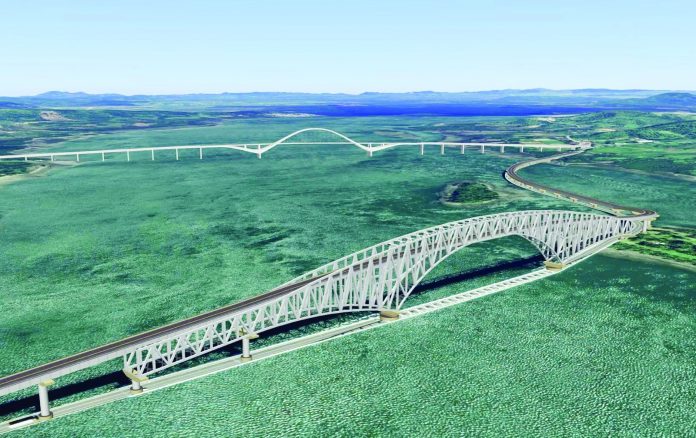
SAN JUANICO BRIDGE 11. The Department of Public Works and Highways together with Japan International Cooperation Agency starts the work for the construction of the San Juanico Bridge II project that will serve as an alternate route to the current San Juanico Bridge. The new bridge, with its perspective shown in the photo, will connect Leyte from Babatngon side to Samar, via Sta. Rita. (Photo Courtesy)
SAN JUANICO BRIDGE 11. The Department of Public Works and Highways together with Japan International Cooperation Agency starts the work for the construction of the San Juanico Bridge II project that will serve as an alternate route to the current San Juanico Bridge. The new bridge, with its perspective shown in the photo, will connect Leyte from Babatngon side to Samar, via Sta. Rita. (Photo Courtesy)
TACLOBAN CITY – The engineering experts from Japan International Cooperation Agency (JICA) conducted an on-site inspection on the proposed site for the construction of the second San Juanico Bridge, the regional office of the Department of Public Works and Highways (DWPH) said in a statement.
Last November 17, the group conducted an on-site visit.
The group started its first on bridge route options. They are again to conduct a similar on-site visit next year.
The proposed site for the construction of the second San Juanico Bridge is located in Tacloban and Babatngon, on the Leyte side, going to Santa Rita in Samar province.
The 2nd San Juanico Bridge Project aims to provide an alternative link between Samar and Leyte and decongest the iconic San Juanico Bridge which is now 50 years old.
Prior to the on-site visit, the DPWH officials led by Senior Undersecretary Emil Sadain had a meeting with JICA officials led by its Southeast Asia Division 5 Director Takehihiro Kido and his senior representative in the country, Fukui Keisuke, among others.
Critical issues that were discussed include the coverage of the feasibility study which will be conducted by the JICA Study Team in coordination with the DPWH route selection, number of lanes, and traffic operation options for the 2nd San Juanico Bridge, including the rehabilitation of the existing San Juanico Bridge, according to the DPWH statement.
They also discussed concerns on the environmental coverage of the study were also discussed, as well as the inclusion of the future operation and maintenance of the bridge.
It was also requested to the JICA during the meeting to consider the design that would complement future road projects in the Eastern Visayas Region, including the proposed rehabilitation of Daang Maharlika in Samar to be funded by the Asian Development Bank (ADB), and the Samar Pacific Coastal Road Phase II under the Economic Development Cooperation Fund (EDCF) of the Government of Korea.
“This project will bring so much development economically to my town, particularly at the village where it is going to be constructed because it means jobs for the people, and investors may put up businesses along that area,” Babatngon Mayor Leny Lugnasin said when asked for her reaction over the proposed construction of the new bridge that will connect Leyte Island to Samar Island.
She added that this will also mean shorter travel time for travelers and motorists especially those who comes from or going to Ormoc or Samar province.
“In disaster response, this proposed new bridge as an additional route will contribute a lot because it will allow the efficient flow of transportation and relief distribution to areas affected by calamities and disaster,” the town mayor added. (ROEL T. AMAZONA)
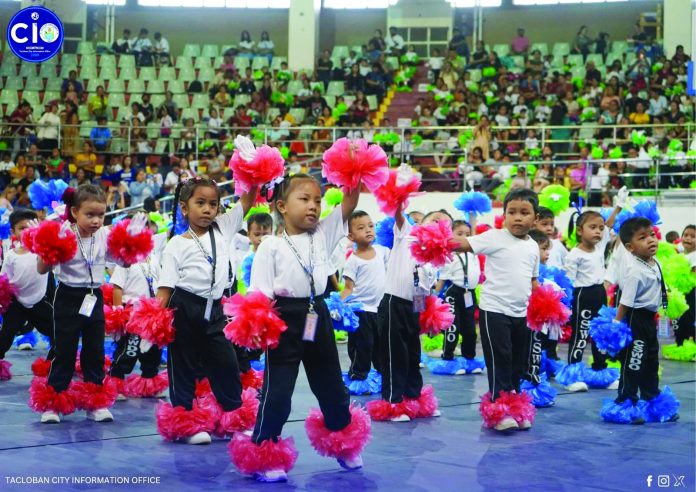
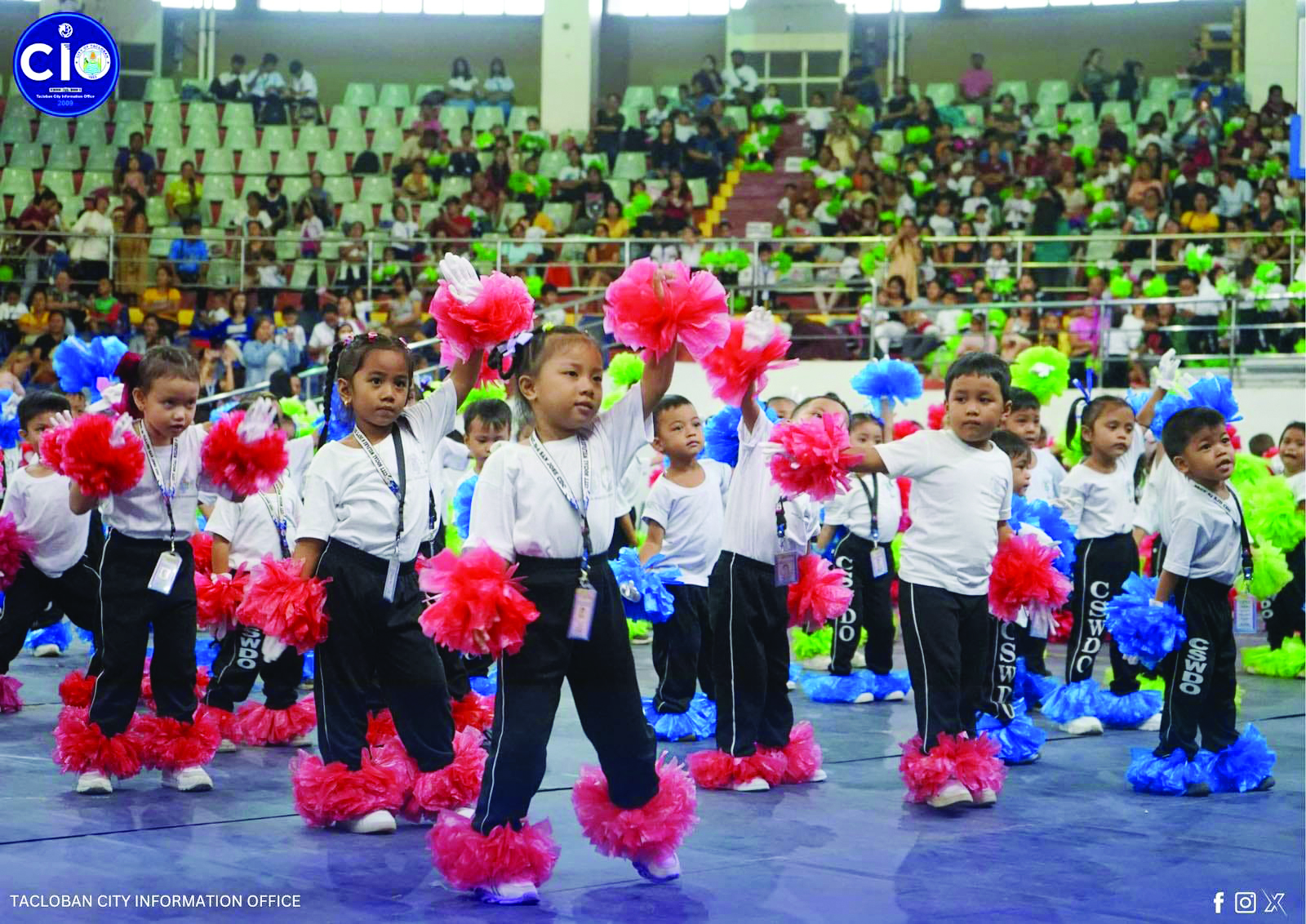
CHILDREN’S MONTH. Children enrolled at various day care centers in Tacloban City displayed their talents during a playground demonstration, one of the highlights of the 31st National Children’s Month celebration held on Thursday (Nov.16). Councilor Aurora Aimee Delgado-Grafil, representing Mayor Alfred Romualdez, announced the different programs of the city government in promoting early childhood education during the program.
(TACLOBAN CITY INFORMATION OFFICE)
Kasambahays also get increase
CHILDREN’S MONTH. Children enrolled at various day care centers in Tacloban City displayed their talents during a playground demonstration, one of the highlights of the 31st National Children’s Month celebration held on Thursday (Nov.16). Councilor Aurora Aimee Delgado-Grafil, representing Mayor Alfred Romualdez, announced the different programs of the city government in promoting early childhood education during the program. (TACLOBAN CITY INFORMATION OFFICE)
TACLOBAN CITY– The more than 2.15 million workers from the private sector in the region will have an additional P30 for their daily wage, before the end of this month.
This was after the Regional Tripartite Wages and Productivity Board (RTWPB) approved Wage Order 23 on November 6 of this year.
The same body also approved a P500 increase for the ‘kasambahays’ or domestic helpers’ current monthly wage as contained under Wage Order 04.
Based on the new wage order, non-agriculture workers in the region will now receive P405 for their new daily wage.
The current daily wage among those in the non-agriculture sector is P375.
However, for establishments in the cottage and handicraft industry that have less than 10 workers, the RTWPB-8 pegged their daily wage at P375 from the current P345.
Meantime, for those who are in the agriculture sector, the daily wage is adjusted to P375 from the current P345.
The wage body in the region also approved to increase in the monthly pay of the domestic helpers from the current P5,000 to P5,500 for those working in the cities and first-class towns.
While it is P5,000 for those in other municipalities belonging to the second to fifth-class economic categories.
The current monthly pay in these categories for kasambahays is P4,500.
The new wage order will take effect 15 days after its publication of a regional newspaper or on November 30.
The last time the RTWPB in the region approved wage adjustment was contained under Wage Order 22 issued on June 27, 2022.
The wage body, in adjusting the current daily wage among workers in the private sector, cited the increase of goods and services in the region from 115.5 percent in June, 2022 to 122.2 in September of this year.
And while the average inflation rate of the region declined from 6.8% in June of last year to 4.9% in September of this year, the poverty threshold for a family of five persons increased to 7.4 percent in 2018 to the current P11,187.
The decrease in the purchasing power of the peso, from P0.87 in June of last year to P0.82 in September of this year, was another factor considered for the wage adjustment.
The RTWPB, which initiated the move on its own or motu proprio, conducted several consultative meetings beginning on August 24, 2023 in Maasin City, Southern Leyte, and ended on October 9 in Tacloban City.
“After due consideration of the results of the consultations and public hearing, and a thorough review and evaluation of the existing socio-economic conditions in the region, the board unanimously agreed to adjust the prevailing daily wage rates of workers/employees in the region to enable them to cope with the rising cost of living without impairing the viability of business and industry,” the board said.
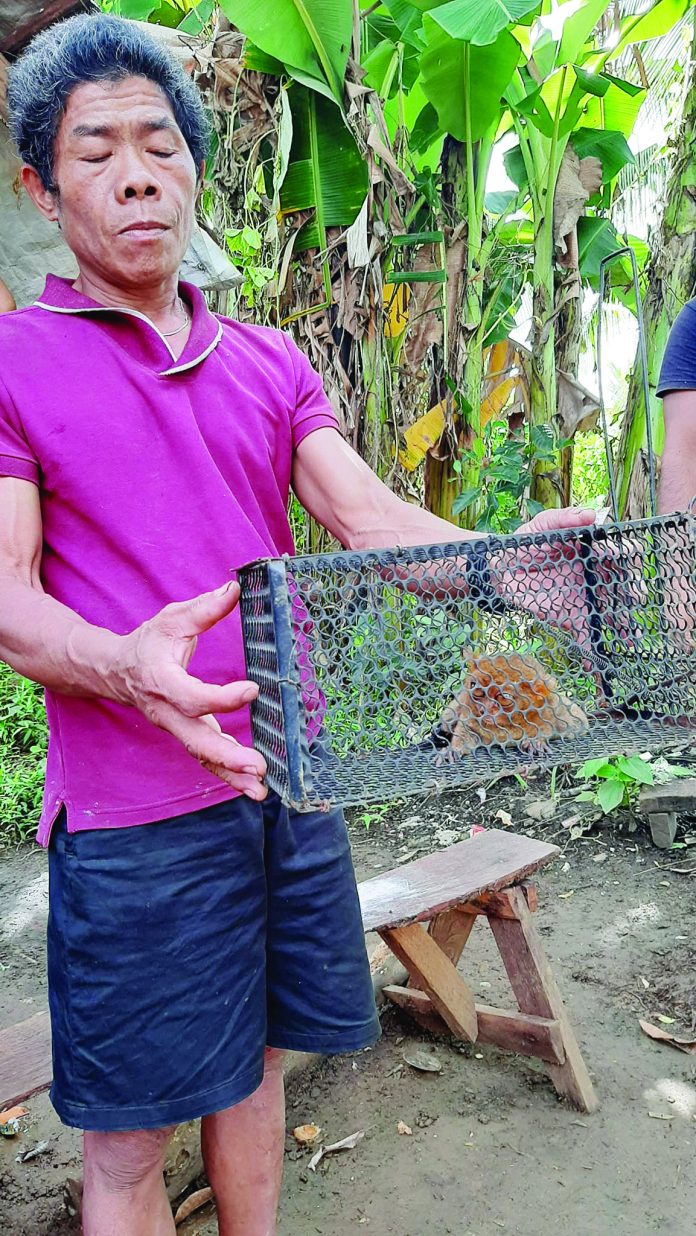
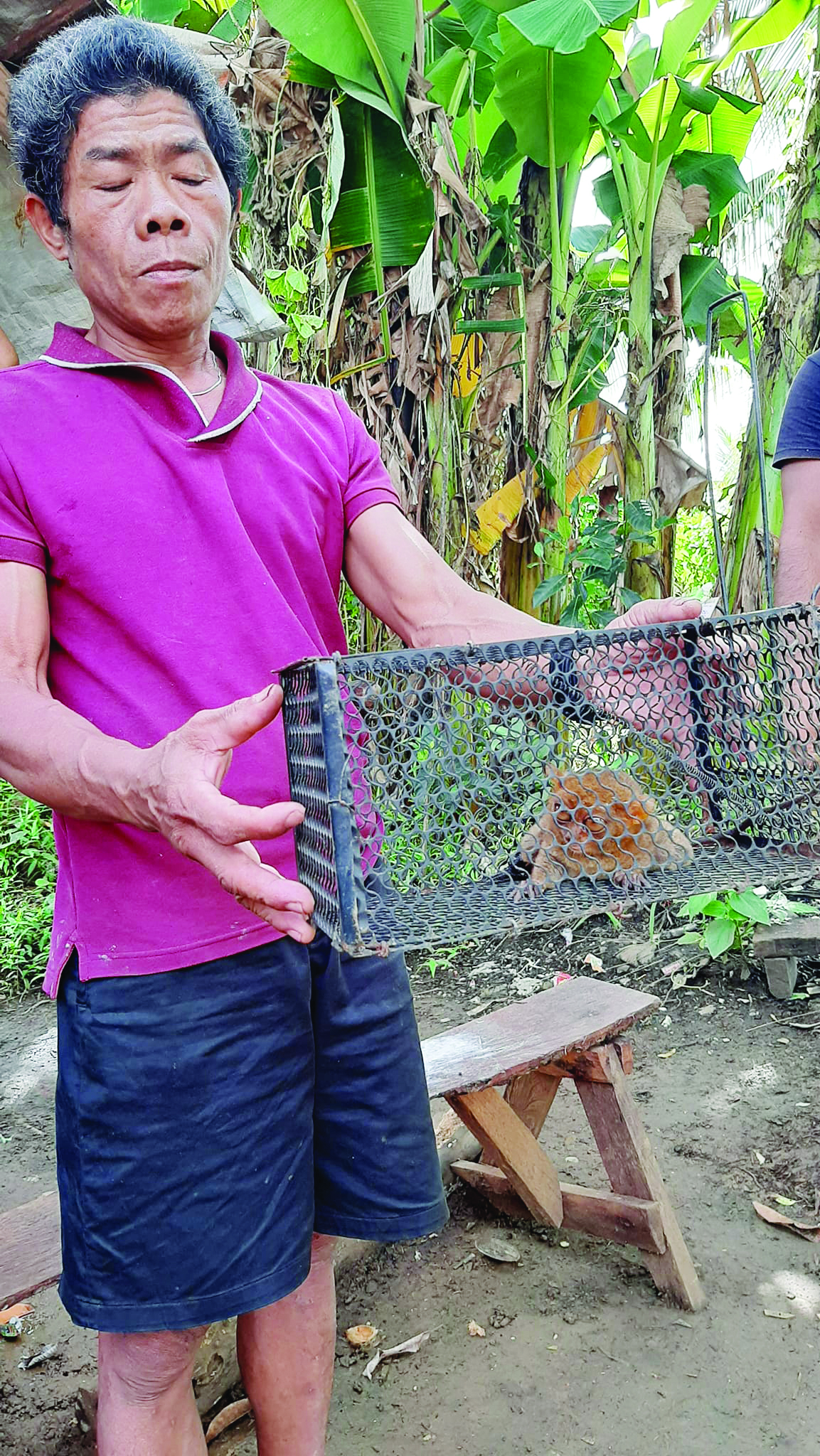
Florencio Caandoy holds a cage where the tarsier he caught was placed. The farmer from Quinapondan, Eastern Samar voluntarily surrendered the primate to the local government which, in turn, gave to the DENR regional office. Photo taken on Nov. 13. (USWAG QUINAPONDAN)
TACLOBAN CITY – A Philippine tarsier locally known as “mago” was caught in Quinapondan town in Eastern Samar province by a farmer last Monday (Nov.13).
Florencio Caandoy holds a cage where the tarsier he caught was placed. The farmer from Quinapondan, Eastern Samar voluntarily surrendered the primate to the local government which, in turn, gave to the DENR regional office. Photo taken on Nov. 13. (USWAG QUINAPONDAN)
The tarsier was caught by Florencio Caandoy while he was collecting firewood in Barangay Palactad who immediately informed their office, Engr. Felix John Bianes, head of the municipal environment and natural resources, said.
Bianes said that this was not the first time that a tarsier was seen in the village as there were sightings of the said primate in the past.
Bianes then informed the regional office of the Department of Environment and Natural Resources (DENR) based in Tacloban City which dispatched a team to the town to look into the discovery of the tarsier.
The DENR personnel conducted an interview with Caandoy as they informed him that keeping a tarsier is illegal and punishable.
Caandoy, however, said that he had no intention to keep it to himself the said animal which was released back to the forest.
The DENR in the region has reiterated its appeal to the public not to keep any wildlife like the tarsier saying it’s punishable under RA 9147(Wildlife Resources Conservation and Protection Act)
Violators face imprisonment of up to four years and a fine of up to P300,000.
Earlier this week, a Philippine tarsier (tarsius syrichta) was seen and photographed in Almeria town in Biliran province.
The town’s information office said that the tarsier was seen on Nov. 11 in the forested area of Sitio Palayan, Brgy Caucab.
Last year, a sighting of tarsiers was documented in Tacloban City during the night survey conducted University of the Philippines Tacloban in Brgy. Sta Elena.
Tarsier is a primate that is endemic to the Philippines and commonly found particularly in the islands of Bohol, Samar, and Leyte, including Biliran and Maripipi islands.
Nocturnal in nature, its main diet includes insects like grasshoppers, crickets, spiders, small vertebrates such as small lizards and birds.
The Philippine tarsier is considered to be one of the smallest primates in the work whose ranges from 118 to 149 millimeters while its average weight is between 113 and 142 grams.(ROEL T.AMAZONA with ROBERT DEJON)
TACLOBAN CITY – The Office of Workers Welfare Administration (OWWA) in the region has awarded the regional winners for the Model OFW Family of the Year Awards (MOFYA) in a simple awarding ceremony held at Hotel de Fides in this city.
Helen Balerite from Leyte province was chosen as the regional winner for the land-based category while Rufo Demiao, Jr. of Southern Leyte was selected as winner for the sea-based category.
The two will be representing the region at the national awarding to be held next year.
Balerite worked as a nurse in Dubai then later on became a food safety quality manager of Marriot Hotel and Intercontinental Hotel, two of the popular hotels of said country after she finished studying food safety management.
This allowed her to save more which she then invested in various businesses that her family put up not only in the country but even in Dubai.
“We need to learn how to save and spend on what is essential and needed by our family,” Balerite said when asked of what advice she has to her fellow OFWs.
“No matter how high your salary is if you don’t know how to manage your finances you will end up with nothing,” Balerite said.
Demiao shares the same advice to OFWs adding that although saving is also important, having constant communication with the family is a must to ensure that their relationship will remain strong despite being separated by distance.
“Giving time to communicate and talk with your family is one of the most important aspects of keeping your family relation strong. This builds trust despite the distance that separates you from each other,” he said.
Demiao has worked as a captain on a cruise ship for over 30 years, allowing him to support the education and needs of his family.
OWWA OIC Regional Director Mary Catherine Pastor hopes that the two MOFYA regional winners will become an inspiration to fellow OFWs who are struggling to work abroad to provide support to the needs on their families.
The official has high hopes that the regional winners will eventually emerge as national winners.
Eastern Visayas has already one MOFYA national winner – ship captain Manuel Gabornes of Lawaan, Eastern Samar – who won the competition in 2012.
MOFYA is an annual search that showcases the best practices on how to nurture an OFW family despite the distance and challenges, and on how their success resonates not only in their community but in the rest of society. (ROEL T. AMAZONA)
The village of Calantiao in Bobon, Northern Samar was awarded by the Department of Science and Technology as this year’s recipient of its community empowerment through science and technology program.(PHOTO COURTESY)
The village of Calantiao in Bobon, Northern Samar was awarded by the Department of Science and Technology as this year’s recipient of its community empowerment through science and technology program.(PHOTO COURTESY)
TACLOBAN CITY – An interior village in Northern Samar will be the region’s representative for this year’s national search for a competition spearheaded by the Department of Science and Technology (DOST) under its community empowerment through science and technology (CEST) program.
The village of Calantiao in Bobon town is the regional winner of the DOST’s CEST program which aims to provide livelihood and alleviate poverty in remote communities using technology-based livelihood projects as identified by the communities.
Calantiao, which is an hour away from the town center, is also identified by the Philippine Army as a beneficiary of its community support program (CSP)being an armed conflict related to insurgency.
Nilda Sapatos, Calantiao barangay chairperson, said that they received three projects from the DOST that are now being enjoyed by her people since 2021.
These are the rice mill, water refilling station, and Starbooks, a standalone offline library with a total amount of P500,000.
The rice mill solves the woes of the farmers on the high cost of transportation to the town center where they usually spend P70 per unhusk rice to transport to the rice milling station located in the town proper.
Aside from the cost of transportation, they also need to pay P4 per kilo for every rice milled.
“Now that we already have a rice mill in our village, farmers only spend for the cost of milling which is only P3 per kilo,” Sapatos said.
The water refilling station, on the other hand, address issues pertaining to water-related health concern that affect most of their children.
Sapatos said that a common health problem related to water in the village is diarrhea.
The source of the water for their refilling station is the Level II potable water system project worth more than PP4.8 million funded under the 2021 Local Government Support Fun – Support to Barangay Development Program (LGSF-SBDP).
“Our village is thankful to the DOST for the three CEST projects that they had given us because of its great impact to the lives of our people,” Sapatos said.
The community received P10,000 cash prize for winning the CEST program.
They will be representing the region at the national search, which will be held this November 25, 2023 at the Iloilo Convention Center, Iloilo City.
Ramil Uy, DOST Eastern Visayas regional CEST coordinator, said that Calantiao was chosen to be part of the program after their central office pledged to the Office of the President to support programs and projects implemented under the National Task Force to End Local Communist Armed Conflict.
“We want to address the socio-economic issue confronted by the village so that they will no longer be influenced and give support to the left-leaning group,” he said. (ROEL T. AMAZONA)