TACLOBAN CITY-The Department of Agriculture (DA) guarantees that the food supply in the region is sufficient and there will be no price increase on food supplies.
Engr. Maria Luisa Capili, DA-8 head of the institutional development section, said that the department is ready for any threat that they may encounter due to this climate phenomenon.
“Kun magka-ano ano man, ready kita, may-ada kita reserved, amo ini hiya nga buffer stocking and provision of alternate and high value crops or — for the plants that require less water,” she said.
While Eastern Visayas experiences extreme heat, Capili is confident that the whole region would not be affected by the upcoming threat, unlike the other provinces since the region continuously experiences rain.
She also added that the department will be conducting a series of training and orientations for the employees and farmers to be totally prepared for the dry spell caused by the El Nino phenomenon.
The Philippine Atmospheric, Geophysical, and Astronomical Services Administration (Pagasa) has announced that the El Niño Southern Oscillation is expected to happen during the 3rd quarter of 2023 until the 1st quarter of 2024.
PALO, Leyte– The visit last week of the candidates for this year’s Miss Universe Philippines is a good advertisement to Leyte, thus said Governor Carlos Jericho ‘Icot’ Petilla.
The 38 candidates visited several top destinations in Leyte and Samar as part of the organization’s advocacy to help promote tourism destinations.
They were required to post on their social media accounts their experience and appreciation of every tourist destination they visited.
Among the tourist destinations they visited were the San Juanico Bridge, Sohoton Cave and Natural Bridge, the mat weaving in Sa-ob Cave, all in Basey, Samar; and Kalanggaman Island in Palompon, and the McArthur Park in Palo.
They also visited the new Leyte Capitol Building, this town, and tasted some of Leyte’s delicacies and even tried to dance the kuratsa.
“This is a good advertisement for Leyte,” Gov. Petilla said.
“I am thankful to Congresswoman Yedda for bringing the candidates here. What we did is to coordinate with them on places that they may visit,” Gov Petilla added, referring to Rep. Yedda Romualdez of Tingog party-list group which is one of the major sponsors of this year’s Miss Universe Philippines.
Petilla added that the social media posting of the candidates will is a good advertisement and will save the province a lot compared if they hire advertisement agencies to help promote Leyte.
“The province and the tourism department will have a lot of work to do in taking in tourists as a result of the visit,” Petilla added. (ROEL T. AMAZONA)
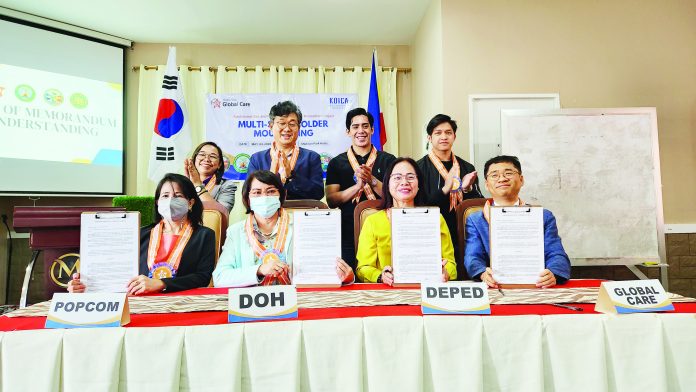
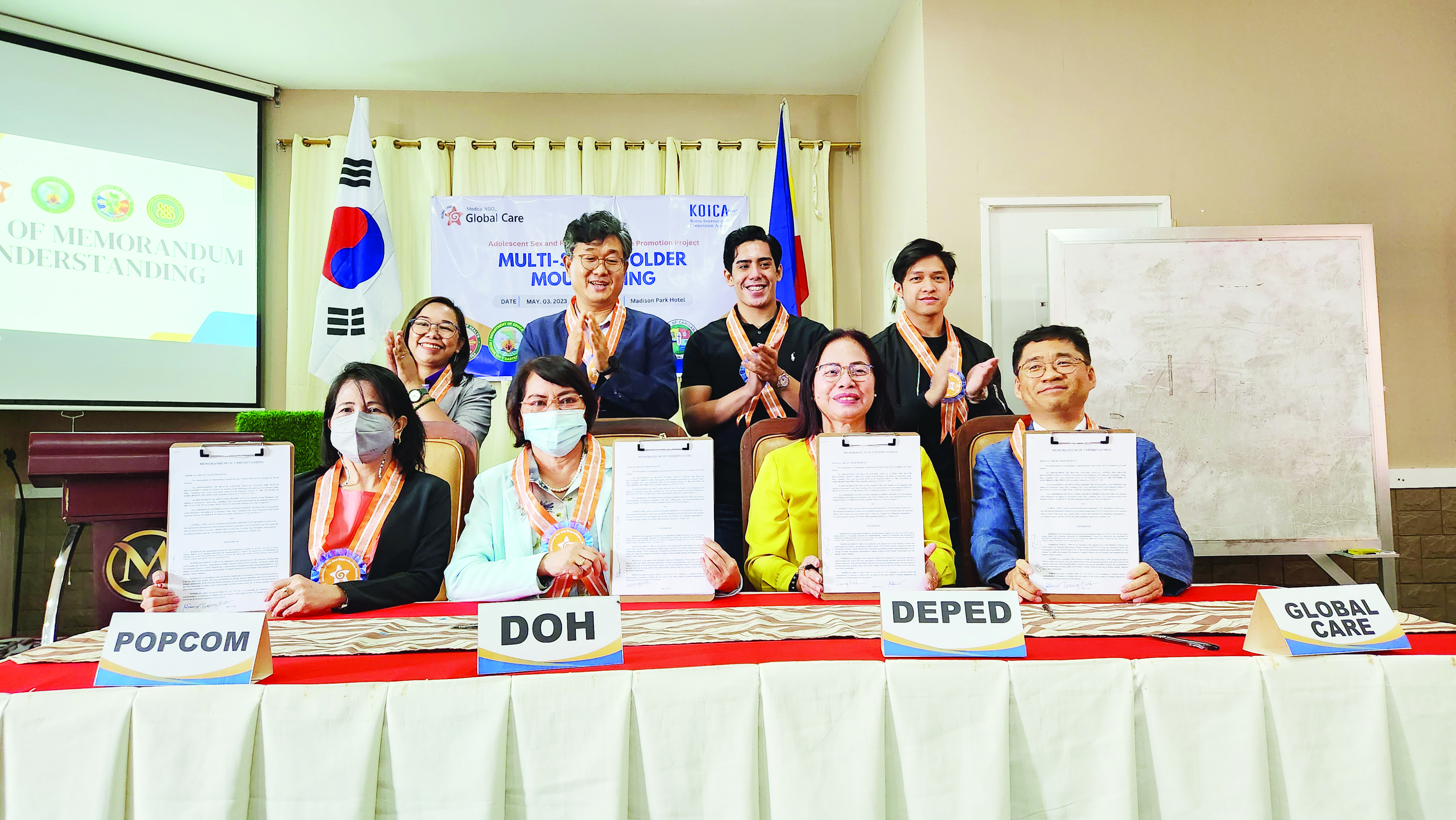
FIGHT AGAINST TEEN PREGNANCIES. A memorandum of understanding was signed by KOICA as represented by its country director Kim Eunsub and Global Care Philippines through Dr. Baek Eun Sung with the representatives of DOH, DepEd, and Popcom which aims to help address the rising teenage pregnancy problem in Leyte, targeting 3 towns as pilot areas. (Global Care Philippines)
3 Leyte towns identified as pilot areas
FIGHT AGAINST TEEN PREGNANCIES. A memorandum of understanding was signed by KOICA as represented by its country director Kim Eunsub and Global Care Philippines through Dr. Baek Eun Sung with the representatives of DOH, DepEd, and Popcom which aims to help address the rising teenage pregnancy problem in Leyte, targeting 3 towns as pilot areas. (Global Care Philippines)
TACLOBAN CITY-The Global Care together with Korea International Cooperation Agency (KOICA) signed a memorandum of understanding with several government agencies which aims to address the problem of teenage pregnancies in Leyte.
In particular, the program has identified the towns of Barugo, Carigara, and Jaro as the pilot areas of this undertaking.
A memorandum of understanding was signed by Global Care Philippines, an international development and health non-government organization, KOICA with its partners which include the Department of Health (DOH), the Department of Education (DepEd), and the Commission on Population and Development (Popcom).
Kim Eunsub, KOICA country director, and Lydia Sagong, the branch manager of Global Care Philippines, led in the signing of the agreement held last Wednesday (May 3) at the Madison Hotel, this city.
Also signing the agreement were DOH Regional Director Exuperia Sabalberino, DepEd Regional Director Evelyn Fetalvero; and Elnora Pulma, Popcom regional director.
Among those present were Jaro Mayor Jassie Tanala and Carigara Mayor Eduardo Ong, Jr. who both promised to fully support and commit on the program.
Kim, in his speech, said that the project shows that South Korea through KOICA is one with the Philippine government in solving the rising teenage pregnancy cases in the country.
He added that through this undertaking, the problem of teenage pregnancy will be given a solution and in the process, assures a bright future among teenagers, especially in the three Leyte towns.
“It is indeed my sincerest hope that this project will prosper…and promote better living standards, especially among adolescents,” he said in his speech.
Sagong, meantime, said that under the program, several measures and activities will be implemented for the next three years of the program.
She said that during the program implementation, there will be an increase on adolescent sex and reproductive health awareness in the communities or down to the barangay level; build up information networks; capacity building for teachers; training for health workers; and conduct a teen mother support, among others.
It was learned that teenage pregnancy cases in these three Leyte towns are increasing.
Just for the first quarter of the year, Barugo has recorded 18 teenage pregnancy cases; Carigara, 14; and Jaro with over 20 cases.
Regional Director Sabalberino said that she is happy that the KOICA and Global Care Philippines is helping the DOH on this campaign.
“Teenage pregnancy is not just a problem to these three Leyte towns but in the entire country and is alarming. We hope with this undertaking, we can find a solution to address this very alarming problem among our teenagers, “she said.
BEST IN NATIONAL COSTUME. The candidate of Eastern Samar for this year’s Miss Universe Philippines, Airissh Ramos, was hailed as the best in national costume held last Thursday at the HRDC amphitheater of Leyte Normal University. With her are Rep. Yedda Marie Romualdez of the Tingog party-list and Raymund Romualdez, son of Tacloban City Mayor Alfred Romualdez.
Miss Universe Philippines 2023
BEST IN NATIONAL COSTUME. The candidate of Eastern Samar for this year’s Miss Universe Philippines, Airissh Ramos, was hailed as the best in national costume held last Thursday at the HRDC amphitheater of Leyte Normal University. With her are Rep. Yedda Marie Romualdez of the Tingog party-list and Raymund Romualdez, son of Tacloban City Mayor Alfred Romualdez.
TACLOBAN CITY– The candidate from Eastern Samar won the best in national costume competition of this year’s Miss Universe Philippines held Thursday (April 4) night at the Human Resource Development Center (HRDC) amphitheater, this city.
Airissh Ramos, who is from Arteche town, wowed the judges and the crowd with her handwoven garment designed by local designer John Hubert Capito made of ‘tikug’ and ‘buri’ fibers embellished with pearls, wooden beads, and crystals made by students from a national high school in Oras, also in Eastern Samar.
In a brief interview with the local media, Ramos said that the gown she wore is her way of recognizing and giving honor to the farmers coming from her province and all its towns.
“I feel overwhelmed for winning the best in national costume. This is an ode not only to the farmers but for the entire province of Eastern Samar,” she said.
She won a cash prize of P50,000.
She also received a special award of ‘Tingog ng Kababaihan’ for the Visayas which carries a cash prize of P100,000.
Runner-ups for the best in national costume were Miss Benguet JoeMay Leo and Kimberly Escartin from Southern Leyte.
The best in national competition was hosted by actor Marco Gumabao and Gazini Ganados, Miss Universe Philippines 2019.
During their five-day visit, the 38 candidates visited tourist destinations in Palompon and Sta. Fe towns, both in Leyte; and Basey, and Marabut, both in Samar.
Among the major sponsors of this year’s Miss Universe Philippines is the Tingog party-list of House Speaker and Leyte Rep. Martin Romualdez. (ROEL T. AMAZONA with JOEY A. GABIETA)
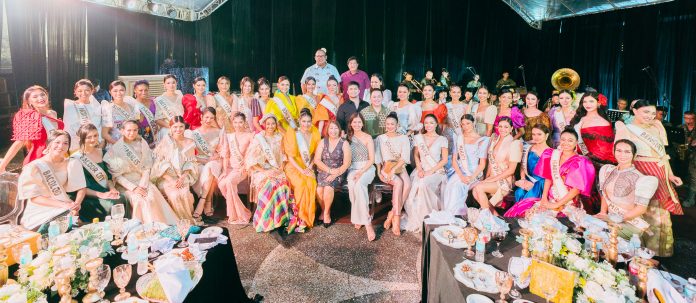
The 38 candidates for this year’s Miss Universe Philippines expressed their elation in coming to Eastern Visayas for a five-day visit as part of the promotion of the prestigious beauty pageant. Tourism Regional Director Karina Rosa Tiopes joined them on this photo.
DOT sees visit will help boost region’s tourism industry
The 38 candidates for this year’s Miss Universe Philippines expressed their elation in coming to Eastern Visayas for a five-day visit as part of the promotion of the prestigious beauty pageant. Tourism Regional Director Karina Rosa Tiopes joined them on this photo.
TACLOBAN CITY – The 38 candidates of the Miss Universe Philippines are all in awe and grateful for the warm welcome of the Waraynons.
The candidates had a five-day visit in the region as part of a segment of the competition.
They visited the town of Palompon and Sta. Fe, both in Leyte; Basey and Marabut in Samar. The best in national costume segment of the competition was held in this city Thursday (April 4) night won by the representative from Eastern Samar, Airissh Ramos.
During their visit, the candidates were not only able to personally see the tourist attractions of the places they visited but also savored the local delicacies.
“I am really honored and in behalf of all the ladies, I would like to thank you for the preparation for allowing us to experience Leyte, its culture, food, dances, and music,” Miss Agusan Del Norte Jannarie Zarzoso said.
“This will really boost our morale, and the 38 beautiful ladies will work to show to the world the beauty Eastern Visayas,” she added.
“More than experiencing the rich history and culture, we also experienced the warm welcome in Leyte. Definitely, we would want to come back and hope that more tourists will come in the coming weeks and months,” Bohol candidate Pauline Amelinckx said.
“Eastern Visayas is amazingly phenomenal. From our first day up to now, we are wrap with so much joy, richness, and joy. From food, places, especially the locals, napakagaan po ng pagtanggap ninyo sa amin, at isang napakalaking pribelehiyo na makabisita kami sa inyong makasaysayang tahanan,” Miss Baguio candidate Krishnah Marie Gravidez added.
Miss Makati Michelle Dee, for her part, said that being able to visit the region and share it along with her fellow candidates is a wonderful experience.
“Damo nga salamat to all the experiences, we have nothing but smile, wonderful food, amazing delicacies,” Dee said also sharing her experience when they visited Sa-ob Cave in Basey where they were able to interact with the local women mat weavers.
Tourism Regional Director Karina Rosa Tiopes said that she is positive that the visit of the Miss Universe Philippines candidates will help boost the region’s tourism industry.
“Over 95% of the Miss Universe Philippines candidates, organizers and technical team are first-timers in Eastern Visayas. While some trace their roots to some towns in the region, they never had the chance to visit. So, every place they visit, every dish and delicacy they taste, every craft they see, every local entertainment experience, every Eastern Visayan they engage with is a revelation of our natural bounty, our culture and heritage, artistry and abilities, character and values,” she said.
Tiopes added that the activities of the 38 candidates would gain promotional mileage not only nationally but also internationally and will firm up the market positioning of Eastern Visayas as an events destination. (ROEL T. AMAZONA)
TACLOBAN CITY– The health office here has started its campaign to immunize children against measles and polio.
The City Health Office (CHO) targets more than 29,000 children below five years for this nationwide immunization campaign spearheaded by the Department of Health dubbed as ‘Chikiting Ligtas.’
The measles and polio inoculation will be done for the entire month of May.
For the measles, targeted are children from 9 to 49 months old while for the polio vaccination are those from zero to 59 months old.
Dr. Danilo Ecarma, CHO in-charge officer, said that due pandemic coronavirus disease (COVID-19), a high number of children missed their immunization vaccine due to restrictions and strict health protocols leading to failure of vaccinating their children against measles, rubella, and polio.
CHO will deploy 52 medical teams in the city together with the assistance of the DOH to assure a door-to-door vaccination activity during the campaign. (CARL ANGELO G. CORPIN, LNU Student Intern)