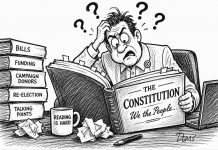
“Technicalities should not be resorted to.” That line, repeated in one form or another in recent political debates, stopped me in my tracks. Whenever public officials begin speaking as though the law becomes inconvenient when it slows power down, alarm bells ought to ring in every citizen’s mind.
I have always believed that laws are like the markings painted on a highway. They are not decorations. They are there precisely for the moments when speed, anger, ambition, and power tempt people to cross into the opposite lane. The disturbing trend today is not merely disagreement over legal interpretation; disagreement is normal in every democracy. What’s troubling is the growing comfort with the idea that rules may be stretched, bent, or redefined whenever they become obstacles to political objectives.
Take the often-repeated criticism of “technicalities.” The word is frequently spoken as though it refers to tricks invented by lawyers to help the guilty escape accountability. Yet legal technicalities are often nothing more than due process wearing work clothes. Rules on jurisdiction, evidence, filing periods, authentication, and procedure exist because history taught societies what happens when governments act first and justify later. Remove procedure from justice and what remains is discretion, and discretion without limits has never been a reliable guardian of liberty.
That is why I become uneasy whenever procedural safeguards are portrayed as enemies of truth. Courts do not ask whether evidence is merely persuasive; they ask whether it is admissible, reliable, and properly presented. Those questions are not obstacles to justice but protections against error and abuse. A legal system that ignores procedure for one side today may ignore it for another side tomorrow. The door, once opened, rarely closes at the same point where it was first pushed.
The same concern arises whenever public debates blur distinctions that the law deliberately keeps separate. Discussions surrounding photocopies, certified true copies, duplicates, and originals belong to rules of evidence developed over generations of jurisprudence. The law already provides circumstances under which copies may be admitted and circumstances under which originals are required. That framework exists not because judges enjoy paperwork but because authenticity matters. If the boundaries become unclear whenever political convenience demands it, confidence in legal proceedings begins to wobble.
What worries me most is not any single controversy but the pattern that seems to emerge when exceptions become fashionable. Every administration in history has faced the temptation to treat rules as flexible companions rather than firm restraints. Power dislikes fences. It prefers open fields. Yet constitutional government was designed precisely to place fences around power, including the power held by popular leaders, powerful institutions, and officials with overwhelming influence.
To be honest, I dislike politics when it starts treating law as clay to be molded by the strongest hands in the room. The law should be a ruler, not rubber. A measuring stick that changes length depending on who holds it is useless to everyone. The ordinary citizen may not know every statute, every precedent, or every rule of evidence, but people recognize instinctively when standards appear to shift according to convenience rather than principle.
For that reason, my preference remains stubbornly old-fashioned. If a law is defective, amend it openly through the proper process. If a rule of evidence is outdated, reform it through legislation or jurisprudence. But bending rules while insisting they remain straight is a dangerous habit for any government to acquire. Nations survive fierce elections, bitter arguments, and noisy politics; what they struggle to survive is the quiet normalization of the idea that law must adjust itself to power rather than power submitting itself to law.