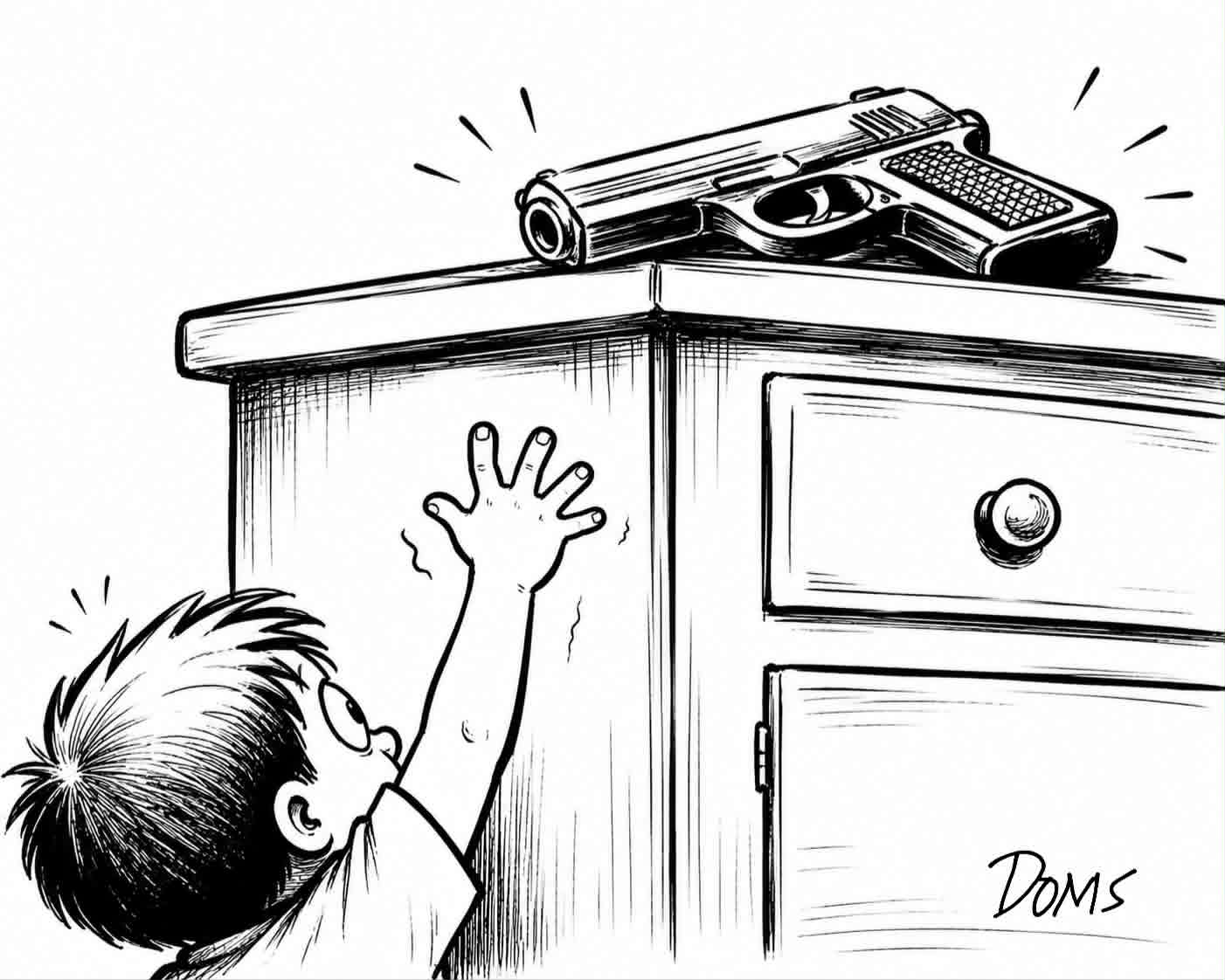
The recent shooting incidents involving minors should force every firearm-owning household to confront a basic responsibility: children and young people must never be allowed access to guns. A firearm in the home becomes a grave danger when an unauthorized young person can obtain it. Adults who possess firearms must secure them with the seriousness that deadly weapons demand.
This responsibility falls heavily on policemen, soldiers, sailors, security guards, other uniformed personnel, licensed gun owners, and anyone entrusted with an issued or privately owned firearm. Bringing a gun home means bringing home an object capable of killing within seconds, whether it is used deliberately, impulsively, or accidentally. It should therefore never be left in a drawer, cabinet, bag, vehicle, under a mattress, or anywhere else accessible to children. A firearm must be properly secured, and its ammunition should likewise be kept beyond unauthorized access. Ownership or official issuance does not end with the right to possess the weapon; it entails a continuing duty to prevent another person from obtaining it.
Young people should not be expected to possess the judgment and emotional restraint of trained adults. Anger after an argument, humiliation from bullying, family conflict, peer pressure, curiosity, emotional distress, or a desire to frighten someone can become deadly when a gun is within reach. Without a firearm, a moment of rage may end in shouting, threats, or a fistfight; with one readily available, an impulsive decision can leave someone dead and several families ruined. Adults cannot control every thought or emotion of a young person, but they can control whether a loaded weapon is available when judgment fails. That is why secure firearm storage is not excessive caution. It is elementary prevention.
The consequences also extend to the adult who failed to secure the weapon. When a minor uses a parent’s, relative’s, or household member’s firearm in a shooting, questions must be asked about how that child obtained it in the first place. Was it properly locked away? Who had access to the key, code, or storage area? Was the child previously allowed to handle it casually? These questions matter because accountability should not begin only when the trigger is pulled. A responsible gun owner must anticipate unauthorized access before tragedy occurs, especially when children and teenagers live in or regularly visit the household.
Authorities and firearm-owning families must therefore treat safe storage as an absolute obligation rather than a personal option. Police and military commands, security agencies, licensing authorities, and other institutions that issue or regulate firearms should repeatedly enforce strict rules on storage, accountability, and unauthorized access, while parents and guardians must make those rules part of everyday household discipline. Every gun should be secured so that no child, teenager, visitor, or unauthorized family member can obtain it. The lesson from shootings involving minors must be acted upon before another life is lost: if an adult chooses or is required to keep a firearm, that adult must make certain that young hands can never reach it.