In the world of business, trust and credibility serve as the keystone of any successful organization. They are fundamental traits that can determine the trajectory of a company’s growth, shaping its brand reputation, consumer loyalty, and overall market presence. This article explores key strategies for building trust and credibility in business, reinforcing strong relationships, and driving a robust reputation.
Understanding Trust and Credibility in Business
Trust, in a business context, refers to the confidence stakeholders place in a company’s integrity and ability to deliver as promised. Credibility, on the other hand, is the perception of a company’s professionalism, expertise, and reliability. Together, trust and credibility form the bedrock on which long-lasting business relationships are built, impacting every aspect of business operations, from customer interactions to employee engagement.
Strategies for Building Trust and Credibility
Transparency: Being open and honest in all business dealings is a vital element in building trust and credibility. This includes transparent communication with stakeholders, admitting mistakes, and being open about business decisions and processes.
Consistency: Consistency in delivering quality products or services, maintaining communication, and fulfilling promises is key to building credibility. Regularly meeting or exceeding expectations solidifies a company’s reputation as reliable and trustworthy.
Ethical Business Practices: Businesses that adhere to high ethical standards command respect and trust. This includes fair treatment of employees, responsible sourcing of products, respect for customer privacy, and commitment to environmental sustainability.
Open Dialogue: Engaging in open dialogue with customers, employees, and other stakeholders fosters trust. This includes actively seeking and responding to feedback, addressing concerns promptly, and involving stakeholders in relevant business decisions.
Demonstrate Expertise: Businesses can establish trustworthiness through showcasing proficiency in their industry. This can be achieved by providing valuable insights and content, participating in industry events, and staying at the forefront of industry trends.
The Power of Trust and Credibility on Business Success
The advantages of building trust and credibility in business are manifold. Trust and credibility contribute significantly to customer loyalty, fostering repeat business and positive word-of-mouth referrals. They enhance brand reputation, making a company more attractive to potential customers, partners, and investors. Establishing trust and credibility within the workplace also cultivates a positive work atmosphere, enhancing employee engagement and productivity. Ultimately, they provide a competitive edge, driving business growth and long-term success.
Trust and credibility play a critical role in determining a business’s success. Here are ways in which they can impact a business:
Customer Loyalty: Trust and credibility are the foundation of strong customer relationships. When customers trust a business and perceive it as credible, they are more likely to become loyal, repeat customers. Trust influences purchasing decisions, as customers feel confident in the reliability and quality of products or services offered by a trusted business.
Brand Reputation: Trust and credibility contribute to a positive brand reputation. A business known for its trustworthiness and credibility gains a competitive edge in the market. A solid reputation attracts new customers, retains existing ones, and can even lead to positive word-of-mouth referrals, expanding the customer base and driving business growth.
Partnerships and Collaborations: Trust and credibility are crucial in establishing partnerships and collaborations. Other businesses and organizations are more likely to engage in mutually beneficial relationships with a business they trust. Trust enhances the likelihood of successful collaborations, joint ventures, and strategic alliances, opening doors to new opportunities and expanding market reach.
Employee Engagement and Retention: Trust and credibility within an organization positively impact employee engagement and retention. When employees have confidence in their leaders and view the organization as trustworthy, they feel appreciated and are inclined to be driven, efficient, and dedicated. Positive internal dynamics foster a supportive work environment, leading to higher employee satisfaction and reduced turnover.
Investor Confidence: Trust and credibility are crucial for attracting investors. Investors seek businesses with a track record of honesty, transparency, and credibility. A company known for its trustworthiness is more inclined to attract financing, collaborations, and backing from investors, which enables expansion and resource availability.
Mitigating Risks and Crises: Trust and credibility act as buffers during times of crisis or risks. A company that has earned trust and credibility is better equipped to withstand challenges, as stakeholders are more inclined to offer support and understanding during tough situations. Trust plays a crucial role in rebuilding connections and restoring faith after a crisis.
Therefore, trust and credibility are fundamental to a business’s success. They influence customer loyalty, brand reputation, partnerships, employee engagement, investor confidence, and the ability to navigate risks and crises. Hence, businesses that prioritize building and maintaining trust and credibility are more likely to thrive in the long term, fostering strong relationships and enjoying sustainable growth.
——-
If you have any questions or would like to share your thoughts on the column, feel free to send an email to jca.bblueprint@gmail.com. Looking forward to connecting with you!
This unsolved murder might have been the cause of the irreconcilable gap between former president Cory Aquino and the kin of the fallen Ninoy Aquino. Many people are wondering why Ninoy’s siblings in former senators Butz and Tessie are always in the opposite side of the political fence with their sister-in-law former president Cory Aquino. People may wonder why former senators Butz and Tessie would take even the worst candidate there is that the opposition would endorse against any protégé of Cory Aquino.
That was not the setup when Butz Aquino first became senator under the administration of Cory Aquino. The falling-out started when Cory Aquino anointed Fidel Ramos as the administration bet to succeed her. The anointed army general is a known operator of martial law and was constabulary chief when Ninoy Aquino was assassinated. He may have had access and was privy to the plots of the despot but did not lift a finger to help solve the murder of Ninoy.
Surprisingly, Cory Aquino chose him to be her worthy successor, a thing that may have caused the displeasure of Ninoy’s siblings who are now seen opposing every political position of the former president. This day is indeed a turning point in our country’s history as it led to the fall of the dictator by way of a bloodless People Power Revolution. An attempt to reopen the murder case of Ninoy Aquino had been posited recently but nothing had resulted from it so far. When will this day find its meaning by serving truth and justice to Ninoy Aquino who offered his life in the belief that the Filipino is worth dying for.
That murder of the century triggered the peaceful People Power revolution that culminated in that historic highway named after the renowned Filipino historian journalist and civil servant Epefanio “Don Panyong” de los Santos avenue (EDSA). The event was became the final stage of a long struggle that was fought relentlessly with sweat and blood by an oppressed Filipino people who fought against the despotic rule of the conjugal dictatorship of Ferdinand and Imelda Marcos.
Many opposition leaders offered their lives just to regain the Filipino people’s lost freedom and liberty. This is the truth of the country’s history that the present magical president is subtly changing. comments to alellema@yahoo.com
WE should have no doubt about this truth of our faith. Christ himself said, “Whoever loses his life for my sake and that of the gospel will save it.” (Mk 8,35) There is no greater loss we can have in this life than the loss of our life. But if we lose it for Christ’s sake, we are assured of saving it. In St. Paul’s Letter to the Romans, the same assurance is made. “If God is for us, who can be against us?” he said. (8,31)
It’s important that we develop this kind of confidence based on this assurance of Christ. We should feel strongly and constantly the presence and power of Christ in our mind and heart. It’s actually when we fail to feel that presence and power that we become easy target to our weaknesses and the temptations around.
Our problem is that we tend simply to rely on our own powers which are no match even to our own weaknesses, much less, to the evil spirits around. Remember St. Paul warning us: “For we wrestle not against flesh and blood, but against principalities, against powers, against the rulers of the darkness of this world, against spiritual wickedness in high places.” (Eph 6,12)
But with Christ, we can conquer everything that is not good for us. Yes, we can conquer even death, as St. Paul himself assured us: “If we died with Christ, we believe that we will also live with him.” (Rom 6,8)
Let us work on how we can have Christ’s presence and power strongly felt in us. That is the ideal condition for us to have since we have to deal with all sorts of difficulties, challenges, trials, temptations, weaknesses, etc. in this life.
When we are tempted, it only means that we have been giving an opening to this temptation since we have failed to be with Christ. Thus, when temptations come, we should enliven Christ’s presence and power in us, perhaps by making many acts of faith and other ejaculatory prayers. That way we will feel strong and ready to face temptations, eager even to do some hand-to-hand combat with the temptations, if needed.
We need to see to it that our union with Christ should, as much as possible, be abiding, completely sealed with no opening, no matter how minuscule, that can allow our weaknesses, the sinful allurements of the world and the devil himself to enter.
Only with Christ can we be keenly aware of the many dangers that lurk within us and around us. Only with him can we immediately and strongly resist the temptations and be unaffected by our weaknesses and the sins around.
In other words, we really need how to pray always. This means we have to know how to convert everything into prayer, always relating everything to Christ—our joys and sorrow, our work and rest, our successes and defeats, etc. Yes, everything can and should be a material and occasion to pray.
We should be in constant awareness of Christ’s presence in us and around us. And our relation with him should be driven by love, by our desire to be with him and to do his will. We have to feel the need for him. In fact, he should be our greatest need, without whom we should feel completely empty. Nothing should replace or substitute for him in our mind and heart. We need him more than we need air.
CLEMELLE L. MONTALLANA,DM, CESE
ASSOCIATE PROFESSOR III
CLEMELLE L. MONTALLANA,DM, CESE ASSOCIATE PROFESSOR III
Kun ha pagkita han Salida, nalilipay kita, maupay! Kun ha pagkita han Salida Nagin mas maupay kita, mas makalilipay!
As a Waray, whose thoughts are written in English and in the most imperfect way, I dare not translate the words. For the audience, understands its own language better.
Let me talk about films and how it must inspire not just entertain.
Films that show people overcoming obstacles in life have a special ability to uplift and encourage viewers. These movies frequently feature characters that overcome impossible obstacles by being brave, resilient, and persistent. These kinds of stories are not only entertaining, but they also act as potent reminders of the human spirit’s ability to triumph against hardship. More significantly, they can inspire viewers to be kind, compassionate, and to feel a part of the community.
Filipino movies like Bituing Walang Ningning , Oro, Plata, Mata (1982) Directed by: Peque Gallaga. Peque Gallaga’s Oro, Plata,,José Rizal (1998) Directed by: Marilou Diaz-Abaya, Bayaning 3rd World (1999) Directed by: Mike de Leon,Dekada ‘70 (2002) Directed by: Chito S. Roño. Starring Vilma Santos, Anak (Vilma Santos). And lately, we have Anak (2000)Tanging Yaman (2000),Mano Po (2002), Dekada ’70 (2002) Got 2 Believe (2002), Magnifico (2003).
All These is what film buff calls maupay nga salida. Still good films must not only entertain but it must, it should give inspiration that would allow the people to emulate. It must be a sort of catalyst for good works beyond the screen.
Ultimately, movies that depict triumph over life’s odds encourage viewers to be kind and generous. They remind us that everyone faces challenges and that a little kindness can go a long way in helping others overcome their struggles. By showing the positive impact of compassion and support, these films inspire viewers to act with kindness in their daily lives. These inspire people to be doer of good and not just as a sponge absorbing depiction and illustration of good it becomes an originator of what is good, in words and in need.
Kun an salida makahatag hin inspirasyon ngan rason pagbiulig , pag upay ngan pag buhat hin mga butang nga makalilipay, mas maupay !
MANILA-On September 9 and 10, the United States government, through the U.S. Agency for International Development (USAID), handed over a mobile storage unit and mobile energy systems worth more than P11.6 million ($208,000) to boost Cagayan province’s disaster risk reduction capacity.
USAID Mission Director Ryan Washburn handed over a mobile storage unit that can store 50,000 food packs to Cagayan Provincial Administrator Atty. Maria Rosario Mamba-Villaflor.
The mobile storage unit will allow the provincial government to store food and non-food items so they can rapidly deliver life-saving assistance in the immediate aftermath of disasters.
“For many years, USAID has dispatched teams to Cagayan and other provinces in Northern Luzon to support local government units in providing life-saving assistance during calamities,” said Mission Director Washburn.
“As your friend, partner, and ally, the U.S. government remains committed to strengthening our partnerships and working with the Philippine government to rebuild and restore lives following disasters.”
During the turnover, USAID also formalized a partnership with Cagayan province and the World Food Programme to strengthen Cagayan’s emergency response efforts through the Preparedness and Response Excellence in the Philippines, or PREP, project.
This project will help reduce disaster risks by improving irrigation canals, water systems, and water-harvesting facilities; set up community flood-control dikes; introduce climate-resilient crops; construct community evacuation centers; and provide cash-for-work training so communities can bounce back from natural disasters.
“People’s empowerment is at the heart of the disaster preparedness and good governance program of the governor,” said Provincial Administrator Mamba-Villaflor. “The governor extends his gratitude on behalf of the people of Cagayan.”
USAID also handed over mobile energy systems (MES) to the municipalities of Lal-Lo and Santa Ana.
The MES units will provide clean and reliable power to support relief operations and essential services in the aftermath of disasters, as well as help restart the power grid.
Because the systems are mobile, they can be deployed anywhere they are needed, particularly in remote and off-grid areas. Unlike traditional generator sets, they only require sunlight to recharge.
While in Northern Luzon, Mission Director Washburn also discussed USAID’s work to support Tuguegarao City’s solid waste management system with OIC City Administrator Juanito Calubaquib and city councilors.
He also spoke with Cagayan Vice Governor Melvin Vargas Jr. about USAID’s programs in the region and visited Santa Teresita municipality to see the Emergency Operations Center that USAID helped construct more than a decade ago.
Since 2010, the U.S. government, through USAID, has provided around P19.6 billion ($344 million) in disaster relief and recovery aid, as well as boosted the disaster risk reduction capacity of over 100 cities and municipalities in the Philippines. (PR)
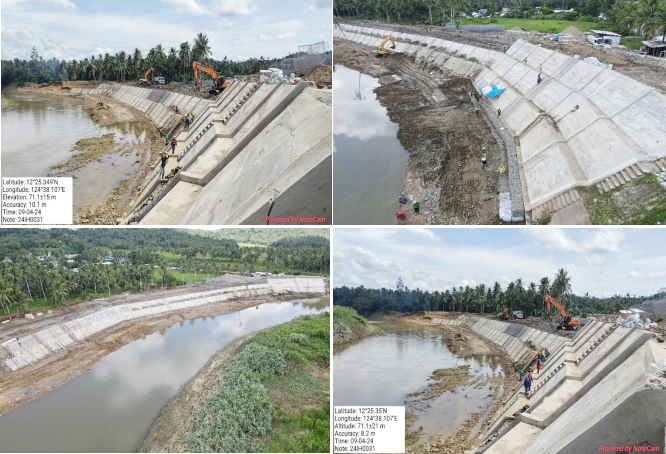
Catarman N. Samar-The Department of Public Works and Highways (DPWH)-Northern Samar First District Engineering Office is currently constructing a flood mitigation structure along the Somoge River in Barangay Somoge, Catarman, Northern Samar.
The P139.90-million project, funded under the 2024 General Appropriations Act, involves the construction of a 308-linear meter flood control structure resting on a steel sheet pile foundation to prevent riverbank erosion. The project also features 309 linear meters of stonemasonry and 274.5 meters of Portland cement concrete pavement.
District Engineer Alvin A. Ignacio emphasized that the project aims to address the community’s severe flooding issues.
“By implementing this project, we are taking a significant step toward mitigating flood risks, protecting lives, and ensuring the safety and well-being of residents in the area,” DE Ignacio said.
Brgy. Kagawad Gemma Dasig Basierto, expressed her appreciation for the project. “Regarding the flood control along the riverside, we are very thankful. In the past, the river was far from the road, but now scouring along the riverside continues. That’s why we are grateful that there is an ongoing flood control project. One day, it will benefit future generations. Without it, Brgy. Somoge might disappear from the map.
“When Tropical Storm ‘Enteng’ recently hit, we were very thankful that the road (highway) didn’t flood, which used to be the signal for residents near the riverside to evacuate. Now, even if it rains all night, the road no longer floods, and we are deeply grateful to the government for providing us with this flood control project here in Brgy. Somoge,” she further stated.
“Tungkol diyan sa flood control sa may riverside, malaki ang aming pasalamat kasi noon malayo pa ang ilog sa kalsada, ngayon patuloy na scouring diyan sa may riverside. Kaya nagpapasalamat kami na may ginagawang proyekto na flood control diyan. Balang araw mapapakinabangan yan ng mga susunod na mga generasyon. Baka mawala sa mapa ang Brgy. Somoge. Recently ng dumating ang “Enteng” na tropical storm, malaki ang aming pasalamat na hindi na bumaha sa kalsada (Highway), yun ang palatandaan na kailangan na mg-evacuate ng mga taong nakatira malapit sa riverside. Sa ngayon, kahit magdamag ang pag-ulan, hindi na bumaha, kaya malaki ang aming pasalamat sa gobyerno na nagkaroon kami ng flood control project sa Brgy. Somoge.” she further stated.
This project seeks to enhance local resilience against flooding and improve the community’s quality of life. (ANALIZA A. PABIA/PR)





“Building trust and credibility in business: Key strategies for establishing strong relationships and reputation”
In the world of business, trust and credibility serve as the keystone of any successful organization. They are fundamental traits that can determine the trajectory of a company’s growth, shaping its brand reputation, consumer loyalty, and overall market presence. This article explores key strategies for building trust and credibility in business, reinforcing strong relationships, and driving a robust reputation.
Understanding Trust and Credibility in Business
Trust, in a business context, refers to the confidence stakeholders place in a company’s integrity and ability to deliver as promised. Credibility, on the other hand, is the perception of a company’s professionalism, expertise, and reliability. Together, trust and credibility form the bedrock on which long-lasting business relationships are built, impacting every aspect of business operations, from customer interactions to employee engagement.
Strategies for Building Trust and Credibility
Transparency: Being open and honest in all business dealings is a vital element in building trust and credibility. This includes transparent communication with stakeholders, admitting mistakes, and being open about business decisions and processes.
Consistency: Consistency in delivering quality products or services, maintaining communication, and fulfilling promises is key to building credibility. Regularly meeting or exceeding expectations solidifies a company’s reputation as reliable and trustworthy.
Ethical Business Practices: Businesses that adhere to high ethical standards command respect and trust. This includes fair treatment of employees, responsible sourcing of products, respect for customer privacy, and commitment to environmental sustainability.
Open Dialogue: Engaging in open dialogue with customers, employees, and other stakeholders fosters trust. This includes actively seeking and responding to feedback, addressing concerns promptly, and involving stakeholders in relevant business decisions.
Demonstrate Expertise: Businesses can establish trustworthiness through showcasing proficiency in their industry. This can be achieved by providing valuable insights and content, participating in industry events, and staying at the forefront of industry trends.
The Power of Trust and Credibility on Business Success
The advantages of building trust and credibility in business are manifold. Trust and credibility contribute significantly to customer loyalty, fostering repeat business and positive word-of-mouth referrals. They enhance brand reputation, making a company more attractive to potential customers, partners, and investors. Establishing trust and credibility within the workplace also cultivates a positive work atmosphere, enhancing employee engagement and productivity. Ultimately, they provide a competitive edge, driving business growth and long-term success.
Trust and credibility play a critical role in determining a business’s success. Here are ways in which they can impact a business:
Customer Loyalty: Trust and credibility are the foundation of strong customer relationships. When customers trust a business and perceive it as credible, they are more likely to become loyal, repeat customers. Trust influences purchasing decisions, as customers feel confident in the reliability and quality of products or services offered by a trusted business.
Brand Reputation: Trust and credibility contribute to a positive brand reputation. A business known for its trustworthiness and credibility gains a competitive edge in the market. A solid reputation attracts new customers, retains existing ones, and can even lead to positive word-of-mouth referrals, expanding the customer base and driving business growth.
Partnerships and Collaborations: Trust and credibility are crucial in establishing partnerships and collaborations. Other businesses and organizations are more likely to engage in mutually beneficial relationships with a business they trust. Trust enhances the likelihood of successful collaborations, joint ventures, and strategic alliances, opening doors to new opportunities and expanding market reach.
Employee Engagement and Retention: Trust and credibility within an organization positively impact employee engagement and retention. When employees have confidence in their leaders and view the organization as trustworthy, they feel appreciated and are inclined to be driven, efficient, and dedicated. Positive internal dynamics foster a supportive work environment, leading to higher employee satisfaction and reduced turnover.
Investor Confidence: Trust and credibility are crucial for attracting investors. Investors seek businesses with a track record of honesty, transparency, and credibility. A company known for its trustworthiness is more inclined to attract financing, collaborations, and backing from investors, which enables expansion and resource availability.
Mitigating Risks and Crises: Trust and credibility act as buffers during times of crisis or risks. A company that has earned trust and credibility is better equipped to withstand challenges, as stakeholders are more inclined to offer support and understanding during tough situations. Trust plays a crucial role in rebuilding connections and restoring faith after a crisis.
Therefore, trust and credibility are fundamental to a business’s success. They influence customer loyalty, brand reputation, partnerships, employee engagement, investor confidence, and the ability to navigate risks and crises. Hence, businesses that prioritize building and maintaining trust and credibility are more likely to thrive in the long term, fostering strong relationships and enjoying sustainable growth.
——-
If you have any questions or would like to share your thoughts on the column, feel free to send an email to jca.bblueprint@gmail.com. Looking forward to connecting with you!