24.7 C
Tacloban City
September 19, 2026 - Saturday | 5:26 AM
Home Blog Page 637

Fair fare hike

0

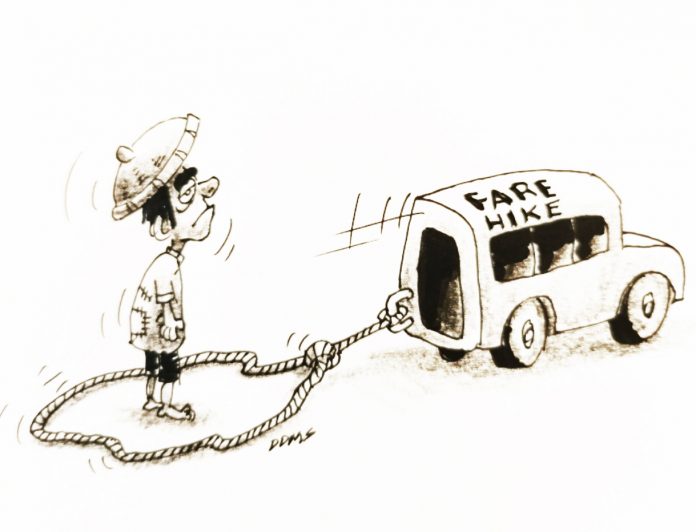
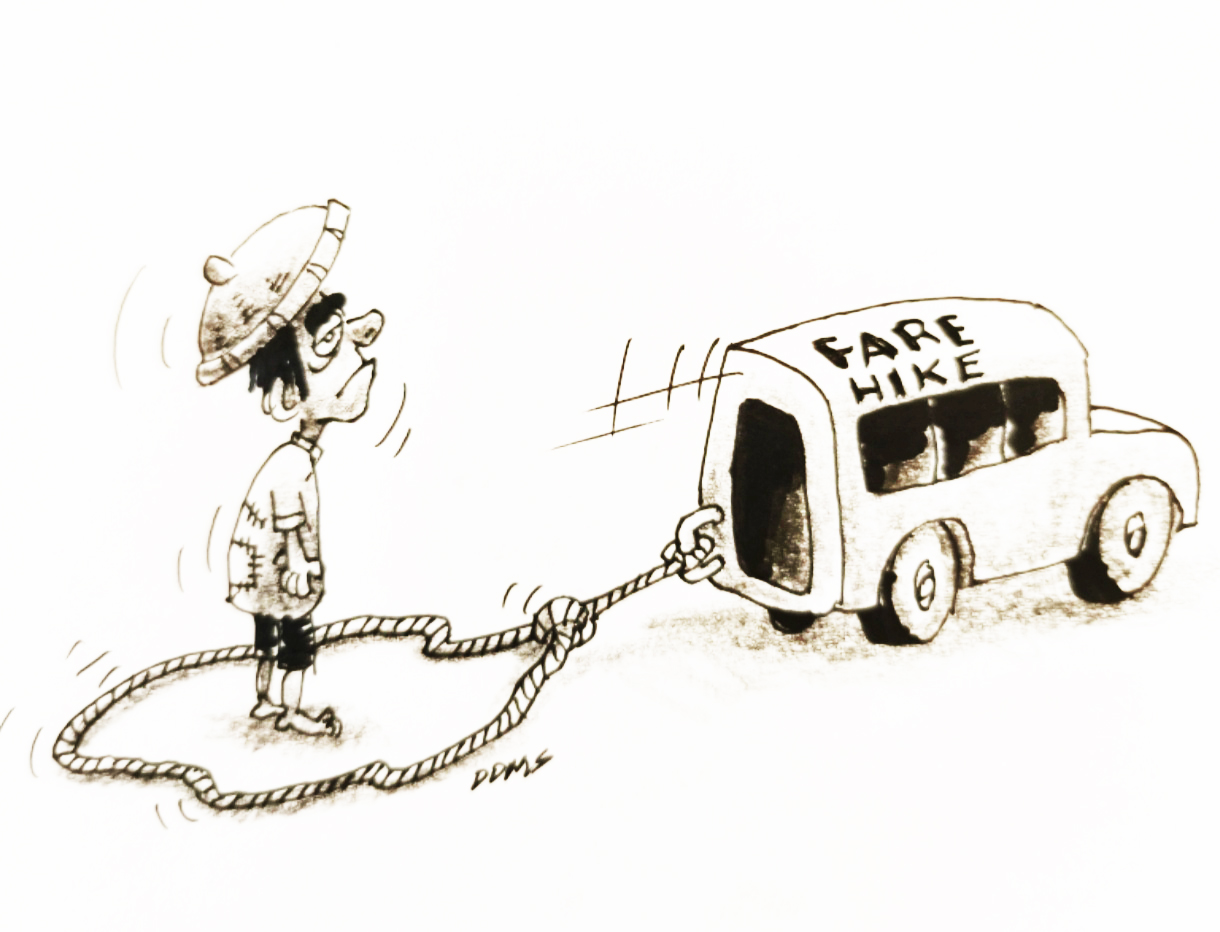
The scheduled hearing this February 19 of the petition to increase the minimum jeepney fare to P15 is a direct blow to the already pinched pockets of the poor. Public transportation is the lifeline of daily survival for minimum-wage earners, informal workers, and students, and any outrageous fare hike will push them further into economic destitution. The government has to balance assisting transport operators to recover their costs while making sure commuters are not asked to pay extra fares.

Yes, the fuel and maintenance fees have skyrocketed, but not only will this fare hike pin jeepney drivers to the wall, but it will also kill the riders who use these public transport vehicles daily. A worker earning less than the minimum wage a day will be seeing most of his or her pay going towards transportation fees alone, which will then leave him or her with less money for food, rent, and other essentials. Students, already paying tuition and school fees, will need to hurdle yet another obstacle just to reach their classrooms. In a nation where every peso is important, charging an additional five pesos per ride is not only inconvenient—it is punitive.

Its economic impact cannot be disregarded. Low-income earners such as small vendors, laborers, and other similar ones will be forced to spend more money just to get to the source of their livelihoods, which would lower their disposable income and retard local expenditure. This would, in effect, undermine small business that relies on daily consumer traffic. The increase in fares, rather than assisting the economy to bounce back, will further ensure poverty and increase the gap between those with the ability to bear increased living expenses and those without.

Although the jeepney drivers and operators are entitled to just rewards for their labor, the government should not lay the financial burden on commuters without looking for alternatives. Fuel subsidies, assistance programs, and a more progressive modernization program must have priorities to assist the transport industry at commuters’ cost. The fare increase should be the last resort, not the first.

LTFRB should painstakingly examine this petition keeping in mind the welfare of the poor. If the administration is genuinely interested in economic recovery and social justice, it should not approve any fare increase that will only aggravate the economic pain of the working class. Alternative solutions that likewise take into consideration the welfare of jeepney drivers and the survival of commuters should be sought.


A messenger

0

In the past weeks, the rain has been just like a lingering guest who refuses to go away. It comes out for a while—long enough for our clothes to dry in the sun and for us to indulge ourselves in the futile hope of blue skies—before bursting its way back in, pouring its heart out as if it never went away in the first place. And this is no soap opera of the seasons; this is the daily or weekly trend for now.

I ceased to track the weather report because, hello, what’s the use? Rain or shine according to PAGASA, we all understand how this game is played: a balmy, sweaty morning ruined by an intense afternoon rainstorm so heavy it makes one wonder if ever did it rain during the summer season at all. Farmers rejoice, commuters rant, gutters overflow, and life continues on this damp rhythm that characterizes our lives. The question is, has it always been so, or have the rains become bolder and more relentless due to climate change?

The elders say no, that this is nothing new. “Ganyan na talaga ‘yan,” they say, brushing aside the unpredictability of the sky. But I will not settle for that that is all there is to it. Our grandparents and parents endured storms, naturally, but I don’t think they had rain dropping in such mad, inconstant ways, moistening areas that were once dry, and lingering in areas that were once stalwart. The last couple of years have been other, not only wetter but more draining like the air itself is working to maintain something it can no longer.

And science concurs. Adults have been saying for years that global warming isn’t simply a matter of temperature, but of moisture too. A warmer world is a more humid one, which translates to more torrential downpours and, ironically enough, longer, worse droughts in between. It’s a perverse, sad irony: parts of the nation are drying up in record drought, and we’re arguing about whether or not to begin cultivating gills. This is not our rainy season anymore, cozy and familiar. This is something other, something out of the way—something that turns roads into rivers overnight and renders flood maps useless within a few months.

And yet, who are we to grumble? We have learned to tolerate this. We splash through puddles shin-deep like it’s acceptable for us, we use umbrellas as much as we cherish our purse strings, and we’ve mastered the offense of mouthing curses against the rain in silence while inwardly admitting there’s nothing that can be done about it. We’re indeed tough, yes, but too shortsighted by it to understand the actual problem. Must we settle for merely controlling and begin questioning what is being done to our skies?

And even more so, what have we done to deserve such a prize? Our mountains are mined, our forests depleted, our cities sprawled out with no concern for the natural flow of water. We asphalt rice paddies, clog rivers with trash, and then get surprised when the rain has nowhere to go anymore. Perhaps the issue is not the rain. Perhaps it is us, bending nature to our will, rather than bending into nature with humility and planning.

If anything, the incessant rain should be demonstrating that the world is altering whether we agree with it or not. We can laugh at it, shake our heads in horror, and curse fate, but the fact of the matter is this: unless we begin to pay attention—unless we change our attitude toward our earth, air, and water—this is only going to continue to go downhill. And one day, when we’re hip-deep in floods which heretofore we had thought impossible, we might perhaps, just possibly, realize that the rain never was the problem. It was just the messenger.

Beware of the leaven of the world

0

CHRIST one time warned his disciples about the leaven of the Pharisees and of Herod which they did not understand at first. (cfr. Mk 8,14-21) It took them time to understand that the leaven Christ was talking about was not the leaven of the bread but rather the doctrine or the teachings, the laws and the ways of the Pharisees and Herod.

The same warning remains valid and in effect up to this time, since there is no doubt that we are today flooded with all kinds of doctrine and ideologies that are becoming more and more in conflict with Christian doctrine and ways.

We have to be wary of today’s many false doctrines that can sound good and can come up with fair promises and assurances, but they actually lack the power to make things happen. They can contain many theoretical truths and can also be supported by a lot of data, facts and other so-called scientific findings, but they lack the most crucial element—the proper spirit.

Yes, false doctrines can give some measure of good results and satisfaction. But that’s where the real danger is, where the subtle treachery is committed. Without the proper spirit of God, it is nothing less than a sweet poison.

False doctrines are usually found, and in abundance at that, in the fields of politics, the social sciences, philosophies and ideologies, and in all the other human enterprises that are not animated by the Christian spirit.

They come as a result of developing some human systems that rely solely on human power and estimation. In a sense, these systems choose to go rogue in developing themselves. They prefer to be entirely on their own. God is taken out of the picture.

In some reports, for example, a number of political parties all over the world have dropped the expression, “under God,” in their pledges of allegiance or commitment. This omission is clearly a sign of the growing secularization taking place in many parts of the world. It’s when to be politically correct, one has to take God out of the picture.

Thus, there is an urgent need to undertake the work of evangelization, that is, to communicate the saving word of God to everyone. In a world that is becoming more and more toxic with all sorts of hot issues, confusing ideologies, belligerent opinions, etc., practically drowning us, there is the urgent need to let God’s healing word to reach and touch people’s hearts.

This task of evangelization belongs to everyone, whether one is a priest or a religious person or a simple lay person. Everyone should realize that it is Christ who is asking us to evangelize. He is actually appealing to us, begging us to help him carry out the continuing work of human redemption that definitely involves the evangelization of people
This is simply the effect and consequence of being a Christian who is supposed to be like Christ and to share his mission of evangelizing and redeeming everyone. We also have to apply to ourselves those words Christ told his apostles: “As the Father has sent me, so also I am sending you.” (Jn 20,21)

Evangelization is an integral and indispensable part of the whole mission of Christ—the redemption of mankind. While it may immediately concern itself in the transmission of the doctrine of our faith, it cannot go alone without being vitally and organically connected to the other aspects of human redemption.

“Why do entrepreneurs turn to franchising”

0

Entrepreneurs often turn to franchise strategic business model for various reasons, leveraging the benefits and opportunities it offers. Franchising provides a pathway for individuals to own and operate a business with the support of an established brand, proven business model, and ongoing guidance from the franchisor. This article explores the motivations behind why entrepreneurs choose franchising as a route to business ownership and success.

Established Brand Recognition: One of the primary reasons entrepreneurs opt for franchising is the opportunity to align with a well-known and trusted brand. By investing in a franchise, entrepreneurs gain immediate access to a recognizable brand name, logo, and reputation, which can attract customers and build credibility faster than starting a new independent venture.

Proven Business Model: Franchising offers entrepreneurs a tried-and-tested business model that has already demonstrated success in the market. Franchisors provide comprehensive training, operational guidelines, and support systems that help franchisees navigate the complexities of running a business effectively. This significantly reduces the hurdles and uncertainties of launching a new venture.

Marketing and Advertising Support: Franchise systems often provide robust marketing and advertising support at both the national and local levels. This support includes access to marketing materials, advertising campaigns, and promotional strategies that are designed to enhance brand visibility, attract customers, and drive sales. Entrepreneurs benefit from the collective marketing efforts of the franchise network.

Operational Assistance: Franchisors offer ongoing operational assistance to franchisees, including guidance on site selection, lease negotiations, inventory management, and employee training. This support helps entrepreneurs streamline operations, improve efficiency, and maintain consistency across multiple franchise locations. Franchisees can tap into the expertise and resources of the franchisor to address operational challenges effectively.

Economies of Scale: Franchising allows entrepreneurs to benefit from economies of scale by leveraging the purchasing power of the entire franchise network. Franchisors negotiate favorable terms with suppliers, vendors, and service providers, enabling franchisees to access quality products and services at competitive prices. This cost-saving advantage enhances the profitability of franchise businesses.

Risk Mitigation: Franchising offers a level of risk mitigation for entrepreneurs compared to independent business ownership. The established brand, proven business model, and ongoing support from the franchisor reduce the uncertainty and challenges associated with launching a new venture. Franchisees can leverage the collective experience and resources of the franchise system to navigate market fluctuations and competitive pressures.

Entrepreneurial Support Network: Franchise systems provide entrepreneurs with a built-in support network of fellow franchisees who share best practices, insights, and experiences. This network fosters collaboration, idea sharing, and camaraderie among franchise owners, creating a sense of community and mutual assistance. Entrepreneurs benefit from the collective wisdom and support of their peers within the franchise network.

In conclusion, entrepreneurs turn to franchising business for the opportunity to align with an established brand, leverage a proven business model, access marketing and operational support, benefit from economies of scale, mitigate risks, and tap into a supportive network of like-minded individuals. Franchising offers a pathway to business ownership that combines the autonomy of entrepreneurship with the guidance and resources of a successful franchise system, making it an appealing option for aspiring business owners.
————–
If you have any questions or would like to share your thoughts on the column, feel free to send an email to jca.bblueprint@gmail.com. Looking forward to connecting with you!

Old friends?

0

The once friends that sought the presidency and rule the country are now archenemies after a breakup caused by political ambitions to stay in power through their subalterns. The magical president used to be a strong supporter of the former president during the 2016 presidential election when he run for vice president. This, despite the former president picking another senator as his running mate. It was an alliance that set aside political affiliations considering that the magical president still supported the former president in his presidential bid. The running mate and the magical president both lost in that election notwithstanding the large margin garnered by the former president.

In the 2022 presidential election, the magical president picked the former president’s daughter as his running mate. It was an alliance brokered by another former president who had strong influence over presidential wannabes who are up for grabs for the presidency. The uncertainty of the alliance was not unlike the candidacy of the former president who had decided on the last hours to run, only to be declared lacking of requirements and had to be accommodated by a political party that nominated him in lieu of a candidate who had already filed a certificate of candidacy. That candidate would later be rewarded with a high government position.

The tandem would later be dubbed as uniteam, a label that stood for unity team. The tandem would run on a platform of unity, with the aim of uniting the people across political parties and colors. It pushed for unity and nothing more. Not even a clear program of government except the call for the people to unite behind their tandem. There are promises during the campaign, chief among them the reduction of rice prices from the almost sixty pesos per kilo to just twenty pesos. That promise was truly too good to be true as there are many factor that determine farmgate prices up to the market prices that consumers had to bear.

It appeared that the vice-president played a crucial role in the victory of the magical president if one will consider the bailiwick in the south and the influence of the former president who is the father of the vice-presidential candidate then. There too were claims on the part of the magical president’s supporters that their family that has the clout to muster the votes from the north contributed too to the vice-president’s election. Such factors that the uniteam considered their edge was up against a strong opposition led by the incumbent vice-president who run on a solid platform. That uniteam would eventually win not merely for their combined influence but through a wondersome turn of an automated counting.

As the uniteam reach the midterm election, misunderstanding over political positioning for the next presidential election caused cracks on their bond. Ploys to destroy once against the other became the order of each camp. Accusations of irregularities and graft of public funds became the headlines of daily news on various platforms. This led to threats against the life of the magical president, his first lady and the speaker who had been aiming to run for the top post in the coming presidential election. People are pissed watching the protracted political war of what used to be political allies and old friends.
comments to alellema@yahoo.com

Liberation of Manila exhibition opens at Manila American Cemetery

0

Manila-On February 13, the U.S. government, through the American Battle Monuments Commission (ABMC), and the National Museum of the Philippines (NMP) inaugurated an exhibition featuring the works of renowned Filipino painters to commemorate the 80th anniversary of Liberation of Manila during World War 2.

The “Liberation of Manila: 80 Years of Remembrance through Art” exhibit invites audiences to reflect on the destruction and resilience experienced during one of the most significant events in Philippine history through the lens of National Artist Fernando Amorsolo, Diosdado Lorenzo, Nena Saguil, and Galo Ocampo.

The exhibition is open for viewing from February 13 to 25 at the Visitor Center of the Manila American Cemetery and Memorial located in Bonifacio Global City, Taguig City. The Manila American Cemetery, the largest overseas American military cemetery in the world, is open to the public from 9:00 a.m. to 5:00 p.m. every day, except Christmas and New Year. Admission is free and guided tours are available, including for schools and large groups.

“Art has the power to transcend time, to give voice to the voiceless, to capture history not as cold facts but as lived experience.  The four powerful works in this exhibit, created by some of the Philippines’ most celebrated national artists, serve as a visual testament to the past,” U.S. Ambassador to the Philippines MaryKay Carlson said.  “They remind us of the shared sacrifices, lives lost, and profound stories that must never be forgotten.”

NMP Director-General Jeremy Barns remarked, “The works you see here now are historical visual accounts – some of them first-hand – of the battle that was… It is the honor of the National Museum of the Philippines to have such significant treasures in its collection, and it is our further honor to share them here at the Manila American Cemetery. Together, we bear the responsibility of commemorating the struggles and victory of those who valiantly fought for our great nation’s freedom and the continued brotherhood of the Philippines and the United States.”

The four artworks were loaned to the ABMC by the NMP from its Fine Arts Collection as part of a series of events marking the 80th anniversary of the Liberation of Manila on February 22.

The paintings featured in “Liberation of Manila: 80 Years of Remembrance through Art” offer a reflection into the past and present, from the devastation of a city at war in 1945 to the resurgence of Manila with structures rebuilt in the present day.

In “Burning of Sto. Domingo Church” (1942), National Artist Fernando Amorsolo’s brushstrokes capture the enormous flames that burned the centuries-old church for three days in 1941. Built in 1588, the Sto. Domingo Church was one of the first structures destroyed by Japanese bombers during the Battle of Manila. After the war, the church was relocated from Intramuros to its present location in Quezon City.

In “Ruins of the Legislative Building” (1945), Galo Ocampo, who was recognized for his art and his service in the United States Armed Forces in the Far East during World War 2, illustrates the shattered remains of what was once a Japanese stronghold in the war. Today, the Legislative Building stands as the National Museum of Fine Arts.

Modernist painter Diosdado Lorenzo’s “Ruins of Sales Street, Quiapo” (1946) portrays the destruction of a bustling district, renowned both then and now for its vibrant markets and heritage architecture, particularly the Quiapo Church which continues to welcome devotees to this day.

Finally, Simplicia “Nena” Saguil, a pioneer in abstract art, painted the “Ruined Gate of Fort Santiago” (1949) as a reminder of the aftermath of intense fighting in the Walled City of Intramuros. Fort Santiago’s rebuilt gate continues to tell Manila’s story and serves today as a symbol of the city’s resilience and rebirth. (PR)

Recent Posts

DALMACIO C. GRAFIL
PUBLISHER

ALMA GRAFIL
EDITOR-IN-CHIEF

ROMEO CEBREROS
OFFICE IN-CHARGE

OFFICE
BRGY. SONGCO, BORONGAN CITY

CONTACT NUMBERS
(055) 261 – 3319 | 0955 251 1533 | 0917 771 0320 | 0915 897 7439 | 0921 511 0010

DALMACIO C. GRAFIL
PUBLISHER

RICKY J. BAUTISTA
EDITOR

ALMA GRAFIL
BUS. MANAGER

OFFICE
RIZAL AVENUE, CATBALOGAN
(INFRONT OF FIRE DEPARTMENT, NEAR CITY HALL)

CONTACT NUMBERS
0917 771 0320 | 0915 897 7439 | 0921 511 0010

EMAIL
lsdaily2@yahoo.com

WEBSITE
www.issuu.com/samarweeklyexpress