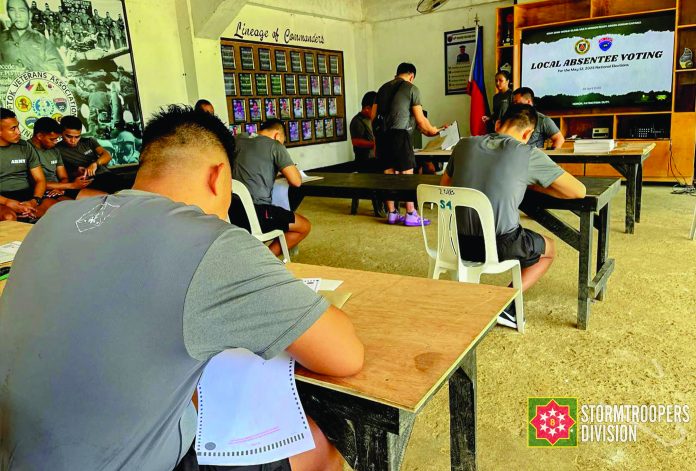
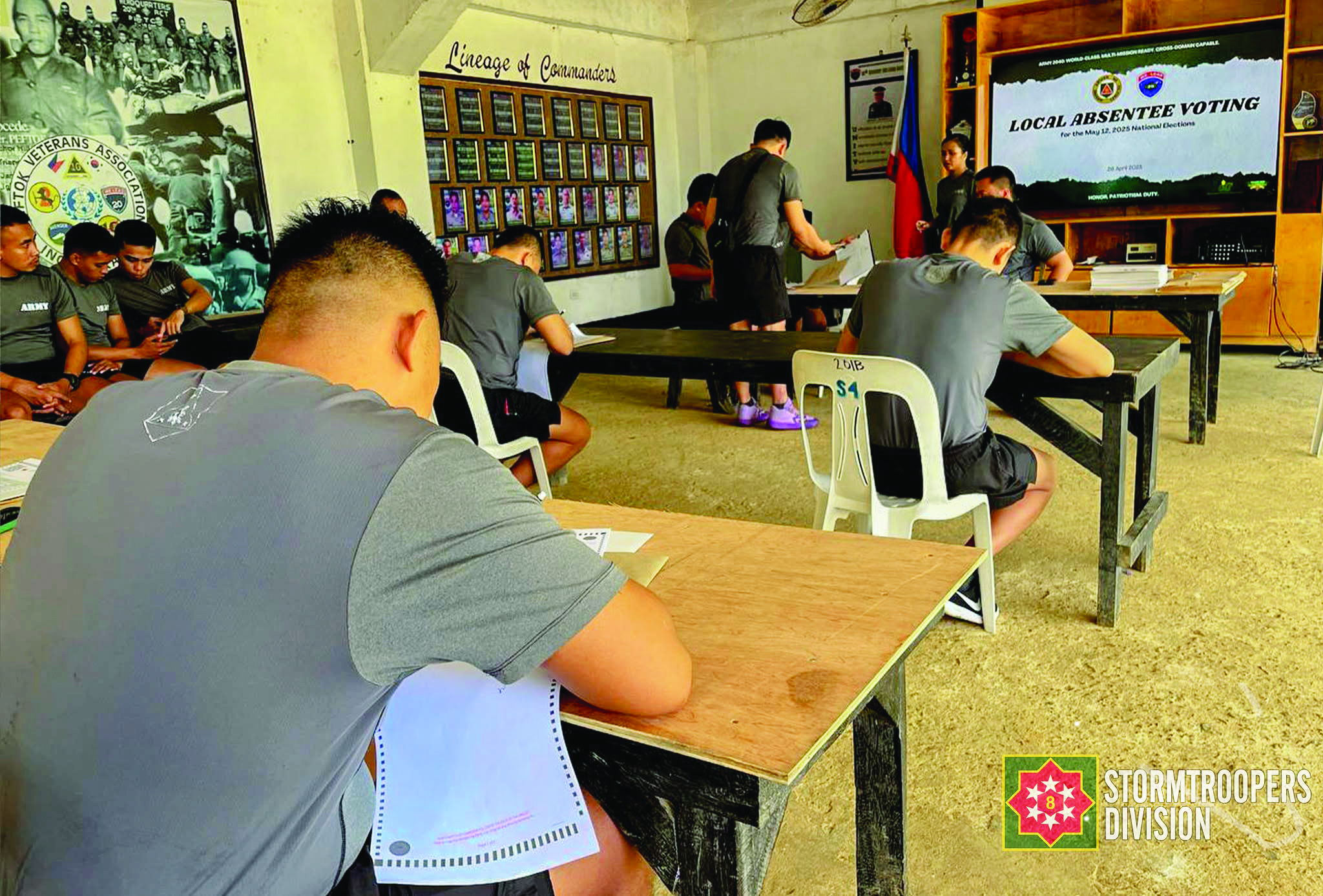
ABSENTEE VOTING. A total of 1,290 soldiers from the region cast their votes ahead of the May 12 elections through the Local Absentee Voting (LAV) system. The voting was held from April 28 to 30, 2025.
(8th ID)
ABSENTEE VOTING. A total of 1,290 soldiers from the region cast their votes ahead of the May 12 elections through the Local Absentee Voting (LAV) system. The voting was held from April 28 to 30, 2025. (8th ID)
TACLOBAN CITY – The Philippine Army’s 8th Infantry Division, through Task Force HOPE–Eastern Visayas, has deployed an additional 86 military personnel across the region to help ensure peaceful and orderly national and local elections on Monday, May 12, 2025.
With this latest deployment, the total number of troops assigned to election security in the six provinces of Eastern Visayas has reached 2,821 personnel.
According to Task Force HOPE (honest, orderly, peaceful elections)–Eastern Visayas Commander Col. Arlino Sendaydiego, the additional forces will be deployed to areas threatened by the presence of communist insurgents and other potential sources of election-related violence.
“The troops will be stationed in strategic locations, particularly in communities affected by the Communist Terrorist Group (CTG). Their mandate is to provide a secure environment for voters, candidates, and election personnel,” he said.
Sendaydiego added that the military will also assist in monitoring the presence of private armed groups, which may attempt to disrupt the elections through intimidation or violence.
Maj. Gen. Adonis Ariel Orio, commander of the 8th ID, assured the public that despite election-related deployments, internal security operations against insurgents will continue without interruption.
“We remain committed to our primary mission of neutralizing the remaining communist terrorist elements. At the same time, our troops will fulfill their election duties while remaining non-partisan and apolitical,” he said.
Orio reminded all deployed personnel to strictly observe their constitutional role of securing the conduct of free, honest, and peaceful elections, without engaging in political activities or favoring any candidate.
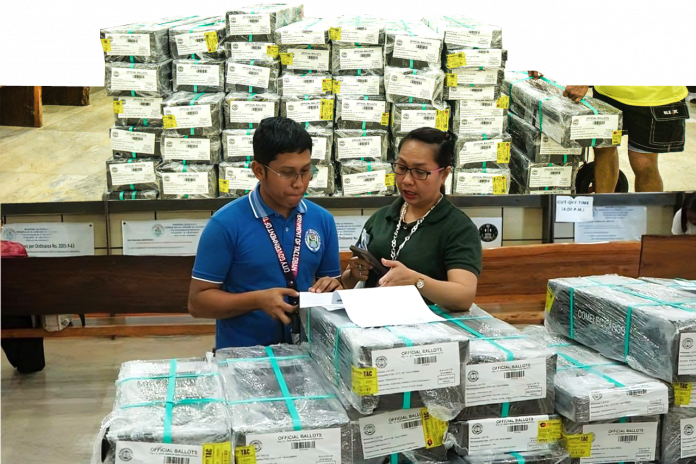
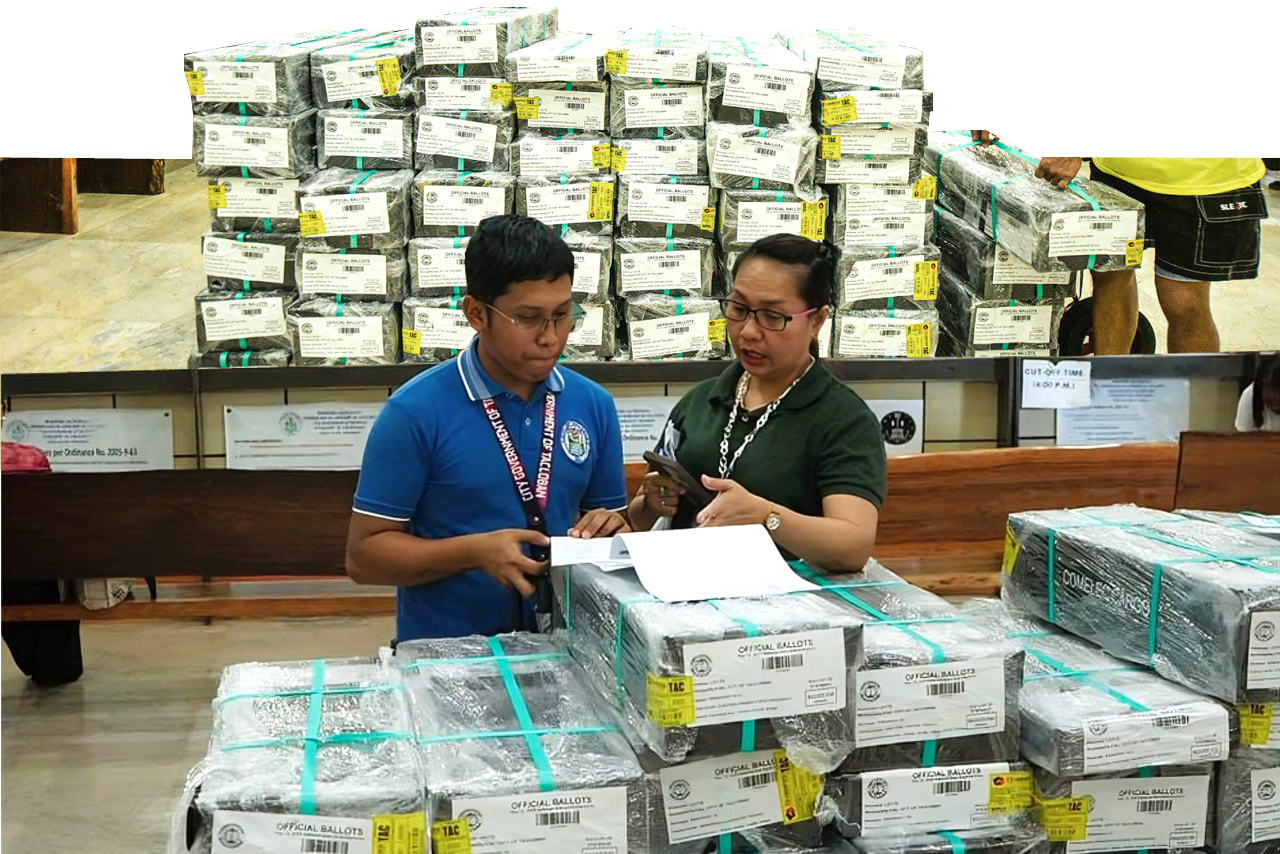
ELECTION-READY. Acting City Treasurer Jennifer Guy receives official ballots and election paraphernalia at the City Treasurer’s Office on April 30, ahead of the May 12 polls in Tacloban City. More than 30 public schools across the city will function as polling centers, housing a total of 223 voting precincts.
(TACLOBAN CITY INFORMATION OFFICE)
On Malacañang probe due to poor service
ELECTION-READY. Acting City Treasurer Jennifer Guy receives official ballots and election paraphernalia at the City Treasurer’s Office on April 30, ahead of the May 12 polls in Tacloban City. More than 30 public schools across the city will function as polling centers, housing a total of 223 voting precincts. (TACLOBAN CITY INFORMATION OFFICE)
TACLOBAN CITY — Water consumers from this city and nearby towns have welcomed Malacañang’s decision to investigate Prime Water Infrastructure Corp. following mounting complaints over poor service.
Prime Water, which entered a 25-year joint venture with the Leyte Metropolitan Water District (LMWD) in 2019, took over operations previously handled solely by the water district. The partnership was intended to improve water services for over 50,000 customers.
But residents say conditions only worsened.
“They are giving us poor service. Not only is the water supply insufficient, but it also smells bad,” said Marlyn Olimpo, a resident of Tacloban City. “I have to wake up very early almost every day because water only comes out of the tap during those hours.”
Olimpo expressed hope that the investigation ordered by President Ferdinand Marcos Jr. would finally lead to better service.
In Sta. Fe town, a resident who declined to be named shared a similar complaint.
“There are times when we have no water at all, yet our bill has gone up to over P3,000 a month—from just P600 before,” she said.
The Freedom from Debt Coalition-Eastern Visayas also voiced support for the probe.
Regional coordinator Fara Diva Gamalo reiterated their opposition to the privatization of public utilities, especially water services.
“Regulation should be the responsibility of the state, not of private companies whose goal is profit,” Gamalo said. “As long as it’s profit-driven, the focus will never be on service.”
She called on Malacañang to expand the investigation to include all areas served by Prime Water, saying the situation in Tacloban mirrors those in other parts of the country.
Prime Water also operates the water district in Maasin City, Southern Leyte, which has more than 5,000 consumers—many of whom have also raised complaints about poor service.
The Leyte Samar Daily Express sought comment from LMWD-Prime Water, but had not received a response as of press time.
But in past statements, the company has said it remains committed to improving service, including replacing aging pipelines and rehabilitating facilities.
LMWD-Prime Water also services the towns of Palo, Tolosa, Tanauan, Jaro, Sta. Fe, Pastrana, Tabon-Tabon, and Dagami.
Water sources include rivers in Barangay Tingib (Dagami) and Barangay Hibunawan (Jaro), as well as Lake Danao in Ormoc City, and the Hinabayun and Binahaan rivers in Jaro.
CHIEF. Movie actress and television host Karla Estrada addresses rumor that she is heading to the regional office of the Department of Tourism in a media interview. The current tourism director, Karen Tiopes, is to retire this year. (FILE PHOTO)
Amid rumor she will hold the said post
CHIEF. Movie actress and television host Karla Estrada addresses rumor that she is heading to the regional office of the Department of Tourism in a media interview. The current tourism director, Karen Tiopes, is to retire this year. (FILE PHOTO)
TACLOBAN CITY – Actress and television host Karla Estrada hinted at the possibility of stepping into a government role, saying she is ready to help lead the tourism industry in Eastern Visayas if given the opportunity.
In a media interview on Sunday night, May 4, Estrada, who hails from Tacloban City, was asked about rumors that she may be considered as the next regional director of the Department of Tourism (DOT) in Eastern Visayas.
While she did not confirm the speculation, Estrada expressed her willingness to serve.
“While I am not confirming it, I am actually ready. I would really love to help promote the tourism of our region, Eastern Visayas,” Estrada said. “I feel I am in a position to help. We have many tourist attractions that are either not well-promoted or not fully developed.”
The position may soon become vacant as current DOT-8 Regional Director Karina Rosa Tiopes is expected to retire later this year. Tiopes has been widely credited for her long-standing efforts in positioning Eastern Visayas as a rising tourism destination in the country.
Estrada, who earned a degree in Office Administration from Philippine Christian University in 2023 under the Expanded Tertiary Education Equivalency and Accreditation Program (ETEEAP), said her background in entertainment could serve as a unique asset.
“I think I can really be of help in promoting our tourism industry,” she added, noting that her public influence could be used to raise awareness and interest in the region’s cultural and natural attractions.
ETEEAP is a government-recognized alternative education program that allows working professionals to obtain a college degree based on their work experience, knowledge, and skills.
Currently, Estrada serves as the director for community engagement of the Tingog party-list, founded by Leyte 1st District Representative and House Speaker Ferdinand Martin Romualdez.
She was the party-list’s third nominee during the 2022 elections. Tingog now holds two seats in the House, represented by Reps. Yedda Marie Romualdez and Jude Acidre.
Estrada is also the mother of popular actor Daniel Padilla and has remained active in both show business and community initiatives.
“I’m proud to be Waray. And I’ll always be ready to serve our region in any way I can,” she said. (JOEY A. GABIETA)
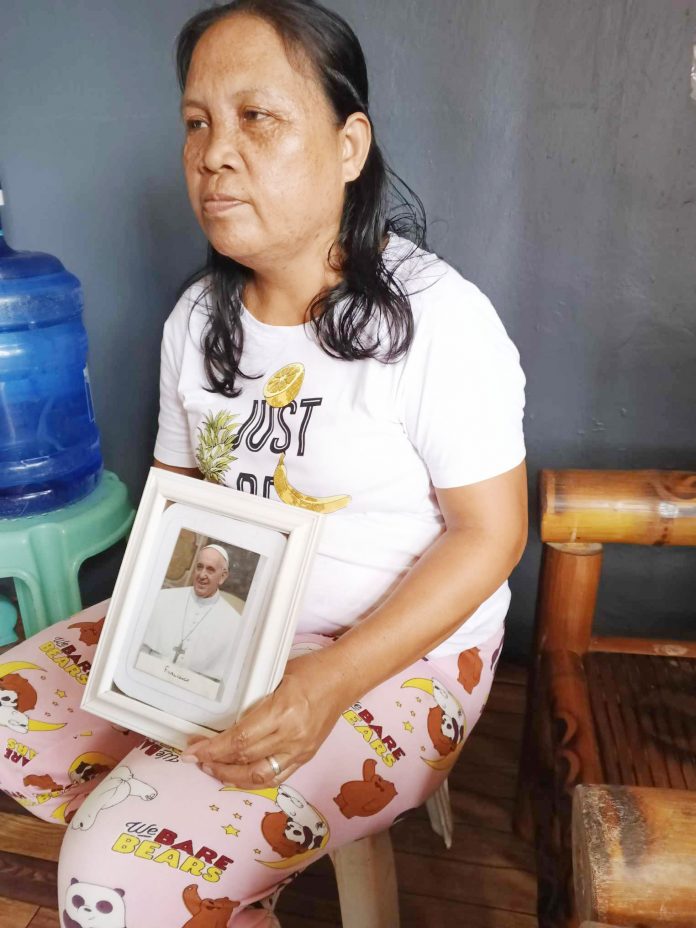
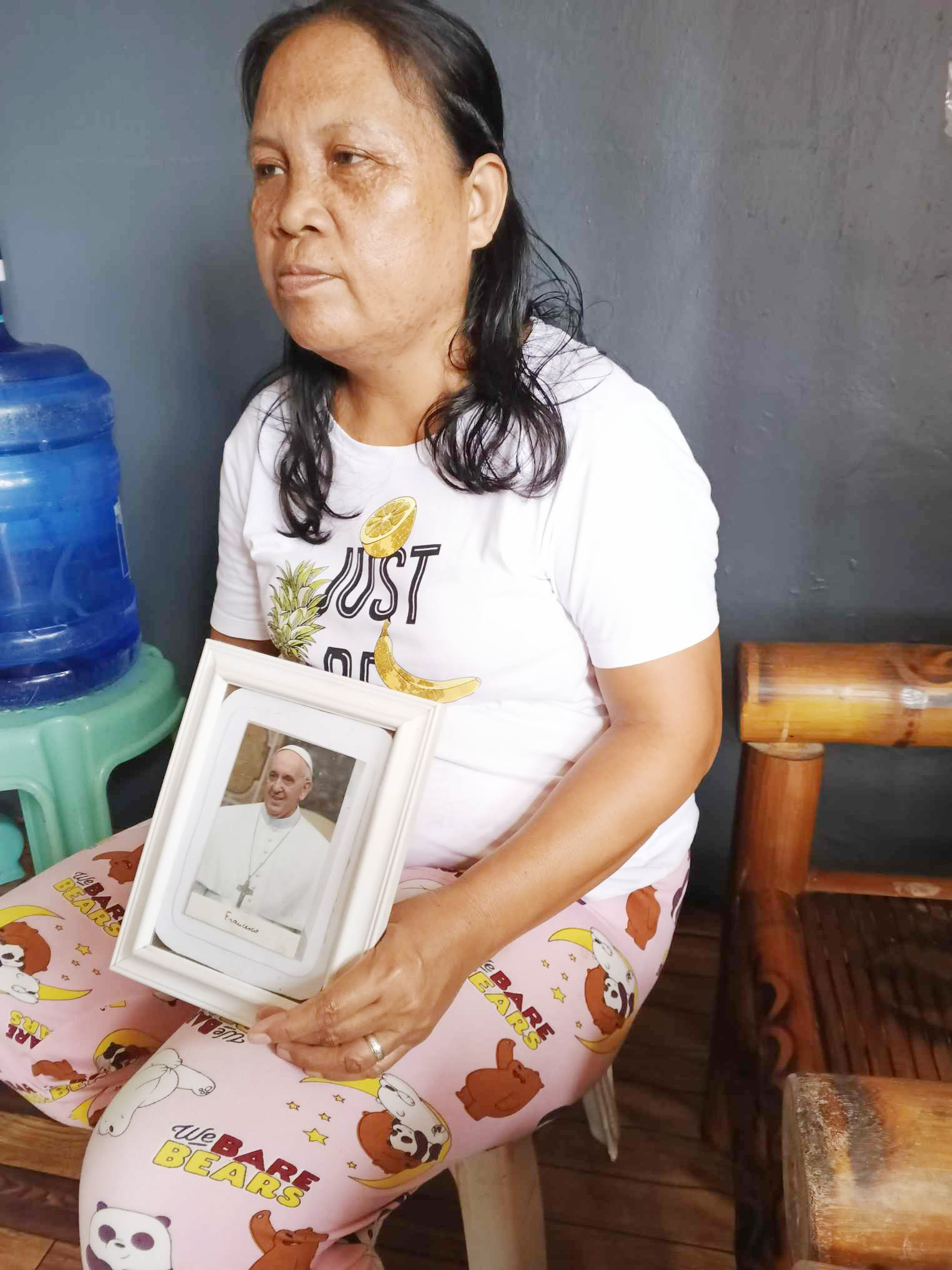
Jenita Aguilar, holding a photo frame of Pope Francis, said she feels blessed to see personally the late Pontiff. (JOEY A. GABIETA)
TACLOBAN CITY – For many residents of Leyte, the passing of Pope Francis on April 21 stirred deep memories of his historic 2015 visit—a moment that brought healing and hope to a province still reeling from the devastation of Super Typhoon ‘Yolanda.’
Jenita Aguilar, holding a photo frame of Pope Francis, said she feels blessed to see personally the late Pontiff. (JOEY A. GABIETA)
Among them is 12-year-old Jullian Jeanars Aya-ay, who, as a toddler, was blessed and cradled by the Pontiff during his unannounced stop in Barangay 86, San Jose, one of the areas hardest hit by the 2013 disaster. Though Jeanars has no memory of the encounter, its significance has never been lost on him.
“I don’t remember that day, but when I learned he passed away, I felt really sad,” he said in an interview at his aunt’s home in San Jose.
On that stormy January 17, 2015, Pope Francis—dressed in a yellow poncho and braving another typhoon, ‘Amang’—held a deeply emotional Mass at Tacloban Airport attended by over 200,000 people. On his way to Palo, he made an unscheduled stop at the Aya-ay family’s roadside house, blessing the family, holding young Jeanars, and giving them rosaries.
Cecile Acebedo shows the dress she wore during her meeting with Pope Francis for lunch at the Archbishop’s Palace in PALO,Leyte in Jan.17,2015. (Cecile Acebedo)
Both of Jeanars’ parents have since passed away. He and his siblings—Jayson Jay, 22; John Mark, 20; and Francheska, 9—now live with relatives in Ridgeview Village, a Yolanda relocation site.
Jeanars, who recently graduated from elementary school, said he hopes to finish his studies in honor of the special moment with the Pope.
Eldest brother Jayson Jay, now working while completing college, vividly recalls the encounter. “It was an experience of a lifetime. I offered a silent prayer when I heard the news of his passing.”
Their youngest sister Francheska, born seven months after the papal visit and named in honor of the Pope, said: “I feel blessed to be named after him. But I’m also sad that he’s gone.”
Their aunt, Jenita Aguilar, 54, described the Pope’s visit as life-changing. “I feel truly blessed to have seen him—not just once, but twice,” she said tearfully. Aguilar also saw the Pope in 2018 during the World Meeting of Families in Ireland, thanks to an invitation from a humanitarian group.
She keeps the rosary given by Pope Francis on her altar and credits his spiritual presence for helping her cope with the loss of her son, who went missing during Yolanda.
‘More than just a visit’
Cecile Acebedo, 48, of Palo, had the rare privilege of sharing a meal with Pope Francis at the Archbishop’s Palace during his visit. “It’s not every day you meet a Pope, much less share a table with him,” she said.
Acebedo, who lost her mother in Yolanda, recalled that she could barely eat during the lunch. “We were in disbelief. I remember he had malunggay-flavored soup. When it was my turn to speak, I thanked him in Italian. He smiled at me.”
Instead of asking for personal favors, she prayed for healing and her family’s future. Her sister, whom she prayed for that day, later passed her overseas employment exam and now works in Rome—fulfilling a dream once held by their late mother.
Everyday encounters, lasting memories
Even those who only caught a glimpse of the Pontiff during his visit cherish the experience.
Marilyn Ecap, 54, said she prayed for her son’s success in the engineering board exams. “He’s now a licensed engineer,” she said proudly.
Corazon Palanas, 53, also from San Jose and now in Ridgeview Village, recalled how she unexpectedly cried when she saw the Pope. “I don’t know why, but I cried—and yet I felt peace.”
Fr. Chris Militante, spokesperson for the Archdiocese of Palo, said the archdiocese is encouraging the faithful to offer prayers for the late Pontiff. Militante, who welcomed the Pope during his 2015 visit, remembered his humility. “He was soaking wet but smiling, even cracking jokes.”
The Vatican, through Pope Francis’s initiatives, helped rebuild over 30 churches in the region, including the Palo Cathedral. One of the Pope’s enduring legacies is the Pope Francis Home for Orphans and the Elderly, established in 2015 and run by the Korean missionary group Kkottongnae.
According to Sister James Montalban, the facility’s administrative secretary, over 150 residents, mostly Yolanda survivors, have received shelter and care. “Today, we serve 52 families who continue to need help,” she said, adding that a novena was offered for the Pope’s soul immediately upon confirmation of his death.
Mourning a Friend and Spiritual Father
For those who met him—or simply saw him pass by—Pope Francis’s visit remains a powerful symbol of hope, solidarity, and healing. In the words of Jenita Aguilar, “He helped us move forward. He reminded us that we were not forgotten.”
Unemployment drops, but underemployment remains a concern
TACLOBAN CITY — Eastern Visayas recorded an improved employment rate of 97.6 percent in January 2025, according to the latest data from the Philippine Statistics Authority (PSA).
This is a significant increase from 94.5 percent in January 2024 and 96.9 percent in October 2024, signaling continued recovery and growth in the region’s labor market.
The higher employment rate means that 2.09 million people were employed out of the 2.14 million in the labor force as of January 2025.
This marks a notable rise of 231,000 employed persons compared to the 1.86 million employed in January 2024, and 19,000 more than the 2.07 million reported in October 2024.
Consequently, the unemployment rate in the region dropped to 2.4 percent, down from 5.5 percent in January 2024 and 3.1 percent in October 2024.
The figure translates to about 52,000 unemployed individuals in January 2025, compared to 107,000 a year earlier and 66,000 in the previous quarter.
Despite the positive employment trend, the underemployment rate—which measures the percentage of employed persons seeking more hours of work or additional jobs—was recorded at 16.1 percent.
This means that approximately 335,000 employed individuals in Eastern Visayas were still looking for better or additional work opportunities.
The region also posted a Labor Force Participation Rate (LFPR) of 63.4 percent, indicating that 2.14 million individuals were actively participating in the labor force out of an estimated 3.37 million population aged 15 years and older.
These figures suggest that while job availability in Eastern Visayas has improved, the quality and sustainability of employment remain critical areas for policy intervention.
Authorities and stakeholders are expected to focus on addressing underemployment, enhancing skills development, and creating more decent and stable jobs for the growing workforce.
SECURITY PREPARATIONS. Security authorities in Leyte are all ready for this Monday’s national elections. Leyte elections provincial supervisor lawyer Ma. Goretti Cañas said that the increased presence of both police and soldiers across the province is seen to secure the conduct of balloting in the province.(FILE PHOTO)
SECURITY PREPARATIONS. Security authorities in Leyte are all ready for this Monday’s national elections. Leyte elections provincial supervisor lawyer Ma. Goretti Cañas said that the increased presence of both police and soldiers across the province is seen to secure the conduct of balloting in the province.(FILE PHOTO)
TACLOBAN CITY– With the 2025 national and local elections set next Monday, May 12, the Provincial Joint Security Control Center (PJSCC) in Leyte has reaffirmed its commitment to ensuring a secure and peaceful electoral process.
In a report released by the 8th Infantry Division, Philippine Army (8th ID), the assurance came during a Joint Security Control Center conference held on April 29 at Camp Downes in Ormoc City. The meeting was attended by key stakeholders from the military, police, and election sectors.
According to the 8th ID, Atty. Ma. Goretti Cañas expressed confidence in the collaborative efforts of the Armed Forces of the Philippines (AFP), Philippine National Police (PNP), Philippine Coast Guard (PCG), and other agencies in maintaining election integrity.
Police chiefs from towns classified under the Commission on Elections (Comelec) “yellow” and “orange” categories—meaning areas of concern and immediate concern—particularly in Leyte’s 3rd and 4th districts, also gave updates on local peace and order conditions.
“Expect an increased police presence, regular patrols, and checkpoints. These are part of our proactive measures to prevent any election-related violence or disruptions,” said Police Col. Dionisio Apas Jr, Leyte police provincial director.
Col. Arlino Sendaydiego, chief of staff of the 8th ID and Task Force HOPE Eastern Visayas commander, assured residents, especially those in geographically isolated and disadvantaged areas (GIDAs), that all security forces are working together to ensure the safety of both voters and election personnel.
“This collaborative effort aims to protect the electorate from intimidation and threats, and to guarantee that their freedom of choice is respected. We also commit to safeguarding personnel from the Department of Education and other agencies involved in the polls,” he said.
8th ID Commander Maj. Gen. Adonis Ariel Orio emphasized the importance of securing not only the voting process but also the transportation and protection of election materials.
“Safeguarding the accurate and transparent counting of votes is essential to upholding the people’s will. Our troops are reminded to remain nonpartisan and professional throughout the entire electoral process,” Orio said.
The 8th ID concluded its statement by reiterating its dedication to a peaceful democratic exercise and called on all stakeholders to support the cause of free and fair elections in Leyte and the rest of the region.