TACLOBAN CITY– A young person with a disability was shot dead Saturday evening, March 7, while trying to protect friends from harassment in Barangay 95, Caibaan.
The victim, identified as alias “Eson,” 18, a person with a speech and language impairment from Barangay 96, was declared dead on arrival at Tacloban City Hospital after sustaining a gunshot wound to the chest.
Police said the suspect, alias “Mamar,” 19, an out-of-school youth from Barangay 95, allegedly shot Eson during a confrontation over the harassment incident.
According to Police Station 1 of the Tacloban City Police Office (TCPO), witnesses said Eson stepped in to help his friends when the suspect suddenly drew an improvised firearm and fired. Despite running to seek help from bystanders, Eson succumbed to his injury.
A follow-up police operation led to the arrest of Mamar in Barangay 95-A, Caibaan. The firearm used in the attack has not yet been recovered. Formal charges are being prepared, and the suspect remains in police custody pending proper disposition.
Police continue to investigate the circumstances surrounding the shooting and are coordinating with witnesses to gather further evidence.
TACLOBAN CITY — The city government of Calbayog has launched an online registry aimed at strengthening communication with its residents working abroad, particularly those in areas affected by conflict or crisis.
At least 170 Calbayognons currently living or working in the Middle East have already registered in the I-Konek Calbayog Registry Portal, a digital platform designed to build a database of the city’s overseas residents.
City officials said the initiative was developed by the local government through its Local Planning and Development Office to ensure that Calbayognons abroad can be easily contacted during emergencies.
According to the city government, the registry will allow authorities to send timely advisories, updates, and assistance programs to overseas residents, especially those in regions experiencing political unrest or humanitarian emergencies.
The program is being implemented with the support of Mayor Raymund Uy and Vice Mayor Rex Daguman as part of efforts to strengthen the protection and welfare of migrant workers from the city.
Officials said the portal also aims to keep overseas Calbayognons connected with the city’s programs and development initiatives while allowing them to remain involved in the cultural, social, and economic life of their hometown.
The local government is encouraging more Calbayognons abroad—particularly those in the Middle East—to register in the portal to help expand the city’s support and communication network for migrant residents.
Authorities said maintaining an updated database of overseas residents will help the city government respond more effectively and provide assistance should emergencies or crises arise in the countries where they are working.
The Department of Budget and Management Regional Office VIII (DBM-RO8) successfully convened the Regional Budget Forum for the Fiscal Year (FY) 2027 Budget Preparation held at The Tropics, McArthur Park Resort, Candahug, Palo, Leyte last February 10, 2026. The activity was attended by various representatives from National and Regional Government Agencies, including the Department of Public Works and Highways Northern Samar Second District Engineering Office (DPWHNSSDEO). The Office was represented by Engr. Joseph C. Romance, Chief, Planning and Design Section; Ms. Maria Lourdes L. Sebanes, Administrative Officer IV (Budget Officer II); and Engr. Jesther Dhiann P. Sosing. Their participation underscores the Office’s commitment to sound fiscal planning and to ensuring alignment with national and regional development priorities.
The program formally commenced with an inspiring opening message from Director Imelda C. Laceras, of the Department of Budget and Management-Regional Office 8 (DBM-RO8), who underscored the importance of strategic planning, fiscal discipline, and results-oriented budgeting in achieving sustainable development goals for the Region.
This was followed by the keynote message delivered by Hon. Carlos Jericho L. Petilla, Chairperson of Regional Development Council (RDC) VIII, who emphasized the crucial role of collaboration among agencies in aligning budget proposals with the region’s priority programs and development agenda.
Assistant Director Aleli N. Hernandez then presented the “FY 2027 Budget Preparation at a Glance,” providing participants with an overview of the budget framework, timelines, and policy directions guiding the upcoming fiscal year.
A series of comprehensive discussions were followed: a) Preparation of the FY 2027 Budget: Guidelines on the Foundation of Tier 1 and Tier 2 was discussed by Ms. Mylene G. De Veyra, Supervising Budget and Management Specialist (BMS), who clarified the distinctions between ongoing commitments (Tier 1) and new or expanded programs (Tier 2), ensuring agencies properly align their proposals with national priorities; b) Conduct of Program Convergence Budgeting was tackled by Mr. Neuman M. Gallardo, Supervising BMS, highlighting the importance of inter-agency coordination to avoid duplication and maximize resource utilization; c) Budget Preparation Forms and Instructions (Updates) were presented by Ms. Rizza Joy D. Barras, Administrative Officer V, detailing revisions and technical requirements for accurate and compliant submission; and d) Submission Requirements and Budget Preparation Calendar were explained by Ms. Rhona B. Capatoy, Supervising BMS, stressing adherence to timelines to facilitate a smooth evaluation and review process.
The discussion on the 2026 Fund Release Guidelines (NBC No. 599 dated January 05, 2026) was delivered by Mr. Emilio M. Albos III, Chief Administrative Officer, providing agencies with updated policies governing fund release and execution to ensure accountability and efficiency.
The forum concluded with closing remarks from Assistant Director Hernandez, who reiterated the significance of timely, transparent, and performance-informed budget preparation.
The Regional Budget Forum served as a vital platform for strengthening collaboration, enhancing technical capacity, and ensuring that the FY 2027 budget proposals are responsive, strategic, and development-focused for Eastern Visayas.
TACLOBAN CITY — Hundreds of participants from government agencies, civil society groups, and various sectors joined a Women’s Walk early Friday morning, March 6, as the city formally kicked off the celebration of National Women’s Month.
Spearheaded by the Tacloban city government, the unity walk began at around 5 a.m. along Magsaysay Boulevard and proceeded through Real Street before culminating at the Tacloban City Convention Center.
The activity forms part of the nationwide observance led by the Philippine Commission on Women, which highlights the vital role of women in nation-building and advocates for gender equality and women empowerment.
This year’s celebration carries the theme “We for Gender Equality and Inclusive Society,” emphasizing the need to expand economic opportunities and ensure equal participation for women in all sectors while promoting inclusive development.
The campaign also highlights the subtheme “Lead like the Babaylans, Filipina,” encouraging women to draw inspiration from the babaylan, the respected female spiritual and community leaders in pre-colonial Philippine society, known for their wisdom, leadership, and role in guiding their communities.
Participants in the walk included barangay officials, employees of the city government, and representatives from several partner agencies such as the Department of the Interior and Local Government in Tacloban, Tacloban City Police Office, Bureau of Jail Management and Penology female dormitory personnel, the Philippine Information Agency, members of the Philippine Army, Philippine Air Force, and the Philippine National Police Maritime Group, among others.
Ednadette Morado, a barangay council member and focal person on Violence Against Women (VAW), said joining activities such as the women’s walk helps highlight the growing role of women in society.
“The women’s walk shows that women are not just women, but a huge contributing factor that gives balance in our society. Today, women are already empowered and part of decision-making in many aspects of community life,” Morado said.
Following the walk, participants gathered in front of the convention center for a Zumba session, further energizing the morning celebration.
During the program, Visitacion Giva, city director of the Department of the Interior and Local Government in Tacloban, emphasized that the pursuit of gender equality remains a continuing journey that requires collective effort.
“Every step we take during the women’s walk reminds us that the journey towards equality is ongoing. It is shaped by courage, determination, and the collective effort of women and men working together to build a more just and inclusive society,” she said.
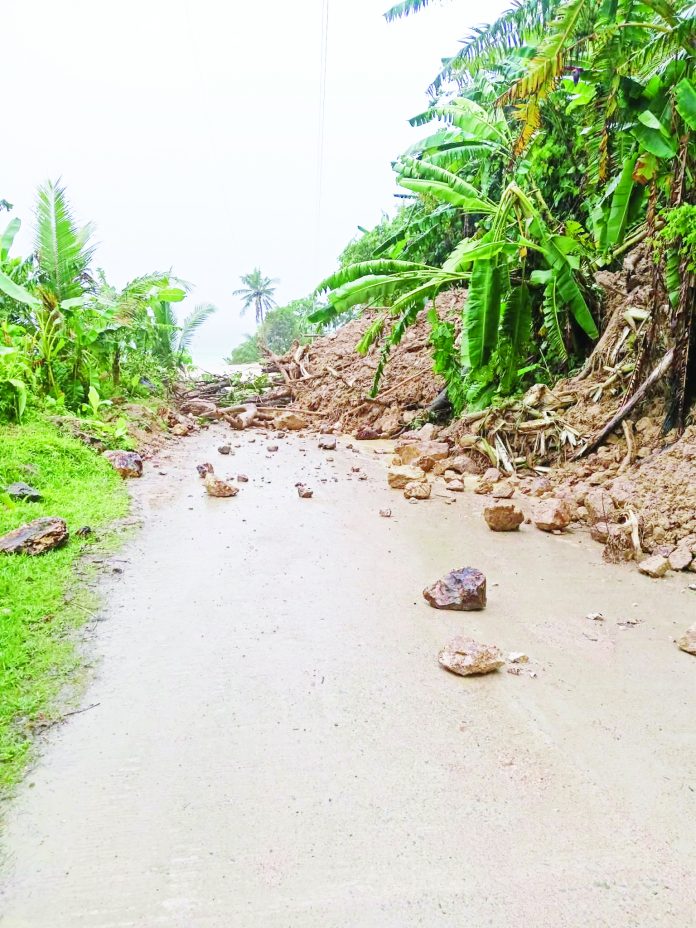
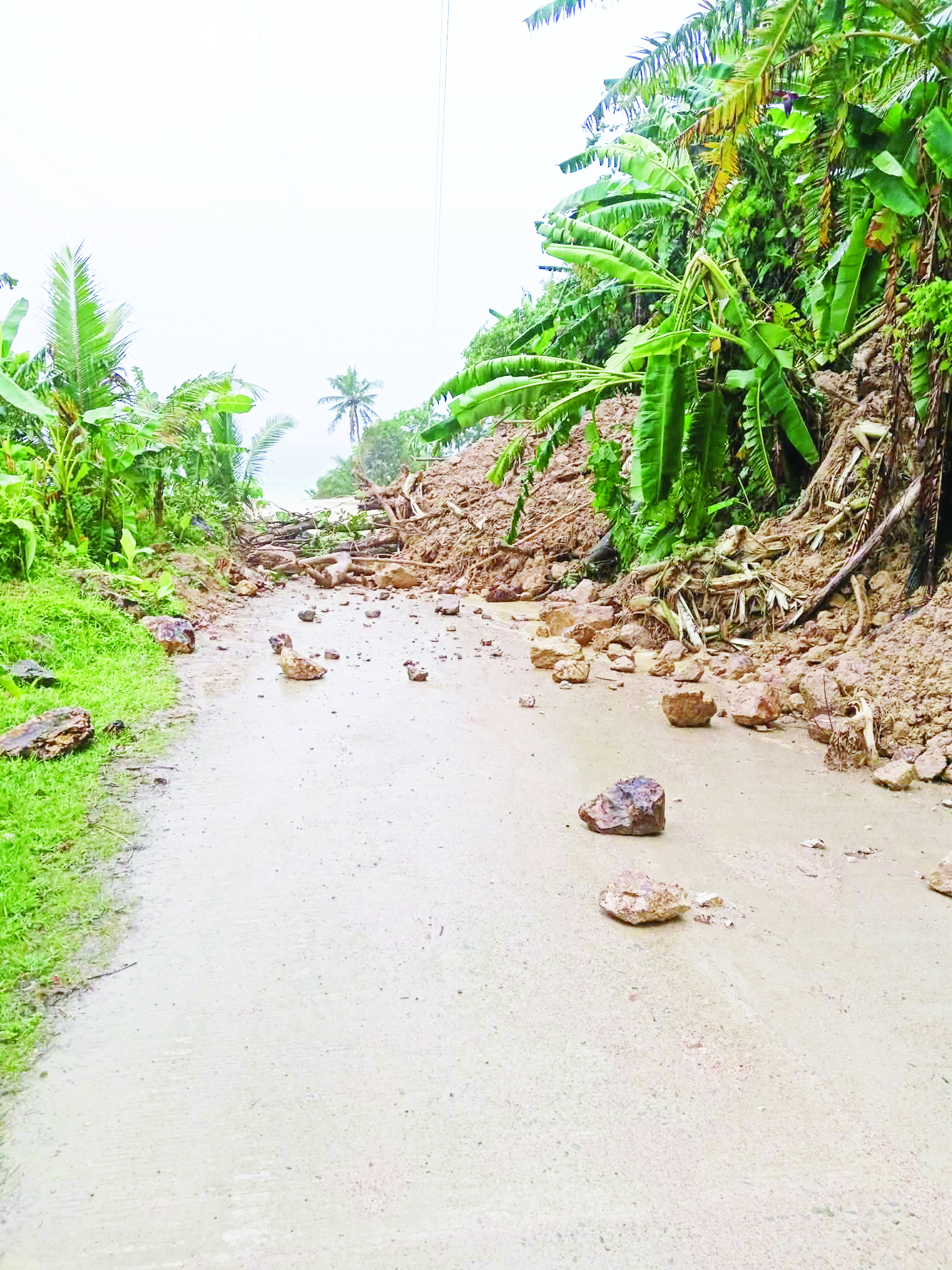
LANDSLIDE. Heavy rains spawned by the low pressure area resulted in a landslide incident in San Ricardo, Southern Leyte. The bad weather has also forced several local government units in Eastern Visayas.(PHOTO COURTESY)
LANDSLIDE. Heavy rains spawned by the low pressure area resulted in a landslide incident in San Ricardo, Southern Leyte. The bad weather has also forced several local government units in Eastern Visayas.(PHOTO COURTESY)
TACLOBAN CITY — Several local government units across Eastern Visayas suspended classes on Monday, March 9, as persistent rains triggered by a weather disturbance raised concerns over flooding and landslides in parts of the region.
The suspensions came after the Philippine Atmospheric, Geophysical and Astronomical Services Administration (Pagasa), an agency under the Department of Science and Technology, warned of moderate to occasionally heavy rains and thunderstorms affecting Eastern Visayas due to the trough of a low-pressure area combined with the northeast monsoon.
In General Flood Advisory No. 2 issued at 6 a.m. Monday, Pagasa said the continuous rains within the next 12 hours could cause rivers and tributaries in several areas to swell, increasing the risk of flooding.
Among the areas being closely monitored are river systems in Borongan City in Eastern Samar, Catbalogan City in Samar, and Tacloban City in Leyte, as well as other flood-prone areas across the region.
The weather bureau also urged residents living near mountain slopes and low-lying communities to remain vigilant for possible flash floods and landslides, particularly in the provinces of Eastern Samar, Leyte, Biliran, Samar, Southern Leyte, and Northern Samar.
In response to the adverse weather, several municipalities ordered the suspension of face-to-face classes to ensure the safety of students and school personnel.
In Sogod, Southern Leyte, authorities suspended in-person classes from kindergarten to senior high school in both public and private schools until further notice due to continuous rainfall and a yellow rainfall warning issued by Pagasa.
Classes at all levels were also suspended in Libagon, Southern Leyte due to heavy rains affecting the municipality.
Similarly, the local government of Hinunangan, Southern Leyte suspended classes in all public and private schools following Pagasa’s heavy rainfall warning.
The suspension in Hinunangan includes both teaching and non-teaching personnel, except those required for emergency response and safety operations as determined by school heads.
In San Miguel, Leyte, officials also ordered the suspension of classes in all levels across the municipality due to the expected bad weather.
The suspension covers teaching and non-teaching personnel under the Department of Education in the San Miguel District, although employees in government offices were directed to report to work to ensure uninterrupted public services.
Meanwhile, the municipal government also moved the scheduled municipal parade and presentations originally set for Monday to March 10 at 7 a.m., while a planned bloodletting activity will proceed as scheduled with safety measures in place.
Classes were likewise suspended in Llorente, Hernani, Balangiga, Gen. MacArthur, Quinapondan, Eastern Samar following the recommendation of the local Municipal Disaster Risk Reduction and Management Office (MDRRMO) due to worsening weather conditions.
The continuous downpour also triggered a landslide that blocked a road in Sitio Caingin, Barangay Pinut-an in San Ricardo, Southern Leyte early Monday, authorities reported.
No residents were in the area at the time of the incident and no injuries were reported. The Provincial Disaster Risk Reduction and Management Office noted that the area is chronically prone to landslides, especially during periods of prolonged rainfall.
Motorists were advised to avoid the affected road as heavy rains continue to affect the province.
Pagasa said the rains are being enhanced by the trough of a low-pressure area located outside the Philippine Area of Responsibility, which is influencing weather conditions across Eastern Visayas.
Local disaster officials said they will continue to monitor the situation closely and issue further advisories if necessary, while urging residents and travelers to remain cautious, particularly in flood-prone and landslide-prone areas, until the weather improves.
UNITY ROAD. The long dream to link the three Samar provinces is slowly being realized as Public Works and Highways Sec. Vince Dizon assured the officials of the Samar Island of needed funding that will result to the completion of various road projects that will connect the island. Dizon met the officials of the Samar Island on March 10. (ROEL T. AMAZONA)
A multi-year project
UNITY ROAD. The long dream to link the three Samar provinces is slowly being realized as Public Works and Highways Sec. Vince Dizon assured the officials of the Samar Island of needed funding that will result to the completion of various road projects that will connect the island. Dizon met the officials of the Samar Island on March 10. (ROEL T. AMAZONA)
UNITY ROAD. The long dream to link the three Samar provinces is slowly being realized as Public Works and Highways Sec. Vince Dizon assured the officials of the Samar Island of needed funding that will result to the completion of various road projects that will connect the island. Dizon met the officials of the Samar Island on March 10. (ROEL T. AMAZONA)
TACLOBAN CITY — The national government is pushing the construction of a multi-billion-peso road network linking the three Samar provinces, a project officials say could help spur development and weaken insurgency in remote communities.
Vince Dizon, secretary of the Department of Public Works and Highways, said the Samar Island tri-boundary road project will connect the provinces of Samar, Eastern Samar, and Northern Samar through a network of major roads.
Dizon discussed the project during a meeting on March 10 with local officials at the DPWH regional office in Palo, Leyte.
“This is a priority project of our President. We will complete this. It may not be finished in one or two years, but our commitment is to secure multi-year appropriations for the next five years,” Dizon said in an interview.
The infrastructure program will cover about 612 kilometers of roads with an estimated cost of P32.78 billion and is expected to be implemented over several years.
Dizon said improved connectivity will make it easier for residents to access markets, government services, and economic opportunities, while also helping government forces reach interior communities where insurgent groups have historically operated.
“This tri-boundary road project is critical not only for the economic welfare of the provinces in Samar Island but also for our anti-insurgency campaign and national security efforts,” Dizon added
The project is among the priority infrastructure initiatives of the administration of Ferdinand Marcos Jr., with funding already allocated for several road segments in recent years.
For his part, Edwin Ongchuan, representative of the second district of Northern Samar, welcomed the continued government support, noting that areas such as Las Navas, Northern Samar have long faced insurgency concerns.
Ongchuan said the road network is expected to improve security while opening economic opportunities for communities across Samar Island and the rest of Eastern Visayas.