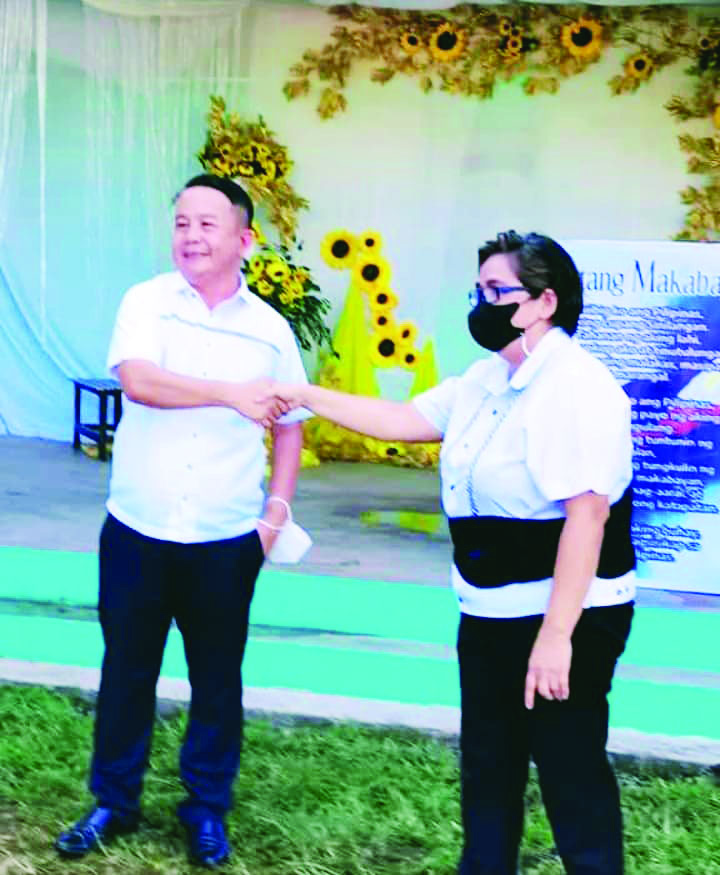
TACLOBAN CITY – Maasin City Mayor Nacional Mercado disclosed that their new quarantine facility is almost complete and ready to accommodate arriving locally stranded individuals (LSIs).
The facility can accommodate around 50 individuals, the mayor said.
“This may not be as comfortable compared to your own rooms but we are doing our best in giving quality service to our constituents most especially on times of crisis,” Mercado said.
The facility is in addition to the existing quarantine areas identified by the city government and to the quarantine facility provided by Philippine Red Cross-Southern Leyte chapter.
Meanwhile, the city government will make it mandatory that all returning residents of the city should undergo swab testing within seven days counting on their arrival.
However, returning residents of Maasin City who remain asymptomatic after 21-days of isolation in quarantine facilities will be discharged despite pending test results.
Those who will be tested positive and have finished their isolation would no longer be asked for another swab testing.
Those with negative results before the end of the mandatory 14-day quarantine must stay in the designated facilities to complete the prescribed isolation period.
The city government have separate quarantine facility for health workers that can accommodate up to seven individuals in separate isolation areas with two separate disinfection tents.
As of July 15, Maasin City had recorded eight confirmed COVID-19 patients, where six had already recovered while two are still active cases.
(ROEL T. AMAZONA)
Maasin City’s new quarantine facility now ready for returnees
Tacloban old dumpsite to be converted into a floral garden
TACLOBAN CITY- The Tacloban City Environment and Natural Resources Office (CENRO) will be doing a floristic restoration of the old dumpsite in Barangay 106, Tacloban City North, according to City ENR Officer Jonathan R. Hijada, together with Site Coordinator Marito Barillo, environmental officer II.
The restoration of the old dumpsite to make it ecologically stable again is a move to convert the land into a tourist destination, in support of Mayor Alfred Romualdez’ goal to beautify the site, and his dream of bringing back Green Revolution to Tacloban City.
The soon to rise two-hectare natural floristic park will showcase local species and certain types of plants which have been carefully considered for the type of soil of the old dumpsite/park site: shrub trees (Paguringon or Kakawate), ornamentals (Kalipayan or San Francisco), and creepers (Kudzu and the local vines present in the area). Such planting activity is set to happen in August of 2020.
The natural park which will be filled with beautiful flower trees, shrubs, and creepers amidst the “greens” in the north is something for Taclobanons to look forward to a few months from now.
(TACLOBAN CITY INFORMATION CENTER)
Thriving barter community members welcome DTI’s non-tax pronouncement
TACLOBAN CITY – The barter community in Tacloban welcomes the clarification made by the Department of Trade and Industry (DTI) on an earlier report that online barter is illegal and must be taxed.
Some residents of Tacloban and from neighboring towns in Leyte province have created an online group accounts called as Tacloban Barter Community and Leyte Barter Community where they regularly share items they want to exchange with others.
The barter trading boomed during the quarantine period as the movements of the people were restrained due to the coronavirus disease 2019(COVID- 19) pandemic.
“If makikita niyo ang Tacloban barter page, mostly sa makikita ninyo na bina-barter ay mga groceries and daily needs like rice and other commodities,” Rhoel Ladera, Tacloban Barter Community member, said.
“Barter became lifeline of many, dahil sa hirap na nararanasan nila, may mga nawalan ng trabaho, at mga businesses na humina ang kita dahil sa COVID-19,” he added.
Ladera added that because of barter, what other people think are trash or useless in their homes became useful during the health crisis.
Tacloban City Vice Mayor Jerry Yaokasin, who is also active in joining the barter community, said that the announcement of DTI is good news to many individuals who are engaging in barter trade.
“This will now encourage many to survive, turning their throwaways & unused/used/extra items into something that they can actually use,” Yaokasin said.
“In this time of pandemic and prolonged quarantine, many people lost their regular sources of income. With no more cash on hand to buy daily necessities, the barter community provides a platform for members to trade their unused/used items for essential supplies. This is welcome relief for many cash-strapped individuals and families,” he added.
Through barter, Yaokasin exchanges grocery goods with old things or vintage items which he collects for his plan of putting up a mini-museum.
“Rather than complain and wait for government dole-outs during this pandemic, online barter gave many residents at home the opportunity to become productive and entrepreneurial. They are not trying to earn, but survive,” he added.
Among those who benefited the online barter trade is a senior citizen named Lito, who exchanged his own produced vinegar with grocery.
Through the help of Angelyn Ladrera Sabusap, the vinegar that he produced was posted over Tacloban Barter Community in exchange of a coffee.
The post became viral in the barter community and received many deals. From his request of coffee in exchange to his vinegar, the barter community members made a deal of bartering his goods with grocery items, fruits, vegetables, rice, that help him for his daily need.
(ROEL T. AMAZONA)
Tacloban’s SCAN system now in full operation

For COVID-19 contact tracing

By:Joey A. Gabieta
TACLOBAN CITY- About 150,000 individuals from this city and those residing in other parts of the region have availed of a system introduced by the city government for easy contact tracing relative to the pandemic caused by the coronavirus disease 2019(COVID-19).
This was disclosed by Randy Calahi, head of the Management Information System (MIS), who said that they are overwhelmed with the response of the public.
It was the office of Calahi that developed the system dubbed as surveillance, contact tracing, analysis and networking (SCAN) which took effect on Thursday (July 16).
According to Calahi, 80,000 people have registered the system online while about 70,000 cards were distributed to all 138 barangays in the city wherein one household is entitled to one SCAN card.
The program is part of the campaign of the city government under Mayor Alfred Romualdez to address the COVID-19 pandemic by having an easy and fast contact tracing for both positive individuals and their close contacts, the MIS chief.
All establishments, particularly frequented by big number of people, are required to have a scanner wherein the SCAN cards issued by the city government would be scanned before the holders would be allowed entry.
Calahi said that they have already distributed SCAN cards to the villages wherein one household is entitled to a single card.
“And for the past two weeks, about 80,000 individuals have downloaded the application on their mobile phones. And many of them are not even residents of Tacloban City,” he said.
Holders of SCAN cards and those who downloaded the application have their own QR code containing their names and mobile phone numbers.
The data are ‘stored’ at MIS command center which works 24/7 for the entire week.
So far, 237 establishments in the city are now using a scanner before they allow entry to the customers.
Calahi said that the program was designed for easy contact tracing as the city continue to grapple with the COVID-19 threat.
Tacloban City, at present has only one active case. Previously, the city has 55 COVID-19 cases which are have now recovered from the dreaded virus.
Calahi said that one unique feature of the application is that it can ‘detect’ if a person is COVID-19 positive which will give an ‘alarm’ sound.
He said that one can receive a text message that someone nearby is positive of COVID-19.
It was learned from the MIS head that they have been doing the application as early as January upon the instruction of City Mayor Alfred Romualdez.
And they were able to perfect the system as early as March.
“This is a zero-cost program as this is just an in-house designed system,”Calahi said.
SCAN System set to take effect on July 16
Based on the executive order issued by Mayor Romualdez
TACLOBAN CITY- In order to improve and standardize the COVID-19 surveillance activity in the city, Mayor Alfred S. Romualdez signed Executive No. 2020-07-026 or “An Executive Order Institutionalizing the Tacloban City COVID-19 Surveillance, Contact Tracing, Analysis and Networking (SCAN) System” last July 1, 2020.
To be implemented city-wide, this system collects and analyses the name, address, and contact details of any individual in Tacloban, including permanent or temporary residents, transients, and tourists so that public health officers can use the same for COVID-19 responses.
Registration can be done through the following methods (1)-via the Tacloban Safe City Application ;(2) via the Barangay unit where an individual resides; and (3) through the border control points for non-resident individuals.
Moreover, all government, non-government offices, business establishments, and industries in Tacloban are encouraged to install the Tacloban Safe City Application in order to regulate the entry of customers, clients, and other individuals in their respective premises.
The executive order, which is set to take effect on July 16, 2020, emphasized that all information collected will be used by the Local Epidemiology and Surveillance Unit of the City Health Office and the Department of Health for public health concern purposes only.
(CPDO TACLOBAN)
DPWH clears Southern Leyte road from landslides, rockslides
MAASIN CITY – A portion of the road in San Ricardo, Southern Leyte blocked by landslide and rockslide debris on Thursday(July 9) is now passable after the clearing operation of the Department of Public Works and Highways.
Southern Leyte district engineering office chief Ma. Margarita Junia said traffic flow has already been restored in Barangay Camang in San Ricardo town early this morning, July 13.
“I received information last night from my maintenance point person about the landslide along San Ricardo road. Upon being notified about the incident, I immediately directed our maintenance workers to clear the area from blockage because the road is a vital link,” Junia said.
The road section leads to Benit Port, the region’s exit point to Mindanao. It is also considered a vital link from Leyte to Mindanao as part of the nautical highway’s eastern seaboard route.
The landslide which occurred on Thursday night was caused by the non-stop heavy downpour in the province this week.
The DPWH field office is stepping up their monitoring in landslide prone areas in Pacific towns and Panaon Island during rainy days. They also assigned workers in vulnerable sections as well as prepositioned equipment in anticipation of rainfall-induced landslides. (PR/FMMT)