When Police Lt.Col. Joy G. Leanza assumed as force commander of the 1st Eastern Samar PMFC on July 2021, he made certain that his Police Community Affairs programs will make an impact and that the presence of their unit will be felt by the community they sworn to serve.
With his PCAS Chief, who’s been with him in his previous assignments, they formulated a program specifically intended to help impoverished family in their areas of responsibility.
This endeavor was christened “Balay Mo, Aaydan Ko”. His unit’s PCAS Team who immersed in the community performing their daily tasks will identify marred shanty or hut whose occupant is indigent and has no financial capability to repair their abode.
PLt. Col. Leanza’s specific criteria is that the handicapped, the sick and the poor will qualify as recipients.
On July 12, 2021 while the 1st Eastern Samar PMFC personnel were passing along Brgy. Nato on their way to Taft, proper, their attention was caught by a small shack in an almost shattered state, its wall is made up of torned woven sacks.
It was learned that the occupant was a 75 year-old widow, without any means of income and is living alone in the house. She narrated how she can’t almost bear and endure the cold especially when it rains.
Initially, the team gave her assorted grocery items and pledged that they will be back.
At 8:00 in the morning of July 16, 2021, the PCAS Team led by PLt.Angelyn Glou A. Cortado, admin and PCAS Chief upon instruction of PLt. Col. Leanza fulfilled their promise to Lola Esabel Morallos Catchin. They showed up carrying plywoods, lumbers, nails and paints.
After half a day, Lola Esabel has a newly repaired shelter. Her old wall made up of torned woven sacks was replaced with blue-painted plywood. She uttered her seemingly endless thanks to the cops as they leave and bound back to the camp.
((PLT CORTADO/PR)
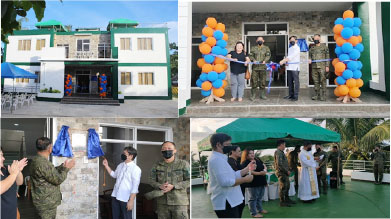
1st Eastern Samar PMFC’s “Balay Mo, Aaydon Ko” launched
New Leyte provincial capitol building targeted to be completed by December, Gov. Petilla says


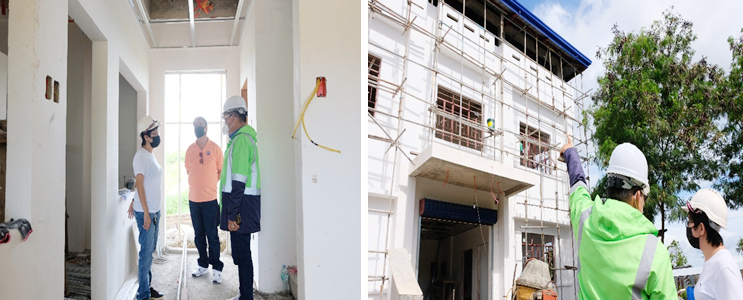
ongoing construction of the new Leyte provincial capitol building located in Barangay Pawing, Palo. The construction
of the new seat of provincial government is expected to be finished by December of this year. Joining the governor
during his visit were Vice Gov. Carlo Loreto and members of the provincial board. (ROEL T. AMAZONA)
PALO, Leyte – The construction of the new provincial capitol building of Leyte located within the 14-hectare property owned by the province located along the Palo West Bypass road, in Barangay Pawing, here, is expected to be finished by December of this year.
This was disclosed by Governor Leopoldo Dominico Petilla who said that they are targeting to occupy the new building by February of next year.
The new provincial capitol, being built at a cost of P800 million with the construction started last Jan.21,2020, covers half of the 14-hectare property of the province. It is a five-storey building, with a mini-theater inside and a helipad on rooftop.
It will house all offices of the provincial government that are currently located at the current provincial capitol building in Tacloban City and in this town.
The new location, according to Gov. Petilla, is ideal because it is located several kilometers away from the sea, making it safe from storm surge unlike to the old provincial capitol building and his current office located in Barangay Candahug at the Government Center, also this town.
When super typhoon ‘Yolanda’ devastated Tacloban City in November 8, 2013, parts of the provincial capitol building was submerged to sea water brought by the storm surge.
During the July 2017 6.5 magnitude quake, parts of the building foundation was damaged resulting for the provincial government to order some departments to hold their offices to other buildings owned by the province, including the Governor’s Office.
“We need to build something that can withstand calamities like storm surge, typhoon, and it is also designed to withstand strong earthquake,” Petilla, who is on his last and third term, said.
Petilla added that they are still finalizing how they will utilized the current provincial capitol building in Tacloban City.
He, however, said that it could be converted into a museum because it is one of the remaining historical buildings in Leyte relative to the World War II.
During the World War II, the building was used as temporary seat of government by then President Sergio Osmeña after Gen. Douglas McArthur and Allied Forces set foot in Leyte in October 20, 1944 when Tacloban was declared as the temporary capital of the Philippines while Manila is not yet liberated from the hands of Japanese Forces.
“But our focus now is to provide offices to our employees because as of the moment the various department of the province is scattered in various places,” he said.
(ROEL T. AMAZONA)
Mayor Romualdez addresses water woes at the northern part of Tacloban City


have a 24/7 water supply at the northern part of the city as he directed to desilt the
Baroguan River, the main source of water supply in the northern part of the city.
TACLOBAN CITY- Mayor Alfred S. Romualdez sent a backhoe to the water treatment facility of the Leyte Prime Waters, formerly Leyte Metropolitan Water District, last August 12 for the desilting of the Baroguan River which was found out to have high sedimentation brought by the soil erosion due to the floods last month.
Located at Barangay 97 in Cabalawan, said river is the water supply source to Tacloban North which has been affected by drought (no rainfall for almost three weeks), aggravated by the river’s heavy silting, resulting in “no supply of water” to the relocation sites in Tacloban North.
Families whose houses were totally damaged when Tacloban City was pummeled by super typhoon “Yolanda’ in Nov.8,2013 were relocated at the northern part of the city.
After plant manager Engr. Bernardo Devaras explained the real problem, Mayor Romualdez immediately addressed the situation by sending a backhoe–hoping, in a way, it will help improve the water supply flow from the river, to be purified at the LMWD Water Treatment Plant, for the consumption of the families in the relocation sites.
(TACLOBAN CITY INFORMATION OFFICE)
16 rebels dead during a 14-hour arm battle
RPOC chair Evardone lauded the “successful operation”
TACLOBAN CITY-At least 16 members of the New People’s Army(NPA), four of them women, were killed during an almost 14-hour arm encounter with government troops in a remote village in Dolores town, Eastern Samar on Monday (August 16).
Major Gen. Pio Diñoso III, the commanding officer of the 8th Infantry Division based in Catbalogan City, Samar, said that the long hours of battle was an indication that the rebels, numbering around 50, were protecting their camp and a high-ranking leader.
Still, he dismissed speculations that the incident could have hit civilians living in Barangay Osmeña, the site of the encounter, saying the rebel camp was located three kilometers away from where the villagers reside and the military used drones and ‘bomb-precision’ when it conducted an airstrike.
“This is a tactical success for us in our campaign against members of the New People’s Army not only in Eastern Samar but for the rest of Samar Island,” Diñoso said during an online interview.
Based on his report, the arm encounter started around 4 am and ended at around 5 pm on Monday in the outskirts of Brgy. Osmeña, 40 kms away from the town proper.
“The (arm battle) took that so long because either they were trying to protect a high-ranking leader and due to their big number, around 50 at least,” Diñoso said.
He described the camp as the NPA’s bomb-making facility with makeshifts and even a training hall. The camp could existed for years now, he added.
Diñoso said that they have to seek assistance from the Air Force for them to conduct an airstrike as he claimed that they could not just enter the camp as it could be surrounded with landmines which could have resulted to deaths of his troops instead.
He, however, could not say yet if what he claimed a high-ranking leader could be one of those killed, four of them were women.
The dead bodies of the rebels, as of press time, are still being retrieved from the site of the incident and would be turn over to the municipal government of Dolores with the members of the scene of the crime operatives(Soco) tasked to help identify their identities.
Diñoso said that they would help in providing decent and formal burial to the dead rebels and to their families.
He also said that members of the 52nd Infantry Battalion, which engaged the rebels, are still scouring the area for possible NPA members who either were killed or wounded.
No casualty was reported on the government troops who were able to recover 29 high powered firearms and several improvised explosive devices (IEDs).
Diñoso also assured the residents of Osmeña of their security as he noted of a possible retaliation from the rebels. It was through the information from the civilians which led for the military to discover the hideout of the rebels.
Meantime, Eastern Samar Governor Ben Evardone lauded the military and the civilians for a ‘very successful operations’ against the rebels.
“Had it not for close cooperation between the military and the local population, the campaign against the communist would not have been successful,” he said.
“I hope that this kind of close collaboration will continue so that we can attain peace and development in our province and country,” Evardone, who also chairs the Regional Peace and Order Council, said.
Evardone and Diñoso called the rebels to surrender their arms and return to the folds of the law and avail the program offered by the government like livelihood and financial assistance for them to start a new life.
Agencies, LGUs need to align transition plans for devolution
TACLOBAN CITY – The Department of Budget and Management (DBM) has called on national government agencies and local government units (LGUs) in Eastern Visayas to strengthen its coordination to prepare for the Supreme Court ruling that will give more functions to local governments starting 2022.
DBM Eastern Visayas regional director Imelda Laceras said during a virtual orientation on Thursday(August 12) that all departments and agencies of the national government should continue reviewing their respective priorities, strategic plans, and functions to reflect the progressive operationalization of the full devolution of basic services and facilities.
Laceras said several national government agencies (NGAs) already have transition plans that include identifying devolved functions and services, service delivery standards, capacity development strategies for LGUs, a framework for monitoring and performance assessment of LGUs, and organizational effectiveness proposal.
“Some LGUs are now starting their transition plans. They have been asked to prepare their transition plans in close coordination with NGAs. Their plans will serve as guides on the monitoring and performance assessment of LGUs by the NGAs concerned, DBM, and DILG (Department of the Interior and Local Government),” Laceras told participants.
Executive Order No. 138 and its Implementing Rules and Regulations mandate all provinces, cities, municipalities, and villages to prepare their devolution transition plans in close coordination with the concerned NGAs to guide them towards the full assumption of devolved functions and services that come with more financial resources.
“This is working progress in the next three years. Let us not lose sight to continue with devolution despite birth pains during the first year of implementation. Through coordination, we can improve, refine and modify the transition,” Laceras added.
The Supreme Court Mandanas-Garcia ruling resulted from the petition made by Batangas Governor Hermilando Mandanas and former Bataan governor Enrique Garcia Jr. before the Supreme Court on local government shares on internal revenue allotment (IRA).
According to the petitioners, LGU shares should include all national taxes.
The Supreme Court affirmed that local government units are entitled to a “just share” on all national taxes collected and not only from the Bureau of Internal Revenue (BIR).
At present, the local government’s IRA share comes from 40 percent of national internal revenue taxes collected by the BIR.
With the Mandanas-Garcia ruling implementation in 2022, it is projected that LGUs will have a 27.61 percent increase in the overall IRA shares.
With the increased budget share, the LGUs are expected to be responsible for the funding and delivery of the activities which have been devolved to them under Republic Act 7160, the Local Government Code of 1991, and other subsequent laws.
Among the functions assigned to local governments based on the Local Government Code are agriculture programs, local infrastructure, environmental services, revenue mobilization, health services, maintenance of peace and order, employment facilitation, transportation, tourism, and housing.
(SARWELL Q.MENIANO/PNA)