ORMOC CITY– A man was arrested by police in Cabucgayan, Biliran for cutting coconut trees without securing the necessary permit.
Arrested was Nelio Pelayo of sitio Andrade of Barangay Asug of the said town last April 26 by virtue of a warrant issued by Judge Ateneoness Bacale, presiding judge of the 2nd MCTC based in Biliran, Biliran.
Pelayo did not recommend for any bail against Pelayo who was charged for violation of RA 8048, otherwise known as An Act Providing for the Regulation of the Cutting of Coconut Trees) as amended by RA 10593 which prohibits cutting of coconut trees unless it’s 60 years old for tall varieties, and at least 40 years old for dwarf varieties.
The accused is now detained at the lockup facility of the Cabucgayan municipal police office. (ROBERT DEJON)
TACLOBAN CITY-Engr. Miguel “Mike” Pedroso was re-appointed to his second term as farmer-director of Region 8 in conjunction with the celebration of Farmers and Fisher Folks Month.
In his installation, Pedroso expressed his commitment to his responsibility as a farmer-director which is to take the lead and be the voice of the department.
He highlighted in his message his goals and aspirations during his term.
One of them is to increase the farmers’ income by making the region’s very own jackfruit known nationally by encouraging the farmers to plant more of it and for the locals to support this activity.
“Hopefully, next time, when we say Region 8, it would be langka just like Davao which is very well known for its durian, malakas ang kanilang marketing, and reproduction,” Pedroso.
Moreover, during an interview, Pedroso gave a message of encouragement to his fellow farmers and fishermen.
“Sa mga magsasaka at mangingisda ng Rehiyon 8, itong buwan na ito ay sa aton ito. This is our time to celebrate, to shine, and to come together to discuss things to improve our industry —eventually, mapataas ang antas ng ating kita,” he said.
Former President Cory Aquino declared the month of May of every year as Farmers and Fisherfolks Month in honor of the farmers and fishermen in the country. (TRIXIE ANNE NICOLE CALVO, LNU Student Intern)
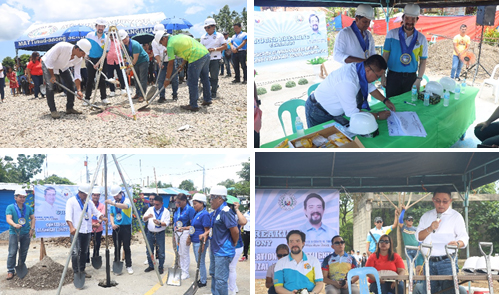
KANANGA, Leyte – The Department of Public Works and Highways (DPWH) Leyte 4th District Engineering Office (DEO) conducted a groundbreaking ceremony on two significant infrastructure projects in Kananga, Leyte on Wednesday, April 26, 2023. The ceremony was led by District Engineer Arnaldo R. Bonifacio, along with Leyte 4th District Representative Richard I. Gomez, Kananga Mayor Manuel Vicente M. Torres and barangay officials.
First is a multi-purpose building with a contract amount of P4,900,086.51 which will soon rise in Brgy. Lonoy Elementary School and aims to provide a conducive learning environment for students that can also be used for extra-curricular activities.(PR)
To help improve the sporting prowess, a sports summit is scheduled to be held in June of this year by the officials of Borongan and its partners.
To help improve the sporting prowess, a sports summit is scheduled to be held in June of this year by the officials of Borongan and its partners.
TACLOBAN CITY – The city government of Borongan will be holding a sports summit next month in an effort to enhance its local athletes who are competing for the city.
The proposed sports summit will also be included as among the activities for the Charter Day celebration of the city in June.
City information Officer Rupert Ambil, said that the sports summit will create a clear and permanent sports program that will turn their young athletes competitive not only for regional competitions but even in the national or international stages.
During the recently-held Eastern Visayas Regional Athletic Association (EVRAA) Meet, Borongan landed 12 among the 13 competing delegations, garnering three golds, three silvers and 11 bronzes.
“After all the lessons that we’ve learned, we sit down with all of the stakeholders during the sports summit in June, and create a sports program,” Ambil said.
“Our kids come and go, but our mentors, our coaches will remain in Borongan. We have to create an opportunity for them to mentor other mentors, and enrich our capacity to create better athletes and create a sports program that does not waiver in terms of training that trains whole year round,” he added.
Ambil further said that the city government under Mayor Jose Ivan Dayan Agda will be focusing on the Department of Education sponsored sports competition by giving incentives to sports organizations in Borongan that will support any sports program of the education department.
“Hopefully, one of the priorities of the city is to create enough facilities for our sports program. Among projects that is in the pipeline of the city is to create a sports coliseum, which we will be proposing in the next several years,” he added.
TACLOBAN CITY– A police officer from this city is now being hunted down after killing a woman on Wednesday (April 3) at about 5:30 pm.
Police Senior Master Sergeant Van Gregory Benitez, 44, shot dead Jessica Durana, 30 using his service short firearm while the victim was on her way home together with her mother, Henerosa.
The victim and her mother were walking along Barangay 43, Quarry district, this city, with the suspect following them.
Without provocation, the police officer shot the victim several times, hitting her on different parts of her body.
This resulted in her immediate death though she was brought to the Tacloban City Hospital. The elder Durana was unhurt during the shooting incident.
Benitez immediately fled from the crime scene.
Master Sgt. Anwar Usman, officer-on-case, said in his report that jealousy could be the reason why the police officer killed the victim.
It was learned that the two were having a relationship.
The city police are now conducting a manhunt operation against the suspect.
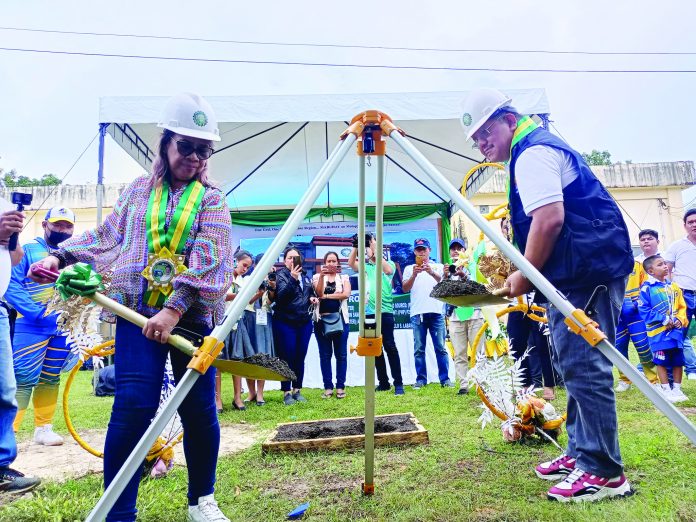
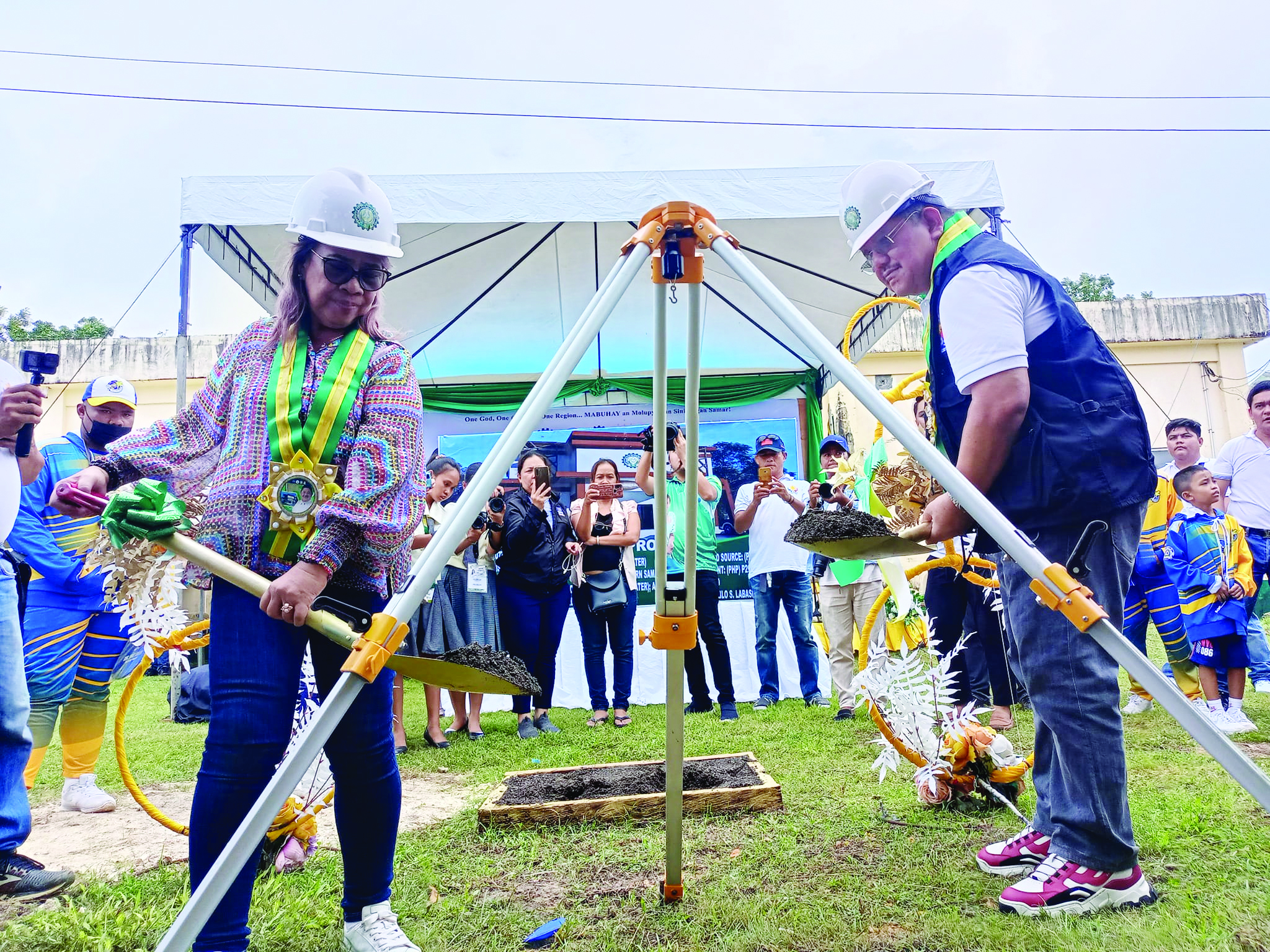
Eastern Samar Rep. Maria Fe Abunda and Rep. Marcelino ‘Nonoy’ Libanan of the 4Ps party-list group and House minority floor leader led in the groundbreaking of an amphitheater at the Eastern Samar State University in Guiuan last May 2.
Eastern Samar Rep. Maria Fe Abunda and Rep. Marcelino ‘Nonoy’ Libanan of the 4Ps party-list group and House minority floor leader led in the groundbreaking of an amphitheater at the Eastern Samar State University in Guiuan last May 2.
TACLOBAN CITY – Rep. Marcelino ‘Nonoy’ Libanan of the 4Ps party-list group said that creating new roads and bridges could help the development of Eastern Samar and in the process, push down the province from the list of poor provinces in the country.
In fact, he said, about P975 million were allocated to fund various infrastructure projects in the second district of the province alone for this year.
Rep. Libanan, who is also the minority floor leader of the House of Representatives, creating new roads and bridges will be a big help to improve the lives of the people of Eastern Samar.
He informed that in August of this year, the Samar Island Circumferential Road will be completed and open for public use.
“This project was started in the 11th Congress during my first term as congressman, in which the Taft-Oras-San Policarpio-Arteche-Lapinig-Gamay-Simora Roads-Mapanas-all the way to Catubig Northern Samar were made into arterial roads,” the lawmaker said.
Meanwhile, the inauguration of the P340 million Maydolong-Basey Road is scheduled this month which includes the 51.775 kilometers which was implemented as a tourism road project. If completed, the road project will serve as the shortest route from Borongan to Tacloban city, the capital city of the region.
The travel will be shortened from one and a half hours to almost two hours compared to an almost four hours trip from Borongan to Tacloban.
To date, the road construction of the Dolores-Maslog-road is ongoing and next year, an additional P 450 million funding will be poured for the completion of the project, Rep. Libanan said.
Libanan vowed to prioritize programs and projects that will help in the progress of the province together with Rep.Maria Fe Abunda.
The two lawmakers led on May 2 the groundbreaking of the proposed multipurpose hall/ amphitheater in the Eastern Samar State University – Guiuan Campus with Guiuan Mayor Annaliza Gonzales – Kwan.
The project was initially funded by Abunda in the amount of P5 million in 2021.
Both Libanan and Abunda believe that education also needs support from their offices and as a way to help address the poverty problem of the province. (LIZBETH ANN A. ABELLA)