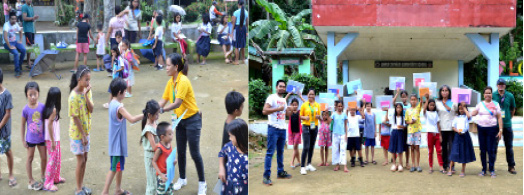
Various government offices of Ormoc City joined by private group conducted their cleanup drive in coastal areas in the city on Saturday (Sept. 15).
(ROBERT DEJON)
Various government offices of Ormoc City joined by private group conducted their cleanup drive in coastal areas in the city on Saturday (Sept. 15). (ROBERT DEJON)
ORMOC CITY-Different government and private agencies lead City Environment and Natural Resources (CENRO) of this city conducted a coastal cleanup activity on Saturday (Sept. 16).
The activity, started with a short program in front of the city superdome, conducted the cleanup drive at the city’s 12 coastal barangays covering Barangay San Juan on the western part of the city up to Brgy. Macabug on its southern part.
Former Philippine Basketball superstar and now City Councilor Rey Evangelista, in an interview, said that it is important to take care of the city’s coastal areas so that we can protect our marine resources.
He said that throwing wastes anywhere should be stopped because it would pollute our water.
Evangelista added that Ormoc City should not only be known as the ‘city with beautiful people’ but as a clean city as well.
“We should take care and throw our garbage in the proper disposal area not just anywhere like in canals, not in the river because the garbage will only be returned to us,” the councilor said.
In Brgy. Naungan, the group from the Philippine Coast Guard and the Bureau of Jail Management and Penology conducted their cleanup, they were able to collect 350 kilos of garbage in its coastline.
Jail Senior Inspector Jimmy Topia said that all residents should be concerned about our environment because this would affect the city’s environment.
He is hoping that the villagers would make cleanup drive a daily activity.
The garbage collected were buried at the city’s landfill (ROBERT DEJON)
In today’s food scarcity and rising prices of food products, lands that lay idle should be maximized for food production. Despite our being an agricultural country, plenty of our agricultural lands are still laying idle; thus, the government should intervene by penalizing landowners who cannot make their lands productive and giving such lands to those who can.
The issue of land productivity is a critical subject for discussion. Landowners have an inherent responsibility to utilize their land in a productive manner. There may be instances where conditions prevent them from doing so. In that case, then, they should give way to those people who can transform their land into highly productive areas, yielding plentiful harvests year after year. This the government should ensure, even if it means penalizing landowners who cannot make their land productive due to unforeseen circumstances or limitations that hinder productivity.
In determining suitable penalties for unproductive lands, it is crucial to consider the various barriers that might prevent landowners from utilizing their property optimally. External factors such as environmental constraints, economic downturns, or changes in zoning regulations can severely impact land productivity. For instance, if a region is affected by severe droughts or natural disasters, landowners may face challenges in cultivating crops or establishing profitable businesses. Recognizing and accounting for these external limitations is essential to avoid imposing unfair penalties on individuals who genuinely strive to make their land productive but encounter unavoidable roadblocks.
Any penalties imposed on unproductive lands should prioritize the promotion of sustainable and responsible land usage. Aside from just resorting to punitive measures, government agencies and land management organizations should offer support and resources to help landowners overcome obstacles hindering productivity. Financial incentives, educational programs, and collaboration with environmental experts can play a pivotal role in guiding landowners towards sustainable practices and alternative uses for the land. Encouraging partnerships between unproductive landowners and those who can utilize the land effectively could also provide an avenue for productive collaborations while promoting responsible land management.
Penalizing landowners who are unable to make their land productive should be approached with a comprehensive understanding of the factors that might inhibit productivity. It is vital to consider any external constraints that landowners may face and ensure penalties are fair and equitable. By taking a collaborative and nuanced approach, governments and land management organizations can facilitate the transformation of unproductive land into flourishing and beneficial assets.
The concept of having a business alongside a job offers numerous advantages that go beyond the realm of conventional employment. Unlike fixed income from a job, a successful business can generate significant profits, allowing for increased financial stability and potential wealth accumulation. A business offers the opportunity to exercise creative freedom, as entrepreneurs can shape their enterprise according to their vision and ideas. This independence and autonomy impart a sense of fulfillment and personal satisfaction that may be lacking in traditional employment settings.
In addition to financial gains and creative expression, having a business simultaneously with a job can cultivate valuable skills and expand one’s professional network. By managing a business, individuals acquire essential entrepreneurial skills, such as problem-solving, decision-making, and risk management. Furthermore, through networking with potential clients, suppliers, and partners, entrepreneurs significantly broaden their professional connections, ultimately opening doors to new opportunities and collaborations. These skills and networks can prove instrumental in advancing one’s career trajectory or even transitioning into a full-time entrepreneurship role.
Operating a business requires self-discipline, resilience, and an entrepreneurial mindset, thereby fostering personal growth in areas such as leadership, adaptability, and perseverance. Navigating the dynamic landscape of entrepreneurship assists individuals in honing their interpersonal skills as well, as they engage with diverse stakeholders, negotiate contracts, or handle customer relations. Such development can greatly enrich an individual both personally and professionally, empowering them to tackle future challenges with confidence and resilience.
Moreover, a business can provide an additional source of income that is not solely dependent on a fixed salary from a job. This diversification of income is particularly advantageous during times of economic volatility or uncertainties, as the individual’s financial situation is less susceptible to sudden upheavals. Furthermore, income from a business can be used to pursue personal passions, invest in further education or training, or contribute to philanthropic endeavors, fostering a sense of purpose and meaning in one’s life.
Despite these advantages, it is essential to acknowledge the potential challenges and risks associated with having a business alongside a job. Time management becomes a critical factor as individuals must effectively balance their commitment to their job while allocating sufficient time to nurture their business. Additionally, the demands and responsibilities associated with entrepreneurship can create considerable stress and pressure.
Entrepreneurs often face long hours, financial risks, and the constant need for innovative strategies, which may result in a potential strain on mental and physical well-being. However, with proper planning, support systems, and a resilient mindset, these challenges can be mitigated effectively.
Indeed, having a business alongside a job offers a myriad of advantages, making it an appealing option for those seeking increased financial stability, creative autonomy, and personal growth. Nevertheless, it is crucial to recognize the potential challenges associated with balancing a job and a business, and to approach this endeavor with careful consideration and planning to maximize the benefits while managing the risks effectively.
The San Miguel Corp. (SMC) through its food unit San Miguel Foods, has been religiously following the government’s corn buying program (CBP) since the advent of the pandemic season. Its food unit has brought directly from local corn farmers over 1.3 million metric tons (MT) of corn worth P23.9 billion since 2020.
The SMC’s food unit corn buying program started in 2020 initially benefitted 13 provinces nationwide including (Luzon): Batangas, Bicol, Bulacan, Isabela, Pangasinan, and Tarlac; (Visayas): Cebu, Iloilo and Ormoc; and in (Mindanao): Bukidnon, Cagayan de Oro, Davao, and Zamboanga.
The CBP targets to source raw materials for its food products directly from local corn farmers to help boost growers incomes, reduce the country’s dependence on imports, and help achieve food self-sufficiency to the farmers.
The SMC management announced that “through this program (CBP), we are assured of local corn supply for our food business, while our local farmers are guaranteed a steady market and fair prices for their crops. Buying directly from boosts their income and keeps their livelihood sustainable.”
In 2020, height of the COVID-19 pandemic, San Miguel Foods purchased 500 million kilos of corn to help farmers affective by quarantine protocols and supply chain disruptions that saw their produce going to waste.
MY COMMENT:
The SMC, like the Ayala and Lopez-owned corporations pride themselves for their successfully managed corporations. The SMC’s Food unit patronage of the local farmers corn produce is worth emulating.
ooo000ooo
NEXT TOPIC : “USAID bares $4.3 million grants to fund climate change projects”
SHARE S & T THOUGHTS through E-Mail: drpacjr@yahoo.com.
THAT’S what happens when we show compassion to anyone in need. We channel God’s love to others. We become more and more like God. We act out our being a person who by definition is meant to relate us with others. By being compassionate, we avoid getting trapped in our own world, putting ourselves in some kind of silo, isolated from God and from the others.
We are reminded of this truth of our faith in that gospel episode where Christ was moved to resurrect a dead man, the only child of a widow. (cfr. Lk 7,11-17) It did not take time for him to do what he did. He immediately took pity on the widow. He took the initiative without being asked.
This gospel episode teaches us the lesson that like Christ we should try our best to be quick in showing compassion to everyone, especially to those in great and urgent need. For this, we have to train ourselves in the art and virtue of compassion which is a matter of entering into the very lives and drama of the others with the spirit of Christ.
If we really want to be “another Christ,” we should be quick to show compassion to others who are in need of one thing or another. This is typical of Christ. Wherever he went, though he had to convey difficult and hard-to-understand messages to the people, since these messages were mainly spiritual and supernatural in character, he never neglected their more immediate human needs.
His heart always flowed with compassion, quick to notice the needs of others and to respond to them. And all this in all simplicity, telling the beneficiaries who were so bursting with gratitude that they wanted to broadcast what they received to the whole world, to keep quiet instead.
It’s an example that we should all try to imitate. One deep desire we should have is that of making as some kind of default mode that attitude of always thinking of the others, wishing them well all the time and doing whatever we can to help.
It’s obviously not easy to do, but we can always try. With God’s grace and with our persistent effort, we can little by little and day by day hack it, such that it becomes second nature to us to think and feel for the others. That’s what compassion is all about. We just have to learn to be tough to take on whatever effort is needed. We have to learn to be all things to all men. (cfr. 1 Cor 9,22)
Compassion starts in the heart, in our thoughts and desires. In this level, there is no limit in what we can do. Obviously, when we try to translate these prayers, thoughts and desires into action and material things, we can be greatly limited. But insofar as prayers and sacrifices are involved, the possibilities are unlimited.
We need to examine ourselves more deeply to see if indeed we are always thinking, praying and wishing others well. We have to be wary of our tendency to let our thoughts and desired be dictated only by self-interest, usually done in a most subtle but effective way. For this, we have to do regular examination of conscience.
Compassion should not be exclusively associated with the sweet and tender moments of pity, sympathy and empathy. It demands sacrifice and self-denial which we should be willing to give.
CLEMELLE L. MONTALLANA,DM, CESE
ASSOCIATE PROFESSOR III
CLEMELLE L. MONTALLANA,DM, CESE ASSOCIATE PROFESSOR III
Are we alone in this wide cosmos ? For centuries we were told that we are . It seems that we are special and we are the only living race inhabiting the Earth or any Planet. Lately , these was proven to be false and that after all these years we were actually wrong.
People have pondered whether or not there are other intelligent beings in the universe for a very long time. One of science and exploration’s most exciting and contentious projects has been the search for extraterrestrial life. However, certain shocking findings in recent years have questioned our preconceived notions and raised the possibility that there may be other life forms present in this huge universe besides ourselves.
One of the most intriguing findings was the detection of a mysterious object that entered our solar system in 2017, named ‘Oumuamua. This object, which was dubbed a “scout” from the Hawaiian language, had a very unusual shape, size, and trajectory. It was also moving at an extremely high speed, faster than any known asteroid or comet. Moreover, it seemed to be propelled by an unknown force, as if it had some kind of engine or sail. Some astronomers have speculated that ‘Oumuamua could be an artificial probe sent by an alien civilization to explore our region of space1.
Another shocking revelation was the presentation of alleged alien remains in the Mexican parliament in 2023. A group of lawmakers claimed that they had obtained several specimens of humanoid creatures that were found in different locations in Mexico and Peru. They said that these beings had three fingers on each hand, elongated heads, and unusual internal organs. They also showed X-ray images that supposedly revealed the presence of eggs, ovaries, and implants made of rare metals in some of the bodies. They argued that these creatures were not related to any known life form on Earth, and that they were evidence of extraterrestrial visitation.
A third remarkable discovery was the observation of a potential ocean world orbiting a nearby star called K2-18. Using the powerful Webb Telescope, astronomers detected signs of water vapor, methane, and carbon dioxide in the atmosphere of this planet, which is about 17% larger than Earth. These are some of the key ingredients for life as we know it, and they suggest that this planet could have a liquid water ocean beneath its clouds. This would make it one of the most promising candidates for hosting alien life in our galaxy4.
These three examples are just some of the many indications that we are not alone in the universe, and that aliens may have already visited or even inhabited our planet. The implications of these findings are profound and far-reaching. They challenge our assumptions about our place and role in the cosmos, and raise new questions about our origins, history, and destiny. They also invite us to rethink our relationship with other forms of life, both on Earth and beyond. How should we react to the reality of alien life on Earth? How should we communicate and interact with them? How should we protect ourselves and our planet from potential threats or conflicts? These are some of the questions that we need to address as we face this new era of discovery and exploration.