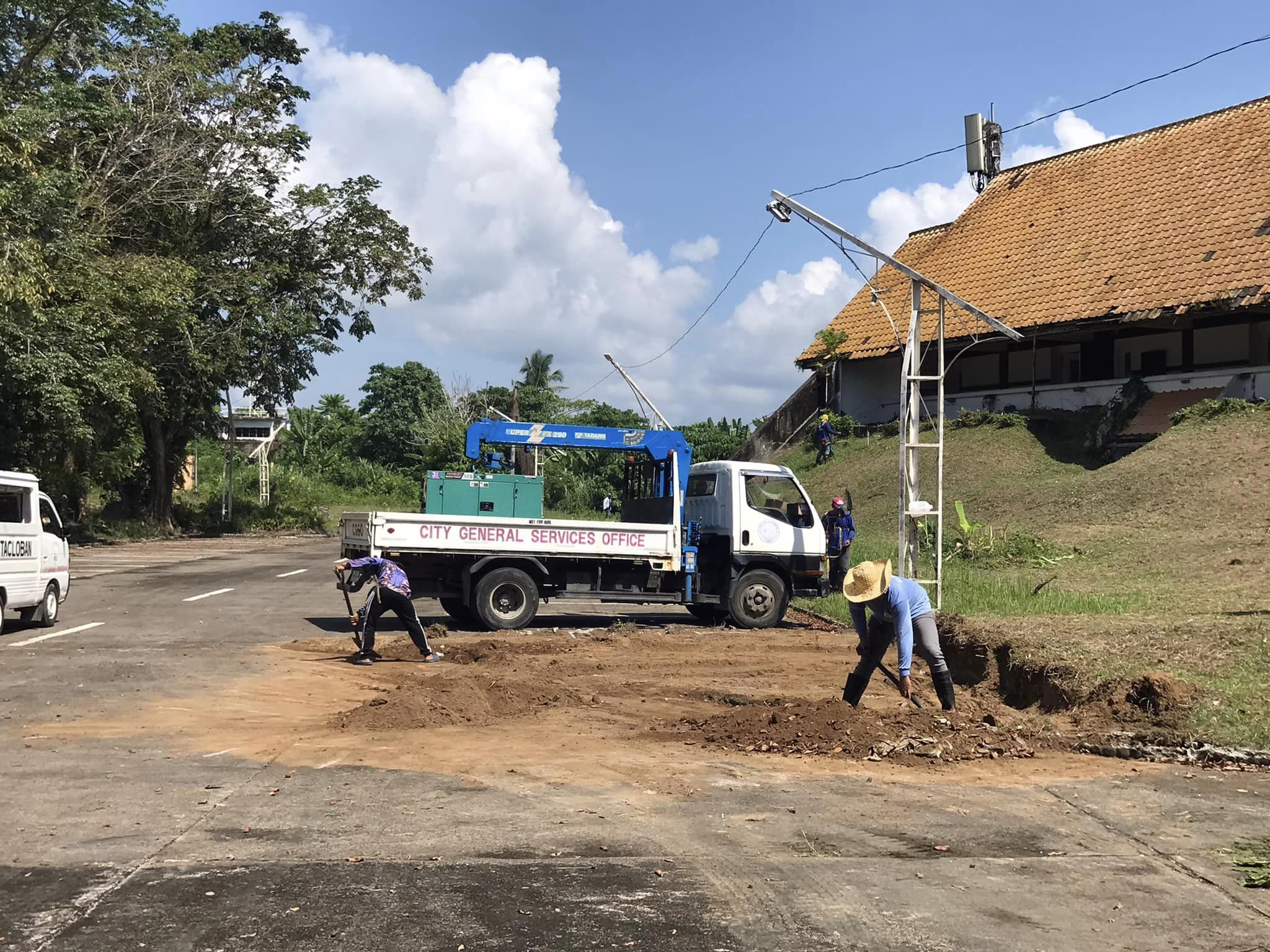
Mayor Alfred Romualdez announced that a sizeable portion of the Leyte Park Hotel would be use during the Tacloban fiesta. Clearing operation is now underway. (TCIO)
TACLOBAN CITY – The city government here will reopen a portion of the abandoned Leyte Park Hotel complex for fiesta activities, Mayor Alfred Romualdez said on Thursday (May 18).
While waiting for the master plan for the full development of the 6.1-hectare complex, Romualdez said the city government has been making improvements to allow some businesses to operate inside the complex in time for the June 30 city fiesta.
“Our plan is to make a part of the Leyte Park Hotel compound as one of the places to visit before and even a week after the fiesta,” Romualdez told reporters in a press briefing at the city hall.
Personnel from the city engineering office have been deployed for the clearing operations, construction of the staircase, and painting of the concrete walling at Leyte Park Hotel.
It will be the location for fiesta activities and carnival in connection with the upcoming fiesta, according to the city government.
“We are preparing this area since we need a bigger and more spacious area for the civic activities intended for the people of Tacloban and visitors from other places,” the mayor added.
The 6.1-hectare Leyte Park Hotel complex was built in 1979 through the initiative of the former First Lady Imelda Romualdez-Marcos.
It was taken over by the government in 1986 after the Edsa People Power Revolution and its ownership was transferred to the Tourism Infrastructure and Enterprise Zone Authority, the Privatization Management Office, and the provincial government of Leyte.
In 1994, the hotel was leased to a private company, but the company decided to build a new property in the city and shut down Leyte Park Resort Hotel in late 2021.
The drafting of the master plan by experts is still ongoing and it will be out within the year for investors to see, according to Romualdez.
The plan will designate hotel, resort, recreation, and commercial spaces.
Reopening the hotel would create at least 2,000 jobs and increase the number of hotel rooms in anticipation of the influx of tourists and even investors.
CALBAYOG CITY-An alleged member of the New People’s Army has surrendered to police in Santa Margarita, Samar.
The former rebel, identified as “Aris, surrendered to Police Major Marval Diaz, officer-in-charge of the First Samar Provincial Mobile Force Company (SPMFC) last May 5.
He was said to have been a member of the communist armed group since 2013 and recruited by alias ‘Kimbo’, the squad leader of the Angel Platoon, Front Committee (FC) – 6, Sub-Regional Committee Browser, whose group operates in the remote villages of Gandara and Matuguinao towns, also in Samar.
“I decided to join the militia in 2013 because I wanted my sister to renounce the movement and return home. However, I was blamed by my family instead saying that I was the one who convinced my sister to join the YM while in fact, she joined in first”, Aris stated.
“My voluntary surrender to Police Major Diaz is a manifestation of my commitment to formally denounce my allegiance to the communist terrorist group so as to finally embrace a peaceful and normal life with my family”, he added.
Diaz said that Aris is the 12th member of the communist group who yielded to 1st SMFC since 2020. Two of which surrendered in January this year and the other one last March.
Aris is the first surrenderer this month under Diaz’s stint.
“I commend my intelligence operatives and all personnel of this unit for setting another record in the roster of former rebels turned surrenderers. All your efforts paid off including the contribution of our counterpart in the locality. I urge you to continue working closely and to stay committed and dedicated to our organization’s mandate to serve and protect our people”, Diaz remarked.
The intensified anti-insurgency campaign of the PNP is in accordance with Executive Order No. 70 issued during the administration of former president Rodrigo Duterte.
The newly-surrendered rebel will be provided assistance under the Enhanced Comprehensive Local Integration Program (E-CLIP) program of the government. (LEVIRESA ATIS GETIGAN)
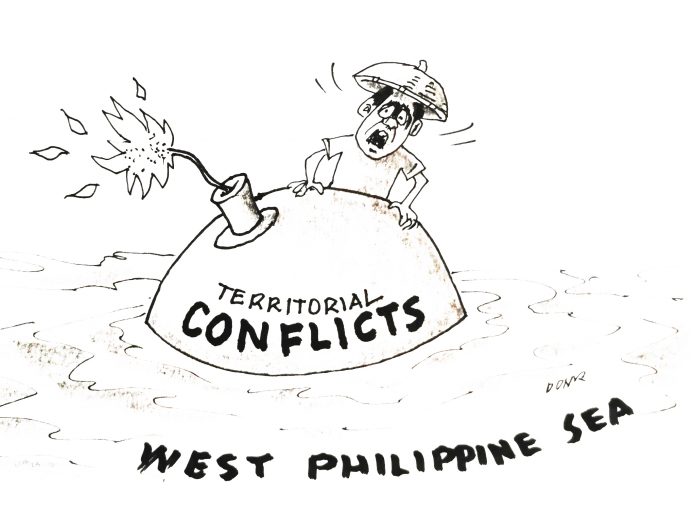
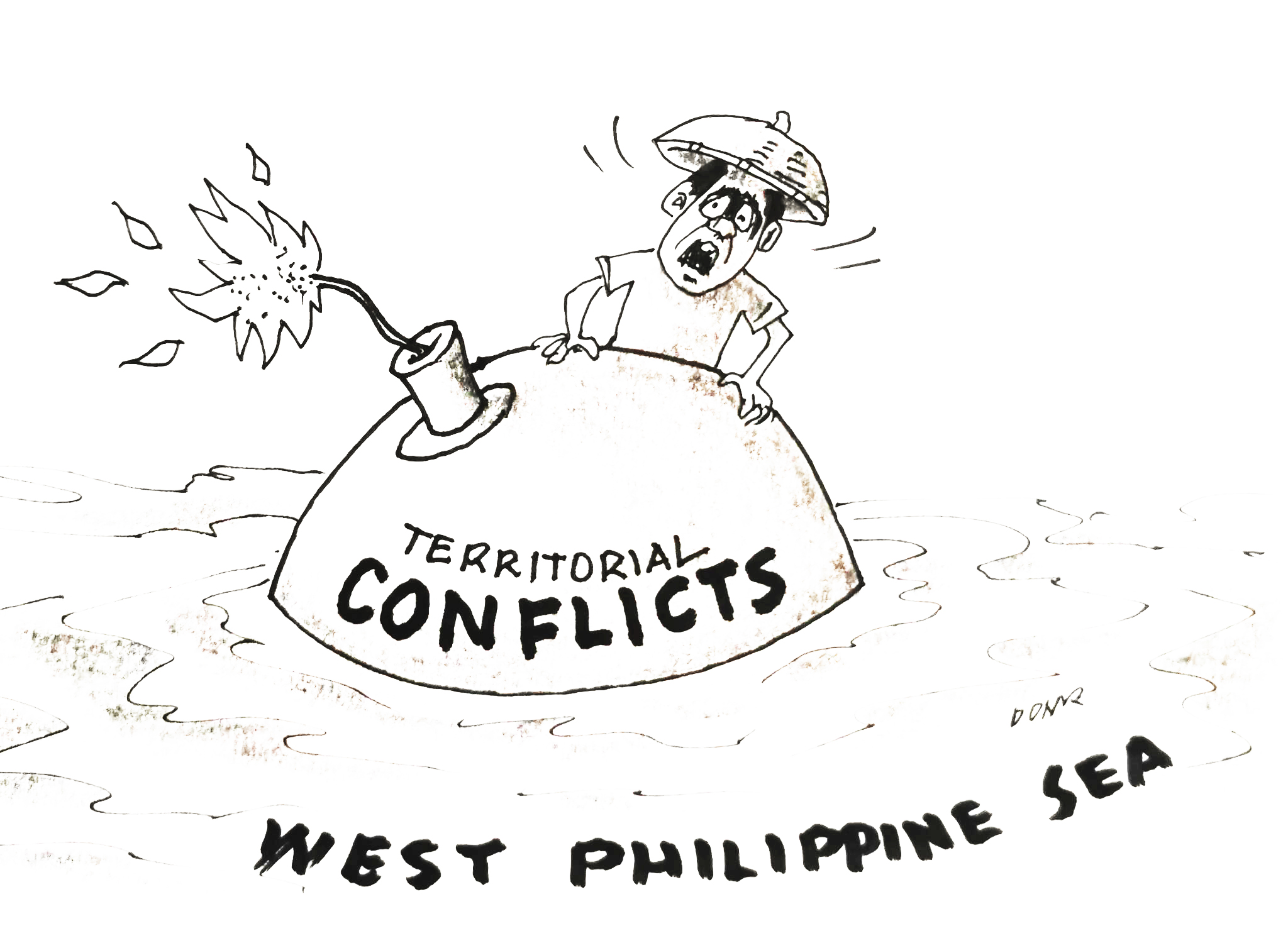
The territorial dispute in the West Philippine Sea remains high in the agenda of claimant nations, namely: China, Vietnam, the Philippines, Malaysia, Brunei and Taiwan, as they are not just competing for control over the vast maritime expanse, but they are also after trade, economy, regional stability and geopolitical significance.
In recent years, military presence has heightened in the SCS, with China undertaking a significant buildup of its armed forces in the region. China’s military expansion in the SCS has caused alarm and raised tensions among Southeast Asian nations, especially the Philippines, Vietnam, and Malaysia. The contested waters are also rich in natural resources including oil, natural gas, and fish stocks, which are all sources of regional contention. Our country has actively challenged China’s claim to the waters, filing an arbitration case against China in 2013, with much of the case involving disagreement over exclusive economic zone (EEZ) rights and maritime entitlement in the SCS.
The United States has also been increasing its naval presence in the region, in a move to support its allies, promote freedom of navigation, and preserve regional stability. The US presence in the contentious waters, considered international waters, has further increased tensions between China and the US, with China seeing the US presence as a threat to its sovereignty. This has led to several close encounters between China and US ships in the disputed waters.
The present situation in the South China Sea is a significant geopolitical concern, with a potential for conflict and widening impact on the global community. With the issue of territorial sovereignty and rights still unresolved, it is crucial for all relevant parties to engage in direct dialogue, pursue peaceful means, and respect international law. The outcome of the South China Sea dispute is important, not only for the claimant states but for the international community as a whole. Therefore, it is imperative that all parties act with restraint and a willingness to compromise, in order to secure a peaceful and diplomatic resolution to the conflict.
Our country is among the countries in the world that is most prone to natural disasters due to its geographical location on the Pacific Ring of Fire. The country has a long history of being devastated by climate-related events such as typhoons, earthquakes, landslides, volcanic eruptions, and tsunamis. These natural disasters have caused significant loss of life, property damage, and disruption to the country’s economic and social systems. In this essay, I will discuss in detail some of the most common natural disasters that the Philippines is prone to.
Our islands are also known to be hit by an average of 20 typhoons each year. Typhoons are tropical storms that are characterized by strong winds, heavy rainfall, and storm surges. The most devastating typhoon in the country’s history is Typhoon Haiyan, locally known as Yolanda, which struck in 2013, killing over 6,000 people and causing billions of dollars in damages. The country’s location in the typhoon belt makes it particularly vulnerable to tropical storms, and it is important for the government to have effective disaster preparedness and response programs to minimize loss of life and damage to property.
Earthquakes are also a common occurrence in the country, given that the country sits on the Pacific Ring of Fire. The most lethal earthquake to hit the Philippines happened in 1990, which struck the island of Luzon and killed over 2,400 people. Since then, there have been smaller scale earthquakes that occur throughout the country, causing varying degrees of damage. Given the high population density of urban areas, even mild earthquakes can be disastrous in cities that have not adequately prepared for seismic hazards.
We are also prone to volcanic eruptions, with over 200 known volcanoes in the country. Mount Pinatubo’s eruption in 1991 was among the most disastrous volcanic events in the Philippines’ history, causing thousands of casualties, displacement of people, and significant economic damage. The Philippine Institute of Volcanology and Seismology (PHIVOLCS) continuously monitors volcanic activity, and its early warning systems enable government officials to evacuate people living within the vicinity of active volcanoes.
Landslides can often accompany natural disasters such as typhoons, earthquakes, and volcanic eruptions. The country’s geography, with its numerous mountain ranges and steep slopes, makes it particularly vulnerable to landslides. In 2006, the Philippines experienced a massive landslide in the town of Guinsaugon, killing over 1,000 people. The country’s mountainous terrain is further aggravated by the deforestation of its highlands, hastening soil erosion and making the country even more vulnerable to landslides.
Tsunamis or seismic sea waves are some of the most destructive natural disasters, and the Philippines is no stranger to this phenomenon. The most recent tsunami to strike the country occurred in 1994, causing significant loss of life and property damage. Given the country’s location along the Pacific Ring of Fire, it is likely to experience more tsunamis in the future.
Flooding is another common natural disaster that the Philippines experiences, especially during the typhoon season. The country’s river systems are easily overwhelmed by heavy rainfall, leading to flash floods in urban areas. In 2012, Typhoon Saola ravaged the Philippines, causing flooding in various parts of the country and forcing tens of thousands of people to flee their homes.
In recent years, the Philippines has experienced an emerging natural disaster: drought. Prolonged dry seasons have led to a significant reduction in crop yields, thereby threatening food security in the country. It is critical for the Philippine government to implement appropriate watershed management systems, water conservation and storage, and other agricultural policies to mitigate drought’s adverse impacts.
These natural disasters continue to wreak havoc on the country’s economy, environment, and people’s lives. It is essential for the government and its citizens to prepare adequately for these disasters by developing robust disaster risk reduction strategies, early warning systems, appropriate land use policies, and enforceable building codes, among others. Through these measures, the country can minimize the loss of life, property damage, and disruption to people’s lives.
No matter the crisis, people still find ways to share the graces of the year that was by feasting with visitors during fiesta celebrations. Many complain about the hardships of daily living but always find the grace to join the community of the faithful in thanking God by celebrating the feast of Saints.
The industrious one may just go fiesta hopping and survive for a month or two on a variety of menu. While it seems impractical to feast on loan, many would still resort to borrowing just to fulfill the grace of the celebration. Whatever strategy one may use to prepare for bountiful celebration, there is always a way to find enough preparation.
Those who do not believe in hosting fiestas for financial reasons are free to live by their conviction. But the many believers still choose to celebrate in thanksgiving to God for the graces and blessings received. The blessings may appear insignificant to the public eye but for the faithful, any grace received is worthy celebrating a feast in thanksgiving.
No one has come out claiming receiving abundant graces as a result of celebrating fiestas. Tracing the causal connection may just be too tough a task if only to prove that there are rewards in fiesta celebrations. On the other hand, even when one ekes out and borrows just to celebrate and give thanks, we too have not heard of anyone becoming poor due to celebrating fiestas.
The practice is really a matter of faith truly dependent on the spirituality of the person. While some argue that fiestas are counter-productive, many are still embracing the religious tradition. We are just at the onset of the month noted as the peak of fiesta celebrations. Many of the less-fortunate and economically poor take advantage of the season but gracious hosts do not mind sharing the graces in these once a year celebration. comments to alellema@yahoo.com
CHRIST already warned us about how our life here on earth is going to be. But he also has assured us that everything would just be ok. We should just stick with him through thick and thin. “In the world, you will have trouble, but take courage, I have conquered the world,” he said. (Jn 16,33).
We should put these words into our mind and heart and make them the principle to follow whenever we find ourselves in some difficult situations. For this, we should just learn how to suffer, since suffering is inevitable in our earthly sojourn. We need to develop a certain kind of spiritual toughness that is based on our faith and vital identification with Christ.
With Christ, we can learn how to be tough when we are made to suffer. Our faith, the ultimate source of truth about ourselves, tells us that suffering is due to sin, to the misuse of our freedom, to our disobedience to the will of God who created us to be his image and likeness, to be children of his, sharing in his very own life.
Yet, in spite of that, God our Father, who is all goodness and the very fount of love, did not and does not cease to care for us. And while allowing us to suffer the consequences of our sin and disobedience, he also showed and continues to show us up to now how to tackle suffering in our earthly life.
Toward this end, God did nothing less than to send his son to us. The son became man and took on all our sinfulness, culminating this mission with his death on the cross. In so doing and in resurrecting, Christ converts our suffering due to sin into a way of our redemption.
Thus, if we have to be truly Christian, we need to be tough, really tough. Christ himself was tough, but with the toughness of love that goes all the way of assuming all the sins of men by offering his life on the cross. To be Christ-like we need to be tough. At the same time, to be tough we need to be with Christ. Otherwise, whatever toughness we may show would not be the real toughness expected of us.
This toughness of Christ was described by St. Paul in his second letter to the Corinthians: “For our sake, God made Christ to be sin who knew no sin, so that in him we might become the righteousness of God.” (5,21).
St. Peter made the same assertion: “Christ bore our sins in his body on the tree, so that we might die to sin and live to righteousness.” (1 Pt 2,24) In other words, Christ was not afraid of sin if only to save the sinner out of his love for all of us who are all sinners. He was and continues to be willing to assume our sins, as if they were his own, if only to save us.
He was not squeamish, prudish or puritanical in his attitude toward our sin. In fact, he was kind of pro-active about it, unafraid to get dirty as long as what really matters about us is accomplished and not compromised. That is why he was fraternizing more with the sinners than with the self-righteous.
As he himself said: “I came not to call the righteous, but the sinners to repentance.” (Mk 2,17) And, “God did not send his Son into the world to condemn the world, but to save the world through him.” (Jn 3,17)