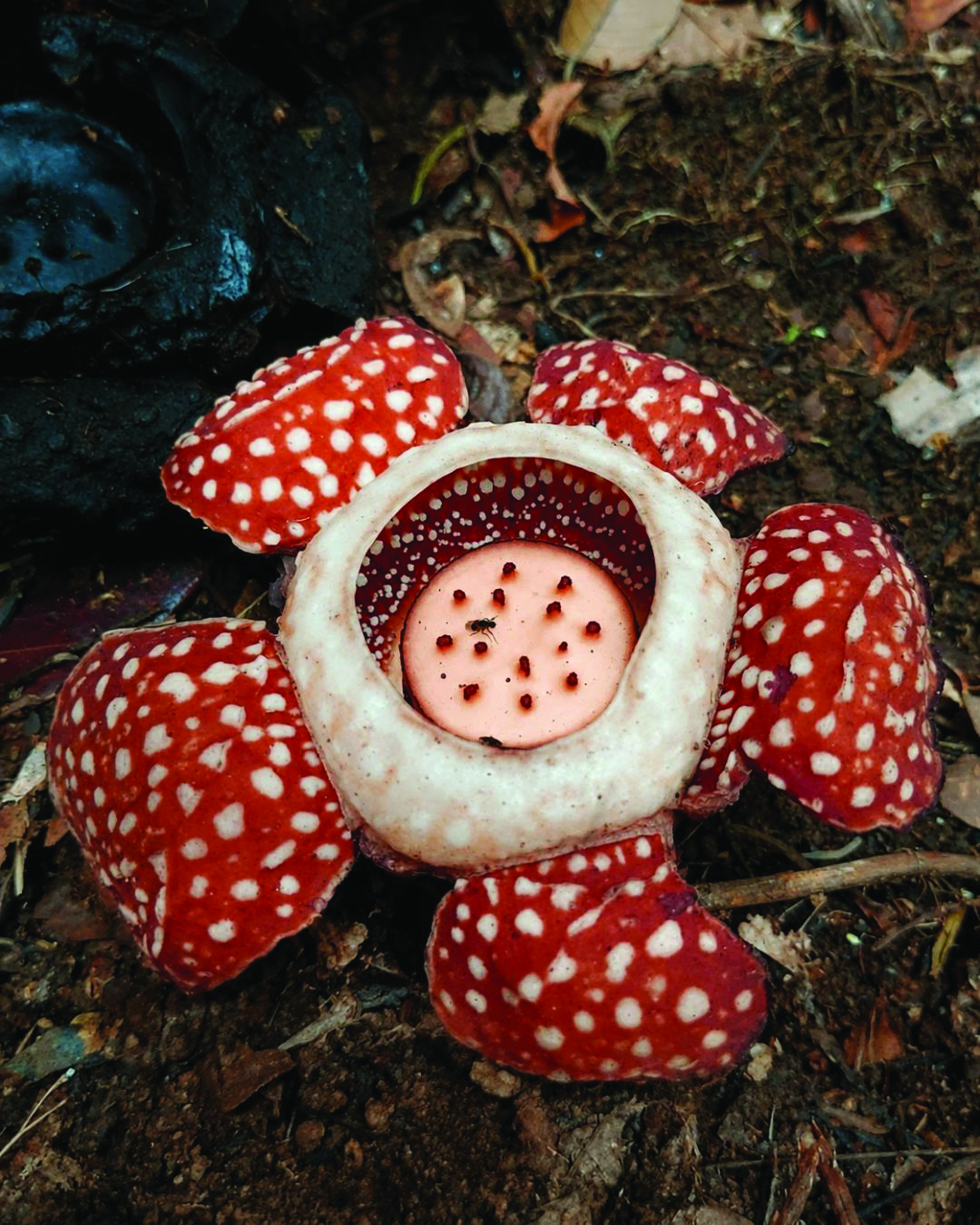
TACLOBAN CITY — The endangered Samar rafflesia (Rafflesia manillana), one of the country’s rarest flowering plants, has been rediscovered inside the Samar Island Natural Park (SINP) after 15 years, offering fresh hope for the survival of the species and reaffirming the protected area’s importance as one of the Philippines’ richest biodiversity sanctuaries.
The rare parasitic plant was documented during a biodiversity survey conducted by the Samar Island Natural Park Protected Area Management Office (PAMO) to determine the current distribution and conservation status of the species within the country’s largest terrestrial protected area.
The discovery was announced by the SINP through a Facebook post on June 29.
The Samar Rafflesia was last officially documented in March 2011, making the latest sighting the first confirmed record of the species in the park in more than a decade.
Botanists Dr. Pastor Malabrigo Jr. and Dr. Julie Barcelona, both leading experts on Philippine flora, verified the identity of the flowering plant.
According to the Protected Area Management Office, the survey was undertaken to locate and map existing populations of Rafflesia manillana and gather scientific data that will support future conservation efforts, habitat management, and long-term monitoring of the endangered species.
Under Department of Environment and Natural Resources (DENR) Department Administrative Order No. 2026-20, Rafflesia manillana, commonly known as the Samar Rafflesia, is listed as an endangered species because of its limited distribution and the continuing loss of its natural habitat.
Unlike most flowering plants, the Rafflesia is a holoparasitic species that depends entirely on vines of the genus Tetrastigma for survival. It has no leaves, stems, or roots and spends most of its life concealed within its host before producing its iconic giant flower, which blooms for only a few days.
The flower is known for emitting an odor similar to decaying flesh, an adaptation that attracts flies, its primary pollinators.
The Samar Island Natural Park spans more than 333,000 hectares across the provinces of Samar, Northern Samar, and Eastern Samar, making it the country’s largest terrestrial protected area under the National Integrated Protected Areas System (NIPAS).
It protects one of the Philippines’ last remaining tracts of old-growth tropical rainforest and serves as a vital watershed supplying water to hundreds of communities across Samar Island.
Aside from the Samar Rafflesia, the park is home to numerous endemic and threatened wildlife species, including the Philippine eagle, Philippine tarsier, Philippine spotted deer, Philippine warty pig, Philippine flying lemur, Samar hornbill, and several rare species of amphibians, reptiles, orchids, and native forest trees found nowhere else in the world.
Environmental officials said the rediscovery highlights the ecological significance of the park and underscores the need to intensify forest protection, biodiversity monitoring, and scientific research to safeguard Samar’s unique flora and fauna from threats such as illegal logging, habitat destruction, land conversion, and wildlife poaching.
The Protected Area Management Office said it will continue expanding conservation initiatives to ensure the long-term survival of the Samar Rafflesia and the many other endangered species that thrive within the island’s remaining forests.
Conservationists said every confirmed documentation of endangered wildlife and plant species inside the park provides valuable scientific information while reinforcing the importance of preserving Samar Island’s globally significant biodiversity.
(JOEY A. GABIETA)