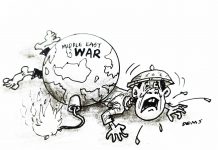
The morning Russia rolled its tanks across the border into Ukraine in February 2022, many analysts predicted Kyiv would fall in days. I remember reading those confident forecasts and thinking how quickly great powers convince themselves that smaller nations are soft targets. History, however, has a stubborn way of humiliating such arrogance.
Three years later, the war has not produced the swift triumph Moscow imagined. Instead, the invasion hardened Ukrainian resistance and rallied international support around a country that many outsiders once dismissed as fragile. A smaller nation, when pushed against the wall, often discovers reserves of courage that no intelligence report can measure. Tanks, missiles, and spreadsheets of military capability rarely capture something as unruly as national will.
I have noticed that powerful states repeat this mistake with almost ritual regularity. They look at maps, budgets, and troop counts, then conclude that victory will follow the arithmetic. Yet war refuses to behave like arithmetic. People defend their homes with a ferocity that seldom appears in military briefings.
Consider the uneasy tension between the United States and Iran. Policymakers and commentators sometimes speak as if a conflict there would be quick and decisive, as though geography, history, and nationalism could simply be brushed aside. But Iran is not a helpless pawn on the chessboard of global power. It is a country with a long memory, rugged terrain, and a population deeply sensitive to foreign intervention—factors that have humbled more than one ambitious empire.
I often think about how leaders, surrounded by strategy papers and glowing screens, can lose sight of the human element. War plans assume predictability; people rarely cooperate with such assumptions. A farmer defending his town, a teacher guarding her children, a mechanic picking up a rifle—these figures do not appear in neat columns of military data, yet they have a habit of reshaping wars.
There is also the quiet strength of national pride. Smaller nations often carry centuries of survival stories—stories whispered in kitchens, taught in classrooms, and sung in old songs. When an outsider threatens that shared memory, resistance becomes more than military duty; it becomes a matter of dignity. And dignity, unlike ammunition, does not easily run out.
That is why I sometimes hear an old line from the folk song Where Have All the Flowers Gone by Pete Seeger echoing in my head: “When will they ever learn?” The question hangs in the air every time a powerful nation assumes that strength alone guarantees victory. Time and again, the battlefield answers with a patient, bruising correction.
Power should travel with humility. Before marching armies or launching missiles, leaders might do well to remember that even the smallest nation contains millions of stubborn hearts. And those hearts, when stirred by invasion or threat, can turn the grand calculations of superpowers into long, costly lessons.