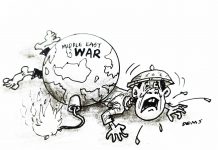
News alerts keep piling up: missiles in the Middle East, drones over Eastern Europe, warships circling the waters of Asia. Each headline feels like another drumbeat in a march nobody wants to finish. I cannot help wondering—are we stumbling, step by step, toward another world war?
I ask that question not as a historian or strategist, but as an ordinary observer who reads the morning news with a cup of coffee that suddenly tastes less comforting. Turn on any broadcast, and the map of the world looks bruised. The fighting between Israel and its enemies has already shaken the Middle East, while Russia’s war in Ukraine drags on with grim stubbornness. Meanwhile, tensions simmer in places like the South China Sea and the Taiwan Strait. None of these conflicts is the same, yet they share an unsettling feature: powerful nations standing behind smaller fires, sometimes openly, sometimes from the shadows.
What troubles me most is how quickly the language of war now slips into everyday conversation. Politicians speak of “red lines,” military “deterrence,” and “strategic responses,” as if the world were a chessboard and human lives were pieces to be moved with cool fingers. But real war does not unfold like a chess match. It burns cities, empties homes, and leaves behind quiet cemeteries where young names are carved into cold stone. History has already shown us this twice in the last century.
The danger today lies not in a single war, but in the way separate conflicts can collide like storm systems. The First World War did not begin as a global war either. It began with alliances, pride, miscalculations, and leaders’ belief that the fighting would be quick. Within months, the entire planet was pulled into a catastrophe no one had truly planned. That lesson should haunt every government office and military headquarters on earth.
What makes our moment even more fragile is the frightening speed of modern weapons. Drones circle above battlefields like mechanical hawks. Missiles travel across continents in minutes. Nuclear arsenals—still sitting quietly in silos and submarines—remain capable of ending civilization many times over. The technology meant to protect nations has also given them the ability to destroy the world faster than any previous generation could imagine.
And yet, when I step outside my door, life continues in its ordinary rhythm. Jeepneys rattle down the street, vendors argue about the price of vegetables, and children laugh on their way home from school. That contrast always strikes me. While diplomats argue and armies move, most people on earth simply want to work, eat, raise families, and sleep peacefully at night. The distance between the lives of ordinary citizens and the calculations of global power can feel painfully wide.
Sometimes I suspect that history’s greatest tragedies arise from that distance. Decisions about war are often made in quiet rooms far removed from the neighborhoods that will eventually pay the price. Meanwhile, the rest of us watch from afar, hoping cooler heads will prevail. Hope, of course, is not a strategy—but it remains one of the few things ordinary people can hold onto while the great powers circle one another.
So, when I ask whether today’s conflicts could lead to another world war, the honest answer is yes. But they do not have to. The world still has diplomats, institutions, and voices of reason strong enough to slow the march toward catastrophe—if leaders choose restraint over pride and dialogue over threats. For my part, I keep hoping that somewhere behind the closed doors of power, someone remembers the simple truth that the rest of us already know: war may begin with ambition, but it always ends with grief.