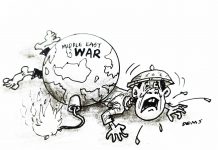
Kun nagtatapo iton duha nga mag isog ngan waray napapirdi, sigurado may ada nabubukolan!
The confrontation between the United States and Iran is not merely about nuclear programs, sanctions, or military maneuvers. At its heart lies a clash of two leadership frameworks, each locked into its own worldview, each unable to bend without risking legitimacy.
On one side stands America under Donald Trump, defined by an aggressive, undiplomatic posture. The administration’s “maximum pressure” campaign against Iran is less about diplomacy and more about leverage. Sanctions, military buildup, and withdrawal from international agreements are tools wielded not to build consensus but to project toughness. This framework thrives on confrontation, presenting strength abroad as proof of resolve at home.
On the other side is Iran, a religious theocracy that perpetuates its regime through suppression and ideological defiance. Its leaders derive legitimacy from clerical authority and a narrative of resistance against Western imperialism. Hostility toward America is not incidental—it is essential, a rallying cry that unifies a population otherwise fractured by economic hardship and political repression. For Iran’s rulers, compromise risks unraveling the very identity of the state.
Together, these frameworks form a mirror-image hostility. America’s aggression validates Iran’s anti-Western rhetoric; Iran’s defiance justifies America’s pressure. Each side needs the other’s hostility to sustain its own narrative. The result is a cycle of escalation where diplomacy is perpetually undermined, not because interests cannot align, but because leadership styles cannot coexist.
And that the World’s Energy Supply Chain is not only disrupted but sadly put on the brink of decapacitation.
The War came with the two leaders defiance and pressure and the World feel the pain .
But the consequences of this collision extend far beyond Washington and Tehran.
In the Philippines, the war’s ripple effects are already visible. As a nation heavily dependent on imported fuel, every spike in global oil prices translates into higher transport costs, electricity bills, and food prices. Farmers face rising expenses for fertilizers and fuel, while commuters and small businesses struggle with inflation. Overseas Filipino workers in the Middle East, numbering in the hundreds of thousands, live under heightened uncertainty, their safety and livelihoods at risk should the conflict escalate.
Thus, at the end of the day, the War is also our war, our disadvantage and never just Israel-US and Iran, it is the Philippine War, one that we are always a victim and never a victor!