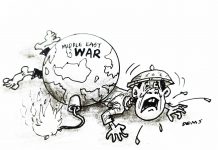
The hearings are broadcast live: lawmakers thundering at each other, congressmen pounding tables, television anchors counting the votes like it’s a championship match. Meanwhile, the same country that funds the spectacle continues to wait for action on runaway prices, failing flood control, and corruption that seems to travel faster than the monsoon. Watching it, I cannot escape the uneasy thought that many of the people entrusted to guard the public interest are busy guarding something else.
I have followed politics long enough to know that public office in the Philippines has always been a complicated mix of service and ambition. But lately the balance seems to tilt in one direction. The language of public duty still fills speeches—those long, echoing words about nation, sacrifice, and people—but when the dust settles, the results often look suspiciously like political positioning. The public agenda gets crowded out by personal score-settling, coalition maneuvering, and the endless choreography of the next election.
One sees it most clearly in how time and attention are spent. The country wrestles with issues that are neither abstract nor distant: rising food prices that gnaw at family budgets, infrastructure projects that collapse under the weight of corruption allegations, and communities that flood whenever the skies decide to open up. Yet the loudest debates in our halls of power often revolve around who embarrasses whom, who gains advantage, and who emerges stronger in the shifting alliances of Manila politics. It is difficult not to feel that the priorities are upside down.
What makes the situation even more frustrating is that the government’s resources are immense. The national budget now runs into trillions of pesos, a sum so large that ordinary citizens can only grasp it by imagining endless columns of zeros. In theory, that money represents classrooms, hospitals, roads, and disaster protection. In practice, we keep hearing about investigations into overpriced projects, missing funds, and the peculiar habit of public works washing away with the first serious rain. The problem is not the lack of money; it is the lack of faithful stewardship.
I sometimes think of government as a large house that all Filipinos are forced to share. The officials we elect are supposed to be caretakers—people entrusted with the keys to the pantry and the safety of the roof. But too often the caretakers behave like tenants who are merely passing through, grabbing whatever they can carry before the lease expires. When public office becomes a temporary marketplace for influence, the national house inevitably grows shabby.
Of course, not every official fits this bleak picture. There are still public servants who work quietly, refusing to treat the government like a personal business venture. But they are often drowned out by the louder figures whose political instincts resemble those of professional gamblers—always calculating odds, always looking for the next move that benefits their camp. The tragedy is that governance begins to resemble a chess match when what the country really needs is simple, steady management.
As a citizen, I find myself caught between irritation and weary humor. We Filipinos have developed a strange tolerance for political theatrics; we watch hearings the way some people watch afternoon dramas. Yet beneath the laughter lies a deeper worry. Every moment wasted on political maneuvering is a moment stolen from the serious work of running a nation that faces storms, economic pressures, and a rapidly changing world.
Perhaps the answer is less dramatic than the problem. Public office must return to its plain meaning: a position of trust, not a ladder for personal glory. That shift will not happen through speeches alone; it will require citizens who pay closer attention, voters who remember longer than a campaign season, and officials who understand that power borrowed from the people must eventually be returned—with interest—in the form of honest service.