26.8 C
Tacloban City
April 02, 2026 - Thursday | 10:26 AM
Home Blog Page 899

Eastern Samar sets its eyes for a drug-free province by 2024

0

BORONGAN CITY-A two-day “Training of Trainers” for the implementers of the Barangay Drug Clearing Program (BDCP) led by the Philippine Drug Enforcement Agency (PDEA) was held at PGO Conference Hall, Capitol Building, Brgy. Alang-alang, this city.

Barangay Drug Clearing Program aims to reduce drug addiction in the country by taking away drugs, reducing the lure of illegal drugs, and minimizing their impact in the community through stakeholder support.

To ensure the effectivity of the application of this program, a “Training of Trainers,” which was held on December 11 and 12, was conducted, which also aims to empower and capacitate the BDCP implementers in the municipal and provincial levels.

A program was conducted before the training, in which executive assistant Raymond Campo, welcomed all the participants and guests, in behalf of Gov. Ben P. Evardone.
Followed by PD DILG Eastern Samar representative Jerry Enriquez, with his challenge to the offices to employ the Drug-free workplace policy.

According to Dir. Alex M. Tablate, in representation of RD, PDEA VIII Atty. Gil T. Pabilona, out of the 22 municipalities and a city in the Province of Eastern Samar, there are still three municipalities which are still affected or not drug-free and/or drug cleared.

Arteche, Dolores and Borongan have been the last three towns that are affected, however the 20 more municipalities are all drug free.

“We cannot do this alone, talaga burublig kita, including an mga taga RHU,” Tabale said as he asked support the LGUs and RHUs.

PCol. Jose Manuel C. Payos, provincial director, PNP Eastern Samar, emphasized the three Cs of success: Cooperation, Communication and Coordination, to bear in mind for the success of the Barangay Drug Clearing Program (BDCP).

This was followed by the signing of the pledge of commitment, for the “Nagkakaisang Adbokasiya Laban sa Iligal na Droga.
(EASTERN SAMAR PROVINCIAL INFORMATION OFFICE)
Dual breaks

0

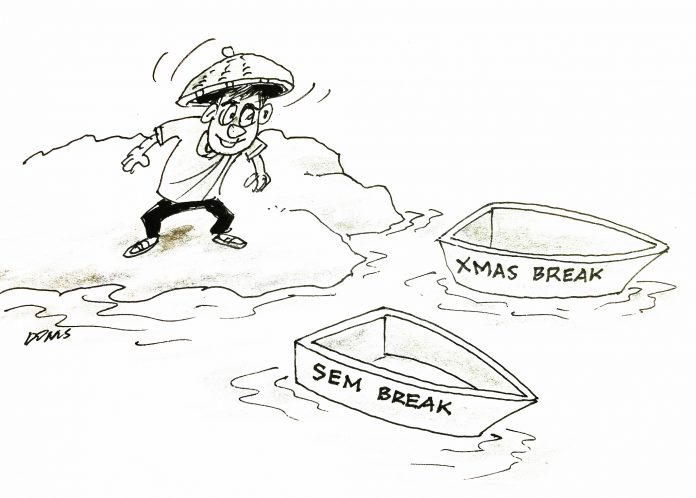
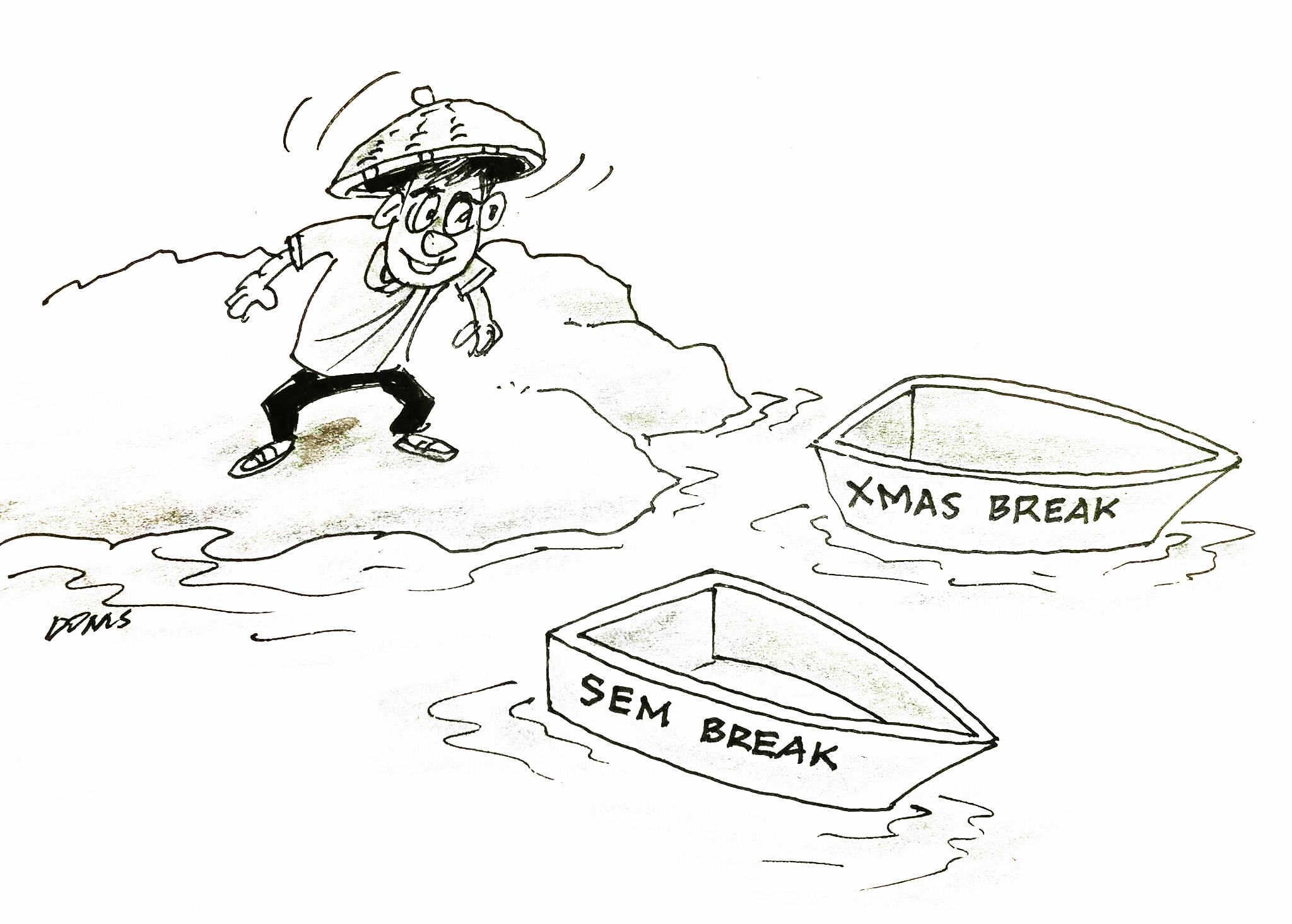
Throughout the academic year, students eagerly anticipate the arrival of Christmas break, a time filled with warmth, festivities, and quality time with loved ones. This time, however, another significant break coincides with this joyous occasion – the semestral break. For undergraduate and graduate students, this period offers an opportunity to recharge, reflect, and delve deeper into their studies.

For some students, the Christmas break is not merely a time for festive celebrations but a period of reflection and rejuvenation. This break offers a respite from the intense academic demands and provides an avenue for self-care. Whether it be spending quality time with family and friends, engaging in leisure activities, or pursuing personal interests, this break enables individuals to strike a healthy balance between work and personal life. By taking the time to rest, recover, and engage in activities that bring joy, students can approach the coming semester with renewed vigor and a fresh perspective.

In addition to the Christmas break, students also have the privilege of enjoying the semestral break. This break offers a longer duration and allows students to engage in more extensive academic pursuits. Often viewed as an invaluable opportunity, the semestral break enables students to delve deeper into their studies and conduct research that contributes to their academic development. Whether it involves conducting fieldwork, analyzing data, or writing research papers, this break provides a dedicated space for focused academic exploration. They can also use this time to interact with their professors, seek guidance, or participate in conferences and workshops to broaden their intellectual horizons.

Both the Christmas break and the semestral break hold immense value for students as they offer occasions for personal growth, reflection, and intellectual development. By utilizing these breaks effectively, students can enhance their academic performance, cultivate their passions, and expand their knowledge base. Moreover, the combination of rest and productive academic engagement during these breaks can equip them with the necessary tools and mindset to excel in their future endeavors.

This holistic approach to time management not only bolsters academic achievement but also nurtures a fulfilling and balanced lifestyle, contributing to their overall well-being. By embracing the opportunities presented by these breaks, students can optimize their potential, leading to academic success and personal fulfillment.

Theories of his birth

0
DOMS PAGLIAWAN

The birth date of Jesus on earth has long been a subject of intense debate among scholars and theologians. While the exact date remains unclear, historical evidence and religious texts offer some insights into this widely contested topic. There have been theories surrounding Jesus’ birth date based on academic research and biblical texts that could shed light on this complex issue.

The most commonly accepted theory suggests that Jesus was born on December 25th. This idea stems from the selection of this date as Christmas in the fourth century by the early Christian Church. The rationale behind this decision is rooted in the religious significance of the winter solstice, a time when days began to lengthen and light triumphed over darkness. Hence, December 25th was believed to symbolize the birth of Jesus as the “light of the world.” While this theory influenced the establishment of Christmas, critics argue that it lacks substantial historical or biblical evidence.

Another theory proposes that Jesus was born in the spring, specifically in April. Proponents of this view contend that shepherds, who feature prominently in the biblical nativity story, were more likely to be in the fields tending their flocks during that season. Additionally, some scholars point to ancient Jewish festivals such as Passover and the Feast of Unleavened Bread, which might align with the timing of Jesus’ birth due to the historical context provided in the Gospels.

An alternative hypothesis suggests that Jesus’ birth occurred not in December or April, but rather in the fall. Scholars supporting this theory often cite the census that compelled Mary and Joseph to travel to Bethlehem. Roman censuses typically took place in the fall, aligning with the idea that Jesus could have been born around that time. Furthermore, ancient Jewish festival celebrations such as the Feast of Tabernacles in the fall may provide further context for this theory.

Despite these various theories, we must also acknowledge that multiple factors complicate the historical investigation into Jesus’ birth date. Firstly, the absence of specific references to a birth date in the Bible makes pinpointing the exact day and month challenging. Moreover, calendars and dating systems used during the time of Jesus differ significantly from those in use today, further complicating the matter.

To further complicate the issue, the primary purpose of the Jesus accounts in the Gospels is not to provide an exhaustive historical biography. Instead, the Gospel writers aim to present theological truths, emphasizing Jesus’ divine nature and his redemptive mission. Consequently, establishing an exact date was not vital to their message. Bearing these factors in mind, it becomes clear that the precise birth date of Jesus may never be known with certainty.

The birth date of Jesus remains a highly debated topic that has intrigued scholars and theologians for centuries. While theories regarding his birth in December, April, or the fall have been proposed, none of them can be conclusively proven due to limited historical evidence and the theological nature of biblical accounts. Ultimately, the exact date of Jesus’ birth may remain an enigma, reminding us that our understanding of faith is often based on spiritual truths rather than historical facts alone. What is so important is that he was born into this world, experienced death, and thus redeemed the fallen human race. He then provides salvation to those who trust him for the deliverance of their souls from hellfire.

Christ in Chistmas

0
CLEMELLE L. MONTALLANA,DM, CESE ASSOCIATE PROFESSOR III
CLEMELLE L. MONTALLANA,DM, CESE
ASSOCIATE PROFESSOR III

We all knew it too well. For a child and the little ones, Christmas is the most wonderful time of the year. For the big commercial establishments and other businesses, its a good time for ROI profit. For the transport carriers in busses, planes or even boats this era usher in the peak season of fully – booked flights and trips.

For the government workers these days are party days. From every segment and subdivisions of groups where the civil servants are affiliated, the party is actually multiple. its like existing in a unique universe every time parties are held.

For the religious, these days are heavy loaded days of the traditions, masses, morning and afternoons.

For the public safety officers, these are times of hightened alert, where every one must keep watch as the insurgents commemorating its anniversary and mourning its founder who passed on.

For the Medical Personnel its a lost time of being with the gang ,and the family as well, sadly Christmas is not an excuse for them to be absent, they need to report to their posts in the hospitals.

For the normal Filipino the stretched Christmas celebration is both a bane and a boon, a blessing and a curse. It is a blessing because its a time of celebration, a curse because it would entail extra cost.

Extra expenses and mandatory gifts to a whole bunch of folks connected to you.
But if we really look back to the simple, uneventful day of days, where the Saviour was born to a manger 8n a barn, it would have been a simple sight, bereft and robbed of the trimmings of the light emitting diodes that nauseates us nor the lofty triangular trees we see.

It was dark, cold and people are shooing away the Family of Jesus.

It was a rejection and non acceptance time that would create resentment to ordinary mortals.

It was an rigorous trip of a walk house to every house and rejection at every turn.
It was without the fervor of parties and glitters of sparkling lights.

It was a sad day that was capped with the triumph of the eventual birth.

Knowingly or unknowingly, we are celebrating it from a purview and vantage of pleasure. We are commemorating Christmas from the view of sales and commercialism.

When we should have shared the pain and the hardship of attaining triumph, when we should be sympathetic of the plight that the Holy Family had endured.

Something must be wrong, something felt bland. It is as if we are not searching for Christ in Christmas, it is as if we are seeking joy and pleasure on a supposed solemn and sacrificial trek.

We must put Christ back to Christmas, we must introspect and remember.

It was not a glittery nor colorful time, it was cold, dark and simple.

While we recognize the triumph of the Saviours birth, we must never forget that it w as not meant to be a thing for parties, nor for lights not even a time for splurge of tasty feast, it was beyond the pleasure seeking selves we have, its about love, sacrifice and simplicity that the Saviour had shown. Its about time we put Christ back to Christmas.

Sports as preparation for Christmas

0
FR. ROY CIMAGALA
FR. ROY CIMAGALA

CHRISTMAS being the birth of Christ our Redeemer, we should be properly prepared for it in both body and soul. The spiritual preparation, of course, takes precedence over the bodily preparation, but the latter also needs to be given due attention, otherwise our spiritual readiness to receive Christ on Christmas Day would be undermined.

One good way to make ourselves bodily prepared for Christmas is through sports. If its true purpose is understood and lived well, sports can give us a tremendous help in properly welcoming Christ into our lives.

We have to understand that sports should not just be a matter of winning in a game or in a race. While that is the immediate intention of anyone who plays, we should go beyond that level and capture the more important purpose of sports.

Sports should train our body and all its faculties—the senses, emotions, passions, imagination, memory, etc.—to be properly aligned to the true dignity of man which is that of being the image and likeness of God, children of his, sharers of his divine life and nature.
In short, sports should make us like Christ, the pattern of our humanity and the savior of our damaged humanity. How? By seeing to it that we regard our life here on earth like a sport too, where we have to train ourselves, submitting ourselves to a certain discipline, etc.

We should echo what St. Paul once said: “Everyone who competes in the games goes into strict training. They do it to get a crown that will not last, but we do it to get a crown that will last forever. Therefore, I do not run like someone running aimlessly. I do not fight like a boxer beating the air.” (1 Cor 9,25-27)

This discipline required in sports and in our life is somehow indicated in the readings of the Mass of December 19 where we are told about Samson whose hair should not be cut (cfr. Judges 13,2-7.24-25), and about John the Baptist who would not take strong drinks. (cfr. Lk 1,15)

The real victory that our sports should give us is not so much a matter of winning a particular game, or of making a lot of points, etc., as in making us more a child of God, filled with love for God and for everybody else, whether we win or lose in a game.

Aside from a strong sense of self-discipline and submitting ourselves in a continuing training program, an indispensable ingredient of this healthy sporting spirit is the sense of acceptance and abandonment that we need to deliberately cultivate. This does not come automatically, as if it’s part of our genes. We have to develop them.

We have to be sport and adventurous in facing the different conditions of our life. And it would greatly help if we too can have an abiding sense of humor. Otherwise, we would just fall into states of sadness, pessimism and despair which actually are unnecessary and are avoidable.

This we can do if first of all we have a strong and deep faith in God, our Creator and Father. If we have that faith, we know that God holds everything in order through his providence. He takes care of everything, irrespective of how things go. Ours is simply to relate everything to him and to go back to him everytime we go astray especially at the end of the day.

DSWD’s 4Ps program helps Bajao youth earn a college degree

0

TACLOBAN CITY– A Bajao youth who was a former monitored child of the Pantawid Pamilyang Pilipino Program (4Ps) of the Department of Social Welfare and Development (DSWD) is now the pride of the indigenous people’s community in Bato, Leyte.

This after Jeraldyn Bansale finished her Bachelor of Science in Business Administration (BSBA) in 2022 from the Bato Institute of Science and Technology, in the same town.
With this accomplishment, Bansale has proven that completing education among poor indigenous peoples of the Bajao community is possible with perseverance and determination, the DSWD said in a statement.

Despite the financial constraints and challenges her family faced, Bansale saw education as the key to breaking the cycle of poverty and providing a brighter future for herself and her loved ones, it added.

“Due to the poverty that we are experiencing, I chose to strive and complete my education to help my parents. Also, to assist my siblings in their needs, especially in their education,” Bansale said, as quoted by the DSWD.

In finishing her education, Bansale said the DSWD’s 4Ps was a significant factor for her family since she was able to use the cash grants for meeting her school requirements, transportation expenses, and other needs, adding that the family development sessions also taught her family some ‘valuable insights.’

The Bansale family became a 4Ps beneficiary in 2014.

“My family learned a lot from the topics in the Family Development Session as they also learned the importance of saving, budgeting, and the value of money,” she said.

According to DSWD Assistant Secretary for Legislative Affairs and co-spokesperson Irene Dumlao, the DSWD remains committed to helping marginalized families, especially indigenous peoples, by delivering programs and services such as the 4Ps that will help uplift their lives.

“The DSWD is providing all the needed assistance to help our kababayans from the indigenous peoples’ sector by providing necessary interventions that will enable them to become empowered and productive citizens, with the prime consideration of their culture and heritage,” she said.

The 4Ps is the flagship program of the national government on poverty reduction and social development implemented by the DSWD.

With around 4.4 million household beneficiaries, the 4Ps program provides conditional financial assistance to the most economically challenged families, fostering improvements in health, nutrition, and education.
(LIZBETH ANN A. ABELLA)

Recent Posts

DALMACIO C. GRAFIL
PUBLISHER

ALMA GRAFIL
EDITOR-IN-CHIEF

ROMEO CEBREROS
OFFICE IN-CHARGE

OFFICE
BRGY. SONGCO, BORONGAN CITY

CONTACT NUMBERS
(055) 261 – 3319 | 0955 251 1533 | 0917 771 0320 | 0915 897 7439 | 0921 511 0010

DALMACIO C. GRAFIL
PUBLISHER

RICKY J. BAUTISTA
EDITOR

ALMA GRAFIL
BUS. MANAGER

OFFICE
RIZAL AVENUE, CATBALOGAN
(INFRONT OF FIRE DEPARTMENT, NEAR CITY HALL)

CONTACT NUMBERS
0917 771 0320 | 0915 897 7439 | 0921 511 0010

EMAIL
lsdaily2@yahoo.com

WEBSITE
www.issuu.com/samarweeklyexpress