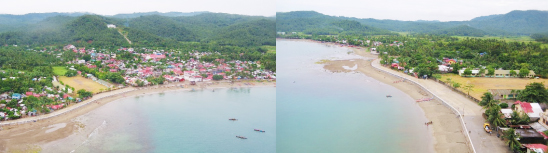
ORMOC CITY-A four-year-old boy was found floating in the seawater past 11 am in Purok 1, Barangay Nijaga of this city last April 26.
The victim was identified as Daniel Aniban, 4, a resident of Purok 3, Brgy. Hamorawon, here.
Based on the report from the local police, residents in the coastal barangay of Nijaga found a floating object in the seawater and when they went to see it, to their shock and horror, learned it was a child.
The residents immediately brought the child to the shoreline with the hope of reviving him before they brought him to a hospital.
The attending doctor, however, declared him to be dead on arrival.
It was learned that the boy came out of their house unnoticed as his mother was inside their room feeding her other child.
The boy reportedly went to the roasted pig near their house and possibly went to the river. (ROBERT DEJON)
Corporal Denver Jay Busa believes his gender will not be a hindrance his work as a police personnel. The 27-year-old cop also affirms his strong obedience to God as he carries out his duty as a peace officer.
TACLOBAN CITY – POLICE OFFICER Denver Jay Busa reflects on his childhood surrounded by books, flowers, and female friends.
“I grew up with a great love for flowers, especially during Flores de Mayo, because I love to decorate our church with lots of flowers to make it look more beautiful,” says the 27-year-old police corporal from Maydolong town in Eastern Samar province.
His fondness for beautiful flowers traces back to the teachings of his catechist teachers at St. Roch the Healer Chapel in their small village of Maybocog in Maydolong, a quaint fourth-class town in Eastern Samar home to over 15,000 people.
“My religion teachers reminded me that when you offer a flower during Flores de Mayo, you offer it to Mama Mary, the mother of Jesus Christ. From this, I realized that we should do our best and give everything to the Lord all the time,” Busa shares.
At the age of nine, Busa began assisting the priest during mass and joining the choir, deeply involving himself in church activities. “Every Sunday, I feel part of a group with a purpose. And that purpose is to serve God and others,” he says, recalling his formative years.
He fondly remembers the late priest Nemesio Quiloña, who influenced him about the Catholic faith and Christian values during his teenage years as a church helper.
A love for knowledge and spiritual matters
As the eldest son of four siblings, Busa already sees himself as the family’s breadwinner. His father, Ernesto Jr., is a coconut farmer, while his mother, Ma. Rodita, works as a laundrywoman.
“My parents work hard for all of us. This is the reason why I also work hard to finish my studies,” he says. Busa expresses gratitude to his neighbor, the late Maximo Mabansag, for introducing him to the Angelus prayer and providing access to educational resources.
“His family strictly observed the Angelus prayer. As a frequent visitor to their house, I discovered the importance of praying for my own family,” Busa shares, reminiscing about his childhood visits to their home.
During his high school years in Maydolong, Busa spent more time with female friends than with males, acknowledging his membership in the LGBTQI community. Despite this, he excelled academically, graduating as valedictorian in elementary and first honor in high school.
In 2015, he graduated with a Bachelor of Science in Elementary Education at Eastern Samar State University-Maydolong Campus, receiving the “Student Excellence Award.”
A Journey to Law Enforcement
Upon graduation, Busa faced challenges securing a teaching position due to political reasons, leading him to explore alternative career paths. Hearing a radio announcement about the need for new police officer applicants at the Police Regional Office-Eastern Visayas (PRO8) reignited his sense of purpose.
After completing the one-year police training course and becoming a leader in his class, Busa now serves at the PRO8 Regional Public Information Office. He handles information dissemination to the public through various platforms and hosts police radio programs.
Grounded in service and faith
Despite the success in his career, Busa remains grounded in his profession and faith. He emphasizes the importance of serving others and striving for righteousness in his work and community involvement.
Starting his day with prayer and devotion, Busa shares Biblical verses on his social media platforms to inspire others. He remains loyal to his profession, proud of the values upheld by law enforcement officers despite criticisms.
In his seven years in the police force, Busa has only fired his gun during marksmanship training, prioritizing maximum tolerance and protection of lives. He believes in the power of law enforcement to combat evil and protect the community.
Busa’s journey from a church helper to a police corporal exemplifies resilience, idealism, and unwavering faith, proving that one can be both tough in duty and Godly in service.
TACLOBAN CITY – The Department of Public Works and Highways and the Eastern Samar District Engineering Office inaugurated a bridge in Barangay Bigo, Arteche in Eastern Samar.
The inauguration was held on April 25 with Department of Public Works and Highways Assistant Regional Director Ma. Margarita Junia, Eastern Samar District Engineer Domcelio Natividad, and Eastern Samar lone district Rep.Maria Fe Abunda in attendance.
The viaduct is a vital infrastructure that will provide accessibility, especially to residents of nearby town Jipapad even during times of disaster such as flooding.
The portion of the national road in Bigo is frequently close to traffic during heavy due to flood waters that usually reach an average of two meters while during extreme rainfall would reaches six meters.
This would result in road closure that lasts for several days until the flood water subsides.
The 80-meter linear bridge worth P96.499 million, with the construction started April of last year, is also considered a vital point for travelers and motorists from Eastern and Northern Samar using the Arteche-Jipapad-Las Navas road.
The completion of the viaduct will not only help in accessibility even during times of calamity and disaster but will also benefit on economic and social development of the villages of Arteche and Jipapad. (ROEL T. AMAZONA)
CATARMAN,N. Samar– District Engineer Alvin A. Ignacio, along with the Inspectorate team led by Construction Chief Engineer Vicente C. Galecio and Planning and Design Chief Engineer Andy S. Ereño of the Department of Public Works and Highways-Northern Samar First District Engineering Office (DEO), conducted an ocular inspection of various infrastructure projects within the first district of Northern Samar on April 23, 2024.
The team inspected the following ongoing projects: Construction of Road in Doña Polqueria, Catarman, Northern Samar; Construction (Completion) of Bridge, Phase III, Galutan National High School (Catarman River) to Barangay Doña Polqueria, Catarman, Northern Samar; and Construction of 1-Storey 4-Classroom, Cawayan Integrated School, Catarman, Northern Samar.
During the inspection, District Engineer Alvin A. Ignacio instructed the construction chief engineer to ensure that the implementation of these projects are in accordance with the approved designs and safety standards. He also emphasized that project engineers must closely monitor the implementation to avoid unforeseen circumstances.
District Engineer Ignacio further highlighted the significant impact these projects will have on the community once completed.
“These projects will not only improve the infrastructure of our district but will also provide better access and facilities for our communities. It is our responsibility to ensure the successful planning, implementation, and completion of these projects for the benefit of the public.”
The routine site visits conducted by the District Engineer and his team serve as a crucial aspect of project management and quality assurance. By actively engaging with project sites, the District Engineer can provide timely guidance to project teams, ensuring that work is carried out efficiently and in accordance with specifications. (ANALIZA A.PABIA, PIO ALTERNATE/PR)
As the sweltering heat of summer envelops our surroundings, the threat of wildfires looms large, and even the smallest spark can swiftly escalate into a catastrophic blaze, endangering lives and consuming precious natural resources. In the face of this imminent danger, individuals must exercise heightened caution and vigilance to guard against the rapid possibilities of fire.
Appropriate measures must be in place with utmost urgency, then. This entails adhering to strict fire safety protocols, such as refraining from outdoor burning, properly extinguishing campfires, and exercising extreme caution when handling flammable materials. Through appropriate fire prevention, individuals can significantly reduce the risk of accidental ignition and mitigate the potential for widespread devastation.
Thus, education and awareness play a vital role in empowering individuals to make informed decisions and take appropriate action in fire-prone environments. It is essential for communities to prioritize fire safety education, equipping residents with the knowledge and skills needed to identify potential hazards, respond effectively to fire emergencies, and protect themselves and their loved ones from harm. Through ongoing education and outreach efforts, we enforce a culture of preparedness and resilience that strengthens our collective ability to withstand the threat of wildfires.
Additionally, collaboration and cooperation should bolster our defenses against wildfires. By working together at the local, regional, and national levels, communities can pool resources, share expertise, and coordinate response efforts to effectively combat fires when they occur. This collaborative approach not only enhances our capacity to contain and extinguish wildfires but also ensures that affected communities receive the support and assistance they need to recover and rebuild in the aftermath of a fire.
As temperatures continue to soar and the risk of wildfires escalates, everyone should remain vigilant in safeguarding against the rapid possibilities of fire. We should fortify our defenses against wildfires and protect our communities, our homes, and our natural environment from the devastating impact of fire. Now is the time to unite in our efforts to prevent and mitigate this threat, ensuring a
Ah, the great Filipino summer tradition: seeking refuge from the scorching heat by flocking to cold springs and rivers. It’s a time-honored ritual, akin to a pilgrimage, where urbanites embark on a quest for aquatic salvation, only to find themselves face to face with a rather unpleasant truth.
Yes, sadly; beneath the glistening surface of these supposedly pristine waters lies a murky reality—a reality where carabaos frolic freely and unsuspecting travelers unwittingly wade into nature’s very own cesspool. That’s upstream, where the water flows from, where farmers have to cool their farm animals in water.
As temperatures soar faster than gossip at a family reunion, the allure of cool, refreshing water becomes irresistible. Families pack their picnic baskets with enough food to feed a barangay and pile into jeepneys like sardines in a can, all in pursuit of that elusive oasis of chill. Yet, as they arrive at their watery destination, their dreams of aquatic bliss are secretly washed away by a tide of disappointment. What they frolic into is a veritable smorgasbord of algae, debris, and a distinct odor that smells of carabao.
But how did these once-idyllic waterways descend into such foulness, you ask? Well, it’s a tale as old as time—or at least as old as irresponsible waste disposal. Upstream, where the air is still fresh and the grass is still green, lies the source of our aquatic woes. Here, carabaos traverse the riverbank, turning what was once a pristine waterway into their very own aquatic playground.
And let’s not forget our fellow humans, who, in their infinite wisdom, have designated these same waters as their preferred restroom facilities. And what’s more, they sometimes detour their piggery wastes into these running waters instead of digging up deep and huge holes for the purpose. That’s the extant problem here in our country—the unsanitary practices of some of our uneducated brethren in the rural areas.
As our intrepid adventurers stand on the riverbank, contemplating their next move, a sense of camaraderie begins to emerge. After all, there’s nothing like the shared experience of wading through waist-deep water that doubles as a carabao spa to bring people together. Laughter rings out like the call of the wild as they swap tales of their aquatic misadventures, finding solace in the absurdity of it all.
And so, the next time you find yourself tempted by the siren song of cold springs and rivers in the Philippines, remember to pack a sense of humor along with your swimsuit. While the waters may not be as pristine as advertised, the memories forged amidst the algae and aroma will be cherished for years to come. After all, there’s nothing quite like a refreshing dip in a carabao swimming pool to make us appreciate the finer things in life.