ORMOC CITY-A newly identified drug peddler was apprehended during a buy-bust operation conducted by the Station Drug Enforcement Team of the local police of Bato, Leyte, and the Philippine Drug Enforcement Agency (PDEA) on Feb.14 in Barangay Iniguihan, Bato town.
Police Captain John Rey Layog, town police chief, identified the suspect as Ricky Satentes, also known as Estoy, 38, married, and a laborer residing in Brgy. Iniguihan.
He is listed as a street-level individual in the drug watch list of both the PNP and PDEA.
Recovered from the suspect’s possession during the 4:55 pm operation was one sachet containing a white crystalline substance suspected to be shabu, which was purchased by an operative for P500.
During a subsequent body search conducted in the presence of an elected barangay official and a representative from the local media, four more sachets containing similar substances were discovered.
Charges for violations of sections 5 and 11 of Article II of RA 9165, the Comprehensive Law against Illegal Drugs of 2002, were filed against the suspect by the arresting authorities. (ROBERT DEJON)
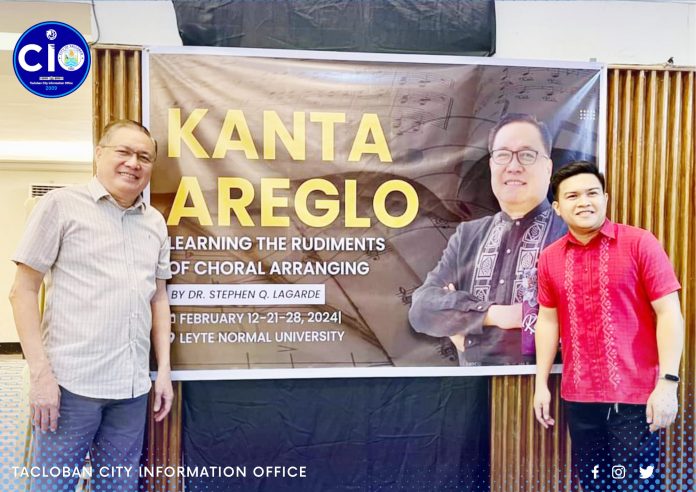
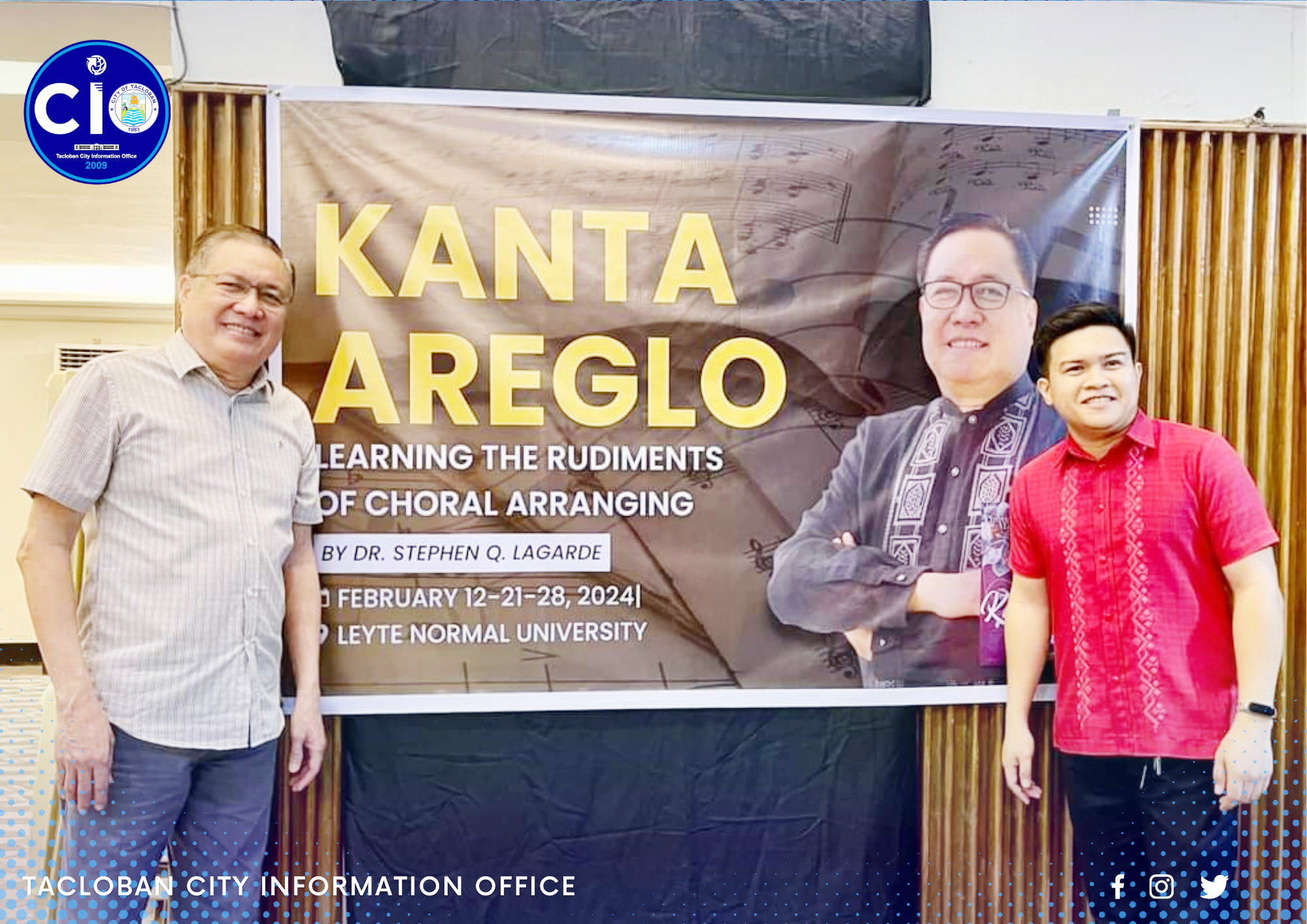
KANTA BINISAYA. Professor Stephen Lagarde of the University of the Philippines Tacloban Campus has brought his Kanta Binisay’a to Leyte Normal University. (TCIO)
KANTA BINISAYA. Professor Stephen Lagarde of the University of the Philippines Tacloban Campus has brought his Kanta Binisay’a to Leyte Normal University. (TCIO)
TACLOBAN CITY-Following its successful national exposure in October 2023, ‘Kanta Binisay’a, curated by Tacloban’s esteemed musical arranger Dr. Stephen Q. Lagarde, takes a significant step by partnering with one of the city’s premiere educational institutions.
On February 14, 2024, the Leyte Normal University inaugurated “Kanta Areglo: Learning the Rudiments of Choral Arranging,” a three-day workshop designed to enhance the skills of Bachelor of Music Education faculty and students in musical arrangement.
A pioneering initiative in the region, Lagarde, the workshop’s resource person, uses the pieces he arranged for Kanta Binisaya, a musical collection featuring iconic ‘binisaya’ songs that highlight the rich musical heritage of Eastern Visayas
“I am primarily using our heritage music as tools in enhancing and enriching the musical arrangement skills of the faculty and students of the music program of LNU. We hope to offer this same workshop to others to keep the music scene in Tacloban vibrant,” expressed Prof. Lagarde amidst efforts to place Kanta Binisaya in an appropriate venue for cultural enrichment and education.
With the enthusiastic support of University President Evelyn Aguirre and the collaboration between the LNU Center for Continuing Education and Lifelong Learning headed by Jacqueline Espina, alongside the Music Education Department coordinated by Jay Mabini, the Kanta Areglo project aspires to position LNU’s music education program as a front-runner in the region.
“We envision this academic program to take a leading role in the promotion of our musical heritage as well as in honing our homegrown musical talents in the area of music composition and arranging,” Lagarde remarked optimistically, anticipating that Kanta Areglo will soon be accessible to the public, contributing to the promotion of Eastern Visayas’ musical heritage, culture and identity. (TACLOBAN CITY INFORMATION OFFICE)
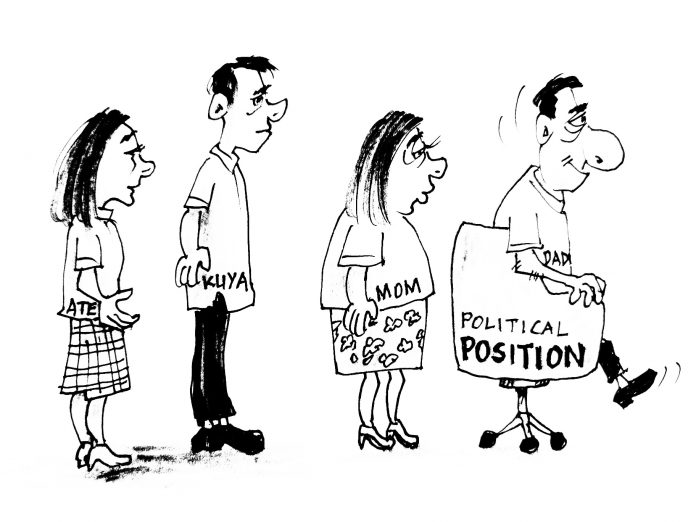
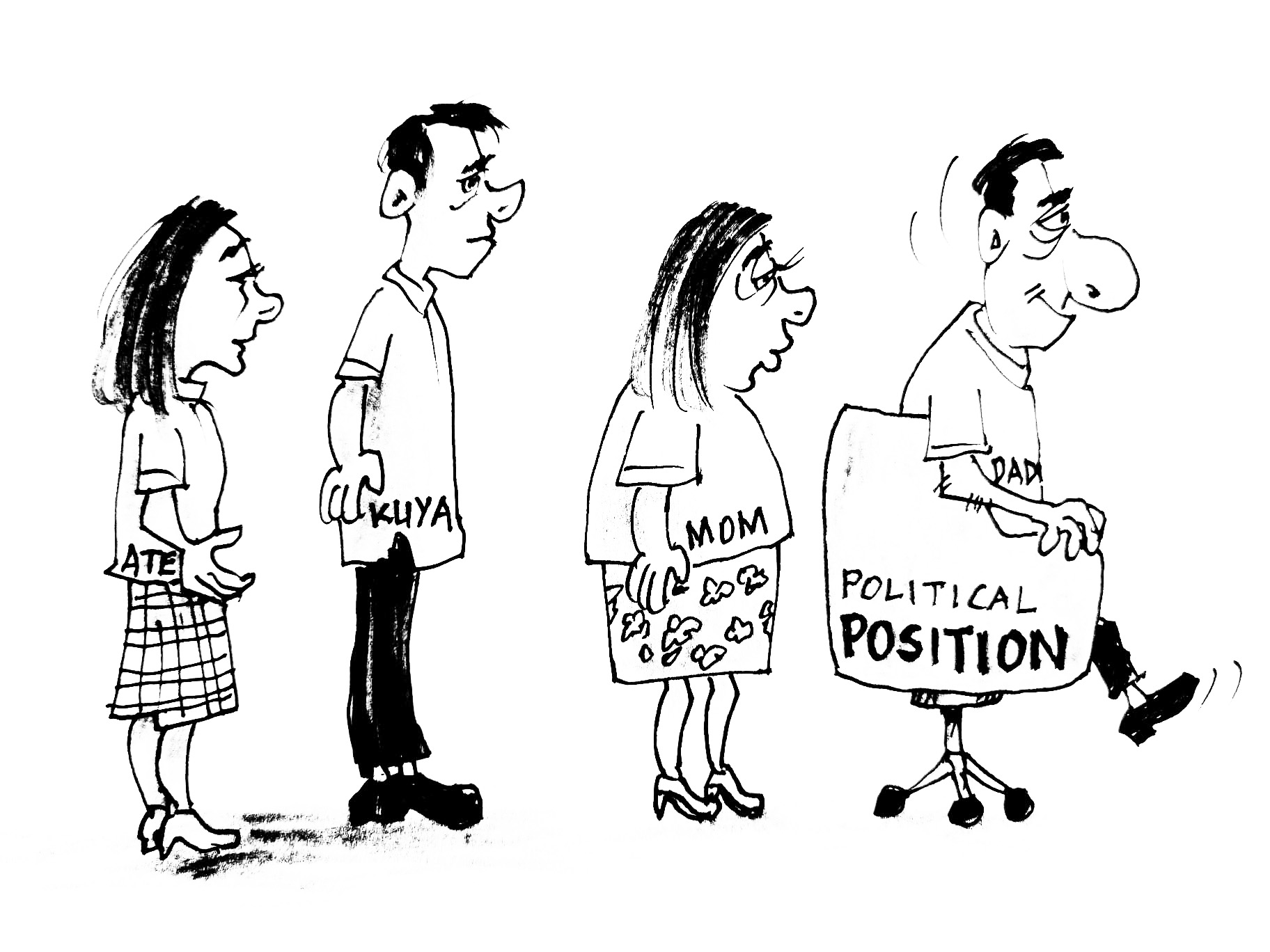
One thing good about democracy is that anyone can make it to high-ranking positions in government through fair and honest elections. But most of the time, this is just in principle because, in actual practice, it’s not the case at all.
In our country, political positions are often inherited, creating a system where power is concentrated within a few elite families. This phenomenon, known as political dynasty, has been a prominent feature of Philippine politics for decades, perpetuating a cycle of privilege and influence that undermines democratic principles. Family names such as Aquino, Marcos, and others are synonymous with political power, with members of these families consistently holding key positions in government.
The proliferation of political dynasties in the Philippines can be attributed to a combination of factors, including a lack of strict regulations on political succession, a culture of patronage and nepotism, and a system that privileges the interests of established political clans. In many cases, political positions are treated as family heirlooms, passed down from generation to generation, with little regard for merit or qualifications. This practice limits opportunities for new and diverse voices to enter the political arena and contributes to a culture of corruption and abuse of power.
While some argue that political dynasties can bring stability and continuity to governance, they stifle democratic processes and perpetuate inequality. The concentration of power within a select few families diminishes the chances of meaningful reforms and contributes to a system where political influence is concentrated among a small, privileged elite. In addition, the perpetuation of political dynasties undermines the principles of democracy, as political positions are not based on popular mandate or merit but rather on familial ties and connections.
There is then a need for comprehensive legislative reforms that restrict the ability of family members to succeed one another in political office. This could include implementing term limits, introducing campaign finance regulations, and promoting transparency and accountability in the political process. Breaking the cycle of inherited political positions is essential for building a more inclusive and democratic society, where political power truly represents the will of the people and not the privilege of a few elite families.
The advancement of artificial intelligence (AI) has brought about a myriad of technological advancements that have revolutionized various industries and sectors. However, with this progress comes the looming threat of AI to job applicants, which aggravates the unemployment problem here in Pinas where job applicants are numerous compared to the rare job opportunities. Soon, many traditional jobs may become automated, leading to potential job loss and displacement for numerous individuals in the workforce.
One of the main threats posed by AI to job applicants is the potential for automation of low-skilled and routine tasks. As AI technologies become more advanced and capable of performing tasks that were once solely done by humans, there is a risk that many jobs in sectors such as manufacturing, customer service, and data entry may become obsolete. This could result in a significant number of individuals losing their jobs and struggling to find new employment opportunities in an increasingly competitive job market.
Furthermore, AI can streamline and optimize processes in various industries, leading to increased efficiency and productivity. While this may be beneficial for companies and organizations, it could also potentially lead to a decrease in the demand for human workers. As AI becomes more integrated into workplace operations, job roles may shift or be eliminated, leaving many job applicants at a disadvantage in terms of securing employment.
Another threat of AI to job applicants is the potential for bias in the so-called AI algorithms and decision-making processes. AI systems are trained on vast amounts of data, which may contain biases that can inadvertently perpetuate discrimination and inequality in the workforce. Job applicants may face challenges in accessing job opportunities or advancing in their careers if AI systems are used to make hiring and promotion decisions based on flawed or biased algorithms.
Moreover, the rapid pace of technological innovation and adoption of AI in the workplace may also pose a threat to job applicants who lack the necessary skills and knowledge to effectively navigate an AI-driven environment. As AI continues to reshape industries and job requirements, job seekers may struggle to keep up with the changing demands of the workforce and find themselves at a disadvantage when competing for jobs against candidates with AI-related skills and expertise.
In addition, the rise of AI-powered recruiting tools and platforms has the potential to impact job applicants in terms of the recruitment and selection process. Many companies are increasingly using AI algorithms to screen and evaluate job applicants based on criteria such as skills, qualifications, and experience. While this may streamline the recruitment process for employers, it could also inadvertently disadvantage job applicants who may be overlooked or dismissed by AI systems due to a lack of keyword optimization or compatibility with algorithms.
Truly, the threat of AI to job applicants requires careful consideration and necessary measures to mitigate its potential impacts. Job seekers and individuals in the workforce must adapt to the changing landscape of AI technologies by acquiring new skills, staying abreast of industry trends, and continuously honing their abilities to remain competitive in a technologically driven job market. Employers and policymakers must also take steps to ensure that the integration of AI in the workplace does not disproportionately disadvantage job applicants and that measures are in place to promote fairness, equality, and transparency in AI-driven hiring and employment practices.
WHAT reassuring description we have about God’s word! From the Book of Isaiah in the first reading of the Mass for Tuesday of the 1st Week of Lent, we read: “As the rain and snow come down from heaven, and return no more thither, but soak the earth, and water it, and make it to spring, ang give seed to the sower, and bread to the eater: so shall my words be…” (55,10-11)
What should then be our attitude toward the word of God? I would say that basically it should be the same attitude that we have toward God himself. And the reason is this—since God is absolute simplicity with no division, parts or distinction in his being, his word must be his being also, his whole divine substance himself.
We, on our part, make some distinction between God in his being and in his word because that is how we understand things in general. We need to distinguish and analyze things, breaking them into parts, before we can arrive at the whole, integral picture.
In fact, in the Trinitarian nature of God, the Second Person whom we refer as the Son, is described also as the very Word of God, the Divine Word, who is God himself insofar as he perfectly and fully knows himself and all his creation. So, God’s word is God himself!
The word of God which now comes to us with some human and natural instrumentalities through the Gospel or the Sacred Scripture together with Tradition and the Church Magisterium, should be regarded in that light.
Its primary purpose is to bring us back to God. And so more than just giving us some helpful earthly knowledge, it gives us the ultimate spiritual knowledge we need to return to God. This character of God’s word is described in the following words in the Letter to the Hebrews:
“For the word of God is living and effectual, and more piercing than any two-edged sword, and reaching unto the division of the soul and the spirit, of the joints also and the marrow, and is a discerner of the thoughts and intents of the heart.” (4,12)
Its purely eternal, spiritual, sacred and transcendent nature is now subjected to the conditions of time, culture, history, etc., in view of how we are. But we should not forget that it is primarily purely eternal, spiritual, sacred and transcendent, which with our spiritual powers plus God’s grace we can manage to abstract from its temporal, material, mundane and prosaic condition.
Let’s remember that God became man. With his incarnation, the divine word assumes the nature of a human word. And just as God became man to bring man back to God, his divine word becomes human word to bring and reconcile the latter with the former where it comes from and where it belongs to.
Since God’s word is God himself and God is everything to us, we have to understand that it contains everything for our needs, especially our ultimate need to be with God. All things true, good and beautiful are contained in the word of God.
Thus, insofar as our sciences, arts and technologies contain truths, goodness and beauty, no matter how technical they are, we have to conclude that they also come from God’s word and belong there also.
Anyone who does not acknowledge this truth about our sciences, arts and technologies can be considered ungrateful and presumptuous. We need to overcome the dichotomy that detaches our sciences, arts and technologies from God’s word.
CLEMELLE L. MONTALLANA,DM, CESE
ASSOCIATE PROFESSOR III
CLEMELLE L. MONTALLANA,DM, CESE ASSOCIATE PROFESSOR III
The ever persistent question came popping up today, as the country observes and celebrate Women’s Month. Who is the stronger, better gender?
These are interesting questions, but they do not have simple answers. There are many factors that influence the strength, lifespan, and emotionality of men and women, such as genetics, environment, culture, and individual differences. Therefore, it is not accurate to make generalizations based on gender alone. However, I can share some information from scientific studies that have explored these topics.
What does the web says;
• Strength: Men tend to be physically stronger than women, on average, because they have more muscle mass and bone density. However, strength also depends on training, nutrition, and health. Some women can be stronger than some men, especially if they practice sports or exercises that require strength12.
• Lifespan: Women tend to live longer than men, on average, in most countries and regions of the world. This is partly due to biological factors, such as having two X chromosomes, which may protect against some diseases and aging. It is also partly due to social and behavioral factors, such as having better access to health care, being less exposed to violence and risky behaviors, and having more social support.
• Emotion: Women and men may experience and express emotions differently, depending on the type, intensity, and context of the emotion. Some studies have found that women are more likely to express positive emotions, such as happiness and gratitude, and negative emotions, such as sadness and fear, than men. Men, on the other hand, are more likely to express anger and pride than
In all, we are certain of the unique gender that men and women are. But to me a man half a century of age, knew better. Women are stronger than men, ask my wife, she knows best.