24.8 C
Tacloban City
April 06, 2026 - Monday | 12:00 AM
Home Blog Page 83

Samar athlete receives P100,000 incentive for SEA Games bronze win

0
RECOGNITION. Alhryan Labita from Basey town, received commendation and cash incentive of P100,000 from the Samar provincial government after winning bronze in the recently-held ASEAN Games in the 4x400 meter relay. (SAMAR PROVINCIAL INFORMATION OFFICE)
RECOGNITION. Alhryan Labita from Basey town, received commendation and cash incentive of P100,000 from the Samar provincial government after winning bronze in the recently-held ASEAN Games in the 4×400 meter relay.
(SAMAR PROVINCIAL INFORMATION OFFICE)

TACLOBAN CITY — The provincial government of Samar has awarded a P100,000 cash incentive to athlete Alhryan Labita in recognition of his bronze medal finish at the 33rd Southeast Asian Games in Thailand.

Labita, who is from the town of Basey, was a member of the Philippine Athletics Team that secured the bronze medal in the 4×400-meter mixed relay during the regional sporting event held in December 2025.

The recognition was led by Governor Sharee Ann Tan, together with Vice Governor Arnold Tan, 1st District Representative Stephen James Tan, and 2nd District Representative Reynolds Michael Tan, highlighting the provincial government’s continued support for Samarnon athletes competing at national and international levels.

Also present during the awarding ceremony were Provincial Administrator Fe Tan-Arcales and Provincial Youth, Education, and Sports Development Office (PYESDO) Officer-in-Charge Jhunlie Escala.

Provincial officials said Labita’s achievement brings pride to Samar and serves as an inspiration to the youth, underscoring the values of discipline, hard work, and perseverance in achieving success in sports.

The provincial government reaffirmed its commitment to recognizing and supporting local athletes who excel and represent the province in major sporting competitions.

(ROEL T. AMAZONA)

NGCP reports slight drop in transmission charges for January 2026 power bills

0

TACLOBAN CITY — Electricity consumers will see a slight reduction in transmission charges reflected in their January 2026 power bills, following a marginal decrease in transmission rates set by the National Grid Corporation of the Philippines (NGCP).

NGCP said the overall average transmission rate for the December 2025 billing period, which is being charged to consumers this month, declined by 0.68 percent to P1.3455 per kilowatt-hour (kWh) from P1.3547 per kWh.

Transmission charges cover the cost of delivering electricity from power plants to distribution utilities and electric cooperatives through the national power grid. These charges are passed on to end-users by local power providers and form only a portion of the total electricity bill.

Of the total transmission rate, Ancillary Services (AS) accounted for P0.5971 per kWh. AS charges cover the cost of maintaining grid stability, including services sourced from the Ancillary Services Reserve Market and from providers with bilateral contracts with NGCP.
Meanwhile, NGCP’s transmission wheeling rate, or the charge for using the transmission network, stood at P0.6058 per kWh.

“For the January 2026 electric bill of end consumers, NGCP charges only about 60 centavos per kWh for the delivery of its services,” NGCP said, noting that its revenues are regulated and capped by the Energy Regulatory Commission (ERC).

The transmission rate for the December billing period is billed to consumers through distribution utilities and electric cooperatives nationwide.

(LIZBETH ANN A.ABELLA)

Expected massive rehabilitation

0

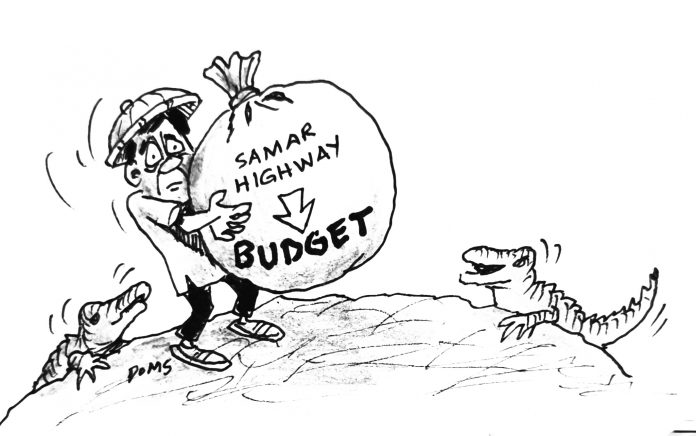
Reports that the Samar Highway—long regarded as the worst in the country—has been given the largest repair allocation for 2026 under DPWH control have sparked guarded hope and firm scrutiny. Such a massive budget must finally deliver real improvements, not repeat years of neglect and failure.

For decades, the Samar Highway has symbolized government indifference to the daily suffering of ordinary citizens. Motorists endure damaged vehicles, longer travel times, and higher costs, while commuters face discomfort and danger on a road that should have been the backbone of regional mobility. The scale of the new allocation implicitly acknowledges the severity of the neglect, and it raises expectations that this time, repairs will be comprehensive, durable, and visible on the ground.

Yet history warns against blind optimism. Large infrastructure budgets have often attracted corruption, padded contracts, substandard materials, and ghost accomplishments, leaving roads barely improved despite billions spent. Without strict supervision, transparent procurement, and measurable outputs, even the largest allocation can vanish into private pockets, mocked by potholes that reappear after the first heavy rain.

The Department of Public Works and Highways must therefore be held to a higher standard. Clear project timelines, publicly accessible progress reports, and independent technical audits should accompany every phase of the rehabilitation. Local governments, civil society groups, transport organizations, and ordinary road users all have a role in watching how funds are spent and in reporting delays, shortcuts, or irregularities without fear or favor.

The most effective response now is sustained vigilance. Strong oversight, public transparency, and swift accountability for any misuse of funds are the only ways to ensure that this allocation translates into safer travel, lower transport costs, and restored confidence in public works. If properly handled, the Samar Highway can finally serve the people it was meant to serve and prove that public money can still be used for public good.

Distorted and bent

0

One only has to open the news and see a teacher suspended for enforcing long-standing rules, while public figures who openly lie, insult, or cheat are cheered, defended, and even rewarded with power. Something has shifted badly when discipline is called ‘oppression’ and shamelessness is rebranded as ‘courage’. I find this inversion not only disturbing but dangerous.

History tells me this is not entirely new. Societies have gone through seasons when moral compasses spin wildly—ancient Rome in its decline, revolutionary France during the Terror, even parts of the twentieth century when propaganda dressed cruelty as duty. What is different now is the speed and reach. In earlier times, ideas traveled by word of mouth or printed page; today, a lie can circle the globe before truth has finished tying its shoes.
I see the roots of this change in how authority and restraint have been caricatured as enemies of freedom. Rules, once understood as guardrails, are now treated as chains. Moral boundaries are mocked as backward, while excess is praised as self-expression. In this climate, right and wrong are no longer measured by consequences or conscience but by applause, clicks, and viral approval.

Technology has poured gasoline on this fire. Social media rewards outrage, not reflection; noise, not wisdom. The loudest voice often wins, not because it is correct, but because it is relentless. I watch young people absorb this lesson early: that visibility matters more than integrity, that being noticed is more important than being right.

Language itself has been bent to serve the confusion. Clear words like “truth,” “responsibility,” and “decency” are treated as suspicious, while vague slogans are elevated as moral shields. When words lose their weight, actions lose their anchors. What used to be plainly wrong can now hide behind clever phrasing and fashionable causes.

The cost of this reversal is highest on the young. I worry about children growing up unsure whether honesty is worth practicing when dishonesty seems more profitable. I worry about students learning that effort is optional, accountability negotiable, and offense is a convenient weapon. A generation raised in this fog may struggle to tell the difference between confidence and arrogance, compassion and indulgence.

This world also breeds exhaustion. When nothing is stable, people grow cynical. They stop believing in institutions, leaders, and even one another. I feel it myself at times—the temptation to shrug and say that standards no longer matter. But surrendering to that feeling is exactly how wrong completes its takeover.

At least to me, the way forward is neither shouting louder nor retreating into silence. It begins with quiet stubbornness: choosing truth even when it is unpopular, fairness even when it is inconvenient, and restraint even when excess is applauded. If enough of us live that way, especially in front of the young, the moral compass may yet steady itself—and point home again.

To know the road ahead

0

The Chinese proverb “To know the road ahead, ask those coming back” is expressed in Mandarin as:  (yù zhī qián lù, wèn guī lái rén). In Waray-waray, these roughly translates to; Para han maupay nga pagmalakaton, pakianhi an umagi na!

This proverb emphasizes the wisdom of learning from those with experience. It suggests that if you want to understand what lies ahead, you should consult people who have already traveled that path.

In the field of Governance, it is important to tap old wisdom and even people with experience on the field or in the arena of the profession.

This proverb aligns with evidence-based governance—the idea that decisions should be grounded in data, history, and expert consultation. It encourages humility in leadership: acknowledging that wisdom often lies with those who have already faced the journey.

Thus, in our field of Public Governance or any Leadership position, the lessons of the past , the mistakes of long-ago are vital lessons to prevent history ofr bad history repeating itself.
Thus, this year, 2026, let these proverb be a guidepost, to ask those who are coming back. What have been the lessons learned on the people who once lead and are now retired. The experience and knowledge picked up along the way are indispensable and can be applied today.

In the Career Executive Service Board, our assessors are mostly Cabinet Officials with sterling records and had been at the forefront of Good Governance who sown great seeds without allowing themselves to the contaminants of corruption that abounds.

They can be resource persons, experts and mentors of our youth and rising leaders. They may be coming back, but they have been there and they have survived the grind, unadulterated and yes, they have overcome the temptations!

Remain child-like even as we age

0

THAT’S essentially the point of our celebration of the Feast of the Santo Niño that, thankfully, enjoys a very popular devotion in our country. Let’s hope that the message not only sticks in our mind but also is effectively lived out in our daily affairs.

Christ himself said it very clearly. “Amen, I say to you, unless you turn and become like children, you will not enter the Kingdom of heaven.” (Mt 18,3) With these words of Christ, it’s quite clear that we all need to be childlike even as we grow in age and stature, and even as we accumulate already quite a significant amount of knowledge with our exposure to the world and the life in general.

Yes, children and heaven are almost synonymous to each other. No wonder we feel like we are in heaven every time we see children around. Every time a baby is born, we are very happy because we somehow know that he just did not come out of his mother’s womb, but rather from the very hands of God who created him before the parents procreated him.
In spite of the many limitations of children, what makes them always desirable is their pure, innocent heart, incapable of malice, ambition, pride and haughtiness. They are a source of many other good things.

Their heart is always trusting in the Lord always, just like a little kid is always confident with his father. Faith and hope easily grow and acquire strength when nurtured in a child’s heart. It’s this attitude that leads them to go on and move on no matter what, for life to them could only be an adventure of discoveries.

It’s this kind of heart that makes them transparent, sincere and simple, not afraid to be known as they truly are. They may still lack the subtlety of prudence and discretion, and be prone to spontaneity, but they hardly mind these deficiencies.

They are only interested in doing what they think is good and enjoyable. Suggestions and corrections do not humiliate them. Rather, they welcome these suggestions and corrections.

Children are humble, teachable, flexible and docile. You can tell them anything, and they always tend to believe and obey. Attainments, achievements and successes do not spoil them. Neither do difficulties, temptations and failures crush them and plunge them to sadness or bitterness.

They are easy to motivate, to be consoled, to be optimistic. Falls and mistakes are easily forgotten. They only leave a mark that becomes a source of precious lessons for them to learn. They are quick to heal when wounded.

In short, children are predisposed to see things as they are, whether they are self-evident natural truths or highly mysterious supernatural realities. What they don’t yet understand, they simply accept and believe, relying simply on the recommendation of parents and elders.

Children somehow capture the spirit of the beatitudes, for they are poor in spirit, they are meek, they are easily comforted when some mourning takes place, they long for what is good and right, they easily forgive, they are pure of heart, they generate peace, and persecutions, insults and the like have no effect on them.

To remain childlike is a necessity to all of us as we cruise through the ocean of life, gaining and acquiring more knowledge and skills. Otherwise, we would have no other alternative but to get spoiled, and to forget where we come from and where we are supposed to go to. This is when we start to complicate our lives.


Recent Posts

DALMACIO C. GRAFIL
PUBLISHER

ALMA GRAFIL
EDITOR-IN-CHIEF

ROMEO CEBREROS
OFFICE IN-CHARGE

OFFICE
BRGY. SONGCO, BORONGAN CITY

CONTACT NUMBERS
(055) 261 – 3319 | 0955 251 1533 | 0917 771 0320 | 0915 897 7439 | 0921 511 0010

DALMACIO C. GRAFIL
PUBLISHER

RICKY J. BAUTISTA
EDITOR

ALMA GRAFIL
BUS. MANAGER

OFFICE
RIZAL AVENUE, CATBALOGAN
(INFRONT OF FIRE DEPARTMENT, NEAR CITY HALL)

CONTACT NUMBERS
0917 771 0320 | 0915 897 7439 | 0921 511 0010

EMAIL
lsdaily2@yahoo.com

WEBSITE
www.issuu.com/samarweeklyexpress