INOPACAN, Leyte-A tragic incident unfolded on Monday morning, March 11th in this town as a three-year-old girl named was fatally stabbed by her father amid a family dispute.
The father, Crisencio Timon Jr., 41, also inflicted fatal wounds upon himself, succumbing to his injuries.
According to Police Major Ian Po, town police chief, the suspect was living with his common-law wife, Cristy Bulacan, and their daughter, “Chinggay” in Barangay Guadalupe.
Reports indicate that prior to the incident, Timon had been grappling with personal and family issues.
Witnesses revealed that he had assaulted his 15-year-old stepson earlier that day and was distressed over Bulacan’s desire to end their relationship.
The situation escalated when Timon, intoxicated from heavy drinking the night before, took his three-year-old daughter for a nap.
Tragically, he then fatally stabbed her in the neck with a knife before turning the weapon on himself, inflicting multiple wounds.
Their bodies were discovered by a neighbor delivering fish, prompting immediate efforts to summon help and transport them to Immaculate Conception Hospital in Baybay City.
Despite swift medical intervention, both father and daughter were pronounced dead on arrival by their attending doctor due to the severity of their injuries.
The community is left in shock and mourning over this devastating loss caused by an unfathomable act of violence within the family. (ROBERT DEJON)
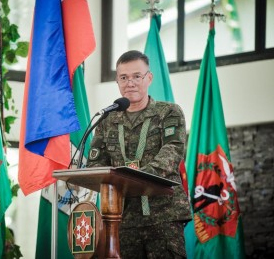
HOUSES FOR FORMER REBELS. The National Housing Authority and the 801st Infantry Brigade agreed to build houses for former rebels who have returned to the folds of the law, dubbed as ‘Saad nga Balay.’ (Photo Courtesy)
TACLOBAN CITY – Deputy Brigade Commander Colonel Carmelito Pangatungan of the 801st Infantry Brigade recently convened with National Housing Authority (NHA) Regional Manager Engineer Constancio Antiniero as part of their ongoing efforts to strengthen engagement with partners and stakeholders.
The 801st Brigade, stationed in Barangay Fatima, Hinabangan town in Samar province, operates within various local government units in the province, as well as in Eastern Samar and Northern Samar provinces.
The meeting between the two officials focused on the implementation of a housing program called “Saad nga Balay,” initiated by the 801st Brigade in collaboration with local government units to provide former rebels with decent shelter as part of their reintegration program.
During the meeting, both parties agreed to collaborate in achieving their shared objective of providing better homes and livelihood opportunities to marginalized communities.
According to a statement from the 801st Brigade, “The National Housing Authority pledged to provide technical assistance and funding for the projects, while the 801st Infantry Brigade will ensure the safety and security of the project sites.”
This collaboration underscores the commitment of the 801st Brigade to foster peace and development in the communities they serve. They also pledged to continue engaging with various agencies, organizations, and individuals to create a more peaceful and prosperous environment for the people of Samar.
By strengthening partnerships with different stakeholders, the 801st Brigade aims to maximize resources and reach more people in need, thereby making a positive impact on the lives of those within their area of operations.
The Saad nga Balay program is currently underway at three sites.
In San Jose de Buan town in Samar province, 14 houses are under construction with the assistance of military personnel from the 87th Infantry Battalion and engineering battalion of the Philippine Army, funded by the provincial and municipal governments.
Recently, a groundbreaking ceremony was held for the Saad nga Balay project in Can-avid, Eastern Samar benefiting 10 former rebels on a property owned by the local government.
Similar housing projects are planned for implementation in Dolores town in Eastern Samar province, providing 10 units of housing. (ROEL T. AMAZONA)
As March marks Fire Prevention Month, individuals and communities must reflect on the significance of fire safety measures and take necessary steps to mitigate the risks of fire hazards. Observing Fire Prevention Month should entail more than mere lip service; it demands tangible actions and a collective commitment to safeguard lives and property.
First and foremost, education must be at the forefront of fire prevention efforts. It is not enough to simply raise awareness about fire safety; individuals need to be equipped with the knowledge and skills to prevent fires and respond effectively in the event of an emergency. This entails disseminating information about fire hazards, proper fire prevention practices, and evacuation procedures.
Moreover, Fire Prevention Month should catalyze rigorous enforcement of fire safety regulations and building codes. Too often, lax enforcement and complacency contribute to preventable fires that result in devastating consequences. Authorities must prioritize inspections, ensure compliance with safety standards, and hold accountable those who neglect their responsibility to maintain safe environments.
Ensuring a culture of preparedness is essential in mitigating the impact of fires. This involves not only having fire extinguishers and smoke detectors readily available in homes, offices, and other public places but also developing and rehearsing evacuation plans. Communities should organize drills and exercises to simulate fire scenarios and ensure that residents know how to respond swiftly and effectively.
Fire Prevention Month presents an opportunity for collaboration among residents, including government agencies, fire departments, businesses, and civil society organizations. By pooling resources and expertise, these entities can implement comprehensive fire prevention campaigns, distribute safety materials, and provide training sessions to empower individuals to become active agents of fire safety.
It is not enough to pay lip service to the cause for a single month out of the year; rather, fire prevention should be ingrained in our collective consciousness year-round. We need to create a culture of vigilance, education, preparedness, and collaboration to mitigate the risks of fires and ensure the safety and well-being of our communities.
Have you ever wondered why children now have a hard time putting their gadgets aside, even if their parents, ate, and kuya are telling them to do something? Are you surprised that the majority of people can spend long hours manipulating their cell phones instead of attending to worthwhile tasks? Well, it’s not just the trend nowadays; it’s the result of people’s confusion in determining which is real and which is not.
The boundary between reality and virtual phenomena is increasingly blurred, ushering in an era where distinguishing between the two becomes daunting. As technology advances, we find ourselves immersed in virtual worlds that mimic reality with astonishing accuracy, while reality becomes augmented by digital overlays. This merging of realms has tremendous implications, challenging our perceptions of what is real and what is not and redefining our understanding of intelligence, be it human or artificial.
At the heart of this merging lies the exponential growth of virtual reality (VR) and augmented reality (AR) technologies. These immersive experiences transport users to alternate worlds where they can interact with virtual objects and characters as if they were tangible entities. With the advent of increasingly sophisticated VR and AR devices, the line between the physical and the virtual becomes increasingly blurry, leading to a seamless integration of the two realms.
The rise of artificial intelligence (AI) further complicates this merging of realities. AI systems are becoming increasingly adept at mimicking human behavior and cognition, blurring the line between pure intelligence and artificial intelligence. AI can analyze vast amounts of data, make predictions, and even engage in creative tasks previously thought to be exclusive to human intellect. As AI continues to evolve, distinguishing between human and artificial intelligence becomes a tough challenge.
This convergence of realities has significant implications for society as a whole. On one hand, it opens up unprecedented opportunities for innovation and exploration, allowing us to push the boundaries of creativity and imagination. On the other hand, it raises ethical concerns regarding privacy, identity, and the manipulation of reality. As virtual and augmented experiences become indistinguishable from reality, the potential for misinformation and manipulation grows, posing significant challenges for individuals and societies alike.
The merging of reality and virtual phenomena erases traditional boundaries in fields such as entertainment, education, and communication. Virtual classrooms, for example, allow students to engage with educational content in immersive ways, transcending the limitations of traditional learning environments. Similarly, virtual concerts and events bring people together from around the world, creating shared experiences that defy physical distances.
In this rapidly evolving landscape, individuals should develop critical thinking skills and digital literacy to grapple with the complexities of merged realities. By taking note of the mechanisms behind virtual and augmented experiences, as well as the capabilities and limitations of AI, we can harness the potential of these technologies while safeguarding against their misuse.
This development represents a paradigm shift in how we perceive and interact with the world around us. As boundaries dissolve and distinctions blur, we are challenged to reconsider our notions of reality, intelligence, and human experience. We have the opportunity to shape a future where the boundaries between the physical and the virtual become increasingly fluid, opening up new possibilities for exploration, discovery, and connection.
CLEMELLE L. MONTALLANA,DM, CESE
ASSOCIATE PROFESSOR III
CLEMELLE L. MONTALLANA,DM, CESE ASSOCIATE PROFESSOR III
I wrote about this months ago and I cant help but write about this again. As an avid bettor of the Philippine Lotto Games, I have spent several thousands trying to hit even just a tail on the jackpot. The million peso worth of prize money cannot be hit even just a hair on its head. For 12 years straight I have not won a single prize above the 3 digits minimum prize. And that my friend is not pure luck or the absence of it, I am also thinking that it is simply impossible to win.
Not until today, when Senator Raffy Tulfo as reported by Hanna Bordey of GMA Integrated News said that one bettor won 20 times in a month. Here is the exact quote:
Senator Raffy Tulfo on Tuesday disclosed that a bettor’s name appeared to have won the lotto 20 times in one month, citing a list submitted by the Philippine Charity Sweepstakes Office (PCSO).
“’Yung PCSO nagbigay ho sa akin ng listahan…Ito nga po ang sabi ko medyo nakakataas ng kilay, meron doon na isang tao nanalo ng 20 times in one month. Meron dun 10 times in one month,” Tulfo said in an interview on Dobol B TV.
The Philippine Charity Sweepstakes Office (PCSO), which oversees the lotto games, has recently faced scrutiny due to various incidents that have raised questions about the integrity of the system. Let’s delve into this matter:
A mathematician from the University of the Philippines (UP) Institute of Mathematics, Guido David, highlighted that the chances of winning in different lotto games are indeed rare. For instance:
The odds of winning in the 6/42 game are approximately 1 in 5 million.
In the 6/49 game, it’s about 1 in 14 million.
And for the 6/55 game, it’s roughly 1 in 29 million.
In summary, while statistical probabilities suggest that successive wins are rare, an audit of the PCSO’s processes is crucial to ensure transparency and address any concerns about rigging or anomalies. As the song goes some guys have all the luck, some guys have all the pain!
THIS is the law we should follow in our life here on earth. It is Christ who shapes and leads the way for us, and we should just follow. Why? Precisely because Christ is the pattern of our humanity, the savior of our damaged humanity. Our life here on earth is a test to see whether we would like to be with Christ, as we should, or to be by ourselves which, though very attractive to us, is actually a tragedy for us.
We are reminded of this truth of our faith in the readings of the Mass for the 5th Sunday of Lent, Year B. (cfr. Jer 31,31-34 / Ps 51,3-4.12-13.14-15 / Heb 5,7-9 / Jn 12,20-33). They talk about God making a new covenant with the people, creating a new heart for them, and of how that covenant is perfected by Christ as long as we, the people, would follow him by dying to ourselves so Christ can live in us.
“If any man ministers to me, let him follow me; and where I am, there also shall my minister be,” Christ said. But for this to happen, he also said: “Unless the grain of wheat falling into the ground dies, it remains alone. But if it dies, it brings forth much fruit. He that loves his life shall lose it, and that he hates his life in this world, keeps it unto life eternal.”
And for us to believe, obey and follow what Christ indicated, we are also given some clue, and that is when the Letter to the Hebrews, the 2nd reading of Mass for the 5th Sunday of Lent, said: “Whereas indeed he (Christ) was the Son of God, he learned obedience by the things which he suffered. And being consummated, he became to all that obey him, the cause of eternal salvation.”
It’s important that we meditate thoroughly on these words of divine wisdom, so we can have a clear idea of what our life here on earth is all about and what we can and should do to pursue the real and ultimate purpose of our life. We cannot be cavalier in our attitude toward this serious duty of ours.
Given, of course, our usual wounded human condition, we really would need to develop a certain plan that would effectively put us on track with respect to this duty of ours to pursue the real goal of our life. It cannot be denied that we have to contend with our many limitations like our tendency to be lazy, complacent, unbelieving, etc.
Everyone should be made to understand that this duty is incumbent on everyone. So, we should just help everyone in inculcating this very basic duty of ours, starting in the family and radiating to the ever widening and growing levels and dimensions of society and human life itself.
Yes, it’s going to involve a “bloody” struggle. But we are assured of victory as long as we go along with Christ who makes himself all available to us. We should never think that we will be going through this struggle by our lonesome, relying only on our own human powers. It’s true that what we would be tackling is overwhelming. But if we only open ourselves to God, nothing would be impossible for us.
We have to strengthen our belief that God never abandons us. It is rather us who can abandon him. That’s the problem that we have to try our best to resolve. If our faith is strong, we would know how to go through the process of suffering and dying to ourselves so we can rise with Christ.