NSSDEO, Brgy. Burabud, Laoang, N. Samar-– The Department of Public Works and Highways – Northern Samar Second District Engineering Office (DPWH – NSSDEO) through Ms. Ma. Amparo Mariam T. Dapug, Administrative Section Chief, conducted an orientation to students from various educational institutions across the 2nd District of the Province of Northern Samar who will be assigned in the agency to gear up for a hands-on experience as they undergo their Work Immersion Program with the agency.
Schools who requested partnership with DPWH-NSSDEO for Work Immersion Program includes Pambujan National High School (PNHS) with a total of 48 student-interns, San Roque – Pambujan Vocational High School (SRPVHS) with 15 student-interns, Rawis National High School (RNHS) with a total of 86 student-interns, and 3 student-interns from Vigo National High School (VNHS).
The orientation was done sequentially, wherein the first batch of student-interns from RNHS were briefed last February 26, 2024, followed by SRPVHS, PNHS, and the second batch of RNHS on February 29, 2024, and VNHS on March 1-2, 2024.
The orientation, aimed at preparing students for real-world application of their academic knowledge, provided the students invaluable insights into the operations and projects of the country’s key infrastructure agency. With a focus on familiarizing student-interns with the agency’s mission, vision, and core values, Ms. Dapug also delved on the possible roles or job that needs to be carried out during their immersion.
As the orientation concluded, both DPWH-NSSDEO and Work Immersion Coordinators expressed optimism about the upcoming work immersion period, accentuating the mutual benefits of such partnerships in fostering learning, growth, and innovation in the field of public works and infrastructure development.
The DPWH remains committed to nurturing the next generation of leaders in the industry through initiatives such as internship programs, further solidifying its role as a pillar of excellence in nation-building.(KHYZEL M. SOSING, PIO STAFF/PR)
TACLOBAN CITY– At least 12 families were displaced including 19 transients when a fire whose origin is still being investigated engulfed Barangay 51 in Magallanes, this city, at about 4:30 am.
Initial investigation by the responding fire personnel disclosed that the fire originated at the beauty parlor owned by Ernie Amascual located on the first-floor house which also caters to commercial establishments and quickly spread at the six stalls of the same house.
The stalls, which were made of light materials, made the fire spread quickly and despite the effort of the local fire bureau, resulted in the burning of 10 houses.
Fire investigators SFO1 Nolly Lacaba and SFO1 Jonald Lace told the media that the cause of the fire and the estimated damage was placed at more than P870,000.
The fire was controlled at about 4: 45 am and was declared fire out at about 5:03 am.
The fire injured only one person after escaping from the fire. (ROBERT DEJON)
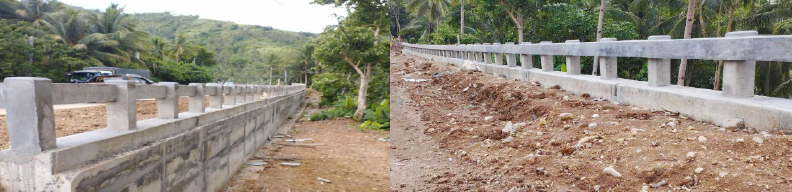
FARM-TO-MARKET ROAD. Residents of Barangays San Isidro and Osmeña, both in MacArthur, Leyte, are now enjoying a concrete road initiated by Leyte’s second engineering district. The project amount at P11.92 million with a length of 992 linear meter.(L2DEO)
TACLOBAN CITY– The completed farm-to-market road (FMR) in Barangay San Isidro, MacArthur in Leyte is benefitting the community in improving the mobility of goods and services and serving as a link for better access to basic social services such as healthcare facilities, schools, and employment.
District Engineer Leo Edward Oppura mentioned that since the project has been completed, it has been a great help to the farmers traversing along San Isidro to Brgy. Osmeña.
Adding to that, they will no longer endure the muddy and bumpy roads during the rainy season, while road dust is brought on by the unpaved dirt roads.
Meanwhile, transportation and delivery of agricultural produce such as rice grains and root crops to the nearby towns are now faster and with lower hauling costs, thus increasing the income of the local farmers.
Accessibility and delivery of basic government and healthcare services is now smoother and easier for the villagers, while students will have a better opportunity to seek a better education system in the town proper.
The project involves the construction of 992 linear meters of Portland Cement Concrete Pavement (PCCP) in 5 meters of width and is in convergence with the CY 2023 Department of Agriculture (DA) program. (LIZBETH ANN A. ABELLA)
SOLITARY. The island of Homonhon in Guiuan town, Eastern Samar may be recognize to be historical place but it has become more known due to the mining operations. Photo shows a passenger motorcycle traversing a dirt road in one of the villages of the island.
Amid report of environmental destruction
SOLITARY. The island of Homonhon in Guiuan town, Eastern Samar may be recognize to be historical place but it has become more known due to the mining operations. Photo shows a passenger motorcycle traversing a dirt road in one of the villages of the island.
HOMONHON ISLAND, GUIUAN, Eastern Samar– Be responsible and protect the watersheds of this historic island.
This was the urgent appeal of Rep. Marcelino ‘Nonoy” Libanan of the 4Ps party-list group as he led in the marking of the 503rd anniversary of the landings of Ferdinand Magellan on the island on Sunday (March 17).
Libanan, who is also the minority floor leader of the House of Representatives, said that destroying the island’s watersheds could lead to scarcity of drinking water on the island, home to more than 4,000 people spread on its eight villages.
“I called on our mining companies to show your heart for our people on the island and not just think of your profits. Lack of drinking water on Homonhon Island is a big problem which could potentially lead to a problem among villagers,” he said in his speech.
And this could be done by protecting the watersheds of the island, Libanan added.
The solon said that if these mining companies would not help protect the watersheds of the island, he would not engage himself to any with them, forewarning the operators of possible dire consequences relative to their mining activities.
Residents on the island have claimed that among the ill- effects of mining activities on the island destroyed their watershed.
Patricia Bagania,70 of Barangay Pagbabangnan where the site of the Magellan landings, said that drinking water is indeed a concern to the residents.
“Hope our officials will address this. We need safe drinking water here on the island,” she said whose grandson, Leonil, 29, works in one of the mining companies.
At present, there are four mining operators on the island, Emir Mineral Resources, Techiron Resources Inc., Global Min-Met Resources, and Verrum Terra Geoscience, Inc.
The island, the site of Portuguese explorer Ferdinand Magellan’s landing on the country in 1521, is rich in nickel and chromite, minerals being extracted by these mining companies, concentrated in the villages of Casuguran and Cagusuan.
Town Mayor Annaliza Gonzales-Kwan supported this call of Rep. Libanan who said that they have crafted a five-year comprehensive development plan for Homonhon.
And included in this plan is the protection of the island’s watershed and its environment.
Gonzales-Kwan acknowledges that due to the mining activities on the island, ‘environmental problems’ arise as a result, though she did not elaborate.
However, these environmental problems could be corrected by coming up with the Homonhon Comprehensive Development Plan which also consists of providing livelihood opportunities for the people on the island and even promoting Homonhon as a tourist site due to its ‘historical wealth.’
“We have also asked assistance from the experts from the University of the Philippines to help us craft the comprehensive land use plan for Homonhon” Gonzales-Kwan added.
The town mayor also disclosed that several projects would be provided like constructing access roads, connecting the eight villages for easy transport among its people and goods.
Gonzales-Kwan also said that a major part of the P6.3 million excise tax for this quarter alone that would be paid by these mining companies would be poured to Homonhon to help fund various programs and projects on the island.
“I assured our people in Homonhon Island that the municipal government would not abandon them. They are my constituents but we have to balance things out like protecting our environment and at the same livelihood opportunities,” she said, adding that over 2,000 people from the island are working on different mining operators.
Gonzales-Kwan also hoped that the national government would no longer issue mining permits to the island.
“For me, the four mining companies now operating on the island are enough. Hope our national government will listen to my appeal,” she said.
But for town parish priest, Fr. Jonathan Pading, the call of the Church to stop all mining activities on the island remains.
“Our call to stop all mining activities here on Homonhon Island continues. These mining activities destroy our environment, including the supply of clean drinking water,” he said.
According to him, because of mining operations, ‘intentional’ forest fires occur on the island to pave the way for the mining activities, in the process affecting their source of drinking water.
“They should not deny the islanders of safe drinking water,” Pading said.
HOMONHON ROAD. Construction of the 21-kilometer concrete road will soon start, connecting the eight barangays of Homonhon Island off Guiuan town, Eastern Samar. On Saturday (March 16), Rep. Marcelino Libanan(left) of 4 Ps party-list group, joined by board member Ralph Vincent Evardone(center) and Guiuan Mayor Annaliza Gonzales-Kwan, led in the groundbreaking of the said road project with a cost of P105 million. (LIZBETH ANN A. ABELLA)
Part of a circumferential road project
HOMONHON ROAD. Construction of the 21-kilometer concrete road will soon start, connecting the eight barangays of Homonhon Island off Guiuan town, Eastern Samar. On Saturday (March 16), Rep. Marcelino Libanan(left) of 4 Ps party-list group, joined by board member Ralph Vincent Evardone(center) and Guiuan Mayor Annaliza Gonzales-Kwan, led in the groundbreaking of the said road project with a cost of P105 million. (LIZBETH ANN A. ABELLA)
HOMONHON ISLAND, GUIUAN, Eastern Samar– Construction of the 21-kilometer road that will connect three villages of this historic island will soon start after the launching of the road project was held on Saturday (March 16) in Barangay Bitaugan.
The launching was led by 4Ps party-list Representative and House Minority Floor Leader Marcelino Libanan, Guiuan Mayor Annaliza Gonzales-Kwan, and Eastern Samar board member RV Evardone.
The project with a total length of 21 kilometers costs P105 million funded by the national government under the 2024 General Appropriations Act and is part of the planned Homonhon Island Circumferential road that has a total length of 61 kms.
“This is just the start of the road projects that we will implement here in Homonhon and this is my commitment to complete the project that will connect villages on this island,” Rep.Libanan said in his message during the launching of the road project in Bitaugan.
Libanan promised to also look for funds for the construction of the road leading to Brgy. Inapulangan, the only village of the town that remains without road access.
Mayor Gonzales-Kwan said that this road project will not only help provide easier access for residents and their farm products and during times of emergencies but will also help tourists reach the village faster to visit the famous Handig beach that is located in Brgy. Habag.
“This road project will ensure residents better services from the government even they are residing in isolated areas,” she said.
“Once completed, this will bring progress and development to the village,” Kwan added.
But while this road project will bring development, some residents from Habag expressed apprehension that this may also result in mining companies finally reach their villages and conduct mining operations.
Homonhon Island is known for its contribution not only to the pages of Philippines history but also to the world, particularly in navigation for being part of the first circumnavigation of the world after the crew of Ferdinand Magellan landed in the area on March 17, 1521, while looking for a new route to Spice Island or Moluccas.
Four mining companies are operating on the island particularly in the villages of Cagusuan and Casuguran, extracting nickel and chromite. However, their operations are limited to these two villages because they are also using Canawayaun, Pagbabangnan, and Culasi as their access road.
“We are not anti-development. We will favor mining operations for as long as this will not destroy our environment,” Habag village chairwoman Jessica Baguinon.
“Our apprehension right now is if this road is completed this might result in mining companies entering our village,” the village chief added.
But now that the access road going to their place is being improved, there is now a possibility that part of their village will also be mined out, Baguinon said.
“This will greatly affect our farmers and fisherfolks,” she said.
Most of the 317 residents of Habag rely on lime and root crops planting, and fishing.
Baguinon added that although they are the most visited village in Homonhon by tourists, this is not enough to provide the residents enough income for the sustenance of their daily needs because tourists would usually visit them during the summer season.
During the launching of the Habag-Bitaugan road project, Mayor Kwan announced that the municipal government is preparing a comprehensive development master plan for Homonhon wherein it aims to address the needs of every villages on the island.
When asked for their reaction on the announcement of the town mayor, the village chief and other officials in Bitaugan replied that this has to be seen first before they believe and give their support.
The launching of the road project from Bitaugan to Hapag was part of the activities organized by the municipal government for the 503rd Philippine commemoration of the first circumnavigation of the world.
It was on March 16, 1521 when the fleet of Magellan saw the mainland of Samar Island but failed to anchor due to rough sea conditions, the following day they sailed toward Suluan Island but after seeing that people were inhabiting the island and out of fear that they will be attacked like on what happened to them in Guam, they remained in their ship and sailed toward Homonhon Island.
It was on March 17, 1521 when they docked and set foot on Homonhon Island to attend to their sickly crew members and look for food and other provisions that they could use in their journey. (ROEL T. AMAZONA/LIZBETH ANN A. ABELLA)
UNESCO SITE. The massive Samar Island Natural Park(SINP), encompassing the Samar Island, was short-listed by the United Nations Educational, Scientific and Cultural Organization (UNESCO) as a heritage site, a move pushed by Samar officials as early as 2018. Photo shows the majestic Langun-Gobingob Cave, among natural attractions found at the SINP. ((PHOTO COURTESY)
TACLOBAN CITY – The Samar Island Natural Park (SINP) located in the heart of Samar Island is finally on the “tentative list” of the United Nations Educational, Scientific and Cultural Organization (UNESCO) World Heritage Site.
The inclusion of SINP at the UNESCO World Heritage Site under the Natural Heritage Category was initiated in 2018 by Samar Governor Sharee Ann Tan and was supported by Northern Samar Governor Edwin Ongchuan, Eastern Samar Ben Evardone, the Department of Environment and Natural Resources and the Department of Tourism.
Samar province also partners with the University of Santo Tomas Graduate School – Center for Conservation of Cultural Property and Environment of the Tropics (USTGS-CCCPET) in conducting a workshop for capacitating the technical working of the three provinces.
“We are ecstatic to now be included in the tentative listing. A proud moment for all people in Samar,” Gov. Tan said in a statement.
In the document submitted by the province to the UNESCO Philippines committee, it states that SINP with an area of 300,000 hectares is home to the largest tract of relatively intact lowland forest in the Philippines and a rich population of dipterocarp species, home of endemic floral and faunal species deemed important from the point of view of conservation sciences.
Also within the park are four areas wherein the rich biodiversity and high rate of endemism converge; these are Sohoton Natural Bridge National Park, Calbiga Caves Protected Landscape, Jicontol Natural Park, and Taft Forest Philippine Eagle Wildlife Sanctuary.
“DOT8 is privilege to be part of this journey. Backed with a very extensive dossier, we pray that in time, we will have Eastern Visayas first UNESCO World Heritage Site,” Karina Rosa Tiopes, the regional director of the Department of Tourism, said.
She added that to be included on the list, sites must be of outstanding universal value and meet one out of 10 selection criteria.
“We are proud to say that SINP not only met not just one but three of these criteria,” Tiopes said.
These criteria include to contain superlative natural phenomena or areas of exceptional natural beauty and aesthetic importance; outstanding examples representing significant ongoing ecological and biological processes in the evolution and development of terrestrial freshwater, coastal and marine ecosystem, and communities of plants and animals; and to contain the most important and significant natural habitats for in-situ conservation of biological diversity, including those containing threatened species of outstanding universal value from the point of view of science or conservation.
SINP was declared a protected area in 2003 and is home to 33 species of mammals, 215 species of birds, 51 species of reptiles, 26 species of amphibians, and 1,000 species of plants where some of which are trees that belongs to the dipterocarp family.
The SINP is one of 24 sites in the country included in the tentative list of World Heritage Sites which is now for validation by UNESCO. (ROEL T. AMAZONA)