ORMOC CITY– The No. 8 most wanted person in Eastern Visayas was apprehended in Quezon City on Friday, April 4, through a joint operation of the municipal police station in Villaba, Leyte and the Special Maritime Response Team of the National Capital Region.
Major Ian Salvador Po, town police chief, identified the suspect as alias “Jason,” 29, single, and a resident of Barangay Camporog of said town.
The arrest was made at around 12:30 pm along Golden Shower Street, Payatas B, Quezon City, by virtue of a warrant of arrest for rape issued by Judge Dexter Lazarte Aguilar, acting presiding judge of RTC Branch 17 in Palompon, Leyte, dated March 31, 2022.
The charge carries no bail recommendation.
Police said the accused fled to Luzon after learning that a rape complaint had been filed against him in 2022. His whereabouts were discovered when a relative of the victim spotted him in Payatas and immediately informed family members in Leyte, who then alerted local authorities.
The suspect was apprised of the charges against him and his constitutional rights under the Miranda Doctrine in a language he fully understood.
He was brought to the Payatas Police Station for booking and proper documentation before being transported back to Leyte to face trial.
ORMOC CITY-A 26-year-old man is currently recuperating at the Biliran Provincial Hospital after being assaulted by a neighbor on Saturday afternoon, April 5, at Sitio San Vicente, Barangay Villa Consuelo, Naval, Biliran province.
The Naval Municipal Police Station identified the victim as alias “Polly,” 26, single, and unemployed. The suspect, known as alias “Glock,” 27, with a common-law wife, is also a resident of Sitio San Vicente.
According to initial police investigation, the incident occurred around 5:30 pm while the victim was at a nearby store trying to connect to an internet service using a “PISO Wi-Fi” machine. The suspect allegedly approached Polly, confronted him, and suddenly punched him in the face, causing the victim to fall and lose consciousness.
The victim was rushed to the Biliran Provincial Hospital for medical attention, while police received the incident report around 10:15 pm the same day.
Responding personnel from the Naval police immediately arrested the suspect, who was informed of the nature of his arrest and apprised of his constitutional rights in a language he understood, following the Miranda Doctrine.
The suspect is now under police custody at Naval police for proper disposition.
ORMOC CITY– A domestic dispute turned deadly in Barangay Buenavista, Quinapondan, Eastern Samar, after a woman allegedly stabbed her husband to death following a heated argument on Saturday afternoon, April 5.
The victim, identified only by his alias “Nat,” 34, a fisherman, was rushed to the Quinapondan Community Hospital but was declared dead on arrival by the attending physician. His wife, known as “Sela,” 37, has been identified as the primary suspect in the incident.
According to a police investigation, the couple got into a verbal altercation around 4:50 pm, allegedly triggered by the husband’s bad habits.
Authorities believe the victim was under the influence of alcohol at the time. The argument escalated into a physical confrontation, during which the suspect reportedly grabbed a kitchen knife and stabbed her husband in the right side of the chest.
Following the incident, the suspect voluntarily surrendered to the Quinapondan Municipal Police Station and turned over the weapon used.
She is now under police custody, and authorities are preparing to file a charge of parricide against her. (ROBERT DEJON)
TACLOBAN CITY – The Local Amnesty Board (LAB)in Catbalogan City has partnered with the Public Attorney’s Office (PAO) in the implementation of the national government’s amnesty program for former members of the New People’s Army(NPA).
Since March of this year, PAO lawyers have been actively assisting LAB Catbalogan by providing legal support in processing amnesty applications.
“This is welcome news. In Samar, PAO is very willing to join every activity. It’s good because they also provide guidance and legal advice,” said Emilda Bonifacio, Eastern Visayas area manager of the Office of the Presidential Adviser on Peace, Reconciliation and Unity (OPAPRU).
OPAPRU plays a key role in implementing the amnesty program by coordinating with various agencies and assisting applicants in preparing their personal narratives.
Bonifacio shared that PAO lawyers are helping former rebels in drafting affidavits and other legal documents, as well as facilitating the oath of allegiance—a task previously carried out by barangay chairpersons.
“Before, the barangay captain could administer the oath, but now only a lawyer is allowed to do so,” Bonifacio added.
In addition to the support from PAO, Samar Governor Sharee Ann Tan has also committed to provide additional lawyers to help review the growing number of amnesty applications.
“There is a lot of work involved in reviewing the documents. It’s not just about showing up to apply—you need to gather many supporting documents, and they must be thoroughly cross-checked,” Bonifacio said.
As of this writing, 363 amnesty applications have been received by LAB Catbalogan from the three provinces of Samar Island.
VISIT OF A SAINT. The Centenary Pilgrim Image and Relics of St. Thérèse of the Child Jesus are currently at the Archdiocesan Shrine of Sto. Niño in Tacloban City, offering the faithful a chance to venerate the sacred relics. The relics have visited the shrine on multiple occasions, with the most recent visit prior to this one taking place in 2023. (Archdiocesan Shrine of Sto. Niño)
VISIT OF A SAINT. The Centenary Pilgrim Image and Relics of St. Thérèse of the Child Jesus are currently at the Archdiocesan Shrine of Sto. Niño in Tacloban City, offering the faithful a chance to venerate the sacred relics. The relics have visited the shrine on multiple occasions, with the most recent visit prior to this one taking place in 2023. (Archdiocesan Shrine of Sto. Niño)
Due to ASF presence
TACLOBAN CITY– A 15-day ‘pork holiday’ was declared by the city government in Borongan, Eastern Samar following the confirmation of African Swine Fever (ASF) in the city.
Mayor Jose Ivan Dayan Agda issued an executive order on Thursday, April 3, declaring a pork holiday beginning Friday, April 4, to April 18 as a preventive measure against further spread of the ASF Borongan.
The order suspends the slaughter and sale of pork products within the period.
“ASF poses a significant threat to the local hog industry, affecting not only livestock but also the economic stability of small-scale hog raisers, meat vendors, and other industry stakeholders,” Agda’s order said.
“Whereas, as a necessary biosecurity measure to mitigate the risk of ASF transmission, the temporary suspension of certain pork-related activities is recommended in consultation with the City Veterinary Office (CVO) and other relevant agencies,” the city mayor added on his order declaring a pork holiday.
The regional office of the Department of Agriculture (DA) confirmed the ASF cases in a letter dated March 28, 2025, stating that samples from a piggery farm owned by Eastern Samar State University (ESSU) in Barangay Maypangdan tested positive for the virus.
Among the restrictions during the pork holiday include the slaughtering and sale of fresh pork except for personal consumption; pork-based processed products (such as pork chorizo and longganisa) are banned; frozen pork sales are allowed only with proper certification from meat inspectors and must come from ASF-free areas; mandatory disinfection of all piggery farms; and inter-barangay transport of live pigs is strictly prohibited.
Based on the order of Mayor Agda, the CVO, in coordination with the Philippine National Police (PNP) and other agencies, were tasked to strictly monitor compliance with the order.
Violators will face confiscation of unauthorized pork products; fines and penalties under Republic Act No. 10536, that amended the Meat Inspection Code of the Philippines (Republic Act No. 9296) which ranges from P100,000 up to P1 million and imprisonment of up to 12 years; and suspension or revocation of business permits for establishments found violating the order.
The Borongan City slaughterhouse will also implement an “All In, All Out” policy to prevent further ASF contamination.
Mayor Agda assured the public that these measures are necessary to protect the local hog industry, small-scale raisers, and market vendors from the devastating impact of ASF.
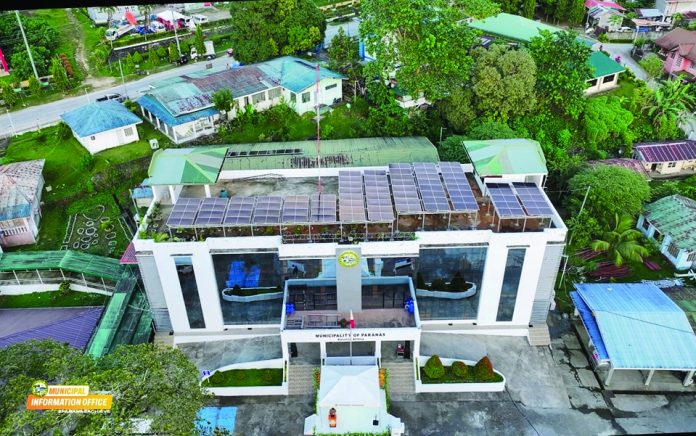
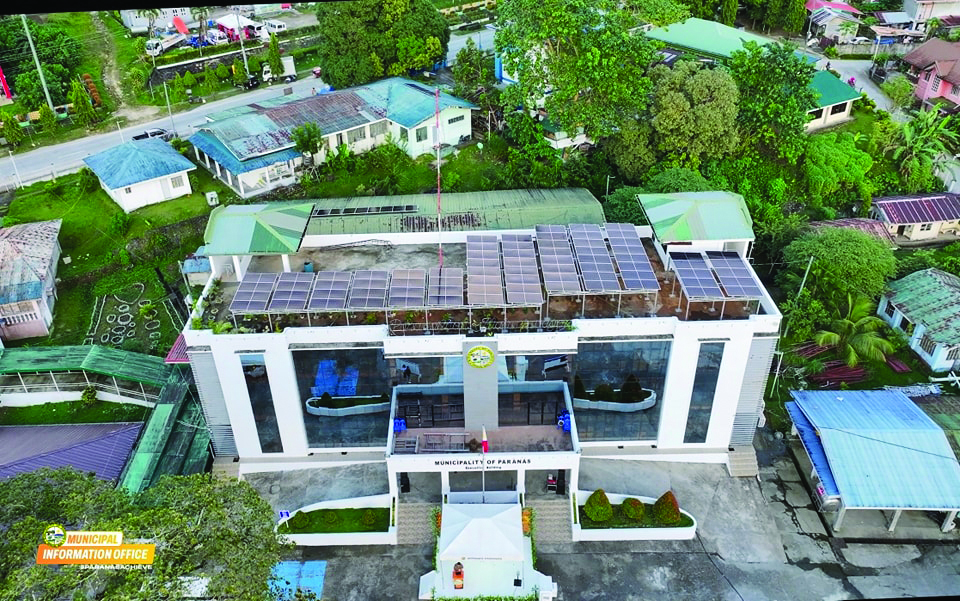
SOLAR ENERGY. The municipal building of Paranas in Samar is now power by solar energy, part of the environment conservation commitment of the local government under Mayor Eunice Babalcon. The 88 units of solar panels were donated by the Institute for Climate and Sustainable Cities.
(THE MUNICIPAL GOVERNMENT OF MUNICIPALITY OF PARANAS)
2nd LGU to resort to solarization
SOLAR ENERGY. The municipal building of Paranas in Samar is now power by solar energy, part of the environment conservation commitment of the local government under Mayor Eunice Babalcon. The 88 units of solar panels were donated by the Institute for Climate and Sustainable Cities. (THE MUNICIPAL GOVERNMENT OF MUNICIPALITY OF PARANAS)
TACLOBAN CITY – The municipal building of Paranas, Samar, is now powered by a 48-kilowatt solar panel system, with a switch-on ceremony held on March 26, 2025.
The solarization project in Paranas was made possible through a partnership with the Institute for Climate and Sustainable Cities (ICSC), a non-governmental organization (NGO) that focuses on climate resilience, sustainable energy solutions, and low-carbon development.
A total of 88 solar panels were installed on top of the municipal hall, making Paranas the first local government unit in Samar to transition its municipal hall to solar power.
The 48-kilowatt system can generate enough electricity to power approximately 30 to 35 households with an average consumption of 200 kWh per month.
“By institutionalizing partnerships between the private and public sectors, with the help of our development partners, we are confident that the government will be able to meet its target of achieving a 35 percent share in the power generation mix by 2030 and 50 percent by 2040,” said Department of Energy Assistant Secretary Mylene Capongcol in a video message.
Paranas, 97 kms from Tacloban City, has been at the forefront of locally-led energy transition efforts since 2019 when it first adopted solar rooftops in its public buildings, including its evacuation center, municipal materials recovery facility (MRF), public schools in Barangays Concepcion, Paco, and Jose Roño, as well as a health center in Barangay Tutubigan.
Mayor Eunice Babalcon stressed that the solarization of the municipal hall brings significant benefits, including cost savings of more than P120,000 per month on electricity bills while contributing to environmental conservation.
“We’re just doing our part in helping communities and the environment,” Babalcon said in an online interview on Wednesday.
The mayor disclosed that the local government contributed by constructing an elevated platform where the 88 solar panels were mounted.
“There are even ornamental plants underneath the panels,” she added.
Mayor Babalcon also shared that all municipal government-owned buildings in Paranas are now solar panel-ready. She is encouraging private households and business establishments across the town to consider switching to solar power as a source of energy.
She further assured that the solar energy supply would remain reliable even during typhoons or heavy rains.
“The solar system still functions even during storms or rainy weather because it has a battery. The energy is stored in the battery and can be used during power interruptions. If there is no battery, solar panels cannot be utilized during outages as there would be no storage for the energy,” she explained.
With the success of these solarization projects, Paranas will continue advancing its Just Energy Transition Agenda by institutionalizing renewable energy (RE) policies and initiatives.
These include developing a municipal RE ordinance and adopting voluntary RE projects from the Department of Energy.
The local government also aims to strengthen RE education and capacity-building programs in Paranas through collaborations with the Technical Education and Skills Development Authority (TESDA), academic institutions, and the private sector.
“Paranas will once again serve as an inspiration to many municipalities and cities in Eastern Visayas and across the Philippines—a model that values cleaner and more sustainable energy sources for the future of their community,” said Angelo Kairos Dela Cruz, executive director of ICSC, in a statement.
The partnership between ICSC and the local government of Paranas for this hybrid solar PV installation project was formalized through a memorandum of agreement signed in October 2024.
Paranas is the second municipality in Eastern Visayas to receive such a project. Guiuan, Eastern Samar, became the first when its municipal hall was powered by solar panels on February 27 of this year.