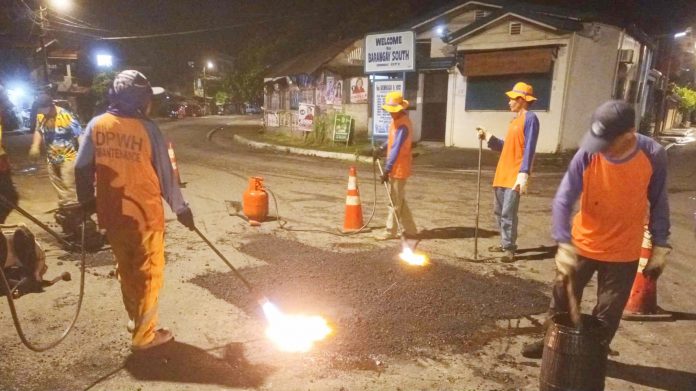
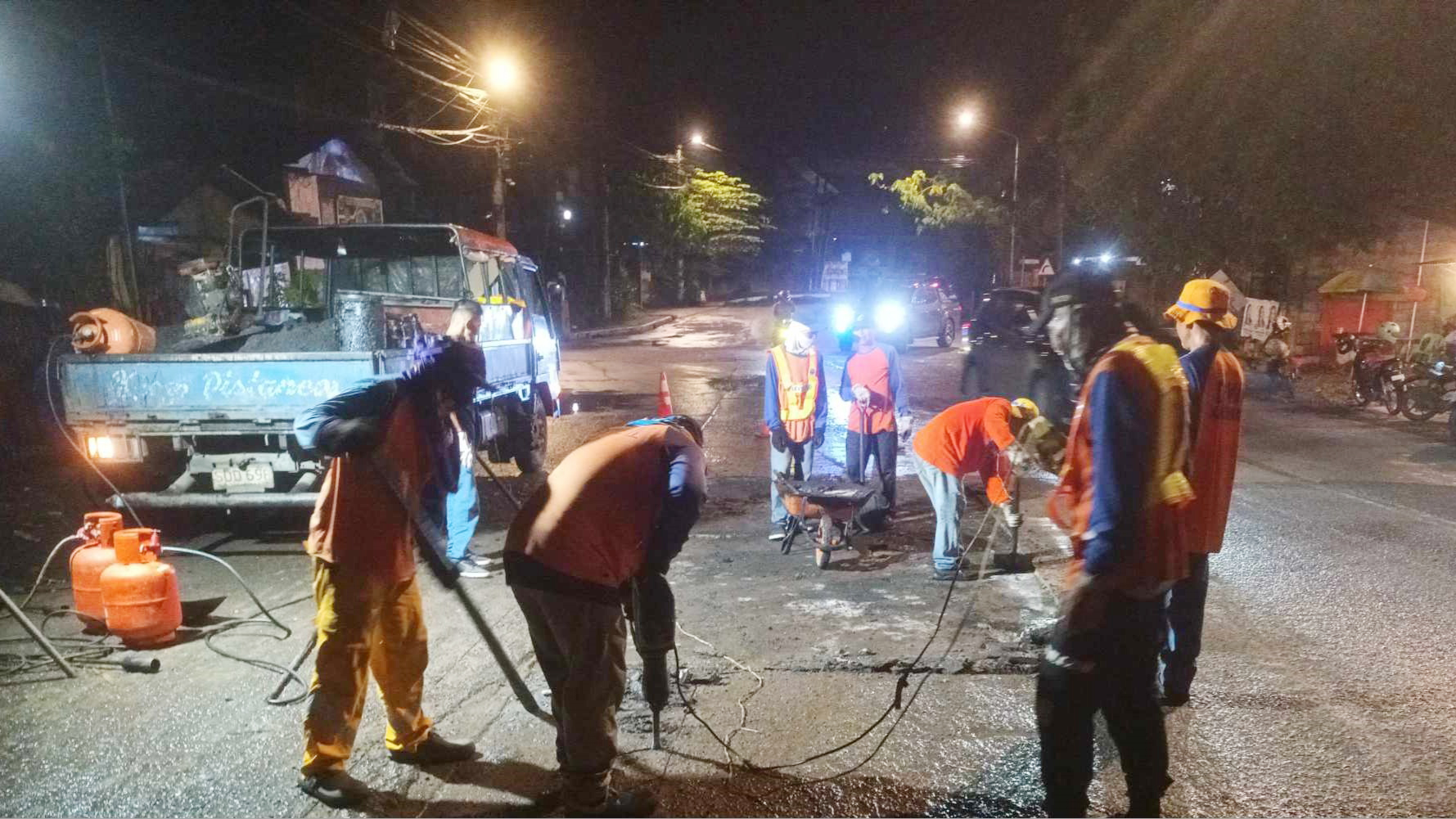
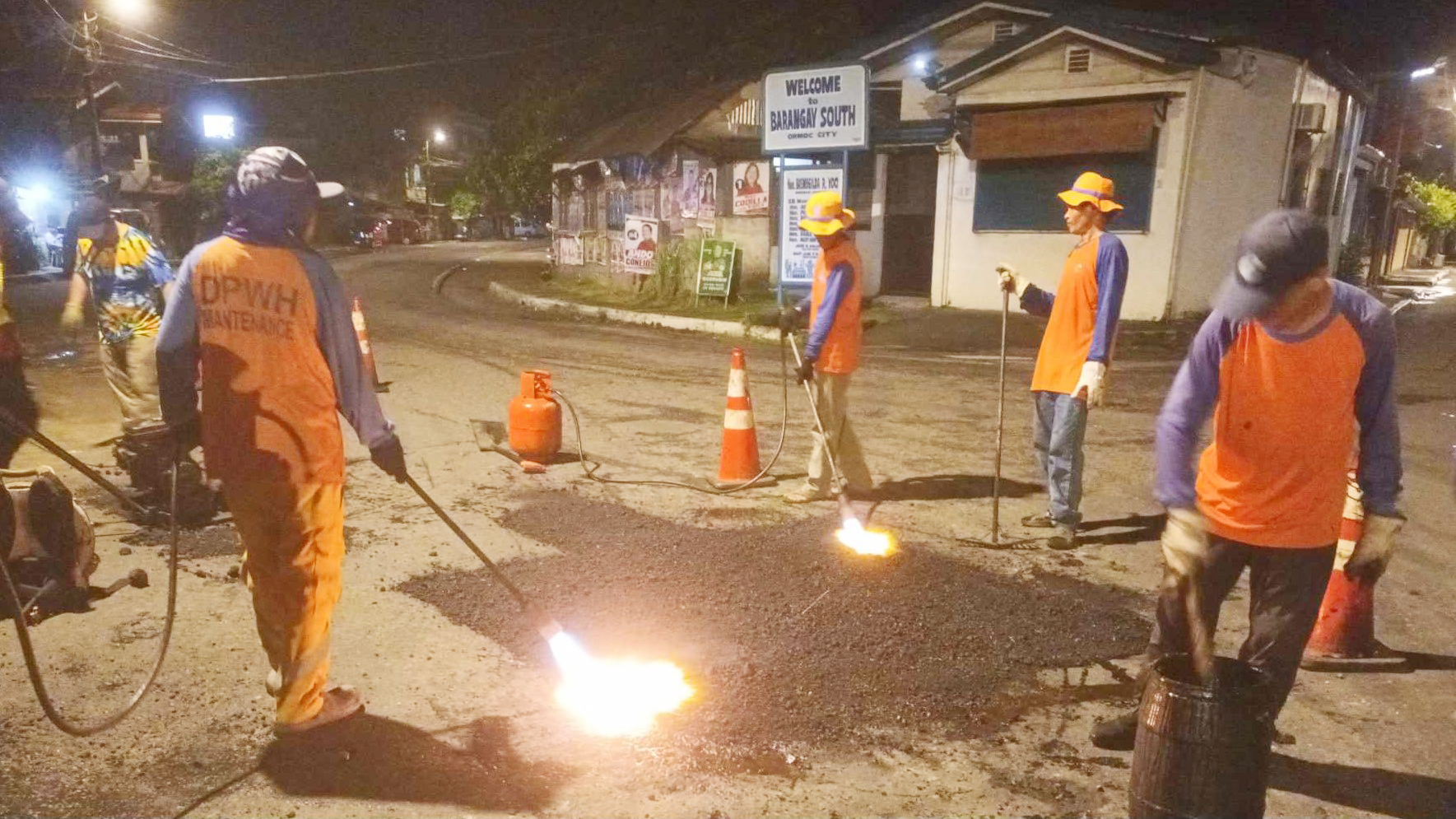
ORMOC CITY– Maintenance field workers of the Department of Public Works and Highways (DPWH) Leyte 4th District Engineering Office (DEO) rendered overtime work to conduct square and patch activities along the Ormoc-Albuera Diversion Road, including the approach of Anilao Bridge along the Palo-Carigara-Ormoc Road.
The team addressed surface deterioration, including potholes and delamination, which pose hazards to motorists. The maintenance works were strategically scheduled after regular hours to minimize daytime traffic disruptions and help decongest the flow of vehicles along the busy route.
These road sections are vital corridors within the district’s road network and through timely preventive maintenance, the DPWH Leyte 4th DEO aims to ensure the continued safety, functionality, and longevity of these infrastructures. (PR)
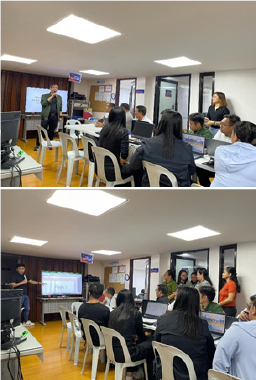
NSSDEO, Brgy. Burabud, Laoang, Northern Samar – On March 7, 2025, at the Mezzanine Floor of the Bureau of Maintenance in Manila, Mr. Gene Ryan A. Altea, Director IV of the DPWH – Bureau of Maintenance, led an engaging in-person session to prepare the CY 2025 Annual Maintenance Work Program/Preparation Budget (AMWP/PB) Preparation. This gathering aimed to meticulously plan for the repair and maintenance of our national roads, bridges, and road safety facilities.
The meeting was a productive platform designed to tackle and resolve the various concerns raised by district engineering offices regarding the Annual Maintenance Work Program/Performance Budget preparations. The objective was clear: to ensure that each district’s proposal adhere to the specific guidelines concerning the source and classification of maintenance activities, as outlined in Secretary Manual M. Bonoan’s memorandum dated January 28, 2025.
Additionally, this event included discussions on preparing the AMWP/PB for the General Appropriations Act (GAA) release and the first round of additional funding. Representatives from regional and district engineering offices participated, including Engr. Christian Dave C. Pangandoyon and Engr. Danny M. Pillado, Jr., of the Maintenance Section of this office, adding their expertise to the session.
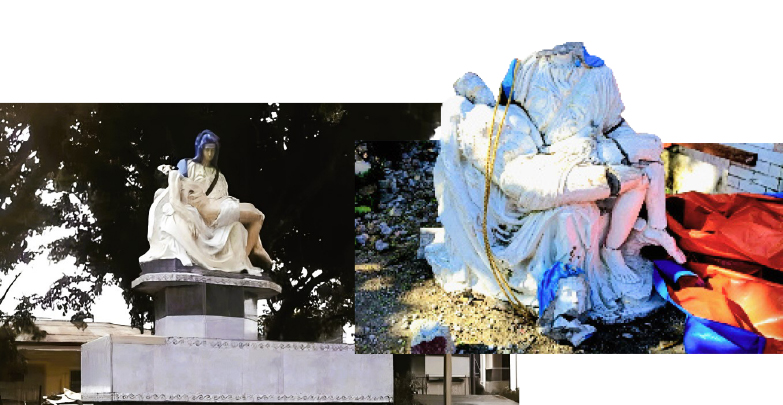
PIETA MONUMENT, THEN AND NOW. Residents of Catbalogan City have voiced strong opposition to the demolition of the Pieta monument to make way for the construction of a popular fast-food chain. The monument, built in 1995, stands as a solemn tribute to the victims of the M/V Doña Paz maritime tragedy in 1987—considered the world’s deadliest peacetime sea disaster. A significant number of the over 4,000 lives lost in the tragedy were from Catbalogan.
(PHOTO COURTESY, JHONIL BAJADO)
In Catbalogan City
PIETA MONUMENT, THEN AND NOW. Residents of Catbalogan City have voiced strong opposition to the demolition of the Pieta monument to make way for the construction of a popular fast-food chain. The monument, built in 1995, stands as a solemn tribute to the victims of the M/V Doña Paz maritime tragedy in 1987—considered the world’s deadliest peacetime sea disaster. A significant number of the over 4,000 lives lost in the tragedy were from Catbalogan. (PHOTO COURTESY, JHONIL BAJADO)
TACLOBAN CITY — The demolition of a memorial monument in Catbalogan City, Samar, honoring the thousands who perished in the tragic 1987 collision between the M/V Doña Paz and oil tanker M/T Vector, has sparked outrage among local officials and residents, especially those who lost loved ones in the world’s deadliest peacetime maritime disaster.
For Lourdes Singzon, the destruction of the Pieta monument is not only shocking but deeply disrespectful to the memory of the victims and their families.
“We were all shocked by the demolition of the Pieta monument. It is not just a simple monument—it is a symbol of remembrance and honor for those who died in the M/V Doña Paz tragedy,” she told the Inquirer in an online interview on Sunday, April 6.
Singzon lost her mother-in-law, Petra Singzon, her aunt Nenita Villapaz, and several other relatives and friends in the December 20, 1987 disaster, which claimed the lives of more than 4,000 people, many of them from Catbalogan City.
Another relative of the victims, who gave her name only as C.V., 57, also expressed grief over the destruction of the marble Pieta monument.
“We are very sad. Because we were never able to recover the bodies of our mother, father, and youngest sibling. The Pieta was a place that gave honor to their memory. It was a symbol of love and remembrance,” she said.
Both Singzon and C.V. appealed to the Diocese of Calbayog—reported to be the owner of the land where the monument stood—not to convert the site into a commercial area.
The area, located beside St. Bartholomew Church in the heart of Catbalogan, is reportedly leased by the Diocese of Calbayog to Shakey’s, a well-known restaurant chain.
The centerpiece of the 1,300-square-meter park was the 5×5-meter Pieta statue, crafted from Italian marble in 1995 by Catbalogan artist Alejandro Villarin and commissioned by a group of Catbaloganons, including actress Tessie Tomas. The statue depicted the Virgin Mary cradling the lifeless body of Jesus Christ—a powerful religious image and a heartfelt tribute to the victims of the M/V Doña Paz–M/T Vector tragedy.
Attempts to get a statement from the Calbayog Diocese in Calbayog City on Monday were made by LSDE through phone calls and social media messages, but the diocese said it has no response at this time.
On Sunday night, hundreds of relatives of the victims held a vigil at the site, pleading with the diocese to abandon plans to commercialize the area.
“We are not against development in our city—I’m a businesswoman myself. But our appeal is to leave the Pieta structure untouched. It’s the only place where we can honor and remember our loved ones, especially during the disaster anniversary and All Saints’ and All Souls’ Days,” Singzon said.
Jhonil Bajado, a history professor and curator of the Samar State University Museum and Archives, also lamented the demolition.
“I vehemently abhor this desecration of a religious and historical structure that gives remembrance to the memory of those who perished in the Doña Paz tragedy,” he said in a separate online interview.
“The demolition of Pieta Park came like a thief in the night and robbed us of the collective effort to honor our fellow Samarnons,” he added.
Bajado, who was among the first to publicly denounce the demolition on social media, said that it was unfortunate that the local Church did not conduct any consultation with its faithful on the matter.
In a Facebook post dated April 5, Catbalogan Mayor Dexter Uy expressed strong opposition to the park’s demolition and conversion into a business site.
“The city government of Catbalogan expresses deep concern over the unauthorized demolition and development activities… at Pieta Park,” Uy said.
He said that when he learned the area had been fenced off and construction equipment brought in on April 3, he immediately directed the City Engineering Office to issue a notice of violation to the franchisee.
The notice ordered the immediate stoppage of all unauthorized construction activities, required the party to coordinate with the engineering office within three days to submit proper documentation for a building permit, and warned that failure to comply would prompt legal action.
Despite this, Uy said, demolition continued and the Pieta statue was already destroyed by the time the order was served.
It was learned that work stopped on Saturday, April 5.
Uy also revealed that in a phone conversation with the franchise holder—whom he did not name—the latter claimed the demolition had the knowledge and consent of local Church officials, including Bishop Isabelo Abarquez.
“Rest assured, the city government remains committed to preserving the heritage and cultural spaces of Catbalogan while ensuring all development projects follow the law,” he said.
The park has been classified under the “parks and plazas” category in the city’s Comprehensive Land Use Plan and was declared a cultural heritage site by the National Historical Commission of the Philippines in 2018.
Meanwhile, Shakey’s Philippines, in an open letter released on Sunday, issued an apology, calling it an “unfortunate situation involving one of our franchisees.”
“We recognize our franchise partner’s intention to relocate and enhance the landmark to a new site, and we are deeply disheartened by the accident that caused damage to La Pieta,” the statement said.
“While we aspire to bring Shakey’s to Catbalogan, our priority at this time is to help rectify the situation and respectfully do what is right for the community,” it added.
For his part, Ariel Donceras, president of the Catbalogan City Chamber of Commerce and Industry, also opposed the destruction of the park.
“I know we need progress and development. We want more jobs and better business opportunities. But progress should never come at the expense of our faith and our values,” he said in his social media post.
“This place is not just about religion, it’s also about respecting our past and making sure that next generation sees the importance of faith,” Donceras added.
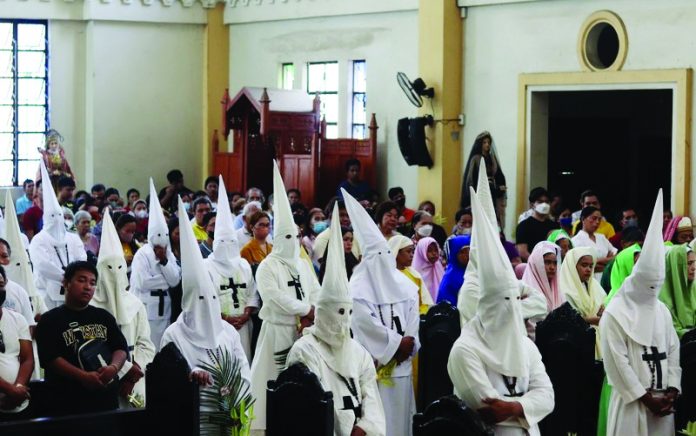
HOLY WEEK OBSERVANCE. The Archdiocese of Palo, speaking through its media coordinator Fr.Chris Militante, said that they are now in the midst of preparation for this year’s observance of the Holy Week. Photo shows participants, known as ‘Tais Dupol’ of the ‘Seven Last Words,’ a reenactment on the passion and death of Jesus Christ. (PHOTO COURTESY)
HOLY WEEK OBSERVANCE. The Archdiocese of Palo, speaking through its media coordinator Fr.Chris Militante, said that they are now in the midst of preparation for this year’s observance of the Holy Week. Photo shows participants, known as ‘Tais Dupol’ of the ‘Seven Last Words,’ a reenactment on the passion and death of Jesus Christ. (PHOTO COURTESY)
TACLOBAN CITY — The Archdiocese of Palo is preparing for Holy Week 2025 while tackling key concerns such as traffic congestion, crowd control, and emergency health services, said Rev. Fr. Chris Militante, director for social communications, during a press conference held on April 7 at the City Hall Media Lounge.
Militante acknowledged the strong support of local government units, especially the Tacloban City government, but stressed the need for traffic rerouting plans due to ongoing roadworks that may disrupt religious activities.
“The support of our local government units, such as the city government, has been very significant. That said, the Church is hoping for rerouting schemes for our people and additional measures to manage the roads,” he said.
With the expected influx of devotees—including tourists and even non-Catholics who often find spiritual renewal during Holy Week—the archdiocese is also reinforcing its plans to ensure safety, order, and immediate medical response.
Fr. Militante shared that preparations are in place, particularly at major religious sites like the Palo Metropolitan Cathedral.
These include the establishment of police assistance desks, medical assistance counters, and coordination with the Department of Health and local government officials.
“In each of our churches, especially in Palo, we have what we call police assistance desks. We also have ready medical assistance counters and tents in place, with active participation from the Department of Health and the LGU to meet urgent needs,” he said.
Holy Week observances will commence with Palm Sunday, followed by confessions scheduled from Monday to Wednesday. The Easter Triduum, which includes Maundy Thursday, Good Friday, and the Easter Vigil on Saturday, will mark the culmination of the weeklong reflection.
TACLOBAN CITY – Tingog party-list Representative Jude Acidre has suggested that Vice President Sara Duterte appoint caretakers or designate personnel to manage her office in her absence, ensuring that public service remains uninterrupted.
In a media conference, Acidre emphasized the need to maintain the functionality of the Office of the Vice President (OVP), despite his current political distance from the Vice President.
“Although we are not politically aligned with the Vice President at the moment, this is my personal take—that personnel should be delegated in the office, and that every effort should be made to ensure that the Office of the Vice President continues to deliver its services,” Acidre said.
Vice President Duterte returned to the country on Sunday after attending to matters related to the detention of her father, former President Rodrigo Duterte, in a prison facility in the Netherlands, facing crimes against humanity relative to his brutal campaign on illegal drugs during his six-year term.
Acidre’s recommendation underscores the importance of continuity in government operations and reflects Tingog Party-list’s commitment to effective governance and public service delivery.
TACLOBAN CITY – The local government of Catarman, Northern Samar, in coordination with the Department of Human Settlements and Urban Development (DHSUD), has identified a site for the construction of a medium-rise residential housing project under the national government’s ‘Pambansang Pabahay para sa mga Pilipino’ (4PH) Program.
The 4PH program aims to address the country’s housing backlog by targeting the construction of one million housing units annually, with the ultimate goal of achieving zero informal settlers by 2028.
Social Housing Finance Corporation (SHFC) Officer-in-Charge Manager Engr. Frederick De Real revealed the development following a site mapping conducted on April 3 in coordination with Catarman municipal administrator Renato Esidera.
According to the initial plan, the housing project will rise on a three-hectare lot located in Barangay Washington. The project will consist of 15 four-storey buildings, each floor containing 27 units, for a total of 1,440 housing units.
The intended beneficiaries include government and private sector employees, as well as members of the informal sector with Pag-IBIG Fund membership.
While the cost per unit has yet to be finalized, SHFC officials informed local authorities that payment will be made annually at a six percent interest rate. Of this, five percent will be subsidized by the national government, while beneficiaries will shoulder the remaining one percent. (ROEL T. AMAZONA)