ORMOC CITY– A barangay peacekeeping officer voluntarily surrendered an improvised firearm, locally known as a “sumpak,” to local authorities on the afternoon of Wednesday, May 2, in Barangay Parasan, Leyte town.
Police identified the barangay tanod only by his alias “Bob,” 55, married, and serving as a community watchman in the said village.
According to the Leyte Municipal Police Station (MPS), the tanod handed over the homemade firearm after one of his constituents turned it in to him. The concerned resident reportedly wanted to avoid any future legal issues and asked the tanod to surrender it to the authorities.
The sumpak is now in the custody of the Leyte MPS for proper documentation and disposal. (ROBERT DEJON)
ORMOC CITY– A female senior citizen was found lifeless, floating in the Tacuranga River in Sitio Kantukling, Barangay Tacuranga, Palo, Leyte at around 7:00 am on Wednesday, May 22.
Police identified the victim only by the alias “Cara,” a resident of Brgy. Tacuranga.
According to the Palo Municipal Police Station, they responded to a report about a body floating in the river.
Initial investigation revealed that the victim was last seen on the morning of Monday, May 19, at the barangay hall of Tacuranga, where she was processing her senior citizen ID. Police also noted that she lived alone.
Scene of the Crime Operatives (SOCO) who examined the area said there were no visible external injuries on the victim’s body.
Residents told police that the victim frequently crossed the river using an improvised bamboo bridge to visit her son in Barangay Naga-Naga. Authorities suspect she may have slipped or fallen while crossing.
The victim’s body was brought to a local funeral home in Barangay Salvacion for post-mortem examination.
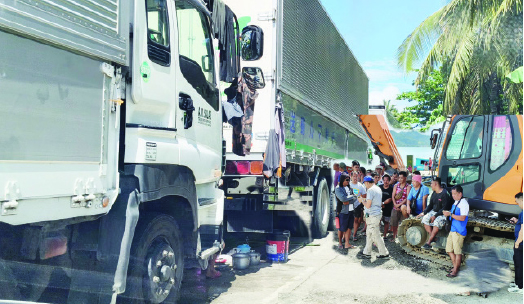
STRANDED TRUCKERS. The government should act swiftly in granting permits to shipping companies which seeks to operate vessels amid the closure of San Juanico Bridge to vehicles weighing 3 tons. This was the call of truckers who were stranded in Basey, Samar for days now as they await for the operation of a port in Amandayehan, Basey en route to Tacloban City. (ROEL T. AMAZONA)
STRANDED TRUCKERS. The government should act swiftly in granting permits to shipping companies which seeks to operate vessels amid the closure of San Juanico Bridge to vehicles weighing 3 tons. This was the call of truckers who were stranded in Basey, Samar for days now as they await for the operation of a port in Amandayehan, Basey en route to Tacloban City. (ROEL T. AMAZONA)
TACLOBAN CITY-Truck drivers stranded for over a week at Amandayehan Port in Basey, Samar are pinning their hopes on the successful start of operations by Santa Clara Shipping Corporation to finally reach Tacloban City.Hundreds of truckers from Luzon, lured by social media posts about the expected resumption of barge services across the San Juanico Strait, have been stuck at the port in Amandayehan village. Upon arrival, they discovered that operations had yet to begin, leaving them stranded with mounting daily expenses and delayed deliveries.
Jonathan De Borja, a driver delivering biscuits to a Tacloban shopping mall, expressed frustration as he watched his earnings dwindle while waiting at the port. He appealed to government agencies to expedite improvement works at the wharf following the successful trial docking of the LCT Adian Dowey on May 21.
“I hope the government hears the cries of drivers. Our families think we’re still earning, but our wages are being spent just to survive here,” he said in a Filipino.
He added: “The government should listen to drivers, not just make empty promises.”
Vinzon Alegan, another stranded driver en route to Zamboanga from Subic, acknowledged the efforts of local officials and government agencies who have provided food and basic assistance. However, he emphasized that enabling them to cross to Leyte is the most meaningful support they need.
“Authorities must work together to get us across. We’ve been delayed here for far too long,” he said, also in Filipino.
Alegan added that their prolonged stay is eating into their income and affecting their ability to support their families: “Some aid is being given, but our earnings are shrinking. How can we buy school needs for our children with classes about to start?”
During the trial docking, Santa Clara Shipping Corporation representative Joseph Go confirmed that Amandayehan Port is viable for their operations. However, he noted that improvements—such as reinforcing the ramp for smoother truck loading and unloading—are still needed.
Go said they are awaiting certification from the Philippine Ports Authority and the Maritime Industry Authority to begin full operations as soon as wharf upgrades are completed.
Amandayehan Port is a local government-run facility primarily used as a fish landing site. It previously served as a barge docking area during the rehabilitation of the San Juanico Bridge in the early 1990s.
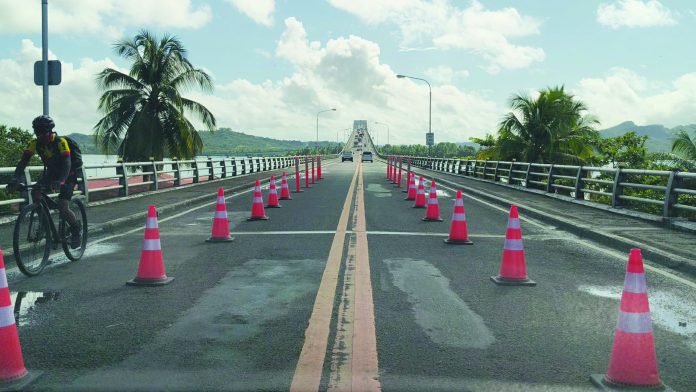
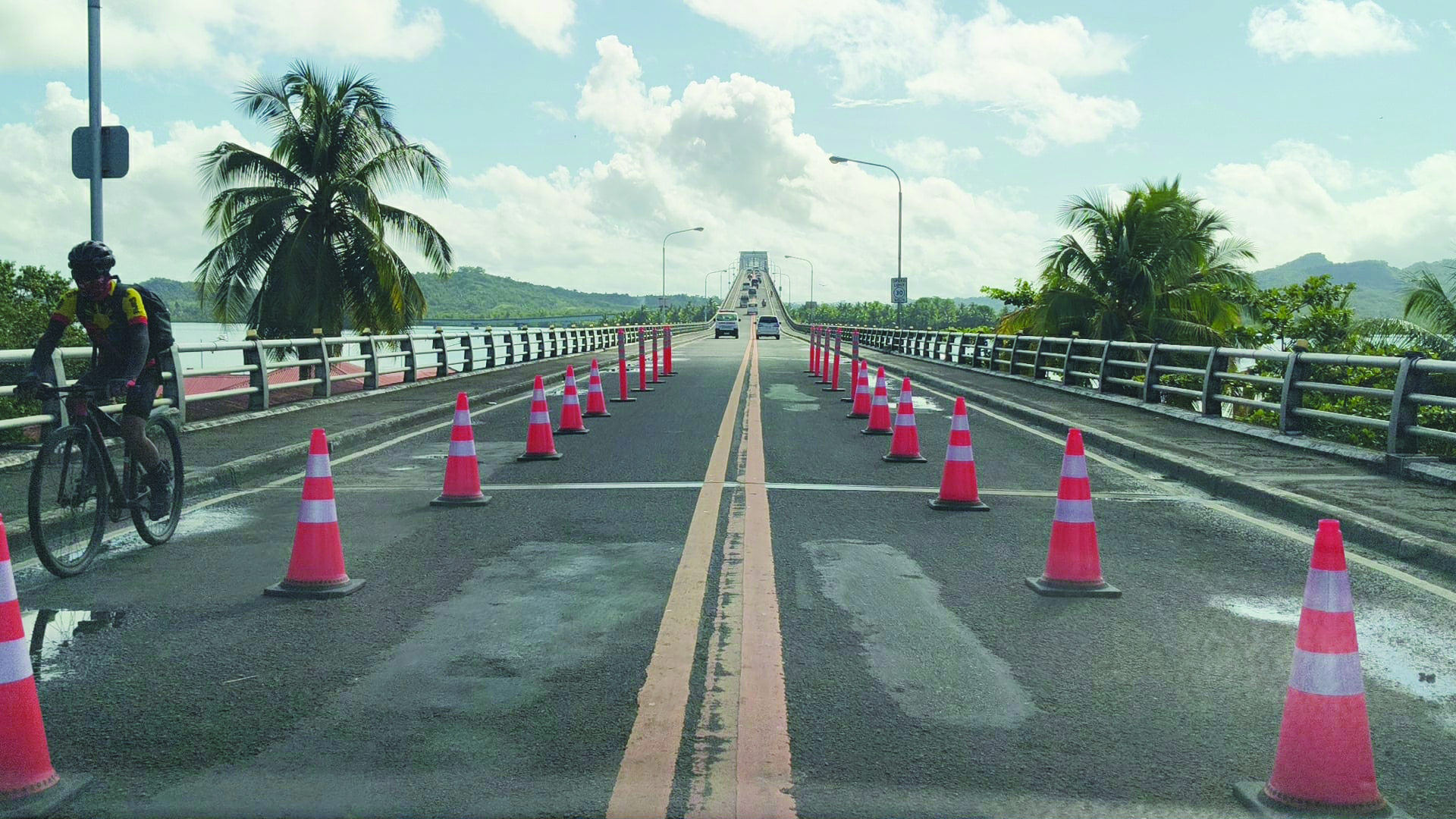
LIMITED RESTRICTION. While vehicles weighing three tons and above are prohibited from crossing the San Juanico Bridge, lighter vehicles are still allowed—but must travel along the centerline to minimize stress on the bridge’s deteriorating outer girders. (ROEL T. AMAZONA)
EV economy in peril?
LIMITED RESTRICTION. While vehicles weighing three tons and above are prohibited from crossing the San Juanico Bridge, lighter vehicles are still allowed—but must travel along the centerline to minimize stress on the bridge’s deteriorating outer girders. (ROEL T. AMAZONA)
TACLOBAN CITY – The imposition of a 3-ton weight limit on the iconic San Juanico Bridge is triggering a ripple effect of economic disruptions across Eastern Visayas, with projected losses reaching up to P600 million per month, according to business leaders and government officials.
The restriction, enforced by the Department of Public Works and Highways (DPWH) on May 14, was prompted by structural defects found in all 42 spans of the 53-year-old bridge, which connects Leyte and Samar and serves as a vital artery between Luzon, Visayas, and Mindanao.
“The economic losses due to issues with the San Juanico Bridge can be significant, considering its role as a critical inter-island link,” said Wilson Uy, former president of the Philippine Chamber of Commerce and Industry Tacloban-Leyte Inc. and current Leyte First District Board Member.
Uy estimates that the daily economic impact of delayed cargo shipments, increased fuel costs, business interruptions, and tourism declines could reach between P10 million to P20 million per day, translating to P300 million to P600 million monthly.
“Thousands of trucks carrying goods between Mindanao and Luzon use this route. Any closure or serious bottleneck can result in spoiled goods—particularly agricultural products—and rerouting costs that affect the entire supply chain,” he added.
Uy warned that transport costs, now surging due to longer alternate routes, will ultimately be passed on to consumers, increasing the prices of essential goods in Samar, Leyte, and beyond. “The disruption has serious implications for wholesale and retail trade, construction, and manufacturing sectors that rely on imported materials,” he said.
The Department of Tourism (DOT) Region 8 expressed similar concerns.
In a statement issued May 16, Regional Director Karina Rosa Tiopes warned that the restriction will hinder the movement of tourists, especially those traveling in buses and large vans, which are now prohibited from crossing the bridge.
“The sudden imposition of a strict weight limit will likely have a significant and multifaceted impact on the tourism industry,” Tiopes said, citing longer, costlier, and less convenient alternate routes as deterrents for tourists.
Eastern Visayas welcomed 1.6 million tourists in 2023, generating P39.33 billion in revenues. In the first quarter of 2025 alone, over 300,000 tourists visited the region, with receipts exceeding P1.77 billion—a momentum now at risk.
The growing crisis has prompted government agencies and business groups to appeal to the national government to expedite the bridge’s P900-million rehabilitation, which is expected to take two years.
The Samar Provincial Disaster Risk Reduction and Management Council (PDRRMC), led by Governor Sharee Ann Tan, has recommended declaring a state of emergency in the province.
A separate resolution was passed requesting the Philippine Navy to provide vessels for transporting fuel, medical supplies, and essential goods between Tacloban and Catbalogan.
The Regional Disaster Risk Reduction and Management Council (RDRRMC) has raised a blue alert status across Eastern Visayas, placing at least 50% of emergency personnel on standby to manage traffic flow, support logistics, and assist stranded travelers.
The Department of Social Welfare and Development (DSWD) has established a Mobile Command Center and is deploying mobile kitchens to provide hot meals to affected passengers at key choke points.
Meanwhile, private shipping companies have started offering expanded Roll-on/Roll-off (RoRo) routes to accommodate vehicles over the 3-ton limit. The Maritime Industry Authority (MARINA) has pledged to expedite permits for RoRo operators to ensure smoother cargo and passenger movement.
Uy stressed that while the economic impact figures are still conservative estimates, they underscore the urgency of immediate national intervention.
“This is no longer just a local inconvenience. The implications stretch across the supply chain from Mindanao to Luzon. The San Juanico Bridge may be symbolic, but right now, it is a very real economic lifeline,” he said.
RONALD O. REYES. ROEL T. AMAZONA, LIZBETH ANN A. ABELLA
ASSISTANCE. Passengers of vehicles not allowed to pass the San Juanico Bridge are being assisted by various government agencies like the Department of Social Welfare and Development by providing food packs to the affected passengers.
( DSWD-8)
ASSISTANCE. Passengers of vehicles not allowed to pass the San Juanico Bridge are being assisted by various government agencies like the Department of Social Welfare and Development by providing food packs to the affected passengers. ( DSWD-8)
TACLOBAN CITY – In response to the growing needs of stranded passengers due to the vehicle restrictions at San Juanico Bridge, the Department of Social Welfare and Development (DSWD) in Eastern Visayas will deploy a mobile kitchen to serve hot meals.
DSWD-8 Regional Director Grace Subong said this is the first time the agency will roll out such a facility in the region to address food access during emergencies like the current disruption, which prohibits buses and trucks from crossing the bridge.
While the agency has family food packs ready for distribution, Subong emphasized that providing freshly cooked meals is more suitable under the circumstances.
“Mayroon tayong mga family food packs pero wala naman silang mga individual kitchen na magagamit sa pagluto,” Subong explained. “Kaya kailangan namin ng tulong ng mga LGU para matukoy kung saan kami magse-set up—isa lang ang mobile kitchen, at dapat may isa sa bawat panig ng tulay.”
The mobile kitchen will initially serve “hot lugaw” and may later offer other nutritious meals in coordination with the National Nutrition Council to ensure that the food provided supports the health of the passengers.
Stranded passengers like Salema Magelis, who was traveling from Maguindanao to Metro Manila with her mother and brother, said their food budget was nearly exhausted after being stranded in both Surigao and Tacloban. What should have been a three-day trip has stretched to four days on the road.
Another passenger, Enar Machete from Surigao, expressed similar concerns, saying he may run out of money for food if delays continue.
To address these concerns, DSWD will meet with local officials from Tacloban and Sta. Rita to identify suitable locations for the mobile kitchen. Subong emphasized the importance of inter-agency coordination in rolling out this initiative.
In addition to hot meals, the DSWD regional office has prepositioned relief supplies and said it is prepared to provide cash assistance through the Assistance to Individuals in Crisis Situations (AICS) program, should the need arise.
ORMOC CITY-A motorcycle crash involving two men ended in injuries and a trip to the hospital after their vehicle slammed into a coffee vending machine in Barangay Canila,Biliran, Biliran around 6:00 pm on Sunday, May 11, 2025.
Police identified the victims as alias “Roy,” 20, single, a student and the motorcycle’s driver; and his back rider, alias “Dale,” 23, single, a laborer. Both are residents of Brgy. San Isidro, this municipality.
The two were riding a motorcycle without a plate number, which was being driven by Roy at the time of the accident.
According to the Biliran Municipal Police Station, a concerned citizen called to report the incident. Responding officers conducted an investigation and found that the motorcycle was traveling from Sitio Moog to Brgy. Canila when the driver lost control and swerved to the left, crashing into a coffee vending machine installed outside a convenience store.
As a result, both driver and passenger sustained injuries and were first brought to the Biliran Rural Health Unit, then referred to the Biliran Provincial Hospital for further medical treatment.
The motorcycle was brought to the Biliran Municipal Police Station for proper disposition.