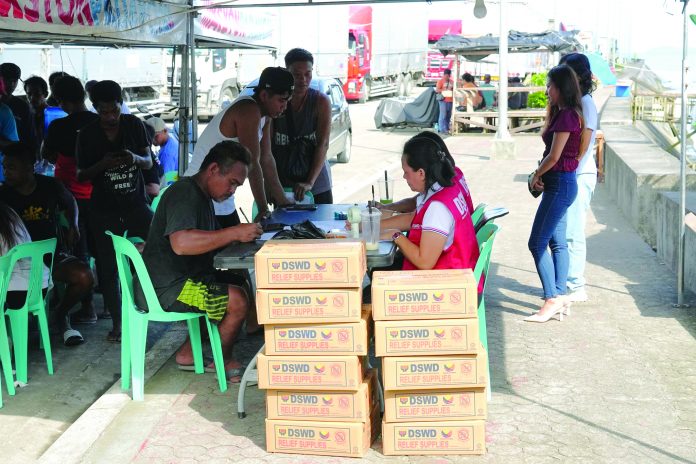
DECONGESTION. With the two ports in Calbayog City now being used as routes in going to Leyte side following the 3-ton load limit at the San Juanico Bridge, the city government has designed a plan to ensure that there will be no truck congestion. (CALBAYOG CITY INFORMATION OFFICE)
DECONGESTION. With the two ports in Calbayog City now being used as routes in going to Leyte side following the 3-ton load limit at the San Juanico Bridge, the city government has designed a plan to ensure that there will be no truck congestion. (CALBAYOG CITY INFORMATION OFFICE)
TACLOBAN CITY – The city government of Calbayog has launched a coordinated response to manage traffic congestion and assist affected individuals at Calbayog City Port and Maguinoo Port, now serving as alternative routes due to the load restrictions imposed on the San Juanico Bridge.
The San Juanico Bridge, which connects Samar and Leyte, has been subjected to weight limitations following structural concerns, prompting rerouting of heavy cargo traffic to maritime alternatives.
This shift has caused logistical bottlenecks in Calbayog, where ports are now key transit points for goods and vehicles.
To address the situation, Mayor Raymund Uy has mobilized several city agencies to ensure order and support for those impacted.
The Calbayog Public Order and Safety Office (CAPOSO) has been tasked with overseeing vehicular traffic, while the Community Program Coordinator manages the orderly queuing of trucks and vehicles awaiting embarkation.
The City Disaster Risk Reduction and Management Office (CDRRMO) has deployed its emergency management team to both ports to respond swiftly to any incidents. Meanwhile, the Department of Social Welfare and Development (DSWD), in partnership with the City Social Welfare and Development Office (CSWDO) and barangay health workers, is distributing food packs to stranded truck drivers. The Philippine National Police (PNP)-Calbayog is also on-site to ensure peace and security.
Mayor Uy clarified that while Calbayog has not been severely affected by the bridge restriction due to its main supply lines coming from Cebu, the city did experience minor disruptions in fuel supply from Leyte. He assured that these have since been addressed through rerouting from San Isidro in Northern Samar and the Bicol Region.
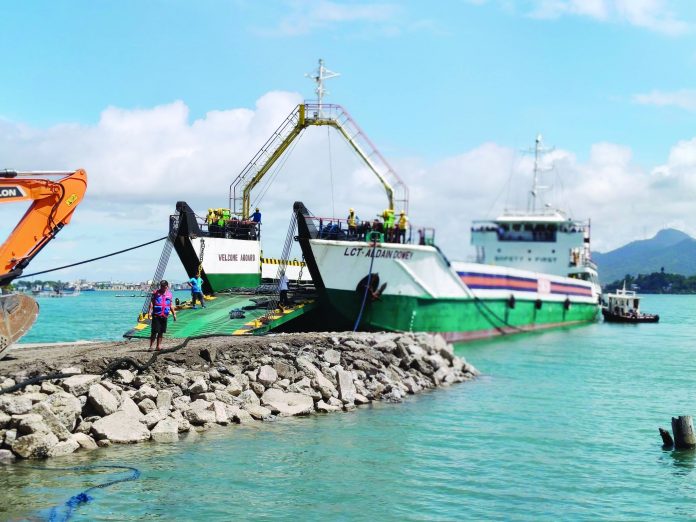
TRIAL DOCKING. As local governments brace for economic disruption due to the weight limit imposed on the San Juanico Bridge, a trial docking was conducted on Thursday, May 22, at the fish landing port in Barangay Amandayehan, Basey, Samar. The port is being considered as an alternative route for vessels transporting heavy vehicles barred from crossing the bridge pending urgent repairs. (ROEL T. AMAZONA)
TRIAL DOCKING. As local governments brace for economic disruption due to the weight limit imposed on the San Juanico Bridge, a trial docking was conducted on Thursday, May 22, at the fish landing port in Barangay Amandayehan, Basey, Samar. The port is being considered as an alternative route for vessels transporting heavy vehicles barred from crossing the bridge pending urgent repairs. (ROEL T. AMAZONA)
Due to San Juanico Bridge weight limit
TACLOBAN CITY – Local government units (LGUs) across Eastern Visayas are urgently mobilizing to mitigate the economic and logistical disruptions caused by new vehicle weight restrictions on the San Juanico Bridge, the vital link between Leyte and Samar islands.
On May 14, the Department of Public Works and Highways (DPWH) imposed a temporary ban on vehicles weighing more than three tons from crossing the bridge, citing safety concerns. The restriction has since strained supply chains, pushed up commodity prices, and impacted public services across the region.
In Tacloban City, the region’s main commercial hub, the impact of the three-ton weight limitation of vehicles at the iconic bridge could also be felt.
Janis Canta, City Planning and Development Officer, warned that the city may soon experience shortages of fuel and essential goods, as demands rise from surrounding provinces.
“Tacloban is the supply hub of Eastern Visayas. This bridge restriction doesn’t just affect us—it affects the entire region,” Canta said on Thursday, May 22.
“We’ve just regained economic momentum after the pandemic, and now we face a new challenge. We’re appealing to the national government for urgent intervention to keep basic supplies moving.”
In Basey, Samar, Mayor Luz Ponferrada expressed concern about possible food shortages if no alternate transport route is made available.
“My fear is hunger,” Ponferrada said. “If we don’t have an alternative for heavy trucks to transport essential goods, our people will suffer.”
As a temporary solution, officials have identified the fish port in Barangay Amandayehan, Basey as a potential roll-on/roll-off (RoRo) route for heavy vehicles.
Its operation is expected to start once the rehabilitation of the fish port will be completed.
Meanwhile, the provincial government of Samar declared a state of emergency on May 20, allowing the use of its calamity fund to cushion the economic impact and speed up local response efforts.
In Eastern Samar, Oras Mayor Roy Ador reported a “large impact” on both the local economy and essential services.
“Consumers are now complaining about rising prices of goods,” Ador said in a statement on May 21.
“Our economic and commercial office has begun investigating and found that some establishments have imposed price increases. We’ve recommended a price freeze as we hold focused discussions with stakeholders to find practical solutions.”
Ador also noted that public services such as emergency patient transport and garbage collection are being affected by fuel shortages, as fuel deliveries face delays.
In Borongan City, the provincial capital, Mayor Jose Ivan Dayan Agda convened a meeting with the Department of Trade and Industry (DTI) and the local Chamber of Commerce to assess the emerging crisis.
“We will create a special task force to monitor supply chains, price levels, and address any disruptions caused by the weight restriction,” Agda said in a public post.
“We urge residents to remain calm, avoid panic buying, and rely only on official information.”
And in Calbayog City, in response to supply chain disruptions caused by restrictions on San Juanico Bridge, its local price coordinating council (LPCC), chaired by Mayor Raymund Uy, convened to stabilize prices.
The meeting led to the approval of price ceilings: P 420 per kilo for pork and P215 for whole chicken. These limits apply to public markets, supermarkets, and meat shops, but not to ‘talipapa’ or convenience stores.
Supermarkets and distributors assured the city of sufficient supply. Meanwhile, the city government has lifted the truck ban and will enforce the display of price tags on essential goods.
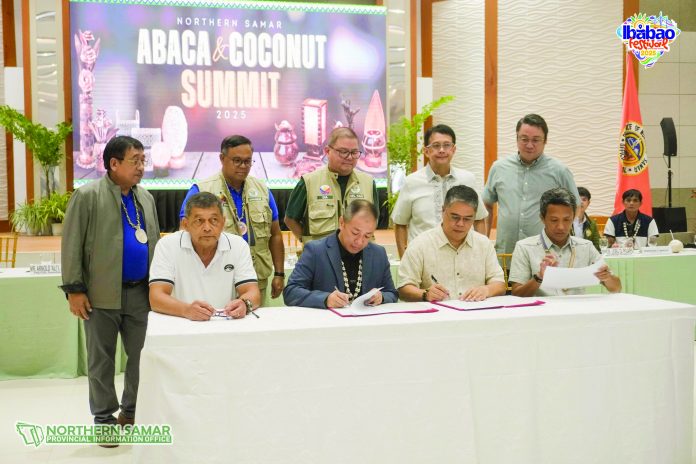
COCONUT INDUSTRIAL PARK. The provincial government of Northern Samar, as represented by Governor Edwin Ongchuan(second from right), entered an agreement on May 18 with the Island Fun, as represented by its CEO Stephen Chen, for the establishment of a coconut industrial park in Bobon town which is expected to boost the coconut industry in the province. Among the witnesses of the signing were Agriculture Sec.Francisco Tiu-Laurel, Jr., and Rep. Paul Daza. (story page 2)
(THE PROVINCIAL GOVERNEMNT OF NORTHERN SAMAR)
COCONUT INDUSTRIAL PARK. The provincial government of Northern Samar, as represented by Governor Edwin Ongchuan(second from right), entered an agreement on May 18 with the Island Fun, as represented by its CEO Stephen Chen, for the establishment of a coconut industrial park in Bobon town which is expected to boost the coconut industry in the province. Among the witnesses of the signing were Agriculture Sec.Francisco Tiu-Laurel, Jr., and Rep. Paul Daza. (story page 2) (THE PROVINCIAL GOVERNEMNT OF NORTHERN SAMAR)
TACLOBAN CITY – The provincial government of Northern Samar has signed a memorandum of understanding (MOU) with private firm Island Fun for the establishment of a Coconut Industrial Park, a landmark project aimed at modernizing the province’s coconut industry.
The MOU was signed by Governor Edwin Ongchuan and Island Fun CEO Stephen Chen during the Abaca and Coconut Farmers Summit on May 18, 2025, held at the Ibabao Hall of the provincial capitol in Catarman.
The signing was witnessed by Department of Agriculture (DA) Secretary Francisco Tiu Laurel, Usec. Arnold Atienza of PhilFIDA, DA-8 Regional Executive Director Andrew Orais, Northern Samar 1st District Representative Paul Daza, Provincial Agriculturist Jose Luis Acompañado, and Engr. Reynato Dubongco of the Philippine Coconut Authority (PCA) Northern Samar.
The project aims to shift Northern Samar’s coconut sector from raw production to advanced, value-added processing, turning the province into a competitive player in both domestic and international markets.
The 3.5-hectare coconut industrial park, to be built in Barangay San Isidro, Bobon, will have the capacity to process up to 300,000 coconuts daily. The facility will integrate various stages of production—extracting, manufacturing, and packaging a range of high-value coconut-based products for export.
The first phase of development includes a P200 million investment for the construction of core infrastructure, recruitment of skilled workers, and commencement of operations. This marks the beginning of a P700 million total investment for the full implementation of the industrial park.
According to the PCA, Northern Samar ranked 18th among the country’s top coconut-producing provinces, with 315,000 metric tons harvested in 2023. The province is home to around 86,000 registered coconut farmers, including landowners, farm workers, and tenants.
Despite this output, local value-added processing remains minimal. The province currently has only one oil mill, one coco sugar producer, two virgin coconut oil manufacturers, and three coco coir producers—highlighting the need for integrated industrial development to stimulate rural income and industry growth.
TACLOBAN CITY – House Speaker Ferdinand Martin Romualdez has expressed his full support for President Ferdinand Marcos Jr.’s recent Cabinet revamp, describing it as a “strong and necessary step” that reflects the President’s readiness to listen to public sentiment and act with decisive leadership.
Romualdez lauded the President’s courage in demanding accountability and reorganizing the administration to realign priorities. He assured the public that the House of Representatives is ready to work closely with the new Cabinet to tackle pressing national issues such as job creation, rising food prices, and improved public service delivery.
“As leader of the 306-strong House, I believe what we need now is unity and compassion—pagkakaisa at malasakit,” Romualdez said in a statement. “I stand with the President. The nation comes first.”
He emphasized that the House will strengthen its oversight functions to help drive the President’s reform agenda and ensure the implementation of meaningful changes that benefit the Filipino people.
TACLOBAN CITY– Cheryl Pascua, regional director of the Maritime Industry Authority (Marina) Region 8, pledged to expedite special permits for ship companies seeking new routes due to the 3-ton weight limit restrictions on the San Juanico Bridge.
Pascua is confident that more shipping lines will adopt new routes to alleviate the burden on the trucking industry and vehicles over three tons.
“Hopefully, more people will apply,” Pascua said.
MARINA has announced that ALD Sea Transport is now providing service for cargo trucks and other heavy vehicles on the route between GGC Port in Punta, Ormoc City, Leyte, and Maguino-o Port in Calbayog, Samar, and vice versa.
Anthero Doyon, chief operating officer of ALD Sea Transport, stated that the RoRo vessels can accommodate approximately 30 to 40 trucks operating in both directions between Ormoc and Calbayog.
Doyon also specified that the vessels are designated exclusively for cargo transport and do not carry passengers.
In addition to ALD Sea Transport, another shipping company registered in Cebu City has submitted a letter of intent to MARINA.
The trucking industry has raised concerns about limited access to the San Juanico Bridge. If fully funded, its rehabilitation will take two years.
DPWH-8 proposed two budget rehabilitation options: a total closure estimated to cost P5.2 billion or a partial closure costing P6.9 billion.
As of April 2025, traffic counts showed around 14,061 vehicles, of which 1,396 were heavy vehicles. (CBA, PIA-8)
ORMOC CITY– A 54-year-old Canadian national, earlier seen alive just days ago, was discovered dead in his rented apartment in Barangay F.E. Marcos, Calubian, Leyte, on the morning of Thursday, May 22.
Authorities reported that the body was already in an early stage of decomposition.
According to PCpt. Alexander Alfonzo, officer-in-charge of the Calubian municipal police, the victim—identified only by the alias “Kevin”—was jobless, married, and had been residing in the village.
The discovery was made after a relative, identified as “Ilumida,” the victim’s mother-in-law, reported the matter to the police. She was alerted by neighbors who noticed a foul odor coming from the apartment and had not seen Kevin since the afternoon of May 19. At that time, he had appeared restless and unwell while lying in bed.
Police responded immediately and found Kevin’s lifeless body lying on his bed in a side-lying position. His remains showed signs of early decomposition.
Further investigation revealed that Kevin had been suffering from an acute ulcer, reportedly due to excessive alcohol consumption and irregular meals, according to his in-laws. His landlord, Dean Barro, also informed authorities that Kevin had failed to pay rent for three months due to financial difficulties.
Authorities are continuing their investigation but have found no immediate signs of foul play. (ROBERT DEJON)