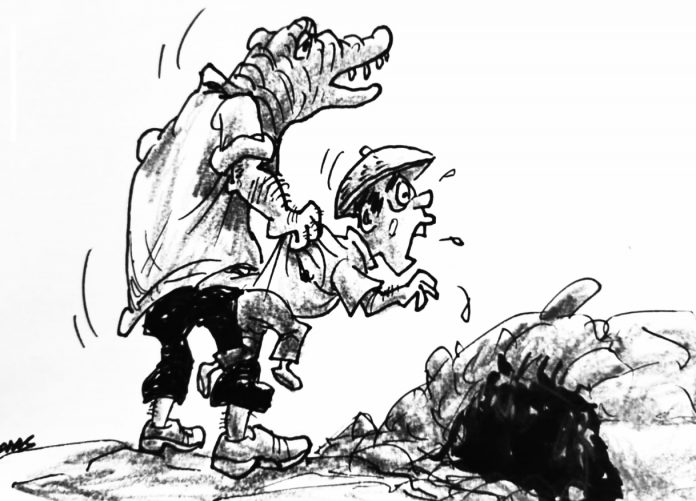

Some senators who appear to be loyal factotums of the former and now detained president had openly manifested their partiality in favor of the impeached vice president. It is well to note that the articles of impeachment was filed during the previous congress but the impeachment trial never happened as the consistent ad hominem to attack the inaction of congress over the previous impeachment complaints filed before the lower house. The explanation is cyclic to buttress the senate president’s position that there is no reason to hurry him now in the same manner that the lower house did not hurry to bring the impeachment complaint against the now impeached vice president.
While the senate has not yet started the impeachment trial, two senators who are long-time loyalists to the former and now detained president, took the floor to move for the dismissal of the impeachment complaint. The motion to dismiss was purportedly based on the defective impeachment complaint and the alleged violation of the constitutional provision that allows only one impeachment complaint in a year. The motion seeks the dismissal of the impeachment complaint without trial.
It was followed by a lengthy discussion on the purported violation of the one-year bar rule that was interrupted by contrary discussion of the minority on the necessity to start the impeachment trial. The discussion was again interrupted by a privileged motion of the magical president’s sister. The discussion which begun on the construction of the word forthwith turned to be a display personal interpretation by each grandstanding senator.
These non-lawyer senators had the gall to discuss legal matters, chiefly the construction of the constitution. They act as if they are better than the lawyers in the senate and the legal luminaries that were invited as resource persons to shed light on the issue of dismissing the articles of impeachment without trial. These supposed senator-judges are to comport themselves with the cold neutrality of a judge.
Unfortunately, they have acted as defense lawyers of the impeached vice president. They keep on arguing that the articles of impeachment is defective and was filed in violation of the constitution. Their conclusion was made without giving the prosecutors the opportunity to explain the issues regarding the questions raised by the biased senator-judges. Another senator who is self-righteous and so assuming argues using the national language that the impeachment is dividing the country and an embarrassment thus the same has to be dismissed.
It is well to remind these senator-judges that their posturing as defense lawyers of the impeached vice president is an unlawful practice of the legal profession. People know that in our country, the practice of any profession requires formal education and license. The person in pursuit of his chosen study and grandstanding non-lawyer senators taking turns with their motion to dismiss the articles of impeachment is pure and simple malpractice.
comments to alellema@yahoo.com


Lagging behind
A quick visit to Baybay City today is enough to shame any mature Taclobanon. Its spanking new streets, well-organized terminals, breezy public market, and growing city center are in sharp contrast to Tacloban’s messy downtown, bumpy barangay roads like that of St. Anthony Subdivision in San Jose, and tacky rotunda, which pretends to be an authentic urban showpiece. Tacloban is behind, not just in image, but in service, and it has no one to blame but itself and its administration.
The sad truth is that Tacloban has become complacent in the thinking that the sad recognition of being the ground zero of Yolanda would be sufficient to guarantee it with continuous sympathy and assistance. Cities do not develop with sympathy—they develop by vision, planning, and bold infrastructure. Look at Maasin City. Quiet, remote, and small, yet its government complex is modern, its roads are upgraded, and its port investments are being noticed. In Tacloban, though, it takes forever to drive through Real Street during rush hour, and the terminal remains messy.
There is now such a need for an efficient transport system in Tacloban—one that is not multicab-dependent and a sea of claustrophobic tricycles. In Baybay, there is only one transport terminal, and a more organized mode of public transport nowadays. Tacloban? It still makes people alight along pedestrian paths with no shield and no regulation. And the pedicabs in the city outskirts are the ones deciding how much fare they should get from passengers, which is usually sky-high. How can the people be served by a city when it cannot even transport them efficiently from one location to another?
And another big shame is drainage. Every good rain is evidence that Tacloban learned nothing from Yolanda. Flooding continues to blanket downtown intersections. Even the main roads—Justice Romualdez, Paterno, even Burgos—are pools of despair. Baybay and Maasin, on a smaller budget, were able to rebuild their flood control and drainage systems. Why not Tacloban, with all the priority promised by the national government and foreign assistance?
Then there is the matter of green space. Parks, recreation grounds, and decent pedestrian walkways—these are nowadays taken for granted in cities’ modernization. But where can one catch their breath or stroll in Tacloban? Rizal Plaza is not enough, Balyuan lags, and the rest are privatized or cemented. Other cities have learned something from the pandemic: give people open, safe spaces to relax and gather. Tacloban still forces pedestrians to swerve around potholes while breathing the dust of incomplete works.
Even barangay roads, many of which have remained uncemented for decades, are screaming for attention. Go to the interior parts of San Jose, Abucay, Tigbao, and even Calanipawan, and you’ll find neighborhoods that feel like they were left out of city planning altogether. Worse, these are the areas vulnerable to flooding and isolation during emergencies, yet they remain under-prioritized in the city’s annual investment plans. It’s as if the city wants to grow without feeding its limbs.
Urban planning in Tacloban appears reactive, not visionary. Projects seem to be done only when there is a leftover budget or political urgency. There’s no coherent master plan that boldly anticipates the city’s future—only patchwork repairs and image-driven beautification. But real infrastructure isn’t just about looking good; it’s about working efficiently. It’s about making the city livable, accessible, safe, and competitive.
If Tacloban hopes to regain its leadership in Eastern Visayas, it must stop riding on its past and start racing toward its future. That means prioritizing projects that matter—flood control, public transport, barangay access roads, civic spaces, garbage disposal, and drainage. It means listening to engineers, not just contractors, and urban planners, not just politicians. And most importantly, it means waking up from the illusion that Tacloban is still the queen city of the region—it no longer is. The crown is slipping fast.