ORMOC CITY-An entire family composed of four persons died after the motorcycle that they were on board was hit by a light truck in Caibiran, Biliran on Sunday night.
Dead on the spot were Jimmy Agosto, his wife Solidad and children Jameson and Jonalyn, report from the regional headquarters of the Philippine National Police said.
The family was on their way home in sitio Tan-ag of Barangay Maurang of the said town when they were hit head-on by the light truck (Fuso canter) driven by Benigno Garcia, a resident of Brgy. Cabibihan of the same town at about 6:20 pm along sitio Taloto which is within the village of Maurang, the police said.
The suspect tried to overtake another motorcycle driven by Anatalia Veruen which resulted for it to hit instead the motorcycle where the victims were on board.
The victims were brought to the Biliran Provincial Hospital but were declared as dead on arrival by their attending physician.
The driver, who was said to be under the influence of intoxicated liquor, is now detained at the Caibiran municipal station.
Charges for reckless imprudence resulting to multiple homicide is being readied against the suspect who was not injured during the said accident. (ROBERT DEJON)
WE should be clear about this. The best teacher we can have, the ultimate one, the one that teaches us everything and in the proper way is Christ. When we have to carry out the task of teaching, we should see to it that we always teach with Christ, in Christ and for Christ.
We are reminded of this truth of our faith in that gospel episode where Christ entered a synagogue on a Sabbath and taught. The people were amazed at his teaching because, as they claimed, “he taught them as one having authority and not as the scribes.” (cfr. Mk 1,21-28)
Later on, their amazement even grew some more when with his words, he drove out an unclean spirit from a possessed man. “What is this?” they exclaimed. “A new teaching with authority. He commands even the unclean spirits and they obey him.”
We should be wary of our tendency to teach simply on our own authority, or on the basis of some ideology or philosophy, etc. This tendency arises when we think that what we are teaching are simply mundane matters like our sciences, technologies and ideologies. We tend to think that Christ, that God, has nothing to do with it.
This is when we have to remind ourselves that everything that we use as subject of our teaching comes from God and is meant to lead us to God. There is nothing that is a subject for teaching that does not come from God.
Christ, and the Church now, may not be directly involved in the technicalities, but there is no doubt that it is God who created everything, including the technicalities, imbuing it with their proper laws. What we do is simply to discover these laws with their technicalities, sometimes coming out with certain inventions and innovations.
But we should not forget that in using these laws and technicalities to achieve a certain good for man, we ought to thank God for them and to glorify him through them. Failing in that regard constitutes failure in teaching.
Thus, a good teacher is one who manages to relate the things he teaches, no matter how technical and mundane, to God and to others. He should inspire the students to love God and others more through the things he teaches. The things he teaches should bring students closer to God.
Failure in this crucial point would expose the things taught and learned to the dynamics of merely worldly values that are very vulnerable to being used and exploited by evil spirits or to being used as means for self-indulgence, the antithesis of love.
This is actually what is taking place these days. We have quite progressed in terms of knowledge. Our sciences and technologies are practically bursting with new developments and possibilities. We are having an overload. But without charity inspiring them, they can easily be misused and abused. Let’s remember what St. Paul said once: “Knowledge puffs up, but love builds up.” (1 Cor 8,1)
A good and ideal teacher, let’s reiterate it, always manages to relate the things taught to God and to inspire his students to love God and others through these things. The lessons he teaches are not merely technical things, or intellectual or theoretical affairs. He manages to link them to the abiding providential action of God.
In other words, while he is most rigorous in the technical and intellectual aspects of the lessons taught, his teaching is such that piety is not impaired or forgotten, but is rather, in fact, fostered!
The Robinson’s Malls nationwide, will use solar energy to operate its Malls nationwide it was revealed by its outfit Robinson Land Corporation (RLC).
Records show that RLC is the largest solar powered mall operator in the Philippines today, as it installs more roof top solar panels in their Robinson malls in Luzon and Mindanao – now totalling 24 malls.
Aside from rooftop solar panels, Robinsons malls spread all over the country, RLC has installed rainwater collection systems in 29 malls and is using greywater for landscaping and irrigation in 15 malls. Likewise, the corporation has invested on renewable energy sourcing that has allowed them to avoid as much a 19,804.94 metric tons of carbon emission in its malls.
The corporation management was quoted saying “power distributor Meralco recently enrolled 10 Robinsons malls to the to the interruptible load program through which RLC committed to de-load a total of 31MW when needed. This has potentials to spare some 124,000 households and small businesses from the inconvenience of unplanned power interruptions.”
MY COMMENT:
The RLC should be commended for their program to use renewable solar energy, installing rainwater collection system and for helping hundreds of Filipino households avail and small businesses are able to do business by de-loading at least 31 MW of energy for their use. On top of these, is RLC’s contribution in mitigating the negative effects of climate change by reducing carbon footprint in the country. Hope that other Mall owners replicate RLC’s climate change initiative.
ooo000ooo NEXT TOPIC : “2nd Green Energy auction being hatched by DOE” SHARE S & T THOUGHTS through E-mail: drpacjr@yahoo.com.
CLEMELLE L. MONTALLANA,DM, CESE ASSOCIATE PROFESSOR III
January 8 until the 9th this year saw a sustained hard and heavy rainfall in our midst. The entire region was literally in water world figuratively similar to that Kevin Costner starrer. However, it was a time when Local Chief Executives was reluctant to call it as such, a dangerous day for its people. Perhaps, the new year with its unfinished works and the needed tasks unfinished or otherwise it was a decision to just delay awaiting other towns.
The waiting game came as no surprise. As perhaps, it would also mean that a management prerogative is in place and that the fact stands that it would be wise to soldier on.
The waiting game came as no surprise . As perhaps, it would also mean that a management prerogative is in place and that the fact stands that it would be wise to soldier on.
Alas, the rains was steady and at time getting stronger. The NDDRMC was shouting on our phones their Rainfall warnings.
NDRRMC (11:05AM, 09 Jan 23) Orange Rainfall Warning sa Leyte. Nagbabanta ang matinding pag-ulan, pagbaha at pagguho ng lupa.
Thats the first warning that came at 11 AM.
NDRRMC(11:25AM, 09Jan23)Orange Rainfall Warning sa Leyte. Nagbabanta ang matinding pag-ulan, pagbaha at pagguho ng lupa.
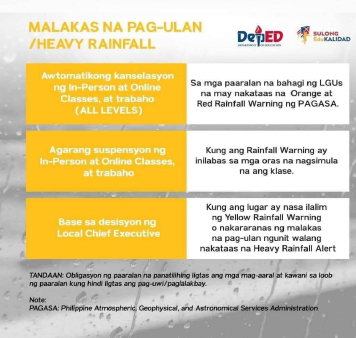
Thankfully DepEd has a issued an advisory that is dependent on the rain advisory. Herein attached.
For now, this would mean that if there is an obvious analysis paralysis from our local executives, our children are safer.
It does not need much of the arbitral decision making, it only needs real RAINS pounding our heads. Thats better.
Observations have it that the transgender movement is seemingly becoming totalitarian as they exercise their increasing control over their ability to speak freely while depriving others of similar free speech about anything relative to transgender issues.
A man was sentenced to three years in prison for saying that men cannot get pregnant. This was in Greece, a highly-civilized country. He was convicted of “transphobic” social media posts objecting to the genital mutilation of children. A 10-month suspended prison sentence and a 5,000 euro fine due to his “public incitement” of “violence or hatred for reasons of gender identity” comprised his penalty.
In the United Kingdom, a woman was threatened with arrest after speaking out against transgender ideology. The arresting police informed her that she was under investigation for a hate crime because of “words or behavior to stir up hatred on the grounds of sexual orientation.”
Still in the UK, a British veteran was arrested over a social media post condemning the transgender movement. “Someone has been caused anxiety based on your social media post. And that is why you’re being arrested,” the police told him as they put him in handcuffs.
A lesbian filmmaker and actress are under investigation in Norway on criminal hate speech charges because she stated that a man cannot be a lesbian. She was told by authorities that her comments about a trans activist on Facebook — a biological male identifying as a female — were the reason for her investigation.
Similar to cases in Greece and elsewhere, her comments run afoul of a criminal code amendment passed in 2020 that added “gender identity and gender expression” as protected categories under Norway’s hate speech laws. Another woman has already been accused under these same laws and, if found guilty of “transphobia,” could face three years in prison.
Those found guilty of private remarks under these laws can be fined or jailed for a year; while three years is the sentence for public comments.
But the lesbian was defiant, stating that she posted her statement on Facebook to expose the insanity of Norway’s hate speech laws, having previously called them discriminatory. “Will the equality minister take action to ensure that lesbian women’s human rights are safeguarded, by making it clear that there are no lesbians with penises, that males cannot be lesbians regardless of their gender identity…?” she asked.
Perhaps she is just after fairness. If we have the freedom of expression, and we can say wholesome comments about anything, then why can’t we comment about transgender issues that invite attention? Why can we not express our opinions without the threat of being arrested? In this world, the mere fact that you exist already provokes some comments. Why do you have to penalize those comments?
Given the extant illegal drug problem in the country, police generals and other authorities have repeatedly been linked to it over the years, which is not surprising since that’s the very reason why it is never eradicated—because some high-ranking authorities are behind drug proliferation.
Even former president Rodrigo Duterte had hinted over and over that some generals and other high-ranking men in uniform are engaged in the drug trade, protecting its operations from being halted by those authorities who are serious about putting an end to this menace. As a big syndicate, it never ceased despite the old man’s bloody war against it.
Now that this crackdown has obviously weakened, the drug trade’s key players are back to business. Their operations show no signs of stopping since big money is involved, and they richly benefit from it. When huge amounts are at work, even the principled authorities yield to the temptation and eventually become protectors of the illegal activity, even facilitating the complications and difficulties that stand in the way.
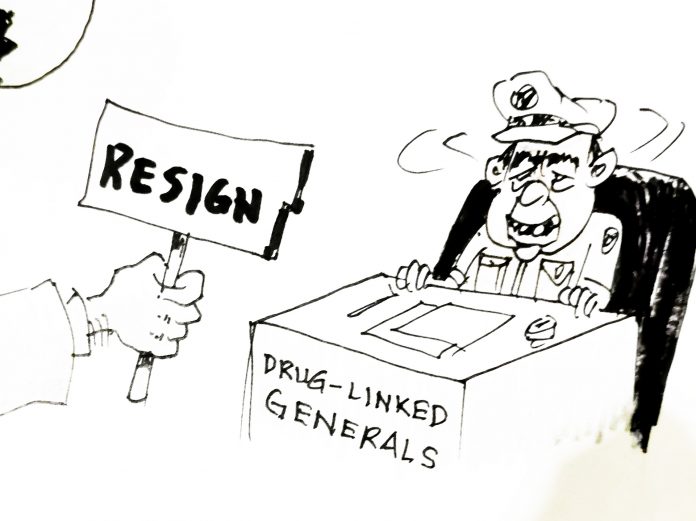
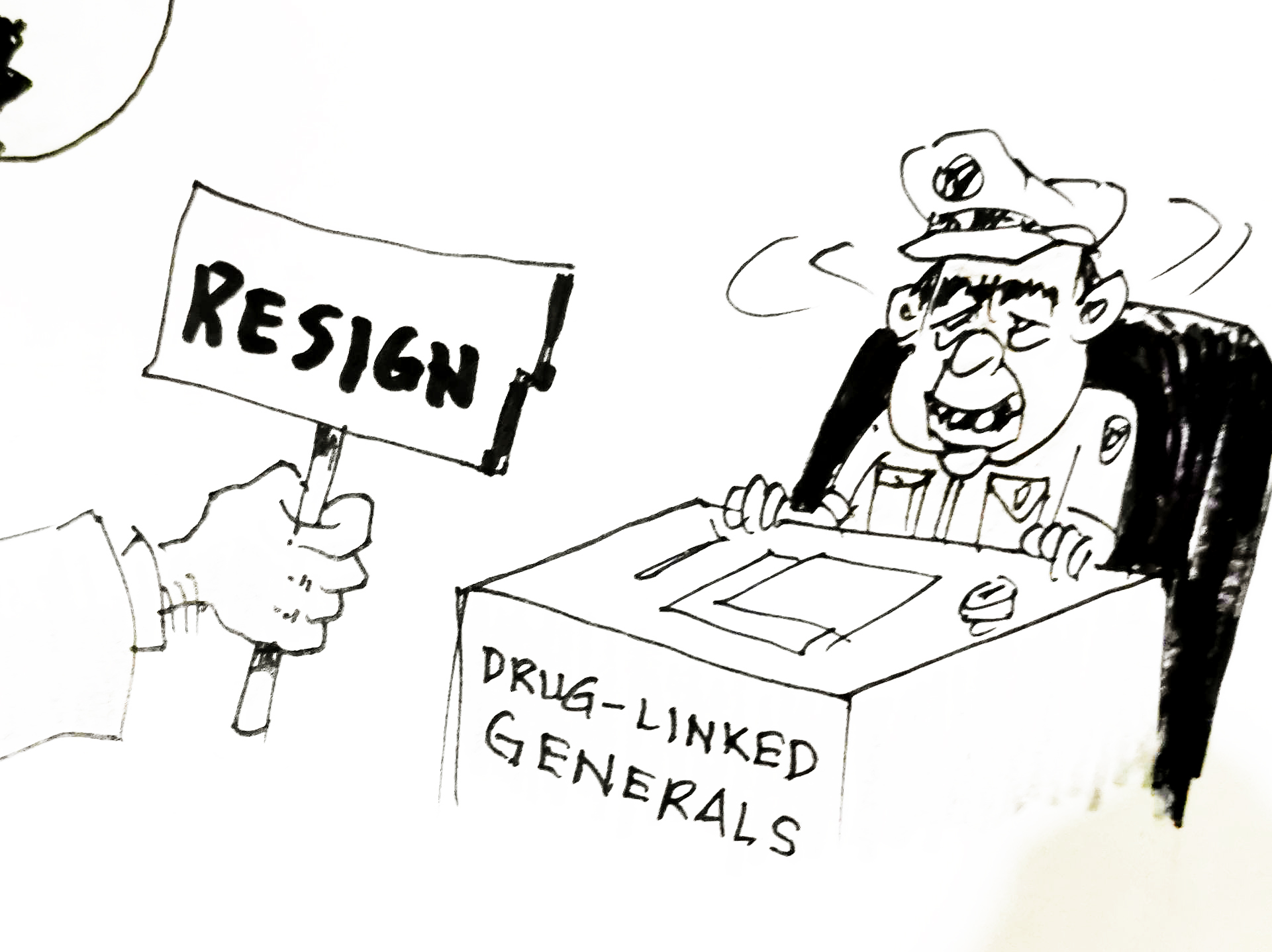
Supposedly, it’s a heinous crime by these authorities, but concerned government watchdogs are only urging them to resign from their positions. Why just resign? For sure, they will not do that! The government should sue them in court, dismiss them from service, and put them behind bars. That’s what they deserve!
That’s the problem with this country’s justice system—when the accused are small figures, the laws are harshly applied. But when the offenders are wealthy, powerful, and influential, the laws are powerless. If small drug users lost their lives in the drug war, then why can’t these generals be at least fired from their jobs and placed in prison? Where are the fairness and justice that people are longing for?