ORMOC CITY-Two construction workers were killed while another one was injured when the metal pipe they were erecting as flag poles touched a live wire owned by the local electric cooperative resulting in their electrocution on Monday (Nov. 7).
Naval chief of police, Major Ryan Delima, identified the fatalities as Kirby Verutiao, 21, and Michael Corpin, 28, both construction workers and residents of Barangay Maurang, Caibiran, Biliran.
Hurt was Mark Edward Mondedo, 20.
Delima said that the three were erecting a flag pole at the Provincial Fire Marshal office at the government center in Barangay Larrazabal, Biliran at about 2:15 pm when the metal accidentally hit a live wire which resulted in the electrocution of the victims.
TACLOBAN CITY – Social media activities that are “outside school setting” are the ones affected by an order issued by the Department of Education(DepEd) and not those that are related to school or class activities like the creation of group chat(gc)that is used by teachers for communicating lessons and activities to their students.
Outside school setting refers to personal activities, DepEd spokesperson lawyer Michael Poa said.
“The wording of the DO 49 is avoid na lang following them, following learners on social media. But if there is a need to communicate with them thru social media platform wala naman pong masama dun,” Poa said.
“Yung mga gc pwede naman kayong magkaroon ng chat doon with students so wala namang problema as long as it is within the school setting as long as instruction. Hindi naman po ibig sabihin na within the school setting nasa loob lang kayo ng paaralan, and I think that is why nagkakaroon ng confusion and we wanted to clarify that within the school setting basta related sa instructions, sa lesson, sa school activity yung pinag-uusapan wala pong problema,” he explained.
Poa added that the creation of gc has been useful to learners especially during the outbreak of the pandemic as teachers made use of it by giving instructions to their students.
According to the DepEd spokesperson, the purpose of the order was to protect the integrity of the teachers and for practice professionalism.
Any violation committed by the teachers, he said, is to be dealt with under the code of conduct and ethical standards for government employees and officials under Republic Act 6713.
Poa added that what the DO prohibits is for teachers ‘crossing the line’ in dealing with their students.
“Dapat there is a line between the teacher and the learner. You have to be professional kasi yung ang relationship niyo teacher and learners. Once teachers crosses that, it might create a lot of problems,” Poa shares.
Poa added that the order also does not order teachers to unfriend or unfollow students who are already in their friend’s lists or being followed in social media platform.
Poa along with the all DepEd undersecretary and assistant secretary were in Tacloban City Wednesday(Nov.9) for a 3-day national executive committee meeting that started November 8 until 10 as ordered by DepEd Secretary Vice President Sara Duterte that top officials of the agency will have a regular dialogue with officials in the regional offices. (ROEL T. AMAZONA)
QUINAPONDAN, Eastern Samar — Sachets and plastic wastes entangled in mangrove roots were the very first intruders that Christopher Quiza, a Bantay Dagat of Quinapondan fish sanctuaries, had to face at the start of his day.
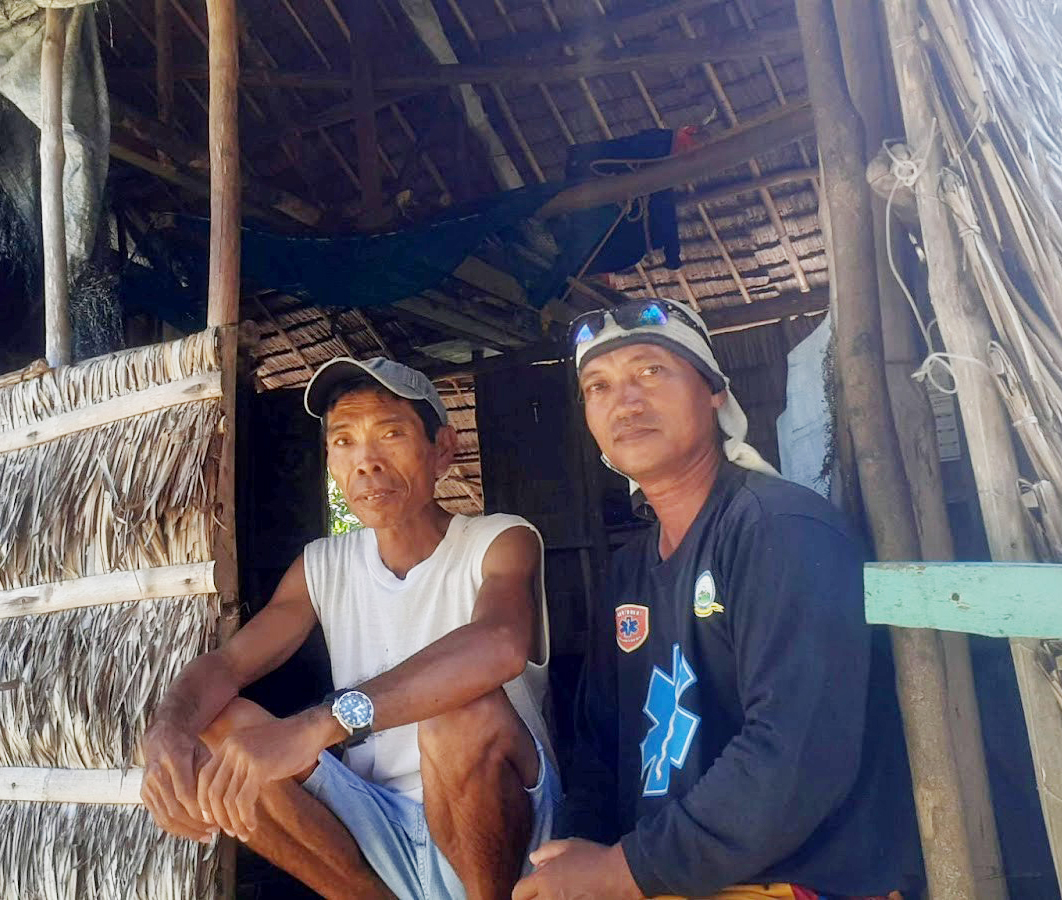
Bantay Dagat patrollers Romeo Germones and Christopher Quiza (from left to right) in their temporary make-shift kitchen. Photo by Ronan Renz Napoto
Just as the sun’s rays lit the sea, Quiza’s bag was filled with trash he collected while rowing around the mangrove forest.
It is his job to ensure that the Panaloytoyon and Mantampok Fish Sanctuaries—breeding grounds of coastal and marine species—are free from wastes and illegal fishing activities.
Members of Bantay Dagat are sea guardians who patrol coastal and marine ecosystems to detect illegal fishing practices and enforce fishery laws and ordinances. In Quinapondan, there are six sea patrollers.
Fish sanctuaries
Panaloytoyon Island was declared a fish sanctuary in 1994. In 1995, Guiuan Development Foundation Inc. (GFDI) established Mantampok Island, which was later maintained and managed by the local government unit (LGU).
In 2017, the Panaloytoyon and Mantampok sanctuaries were declared as Marine Protected Areas (MPAs) through a municipal ordinance. Quinapondan Vice Mayor Leo Jaspher Candido said the move was based on the principle of sustainability and only intended to regulate—not prohibit—the fishing activities around the sanctuaries.
According to a recent study published in One Earth Journal, MPAs contribute to climate change mitigation and adaptation by sequestering carbon dioxide, protecting coastal communities and biodiversity, and enhancing fishers’ catch and income.
These are important as Eastern Visayas is frequently battered by strong cyclones and is exposed to other climate shocks.
“If we don’t have a healthy ecosystem, where can nearby communities directly source their food?” said Jonh Rey Gacura, a research assistant at GDFI.
From sea to land
Before sunrise, Orly Tabungar already emptied his bucket after watering eggplants and squash on his newly-tilled farm—a different scene from what he used to do.
His boats and fishing nets are now hung up and left to dry, hoping to soon meet the blowing waves from Quinapondan’s east coast.
The decline in fish catch forced Tabungar to shift his focus to farming and parallel activities supporting both fishers and farmers. He is currently the chairman of the board of a cooperative called Island of Samar and Leyte Cooperative (ISLACO).
Tabungar, who also leads the Sto Nino Fisherfolk Association, has witnessed conflicts between members who are now part of the Bantay Dagat and those who continue catching fish for a living because of heightened implementation of the local fishery ordinance.
“The fish sanctuary covers a big portion of where we used to fish, which now leaves us with a smaller area already,” Tabungar said.
Bantay Dagat vs fishers
Quiza recounted when they encountered a group of intruders who tried to fish around the boundaries of Panaloytoyon Fish Sanctuary. As their first action, they called the intruders out and explained that fishing in the fish sanctuary is prohibited.
“We just calm ourselves and try to recognize these people,” he said, adding there were cases filed against individuals who still pushed through with their illegal activities despite warnings.
Their role as active watchdog resulted in threats and curses from, and silent clashes with the fishers who they used to meet around the waters of Quinapondan. There was also an instance when he was invited to a fistfight by a fisherman he previously called out, but Quiza disregarded it.
The tension began after Bantay Dagat members were deployed to more areas, making their presence more visible.
Felix John Bianes, the Municipal Environment and Natural Resources Officer, said that although there are areas where fishing activities are prohibited, fishers can still access a large portion of the town’s municipal waters.
The local environment office conducted a series of information and education campaigns to inform fisherfolk organizations about the ordinance even prior to its implementation. But Bianes said the office has so far engaged with only two communities.
“It is important for them to understand the importance of fish sanctuaries and the consequences when it is destroyed,” Gacura said.
Just transition
Tabungar said that most of the fishers are having difficulty coping with dwindling fish catch and the implementation of regulation. He urged the local government to support small fishers while fish sanctuaries are being established.
In a bid to address the issues raised by some fisherfolk, the LGU, with the support of the Bureau of Fisheries and Aquatic Resources, provided them with fishing boats, nets, and gear.
But for GDFI, the local government should consider introducing mariculture, or the farming of marine organisms for food and other products.
Gacura said the provision of fishing gear as an “ayuda” to fishers does not make sense as “we are increasing pressure in a situation where fish stocks are already depleted.”
According to Vice Mayor Candido, the government has introduced bangus culture to a few fishers in Brgy. Sto Nino. The introduction of alternative livelihood sources such as mud crab culture and seaweed farming is also part of their administration’s flagship program.
Ways forward.
Candido acknowledged the issues raised by both the fishermen and the members of Bantay Dagat, and said the government is open to discuss the stakeholders’ concerns on the implementation of the ordinance.
This, according to Quiza, is a smart move to help both parties address their concerns and join forces in protecting marine sanctuaries and ensuring food security.
As the Quinapondan government moves forward with their plans to secure the welfare of their people and marine ecosystem, Candido said they are looking forward to harnessing the available data and science to guide their decision-making processes.
Tabungar expressed his support to the LGU’s plans and noted that “all information dissemination should be done at every barangay to ensure that all are informed of their decisions.”
“I wish to have more catch to sustain the daily needs of every family of fishers,” Tabungar said.
The move also made Quiza, the sea patroller, hopeful that he would start his day with then-intruders as their partners in protecting sanctuaries in their town.
This story was supported by Climate Tracker Asia and Oxfam Pilipinas
OUR LADY OF HOPE OF PALO. Archbishop John Du lead in crowning the Our Lady of Hope of Palo on Nov.8, coinciding the 9th year anniversary of the onslaught of Super Typhoon Yolanda.’ Several accounts say that a woman protected and save them during that monster disaster. (ARCHDIOCESE OF PALO)
TACLOBAN CITY– A Marian image who inspired hope in the aftermath of Super Typhoon ‘Yolanda’ was crowned Tuesday (Nov.8), coinciding with the ninth-year commemoration of the monster tragedy.
The episcopal coronation of the Our Lady of Hope of Palo was held at the Palo Cathedral, Leyte, presided by Archbishop John Du and attended by priests and local officials led by Governor Carlos Jericho Petilla, Palo Mayor Remedios ‘Matin’ Petilla, and Rep. Jude Acidre of Tingog party-list.
The image, made of wood retrieved from the debris of the cathedral which sustained much damage due to Yolanda, was made by ecclesiastical artist Willy Layug with the crowns of the Our Lady of Hope and Her Child Jesus handcrafted by Noli Manalang.
During his visit to Tacloban City and Palo on January 17, 2015, Pope Francis blessed the seven-foot Marian image now enshrined at the cathedral.
Du said that he decided to commission to make the Marian image back in 2014 based on several accounts during the onslaught of Yolanda saying Mother Mary had saved and rescued them from the storm surges.
Archbishop Du said that the coronation of the Our Lady of Hope of Palo nine years after Yolanda’s onslaught was an indication that the survivors have moved on from the tragic disaster.
“As we have nine days novena for the dead; we were all mourning for the past nine years. In the same way, Our Lady was mourning with us,” he said in his homily.
“But now after nine years, our time of mourning has come to an end. There is a festive character to our celebration,” Du added.
Prior to the episcopal coronation, the Our of Lady of Hope of Palo with the Child Jesus has no adornment.
The Marian image is dressed in a Filipino attire symbolizes that She is ‘with us,’ Du said.
The crowns symbolize hope while the flowers depicts of new day; the anchor is for stability amidst the storms of life while the pearls, fruits of the sea, shows the Lady has triumphed over the waves of the storm.
Meantime, the olive branches means a sign of new life with the aquamarine stones to depict the element of water and the sea while the moissanite diamonds, silver, and gold point on the regal stature of Our Lady of Hope of Palo.
The feast day of Our Lady of Hope of Palo falls every Nov.8. (JOEY A. GABIETA)
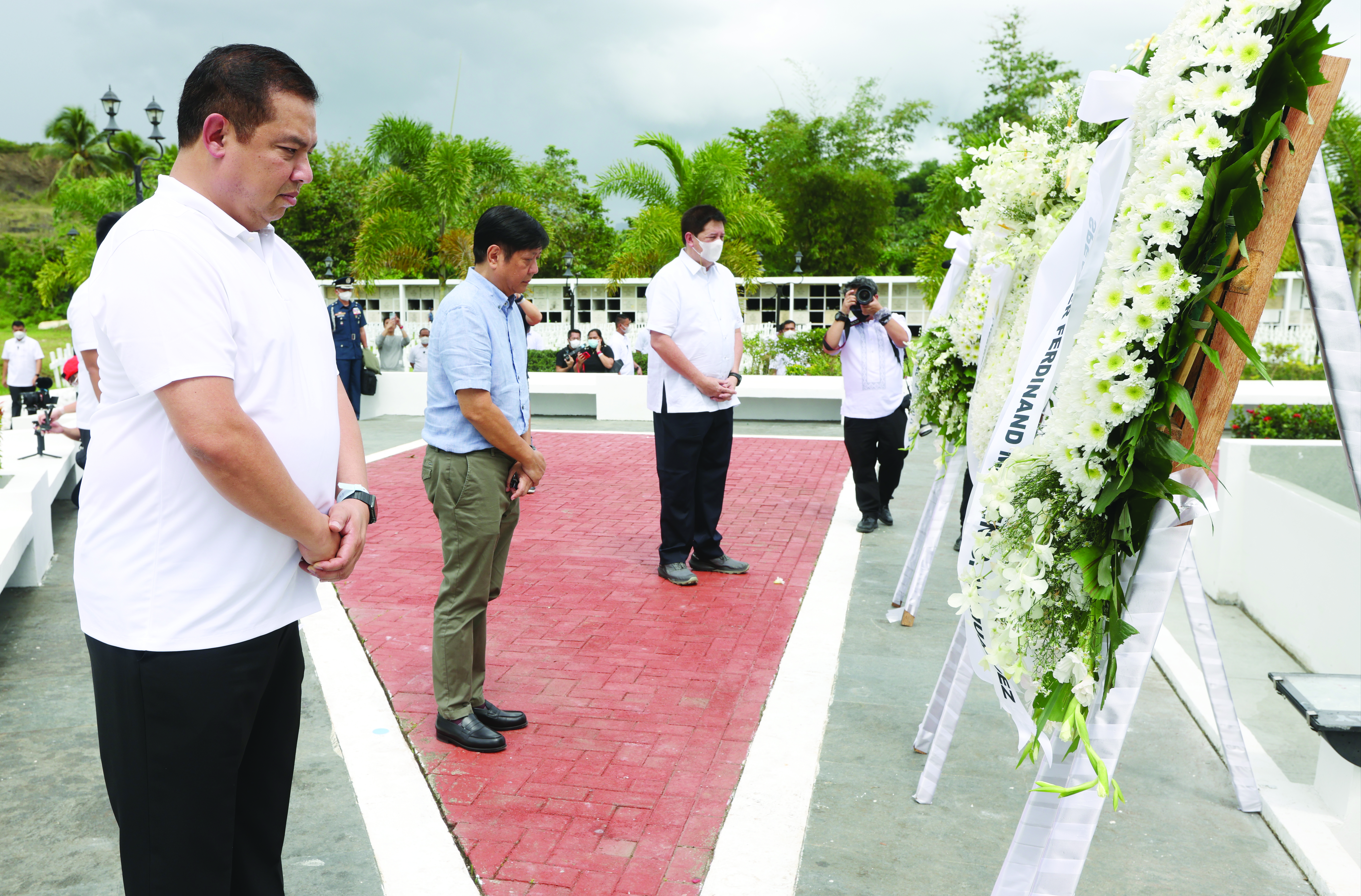
President Ferdinand “Bongbong” Marcos Jr.(center), Speaker Martin G. Romualdez (left) and Tacloban City Mayor Alfred Romualdez (right) lead the wreath-laying ceremony and offered prayers in honor of ‘Yolanda’ victims at the mass grave in Barangay Basper where 2,273 bodies of victims of the Super Typhoon Yolanda were buried during Tuesday’s 9th year Yolanda commemoration. (VER NOVENO)
TACLOBAN CITY-President Ferdinand ‘Bongbong’ Marcos, Jr. said his coming to the anniversary of the onslaught of Super Typhoon ‘Yolanda’ is not just to remember the dead buried but those who remain to be unaccounted.
In his less than 10-minute speech during the 9th year anniversary of one of the world’s strongest typhoons to hit inland on Tuesday (Nov.8), the President said forgetting the unaccounted would mean the tragedy of Yolanda will continue.
“They say why do we commemorate Yolanda still after nine years? I come here because I must commemorate those unaccounted dead that up to now we do not know how many that number is. We must come to these commemorations so that we will remember those who were told not to remember,” Marcos said.
“..And we will not forget about them. And we cannot forget about them. And I know, you do not forget about them. That is why we continue to commemorate Yolanda and we continue to grieve our dead. Because we not only grieve the dead that are here, but we also grieve for those who we don’t even know how many they are, who they are and where they are,” the President added.
In a brief interview after his speech, the President admitted that since Day 1, he has questioned the number of deaths due to Yolanda.
“I’m questioning that since Day 1. Six thousand ang sabi nila. Its not just 6,000 plus,” he said.
The counting of deaths due to Yolanda was stopped with still thousands of people reported missing.
Based on the official figure released earlier by the government, the number of deaths in Eastern Visayas, to include here in the city considered to be the ground zero of Yolanda, reached up to 6,000.
However, nine years after the monstrous disaster struck the region, questions as to the actual number of deaths remains.
On the earlier days after Yolanda pummeled the city and some parts of the region, then police director for Eastern Visayas Elmer Soria said that the number of deaths due to Yolanda could have reached 10,000.
After he issued that statement, Soria was relieved from his post on the ground that he would undergo ‘stress debriefing.’
Yolanda occurred during the term of former President Benigno ‘Noynoy’ Aquino III.
Tacloban City Mayor Alfred Romualdez, who was then the outgoing mayor when Yolanda hit the city on November 8, 2013, said that he support on the statement of the President, who is his cousin.
Romualdez said that while it was really ‘difficult’ to make an actual number of those who perished due to Yolanda, the number of casualties in the city could be higher.
“I think the number of deaths could not be lowered than 5,000. Aside from those that we have buried (at the mass grave), there were families who lost their loved ones who buried them right away,” the city mayor said.
The official figure of the number of deaths in the city were placed at 2,270 who were all buried at a mass grave at Holy Cross Memorial Cemetery in Barangay Basper where the commemorative program was held.
Among those present during the commemorative event were Senator Francis Tolentino, Leyte congressman and House Speaker Ferdinand Martin Romualdez, Eastern Samar Rep. and House minority leader Marcelino Libanan, and Interior Sec. Benhur Abalos.
SALCEDO, Eastern Samar — When Super Typhoon Yolanda (international name: Haiyan) wiped out much of the mangroves in Eastern Visayas, Oliver Layugan, a resident of Salcedo town, was filled with horror.
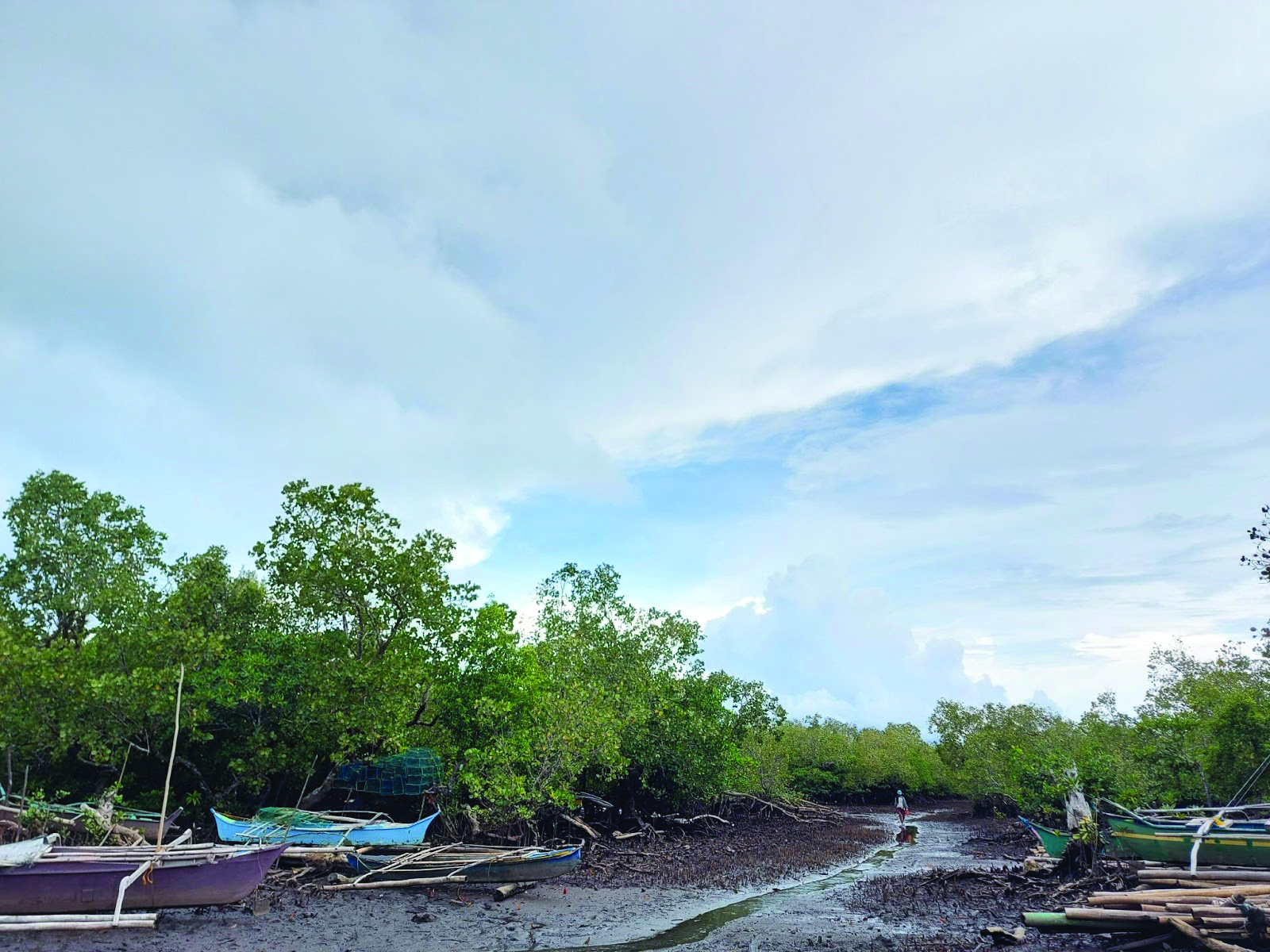
A wharf located in the middle of the mangrove protected zone in Barangay Caridad in Salcedo, Eastern Samar. Photo by Queene Tisha Dela Cruz)
“The [destruction of] mangroves after Yolanda was a lot bigger than I had expected… Huge mangroves were toppled down and drowned in mud,” Layugan said.
Some 5,163.06 hectares of mangrove forests were destroyed in the provinces of Leyte and Eastern Samar when Yolanda ravaged the central Philippines. According to the Global Mangrove Watch, 4,395.82 hectares of mangroves had recovered in the two provinces in 2020.
In the northern coast of Salcedo, mangroves have returned to their pre-Yolanda extent, save for some small patches, a study that calculated post-Yolanda mangrove damage and recovery using remote sensing found.
Over the years, the local government of Salcedo and private organizations have been working hand in hand to restore mangroves that protect coastal communities from storms and help in the fight against climate change.
Jessica Rojero, barangay captain of Caridad, said most of the mangroves in the village “are already recovered and in good condition.”
Community-based effort
In 2014, several organizations in Brgy. Caridad became beneficiaries of a program that aimed to restore mangrove areas and establish a nursery, which became a source of income for community members. Groups earn P10 for every mangrove seedling purchased from their nursery.
The barangay is also imposing fines and penalties to individuals who engage in the illegal cutting of mangroves in the protected zone.
“We are thankful that the community is participative and supportive in terms of these programs as well as for the active participation of the local organizations present in the barangay,” Rojero said.
Matarinao is also one of the barangays in northern Salcedo that reported good mangrove recovery. Residents there are active in reporting illegal activities, especially since mangroves are located in their backyards.
The Department of Environment and Natural Resources (DENR) introduced a family-based project where locals are paid annually by planting and nurturing 30,000 mangrove seedlings in the coastline.
Residents there applied the clustering method of planting, instead of the conventional straight line technique, claiming it has a higher success rate.
“A paradigm shift [is needed] as the government and most agencies define success at the start as present seedlings or hectares planted. Biological success should be defined at the end: What was the percent [of] survival? How many hectares have been created? And for that, we need monitoring,” said Dr. Jurgenne Primavera, a renowned mangrove expert in the country.
Locals said the rehabilitated mangrove areas in the northern coast of Salcedo do not only provide protection to communities but also sustain fisheries.
“Mangroves are important to us, especially those who live here in the coastline because it lessens the effects of the waves and the destruction to the community,” said Juny Natividad, a resident of Matarinao.
Lack of protection
On the other hand, large swathes of mangroves in the southern coast of Salcedo were still unable to recover nine years after the onslaught of Yolanda.
Allen Glen Gil, one of the authors of the study mapping mangrove damage and recovery in Eastern Visayas, explained that the largest damage was seen in the town’s southern portion because it was closer to where the super typhoon first made landfall.
Mangroves in the coastal barangay of Tagbacan are still recovering from the destruction caused by Yolanda, leaving residents concerned about the lack of coastal defenses.
According to the Municipal Environmental and Natural Resources Office (MENRO), parts of southern Salcedo’s coastal barangays have not yet recovered because of their geography. The frequent typhoons that hit the area also affect the growth of mangroves.
Restoration efforts usually fail when mangroves are planted in appropriate sites or when wrong species are planted. Rhizopora or bakhaw is commonly found in the area, even though it is not a good species for planting in some seafront or coastal areas.
“Why bakhaw? Because the propagules [are] quite big because if we plant avicennia marina and sonneratia alba you need a nursery. It is planted by convenience not by ecology,” Primavera said.
“Always remember the differences between the variety of mangroves and their locations. First, do not plant bakhaw on seagrass beds and mudflats. Plant pagatpat/piapi in the middle-upper intertidal and the LGU should monitor and report the percent of surviving mangroves rather than percent of target seedlings/area planted,” she stressed.
Tagbacan’s Sangguniang Kabataan Chairman Rexon Oguirra also said that illegal cutting of mangroves and the lack of community support also contribute to mangrove degradation in the area.
Wrong species
Barangay councils are still looking for ways to improve their mangrove rehabilitation programs and collaborate with other non-government organizations in implementing their future activities.
One of the major problems faced by the coastal folk is the lack of information dissemination on the proper ways of planting mangroves. The environment office of Salcedo said it trains residents to be knowledgeable on mangrove rehabilitation.
Primavera urged communities to try planting other species in areas where mangrove restoration endeavors have failed.
She added that the government should do an education campaign, implement a shift from paid labor to voluntary labor, and assist residents in securing forest management agreements and legal ownership of their mangrove areas in order for more people to appreciate mangroves and their ecosystem services better.
“I wish my people knew the reason why the air is so hot, why it is hard to catch fish in the nearby seas,” Layugan said.
“If the mangrove forest is fully restored, the extreme heat in the island can be lessened and we can be protected from the threat of typhoons,” he added.
This story was supported by Climate Tracker and Oxfam Pilipinas.
By: Queenee Tisha Dela Cruz and Dianuz Emstien J. Discar