ORMOC CITY– A barangay treasurer from the town of Almagro, Samar was shot dead in Calbayog City on Thursday (August 3) at about 12:35 pm.
Killed was Jocelyn Bago, a treasurer of Barangay Imelda who tried to grapple with the suspect who shot her point blank, the local police said.
It was learned that the victim, who was with village chairman Glocer Villa, was on board a motorcycle when she was approached by the suspect.
The victim tried to fight back with the suspect, who took a plastic bag that contained the amount of P200,000 intended as salaries for village officials.
The unidentified suspect, however, pulled a gun and shot her repeatedly.
This is the second time that a robbery involving a barangay treasurer occurred in Calbayog City.
Last July 20, the treasured of Brgy. Caloocan, Erecita de Leon,59, while walking along at the old national road within their village, a rider-in-tandem appeared and grabbed her bag containing P90,000 payroll money for the village officials.
While the victim survived, the suspects were able to cart the money away.
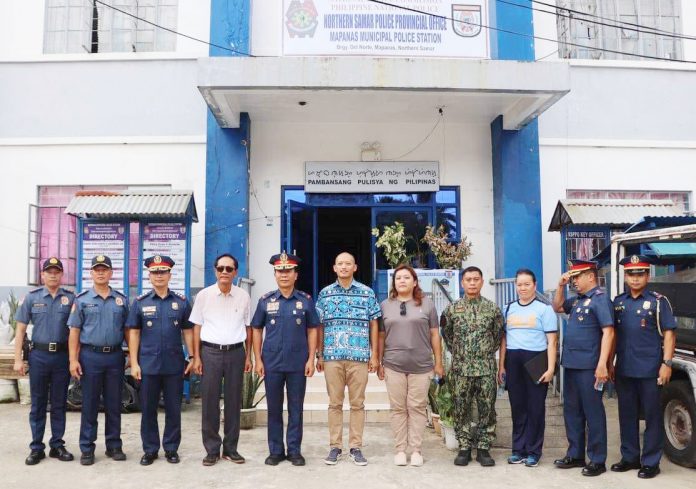
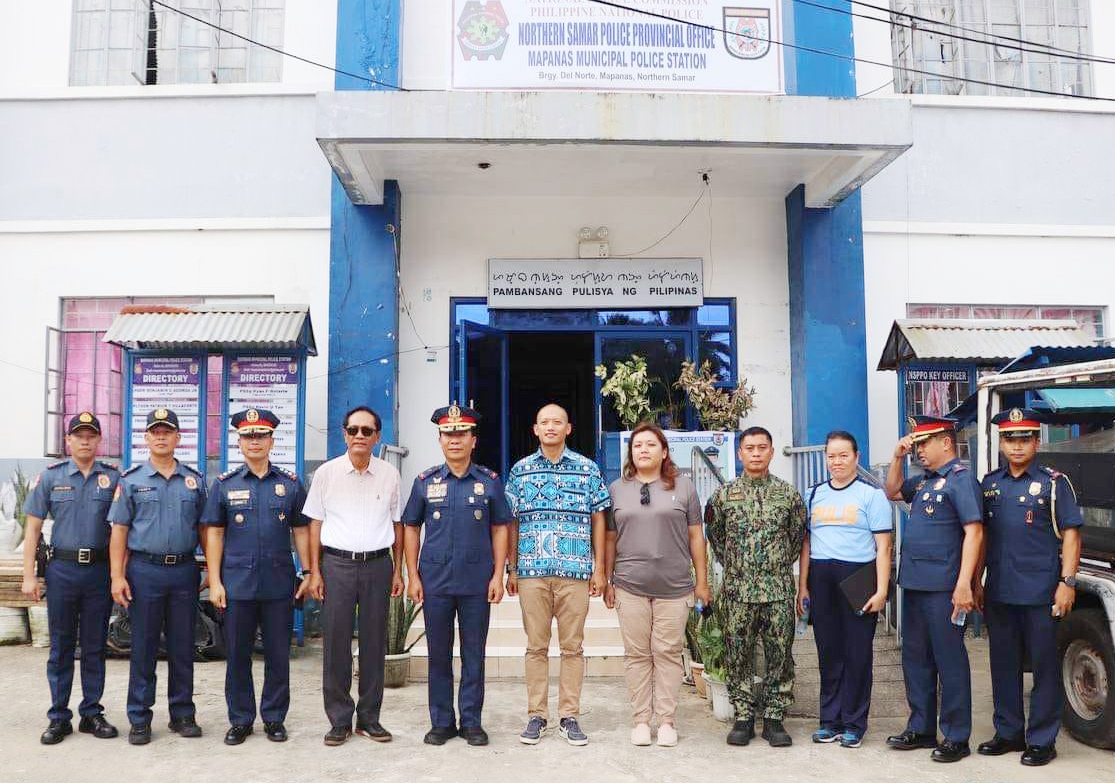
B/Gen. Vincent Calanoga, police regional director, expressed his thanks to the mayors of Mapanas and Palapag, both in Northern Samar for their continued support to the thrust of the police organization, particularly in maintaining peace. Photo shows Calanoga poses for posterity with Mapanas Mayor Ronn Michael L. Tejano, Vice-Mayor Maria Louisa Barbara Tejano, and Ambassador Bienvenido Tejano during his July 29 visit to the municipality.
(LGU Northern Samar)
B/Gen. Vincent Calanoga, police regional director, expressed his thanks to the mayors of Mapanas and Palapag, both in Northern Samar for their continued support to the thrust of the police organization, particularly in maintaining peace. Photo shows Calanoga poses for posterity with Mapanas Mayor Ronn Michael L. Tejano, Vice-Mayor Maria Louisa Barbara Tejano, and Ambassador Bienvenido Tejano during his July 29 visit to the municipality. (LGU Northern Samar)
TACLOBAN CITY – Police B/Gen. Vincent Calanoga, the police regional director, expressed his gratitude to the mayors of Palapag and Mapanas, both in Northern Samar, for their continued support towards achieving lasting peace and development.
Calanoga visited the two municipalities last week where he met the mayors of the two local governments.
The police regional director disclosed that he is grateful that both Mapanas Mayor Ronn Michael Tejano and Palapag Mayor Florencio Batula, Jr. of their commitment to the police organization in the area of peace and development efforts.
“The PNP, being a permanent fixture in the community, vows to be always in support with the local government units,” Calanoga said.
“Our role is to work together with you, not only on peace and security but also in bringing services to the community so the people would not feel isolated, neglected, and abandoned by the government”, the police regional director said during his separate meeting with the two town mayors.
In his talk with Mayor Tejano, the town official underscored their gratitude for the intensive police visibility and community engagement of PNP-Mapanas which led to the increase in the number of New People’s Army surrendering to the government authorities.
Calanoga added that mayor also noted an improved perception of the community in the PNP forces, attributing it to the discipline in leadership and the consistent conduct of awareness campaigns on the services of the government.
Meanwhile, in his talk with Mayor Batula, the Palapag official emphasized the importance of their Local Government Support Fund – Support to the Barangay Development Program (LGSF-SBDP) a holistic project that will help them sustain the peace and order in the community.
Calanoga added that the Palapag mayor also emphasized that the construction of classrooms, barangay, and health centers, farm-to-market roads, provision of potable water supply, and addressing agricultural issues will gain more public support, making them less vulnerable to communist front deceptions and propaganda. (ROEL T. AMAZONA)
ORMOC CITY-Police authorities in Calbayog City are still on the manhunt against the suspects who killed a man who was just resting on his parked motorcycle.
Police identified the victim as Harold Bernate and a resident of Purok 2, Barangay Obrero in the said city who was resting on his motorcycle at about 9:11 pm along the Maharlika Highway in Brgy. Bagacay.
Initial investigation conducted by the local police disclosed that while the victim was sitting momentarily on his parked single motorcycle, a single motorcycle boarded by three unidentified suspects arrived in the area.
Later, the victim was shot by the unidentified persons with the use of an undetermined caliber of firearms, hitting him at the different parts of his body that resulted in his immediate death.
The suspects fled right after the incident with the local police still conducting their investigation on the case. (ROBERT DEJON)
HADANG FESTIVAL. The contingent from Calbayog City, the ‘Hadang Festival,” was named as the grand champion for this year’s Tandaya Festival of Festivals held Sunday(August 6). The cultural event is part of the Samar Day celebration on August 11. (Samar Public Information Office)
Part of the Samar Day celebration
HADANG FESTIVAL. The contingent from Calbayog City, the ‘Hadang Festival,” was named as the grand champion for this year’s Tandaya Festival of Festivals held Sunday(August 6). The cultural event is part of the Samar Day celebration on August 11. (Samar Public Information Office)
CALBAYOG CITY – The ‘Hadang Festival’ of Calbayog City emerged as the big winner of the Tandaya Festival of Festivals 2013, a revived cultural festival of Samar province.
The Calbayog City-based festival was one of the crowd favorites, besting 10 other contingents, winning P500, 000 cash prize.
Hadang Festival portrayed a ritual dance that features the olden people of Calbayog on how they court good favor with the gods to bring abundance of harvest, cure the sick, and drive away evil by offering a live rooster.
Calbayog City Mayor Raymond Uy was excited that aside from topping the competition, the city served as the host of the revived province-wide cultural festival.
“We are glad that the festival of festivals was held here in Calbayog and our residents are able to watch the different performances of each locality in the province,” he said.
“This allows us to showcase not only our festival but also inform our fellow LGUs that we have the capacity to mount big events and conferences,” Mayor Uy added.
The win bolstered their desire to compete at the national level cultural competitions like the annual Aliwan Festival in Manila.
Winning second place was the ‘Makarato Festival,’ another crowd favorite, of Matuguinao.
Makarato is a festival that highlights the “makarato’ variety of red rice produced in the town. They won P400,000.
In third place was the ‘Bangahon-Karabaw Festival’ of Gandara which tells the story of the town people’s journey from escaping the American Forces that are hunting the town people after the Balangiga Encounter in 1901 and how they thrived from producing carabao milk that they uses to produce a “keseo”.
In fourth place was ‘Tinago Festival’ of Tarangnan which tells the story of the town becoming Samar province first settlement and “cabecera” when Jesuit missionaries set foot in there in the late 1500s.
The third and fourth placers won P300,000 and 200,000 respectively while non-winners received P100,000 consolation prize.
The holding of the Tandaya Festival of Festivals, which was stopped due to the coronavirus disease pandemic for the past two years, is among the highlights during the annual Samar Day celebration which is held every August 11 of the year. (ROEL T. AMAZONA)
Our country is known for its diverse agricultural sector. Despite the country’s potential for agricultural productivity, it still heavily relies on importation of agricultural products to meet its domestic demand. Why does the government resort to the importation of agricultural products? What are its implications for the country’s economy and food security? And what potential strategies can reduce this dependency?
Several factors contribute to the Philippines’ importation of agricultural products. Firstly, the country faces challenges in terms of land scarcity and limited arable land, resulting in inadequate domestic production capacity. Additionally, natural disasters such as typhoons and droughts often lead to decreased agricultural output and further necessitate imports. Moreover, the lack of advanced farming techniques and infrastructure hinders productivity and the ability to meet domestic demand independently. Lastly, the preference for cash crops, such as tobacco and sugarcane, instead of staple crops, contributes to the need for imports.
The importation of agricultural products has significant implications for the Philippine economy and food security. On the one hand, it provides an opportunity for economic growth and stability through revenue generation, employment, and increased trade. However, heavy dependency on imports poses risks to the country’s food security and self-sufficiency. Relying on other countries to meet domestic demand puts the Philippines at the mercy of global market fluctuations, impacting food accessibility and affordability for its population. Furthermore, it weakens the agricultural sector’s competitiveness and stifles local farmers’ growth potential.
To reduce the importation of agricultural products, various strategies can be implemented. There is a need for investments in research and development to enhance farming methods, increase productivity, and improve the quality of local crops. This could be achieved through partnerships between the government, academic institutions, and private companies to ensure the transfer and adoption of advanced agricultural technologies.
Promoting diversification of crops by incentivizing farmers to focus on staple food production can contribute to reducing import dependence. The government should then prioritize policies that support domestic farmers, such as providing access to credit, improving irrigation systems, and investing in rural infrastructure.
It is quite bewildering that despite the prevalence of senseless contents in the blogosphere, these blogs still manage to attract significant viewership. This can be attributed to several underlying factors, such as human curiosity, the need for escapism, viral trends, search engine optimization, the influence of social media, and the power of relatability. By delving into these factors, it becomes clear that senseless contents, though lacking intellectual depth, can still engage and captivate audiences.
One of the primary reasons why senseless contents continue to thrive is rooted in human curiosity. People often find themselves intrigued by bizarre or unorthodox topics that deviate from the conventional norm. This curiosity drives individuals to seek out and engage with unconventional blog posts, even if they lack intellectual substance.
In an increasingly fast-paced world, many individuals seek entertainment and relaxation through mindless activities. Senseless contents in blogs provide an escape from the pressures of everyday life by offering light-hearted and often absurd content. These blogs serve as a form of mental decompression, allowing readers to momentarily detach from their daily routines and indulge in the whimsical.
Senseless contents often capitalize on viral trends and sensationalized headlines to capture viewership. Bloggers strategically employ clickbait techniques, such as catchy titles or provocative thumbnail images, which trigger curiosity and encourage users to click on their article. This deceptive yet effective tactic plays a key role in driving traffic to these blogs.
Search engines play a crucial role in the success of senseless blogs. Many bloggers employ SEO techniques to optimize their content for search engine ranking, thereby increasing their visibility. This enables even the most inconsequential topics to gain traction and attract viewership, as they are strategically placed in front of the eyes of potential readers.
The widespread influence of social media platforms cannot be ignored in the context of attracting viewership to senseless blogs. These platforms serve as powerful distribution channels, allowing bloggers to share their content with a vast network of followers. As peculiar or nonsensical blogs often possess an element of novelty or amusement, they tend to be shared widely across platforms, thus generating higher viewership.
It is essential to acknowledge that senseless contents can also possess an element of relatability, allowing individuals to connect with like-minded readers. While the substance may be lacking, the sheer act of recognizing oneself in a blogger’s experiences or thoughts can be gratifying. This sense of belonging and shared experiences foster a loyal readership base, bolstering the popularity of otherwise senseless blogs.
As strange as it may seem, senseless contents have managed to carve out a significant niche in the blogosphere. Through understanding the underlying factors that contribute to their popularity, we gain valuable insights into the complexities of viewership dynamics. While critical analysis and intellectual depth may be lacking in these blogs, it is evident that there is a demand for lighter, more whimsical content that provides entertainment and escape from the mundane.