

The continued onslaught of the so-called cashless transactions on the mainstream global community seems to pave the way for the feared ‘mark of the beast’ whose usage characterizes business transactions in the biblical end times.
Otherwise described as a palm-reading payment technology, one such cashless transaction was introduced by Amazon at Whole Foods locations in California. This enabled the customers to pay for their groceries by simply scanning their palms at checkout terminals instead of using cards or cash.
Cashless payment system—what a breakthrough indeed, how convenient. Very soon, for sure, this will become trendy, then be accepted as a normal procedure in this high-tech world that we live in. But why is it alarming to some people with background knowledge of the Holy Scriptures?
In Revelation 13, starting from verse 1, the beast is introduced and described, having emerged from the sea, with seven heads and ten horns and crowns. The dragon gave him power and great authority, and both of them were worshipped by the people. Power was given to him over all races and nations, speaking blasphemies against God and His people, doing great wonders and miracles.
“And he causeth all, both small and great, rich and poor, free and bond, to receive a mark in their right hand, or in their foreheads: And that no man might buy or sell, save he that had the mark, or the name of the beast, or the number of his name” (Revelation 13:16-17 KJV).
At the moment, palm-scanning technology is still kind of superficial, with no microchip implanted into the palms. One may simply register his/her palm print using a kiosk or at a point-of-sale station. To register, one needs to provide a payment card and phone number, agree to the terms of service, and share an image of the palm. Once completed, one can take items to checkout and not have to take out a wallet — or even your phone. A hover of a hand over the device is all that’s needed to pay and leave.
Could this be a foretaste of the ‘mark of the beast’? Very likely. This could be a form of conditioning to get people used gradually to the utilization of that palm-scanning thing. Once accustomed to the practice, people will no longer protest though the implantable microchip is introduced. That mark, unfortunately, will be contained in that microchip, and that’s the number of the beast which the Bible warns people not to receive.
The roads now are leading to that implantable microchip containing the number 666. There’s the requirement for a national ID, whose data are likely to be transferred to that chip, and there’s this palm-scanning alternative to debit and credit cards for business transactions. We must indeed be living in the end times when all these things shall come to pass.
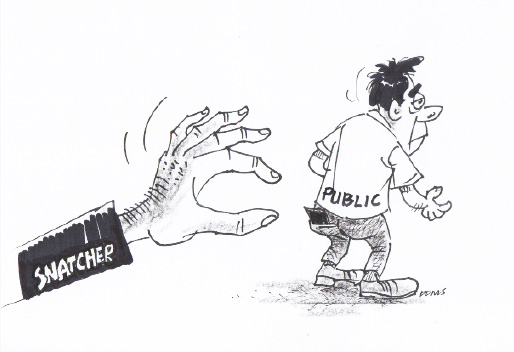

Plasticity
The dangers of the toxic materials that plastics transfer to our food when used as containers are very real. It may not cause immediate adverse effects, but we are all victims of some sort of food poisoning every time we use plastic for our food. The concern raised in keeping these non-biodegradable materials from the bowels of the earth may have some basis. But just how can government stop the use of plastic from dirtying our environment is a big question.
We are again brought into a weird unrealistic idea that is clearly no more than mere sloganeering. In order to protect the environment, government has brought the idea of discouraging people from utilizing plastics that are not organic and contaminate the environment. We are all aware of the hazards that plastics bring not only to the environment but to human health as well.
While people are using plastic as part of daily life, it is hard to reorient their ways into non-plastic habits. The use of the material has found wide acceptance that it has eliminated the biodegradable materials. Where before, papers were used as wrappers for many items, we now seldom see people using paper for such simple purposes. The convenience of using plastic has caught the mindset of people that they no longer think of the ill effects that plastics bring to the environment. But the concern is really more on the improper disposal of garbage that ruins our environment.
In efforts to minimize if not eliminate the use of plastics, local government units are passing local legislations that ban commercial establishments and supermarkets from using plastics and encouraging customers to bring their own biodegradable bags as plastics are only allowed for wet products.
But if plastics are hazardous to life, by all means government must take appropriate measures to protect the people. It is very impractical to focus the drive on the end-user. The suggestion to cut the problem at the root cause is always the best option. Efforts should be made to stop its production if the material is hazardous.
Making a campaign that discourages end users is deemed ineffective. It speaks of something that is being done for the sake of doing something. If government is serious in saving and protecting the environment, it should set its attention on stopping the problem at the source, otherwise, all these brouhaha are mere acts of plasticity.
comments to alellema@yahoo.com