24.3 C
Tacloban City
March 18, 2026 - Wednesday | 7:39 PM
Home Blog Page 1093

The basis of our hope

0
FR. ROY CIMAGALA
FR. ROY CIMAGALA

WHEN Christ told his disciples that he would send the Holy Spirit to them (cfr. Jn 15,16-16,4) after he shall have died, resurrected and ascended into heaven, he was reassuring them—and us—that despite whatever we experience in this world, we can have hope to reach our final destination, which is to be with God in heaven, fully transformed into his image and likeness as God wants us to be.

We should just learn how to strengthen our hope always, since that is a crucial virtue to have. Given our condition of pilgrim here on earth, exposed to all sorts of challenges, trials, difficulties and the like, we should make sure that we are always on the move toward our ultimate, spiritual and supernatural goal. That’s what hope does for us.

We should not get distracted or entangled by our earthly affairs, whether good or bad, for as the Letter to the Hebrews would put it: “For here we do not have a lasting city, but we are seeking the city which is to come.” (13,14) Thus, we have to strengthen our hope always. Our earthly affairs should only be a means and occasion to foster our hope to get us to our ultimate destination.

Hope is first of all not just a virtue that we produce, cultivate or keep to ourselves. It is first of all a gift of God, given to us in abundance. It is the gift of Christ himself who, by the Holy Spirit, is made present in us through his words, his sacraments, his Church. All we have to do is to correspond to this wonderful reality as faithfully and vigorously as possible.
That is why we need to be most mindful of the truths of our faith, giving time to meditate on them and to make them sink in our very consciousness. We have to be wary of our tendency to be carried away by our earthly concerns, no matter how legitimate they are. For again, as the gospel would say, “For what shall it profit a man, if he shall gain the whole world, and lose his own soul?” (Mk 8,36)

It’s important that just like in that management style called MBO (Management by Objective), we have to have a clear vision of our ultimate goal and make it the strongest desire of our life, so that we don’t get entangled with the ups and downs and the drama of life.

Christ has warned his disciples—and us—that because of him, we will encounter severe trials that would go to the extent of testing our very faith. We have to be ready for this eventuality by always developing a sharp sense of discernment of what the Holy Spirit would be prompting us to think, say, do and react.

We also need to be constantly reminded of what Christ himself assured us. “In this world, you will have trouble. But take heart! I have overcome the world.” (Jn 16,33) We need to be ready when some fears, and worse, anxieties and depression, would come to us.

This, of course, will require some significant effort, because especially nowadays people are getting too hooked in their earthly, temporal affairs. Some of them who are considered more in the successful side, get too immersed in them that they forget their spiritual and supernatural goal. Others, who are more in the losing side, eventually fall into discouragement and despair. They end up finding no meaning in life.

We should do everything to sharpen our sense and virtue of hope!

Future of conventional cars

0
DOMS PAGLIAWAN

The advent of electronic cars has sparked significant interest in the automotive industry, and it is quickly gaining momentum. The electronic car is seen as the future of the automobile industry, with many car manufacturers underlining their commitment to developing e-cars. Some experts are predicting that conventional cars may disappear at some point in the future.

The shift to e-cars is rapidly becoming a reality, with technological advancements making it possible to produce electronic cars with longer ranges, improved charging infrastructure, and faster charging times. These factors are making e-cars more attractive to consumers, as they eliminate the problems often encountered with conventional cars- high fuel costs, air pollution, and the need for frequent maintenance.

The push towards developing alternative fuel sources and more eco-friendly vehicles is another significant driver behind the move towards e-cars. Governments across the world are investing heavily in renewable energy sources like solar and wind power, which can be used to power electric vehicles. This shift away from fossil fuels towards cleaner sources of energy is another factor that could lead to conventional cars being phased out.

Governments are providing policy support and tax incentives to encourage the development and adoption of electronic cars. In many countries, subsidies are available to reduce the cost of purchasing an e-car. These incentives are designed to encourage people to switch from conventional cars to e-cars and lower the cost of owning these vehicles.

The environmental impact of conventional cars on the planet has never been more pronounced. The massive amounts of carbon emissions produced by gasoline-powered vehicles are contributing to climate change. E-cars, on the other hand, produce no carbon emissions and are therefore seen as a more eco-friendly alternative to conventional cars.

E-cars could provide significant economic benefits. E-cars require less maintenance than conventional vehicles, reducing the need for expensive repairs and service. In addition, e-cars are much cheaper to operate, as electricity is less expensive than gasoline. This lower cost of ownership could lead to more consumers purchasing e-cars, leading to the eventual phase-out of conventional cars.

The move towards e-cars could lead to a decrease in global oil dependency. As more consumers and governments embrace electronic vehicles, the demand for fossil fuels could decline, leading to a lower reliance on oil-producing countries. This lowered reliance on fossil fuels could also help to reduce political tensions, which are often fueled by oil conflicts.

Advancements in technology mean that e-cars will continue to improve over time, making them even more reliable and practical. The battery technology used in e-cars is also improving, and this could lead to longer-range e-cars, making them more practical for long-distance travel.

The proliferation of e-cars could also lead to a shift towards autonomous vehicles. With less noise, fewer emissions, and easier maintenance, electronic cars are well suited to autonomous driving. As the automotive industry continues to advance towards autonomous driving, the demand for conventional cars could decline even further.

One of the most significant barriers to widespread adoption of electric vehicles is the lack of charging infrastructure. However, this is rapidly changing as more charging stations are being built across the globe. The increasing availability of charging infrastructure will make it more convenient for consumers to own e-cars, and this will further increase the demand for these vehicles, leading to the phasing out of conventional cars.

As electric vehicle technology evolves, and the demand for more eco-friendly and practical transportation is increasing, it is becoming increasingly evident that conventional cars may be phased out. The environmental, economic, and political benefits of e-cars, combined with policy support and technological advancements, are driving the automotive industry towards electronic cars. The transition to fully electric transportation could lead to a cleaner, more efficient and sustainable future.


Food crisis in the offing

0

The world’s population is growing rapidly and is expected to reach 10 billion people by 2050, which means that food production will have to increase by 50% to feed everyone. But achieving this would not be easy as the world is faced with challenges such as climate change, water scarcity, diminishing arable land, and high levels of food waste.

Climate change is one of the major factors contributing to the food crisis. The unpredictable weather patterns are affecting agricultural productivity, making it difficult to grow some crops. Extreme weather events such as droughts, floods, and storms cause destruction to crops, leading to food shortages. The rising temperatures are also affecting crop yields and the nutritional value of food. Therefore, unless the world takes swift and robust action to address climate change, food insecurity will become a persistent problem.

Water scarcity is another significant factor contributing to the food crisis. It is estimated that almost half of the world’s population will be living in areas with severe water shortages by 2050. Water scarcity affects food production because most crops require water to grow.

This shortage might limit the capability to produce enough food to sustain the world’s rapidly expanding population. Thus, there is a need to invest in water management strategies such as rainwater harvesting, water-efficient irrigation systems, and improved agricultural practices.

Diminishing arable land has become a critical issue that could lead to future food insecurity. Land-use patterns like deforestation, urbanization, and soil degradation have caused the loss of agricultural land. The world needs to invest in innovative agricultural practices that require less land for cultivation. This could be achieved through the use of technology such as vertical farming, hydroponics, and aquaponics.

Food waste is another aspect of the food crisis that needs attention. Research shows that about one-third of the food produced for human consumption is wasted every year. This wastage is caused by poor storage, transportation, and handling practices. Food waste worsens the food crisis since the wasted food could have been used to mitigate food insecurity in vulnerable regions. Therefore, there is a need to establish efficient food supply chains, reduce food losses, and make efforts to preserve food.

Food crisis is a global phenomenon that needs serious attention, especially considering the approaching population explosion. Governments, private sectors, and individuals need to collaborate and establish innovative techniques aimed at addressing the root cause of the food crisis. These may include investment in improved agricultural practices, promotion of food preservation methods, adoption of food efficiency, and the expansion of sustainable agricultural land-use strategies. Through coordinated efforts, it is possible to avert an imminent food crisis.

Engr. Alvin Ignacio: the new district engineer of DPWH Eastern Samar District Engineering Office

0
Engr. Alvin Ignacio was designated as the new district engineering office for Eastern Samar, replacing Engr. Margarita Junia who was named as the assistant regional director of the Department of Public Works and Highways. (ESDEO)

BORONGAN CITY-Effective April 24, 2023, Engineer Alvin Ariola Ignacio is the new district engineer of the Department of Public Works and Highways – Eastern Samar District Engineering Office through Special Order 79, series of 2023.

Engr. Alvin Ignacio is a native of Catarman, Northern Samar, born on October 21, 1968. He is married to Agnes D. Ignacio, an elementary school teacher. He has only one child named Allan Francis D. Ignacio, who is now 18 years old.

DE Alvin completed his primary studies at Catarman I Central Elementary School and his secondary studies at Northern Samar Academy.

He graduated with his Bachelor’s Degree in Civil Engineering at the University of San Carlos, Cebu City, in 1989. He took up a Master’s in Public Administration at the Philippine College of Health Sciences and completed it in 1999.

He has been in the DPWH practicing the civil engineering profession for 33 years of experience.

Engineer Ignacio entered the department on February 1, 1990, as Civil Engineering Aide under casual status and became a permanent employee on June 3, 1996, as Engineer II in Catarman, Northern Samar District Engineering Office.

He was promoted to Engineer III and designated as OIC-Assistant District Engineer of Northern Samar 1st DEO from August 27, 2010, to January 15, 2012. He continued his designation as OIC-Assistant District Engineer to Samar 1st DEO from January 6, 2012, to March 25, 2013. He became a full-fledged Assistant District Engineer from March 26, 2013, to June 2, 2016.

Through hard work and dedication, he was appointed District Engineer at Samar 1st DEO, Calbayog City, Samar, from June 3, 2016, to July 21, 2022.
Before his assignment to DPWH Eastern Samar District Engineering Office, he became the chief of staff of the Regional Director in DPWH Regional Office VIII. (PR)

Man killed in a sting operation; cops recovered shabu valued at P10.2 million

0

ORMOC CITY– A man allegedly involved in the illegal drug trade was killed in a shoot-out with law enforcers in Ormoc City Monday (May 15) at about 1:40 am.

Killed was Allan Bulahan,38, during a buy-bust operation in Barangay Tambulid in the said city with the operatives confiscating suspected hydrochloride methamphitime or shabu with a commercial value of P10.2 million, one of the biggest hauls by the local enforcers in the region in years in the course of illegal drug campaign by the government.

He was listed as a high-value individual by the regional police office relative to the illegal drug operations.

Report from the Ormoc City police disclosed a poseur-buyer approached the suspect with the intention to buy the illicit drug and arrest him.

However, the suspect, said to be the bagman of suspectd drug lord Kerwin Espinosa, noticed that some men were approaching towards them and sensed that they were law enforcers.

This resulted for the suspect to draw his gun of still unknown caliber with the law enforcers firing back, hitting him on the different parts of his body.

The suspect was brought to the Ormoc District Hospital where he was declared dead on arrival by the attending physician.

Seized from him were seven sachets of suspected shabu weighing 1.5 kilograms with a street value of P 10.2 million.

The operation was conducted by personnel from the regional drug enforcement unit and the Ormoc city police.
(ELVIE ROMAN ROA)

P40 million earmarked to improve road network in Leyte’s second district

0
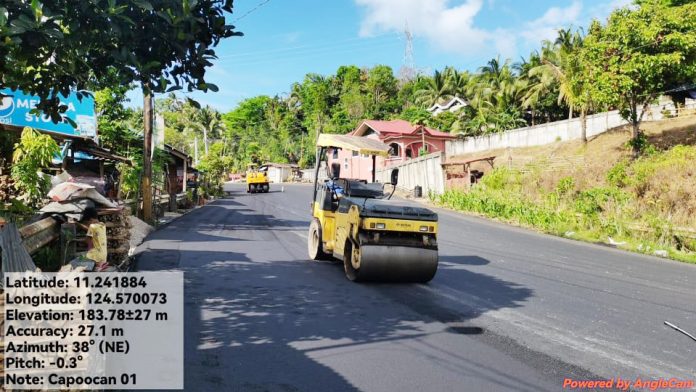
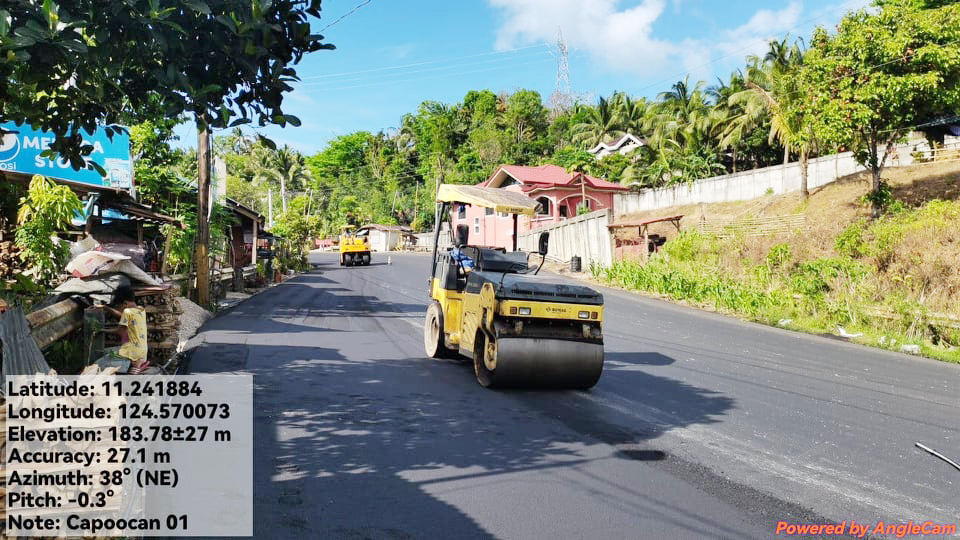
Note: Capoocan 01 Azimuth angle: 38? (NE) Pitch angle: -0.3?

TACLOBAN CITY-To provide better and enhance transportation facilities, the Leyte Second District Engineering Office (L2DEO) of the Department of Public Works and Highways (DPWH) allotted P38.96 million under its preventive maintenance program to improve the Palo-Carigara-Ormoc road, particularly in Barangay Sto. Niño in Capoocan town.

Note: Capoocan 01
Azimuth angle: 38? (NE)
Pitch angle: -0.3?

District Engineer Leo Edward Oppura said that this is one of the priority projects of the district office since the Palo-Carigara-Ormoc road network is a busy road catering to a large volume of vehicles to and from the cities of Ormoc and Tacloban and the Biliran province.

This project’s budget includes the reconstruction of damaged concrete pavement in intermittent portions and the application of one kilometer in four lanes of asphalt overlay to provide seamless and convenient travel.

Provisions for reflectorized thermoplastic markings will be applied to improve nighttime visibility and help minimize lane-departure crashes.

DPWH preventive maintenance projects aim to prevent widespread deterioration of the road surface, thus lowering future costs of re-constructing the entire road pavement.

The project started its construction on February 20, 2023, and is expected to be completed by next month.
(LIZBETH ANN A. ABELLA)

Recent Posts

DALMACIO C. GRAFIL
PUBLISHER

ALMA GRAFIL
EDITOR-IN-CHIEF

ROMEO CEBREROS
OFFICE IN-CHARGE

OFFICE
BRGY. SONGCO, BORONGAN CITY

CONTACT NUMBERS
(055) 261 – 3319 | 0955 251 1533 | 0917 771 0320 | 0915 897 7439 | 0921 511 0010

DALMACIO C. GRAFIL
PUBLISHER

RICKY J. BAUTISTA
EDITOR

ALMA GRAFIL
BUS. MANAGER

OFFICE
RIZAL AVENUE, CATBALOGAN
(INFRONT OF FIRE DEPARTMENT, NEAR CITY HALL)

CONTACT NUMBERS
0917 771 0320 | 0915 897 7439 | 0921 511 0010

EMAIL
lsdaily2@yahoo.com

WEBSITE
www.issuu.com/samarweeklyexpress