CATARMAN, Northern Samar – The provincial government of Northern Samar has forged a five-year partnership with the Korean International Cooperation Agency (KOICA) and World Vision to strengthen maternal, newborn, and child healthcare, a program expected to reduce maternal and infant deaths by improving access to quality health services, upgrading facilities, and enhancing the skills of community health workers.
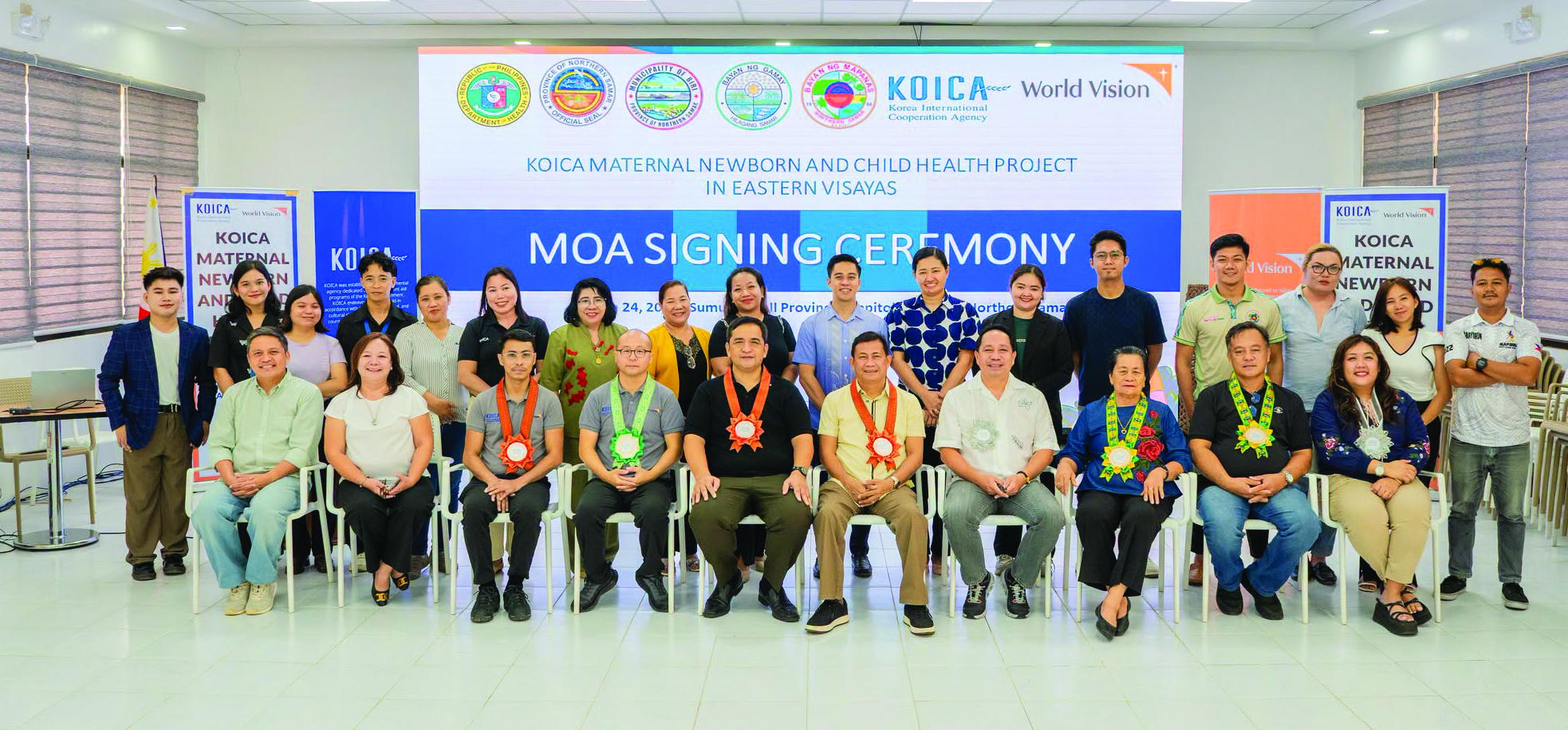
Provincial officials expressed gratitude to the Korean International Cooperation Agency (KOICA) and World Vision for their continued commitment to improving healthcare services in Northern Samar following the signing of a memorandum of agreement (MOA) on June 24.
The agreement, signed by KOICA, World Vision, the provincial government of Northern Samar, and the municipal governments of Biri, Gamay, and Mapanas, formally launched the second phase of the Maternal, Newborn, and Child Health (MNCH) Project in the province.
Present during the signing were World Vision Korea Project Director Jihwan Jeon and World Vision-KOICA MNCH Project Manager Romil Jeffrey Juson, along with provincial and municipal officials.
Representing Governor Christopher Harris Ongchuan, Board Member Dexter Galit said the partnership goes beyond a formal agreement and represents a shared commitment to protecting the lives of mothers and newborns through safe, accessible, and quality healthcare.
“The signing of this agreement is more than formalizing a partnership. It reflects our shared commitment to the people we serve—especially mothers, newborns, children, and families—to ensure they have access to quality healthcare services,” Ongchuan said in a message read during the ceremony.
The governor said improving healthcare remains one of his administration’s top priorities, noting that a healthy population is essential to the province’s economic and social development.
He added that the MNCH Project complements the provincial government’s long-term development agenda by strengthening healthcare delivery, particularly in geographically isolated and disadvantaged communities.
The five-year project, which will run until 2030, includes capacity-building programs for healthcare workers, rehabilitation and construction of health facilities, provision of medical equipment, medicines, vitamins, and supplies, and implementation of community-based health promotion campaigns.
The initiative also seeks to improve access to maternal and child health services while providing additional support to vulnerable families in Northern Samar.
Vice Governor Clarence Dato, represented by Board Member Lope Radomir, described the partnership as a significant milestone in advancing public health in the province.
“This gathering is more than a ceremonial signing of documents. It is our affirmation of a shared commitment to ensure that every Nortehanon receives quality healthcare, every child is given the opportunity to grow healthy and strong, and every family—especially those in vulnerable and underserved communities—has access to essential health services,” Dato said.
For the municipality of Mapanas, one of the three project sites, the program is expected to address persistent challenges in maternal healthcare.
Vice Mayor Maria Luisa Barbara Tejano welcomed the inclusion of Mapanas in the project, saying it would greatly benefit the municipality by improving the capacity of healthcare workers who care for pregnant women and newborns.
She said that despite having a functioning birthing facility, some expectant mothers still choose to deliver at home with the assistance of a traditional birth attendant, locally known as a hilot, instead of giving birth in healthcare facilities attended by skilled birth professionals.
“We continue to encourage pregnant women to deliver in health facilities because we want every mother to have a safe childbirth,” Tejano said.
World Vision-KOICA MNCH Project Manager Romil Jeffrey Juson expressed confidence that the second phase of the project would significantly contribute to reducing maternal and newborn deaths in the three beneficiary municipalities.
A major component of the project is the implementation of Timed and Targeted Care for Families (ttCF), a community-based strategy that trains barangay health workers (BHWs) to regularly visit pregnant women and families with newborns.
Under the program, trained health workers will conduct scheduled house-to-house visits to monitor pregnancies, identify potential health risks early, provide health education, and ensure that expectant mothers receive timely prenatal and postnatal care.
“This project focuses on Timed and Targeted Care for Families (ttCF). We train our barangay health workers to conduct regular home visits because pregnant women and newborns need to be closely monitored,” Juson explained.
“It is important to care for the mother during pregnancy so that the baby is born healthy. If a newborn is not healthy at birth, complications can arise. That is why we are strengthening the training of barangay health workers, who will conduct house-to-house monitoring of pregnant women and ensure they receive the care they need,” he added.
The KOICA-funded initiative is expected to strengthen Northern Samar’s healthcare system by improving maternal and child health services, expanding access to quality healthcare, and empowering frontline health workers to provide life-saving interventions at the community level.
(JOEY A. GABIETA)