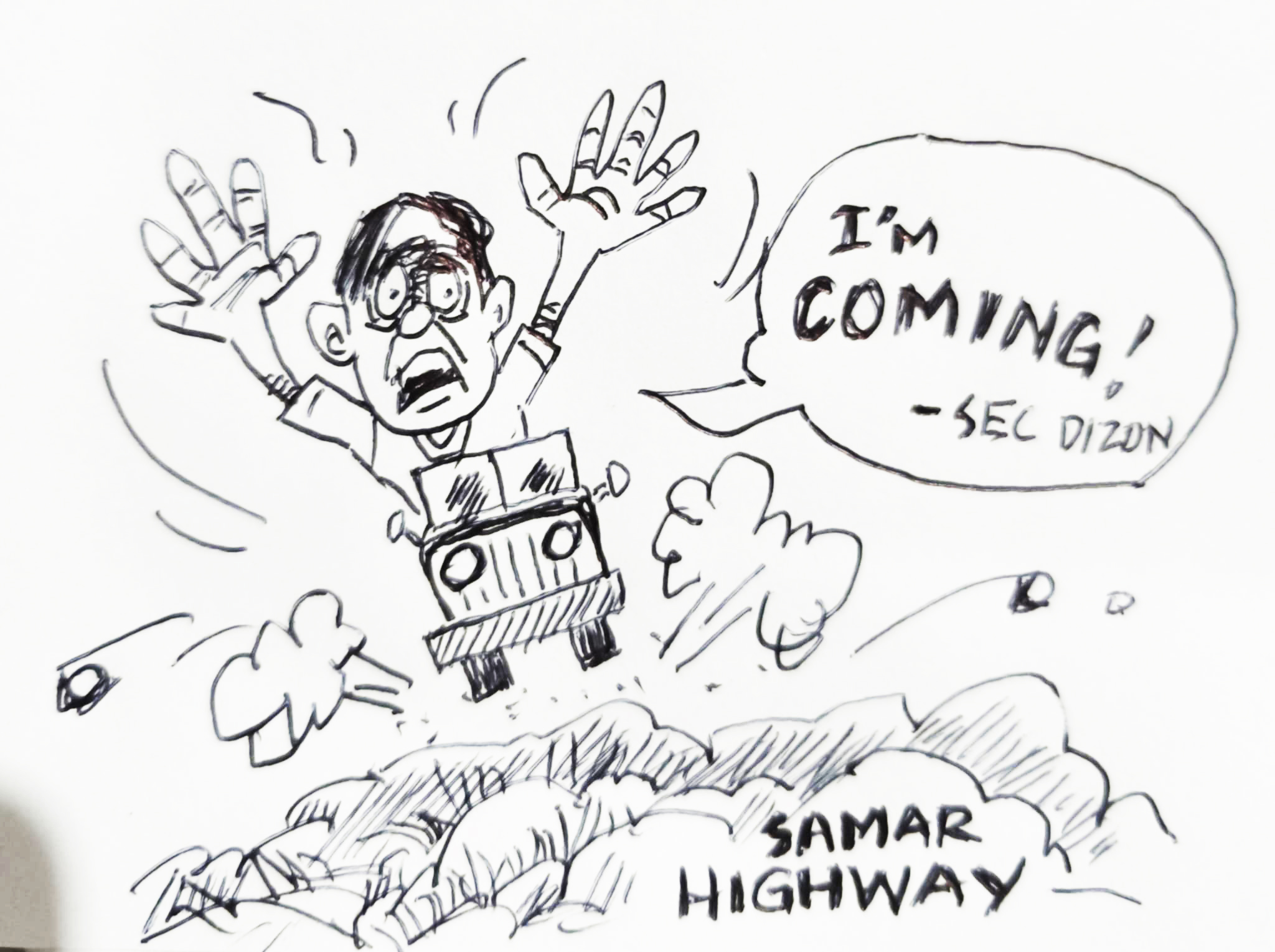
The announcement of Public Works and Highways Secretary Vince Dizon’s visit to inspect the Samar highway only breeds doubt rather than hope. Because supposedly, a thorough investigation does not forewarn those with much to hide.
The Samar highway has been notorious for years, but it has been notorious, not because of the geography of the place nor the weather, but because the funds meant for the construction of the roads seem to be wasted on temporary repairs, with some parts of the roads deteriorating almost immediately after repair, with the same people involved every year, and with the people used to the usual litany of excuses for the state of the roads.
But by making the announcement of the inspection, the very purpose of the inspection, which is to investigate, becomes a mockery because the repairs, the patchwork, and the clearing of the roads are already underway, not to fix the roads but to fix the roads for the purpose of the inspection, a usual ruse for the roads to be repaired only to deteriorate once again when the attention of the government has moved to the next problem.
An unannounced inspection would have shown the reality of the highway on a day-to-day basis—the potholes that devour cars, the sections that were abandoned unfinished after receiving funds, and the normalcy of shoddy work. It would have shown the reality of corruption, not as some spectacular crime, but as the normal shortcuts, cost overruns, and protective alliances between officials and those who do business with them. The idea of transparency does not hold when those to be inspected are given time to arrange things.
If the point of inspection is to bring about change, then it needs to be unannounced, technically sound, and backed by consequences that extend beyond slaps on the wrist. It needs independent engineers, publicly announced contracts, and criminal consequences for repeated failure, not last-minute repairs. It needs to be about more than appearances, so that the Samar highway ceases to be a symbol and becomes reality.