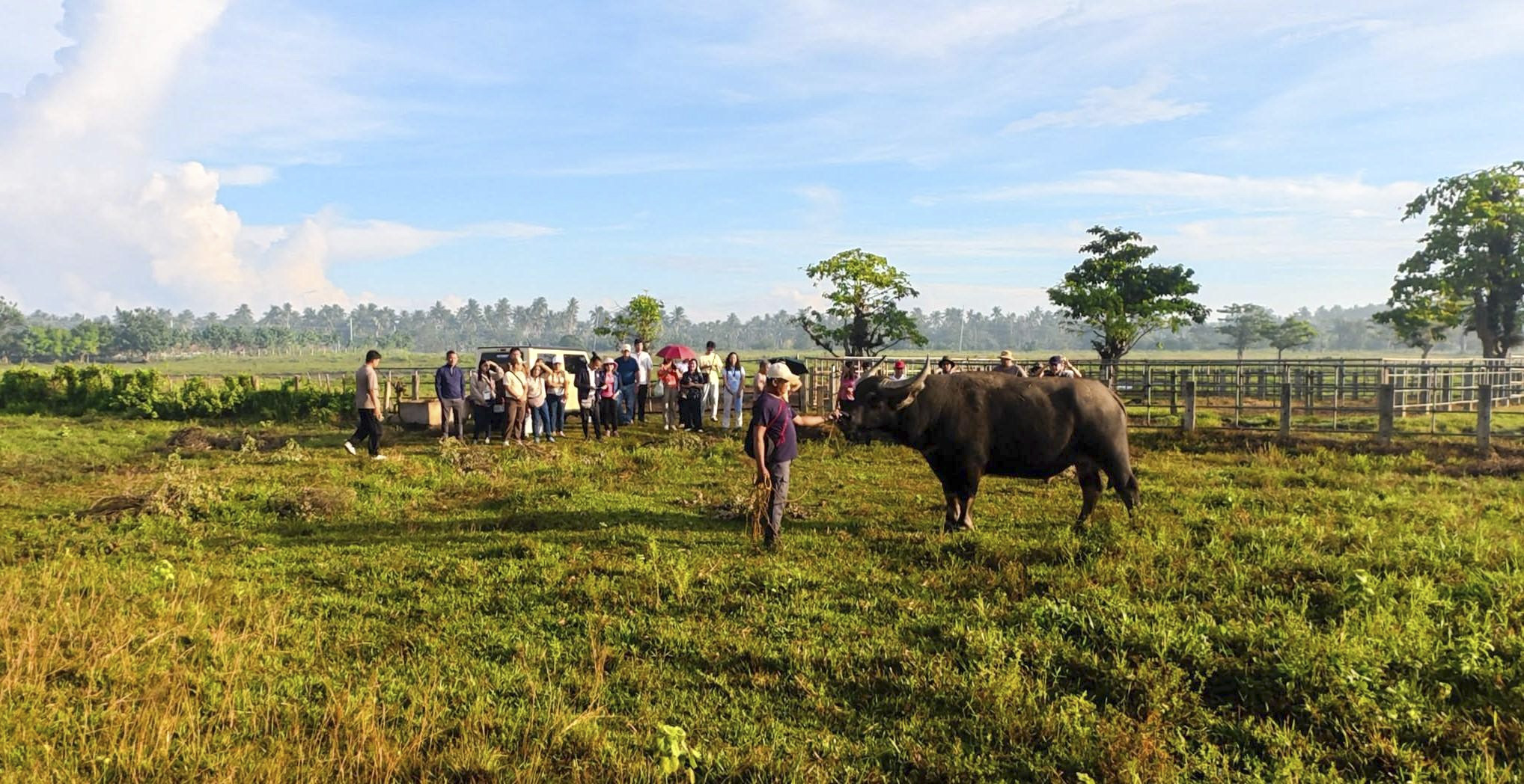
TACLOBAN CITY – The Department of Agriculture (DA) and the Northern Samar provincial government are looking at establishing conservation and breeding programs for giant carabaos as part of efforts to improve livestock productivity and support farmers in the province.
The initiative was discussed during a technical mission led by DA Assistant Secretary for Ruminant Livestock Dr. Benjamin Albarece on Sept. 15, which included an assessment of existing giant carabaos and consultations with local officials and farmers.
Albarece met with Northern Samar Gov. Harris Christopher Ongchuan to discuss possible conservation measures and genetic improvement strategies for the province’s carabao population.
Also joining the meeting were Dr. Felicidad Anthea Naputo of the DA Regional Field Office VIII Livestock Program and Dr. Julius Abela of Visayas State University.
Albarece proposed exploring the crossbreeding of giant carabaos with existing water buffalo in Northern Samar to develop improved genetic stocks with traits that could increase milk and meat production.
He also recommended the establishment of privately led livestock breeders for each livestock commodity to complement government programs and accelerate genetic improvement, population growth and productivity.
The DA’s Unified National Artificial Insemination Program (UNAIP) could also provide farmers access to quality livestock genetics, training and technical assistance, particularly for small-scale producers
The provincial government and the DA will identify potential sites for conservation farms and work with farmers to assess their animals and existing management practices.
Stakeholder consultations will also be conducted to develop appropriate conservation and genetic improvement strategies for carabaos and other livestock in the province.
Ongchuan said carabaos remain important to farmers, particularly those who depend on the animals for farm operations and the production of meat and milk.
“While we adopt modern technologies and advanced mechanisms in agriculture, we also recognize the importance of sustaining our livelihood animals, particularly the water buffaloes or carabaos as these remain vital to our farmers,” Ongchuan said.
He said many farmers continue to use carabaos for land preparation, hauling and transporting agricultural products.
Ongchuan also cited the potential of carabaos to help farmers reduce dependence on fuel-powered machinery amid rising fuel costs.
“In these trying times, we have to practice being less reliant on costly fuel-powered machinery. Instead, turn to carabaos, which can perform the same tasks without requiring fuel, for a practical and cost-efficient option for our farmers,” he said.
During the technical mission, the DA delegation inspected existing giant carabaos in San Roque, where Mayor Mary Ann Avalon joined the site visit and discussions.
The team also proceeded to Palapag to assess areas with existing cattle-farming activities and their potential for further livestock development.
A consultation involving Palapag Mayor Florence Batula, Pambujan Mayor Owen Lamberto Siervo, Municipal Administrator Jesus Acebuche, representing Laoang Mayor Charlene Ongchuan, artificial insemination technicians and local farmers discussed the status, challenges and opportunities in cattle and carabao production and breeding.
The mission included private consultant Leo Abuela, Mel Montenegro, executive assistant, members of the DA and LGU Guinobatan technical teams, and veterinary experts from the academe, including Bicol University Dean Dr. Rosefe Dy and faculty member Adrian Sula.
The Provincial Agriculture and Veterinary Office, headed by Dr. Jose Luis Acompañado, will work with the DA in identifying potential conservation sites and coordinating with farmers as the proposed breeding and conservation program is developed.
Ongchuan said the provincial government would continue coordinating with national agencies, local governments, academic institutions and the private sector to support livestock development and agricultural livelihoods in Northern Samar.
The proposed initiative seeks to conserve the province’s giant carabao population while improving livestock genetics and productivity for the benefit of local farmers.
(ROEL T. AMAZONA)